Quick Answer
Yes, an HVAC filter can be too restrictive for a particular system. However, a higher MERV rating does not automatically mean poor airflow. Restriction depends on the entire filter design, including media area, thickness, pleat construction, face size, and how dirty the filter becomes.
A clean MERV 13 filter may work well in one system and create too much resistance in another, while a heavily clogged lower-MERV filter can create more resistance than either. If airflow drops after a filter change, confirm size, fit, condition, direction, and supported MERV before assuming the filter alone is responsible.
What Does “Too Restrictive” Actually Mean?
Air has to move through filter media before reaching the blower and conditioned spaces. Every filter resists that movement to some degree. The blower is selected to move air through the filter, coil, ducts, registers, and other components within an expected range.
A filter becomes too restrictive for a particular setup when it creates more resistance than the system can comfortably handle. Airflow may fall enough to affect comfort or normal operation. Pressure drop is simply the amount of resistance moving air encounters as it passes through the filter.
The word “particular” matters. A filter is not restrictive in isolation: face size, rack design, blower setting, duct system, coil condition, and how much air the system moves influence the result. Weak airflow alone does not identify which part of that path is responsible.
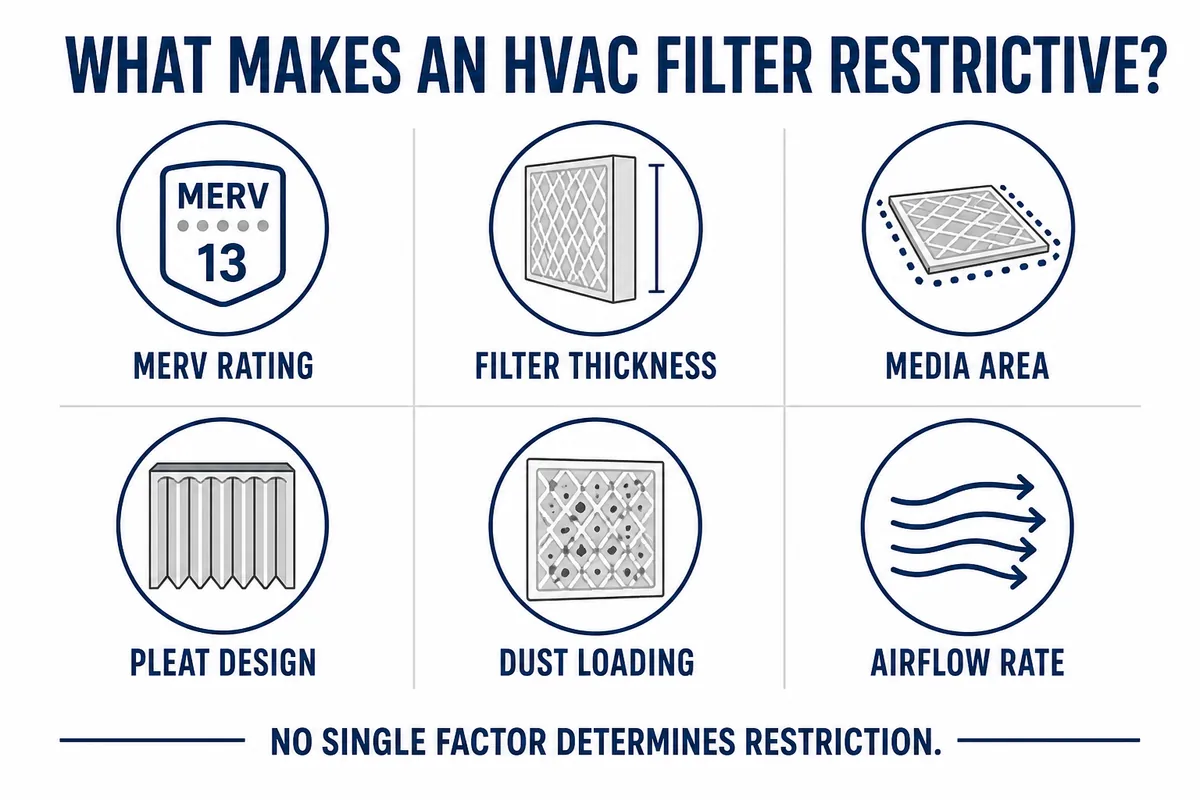
What Determines Filter Restriction?
| Factor | How it affects restriction | What homeowners should know |
|---|---|---|
| MERV rating | Higher efficiency often requires finer particle capture. | MERV does not reveal the complete pressure drop. |
| Filter thickness | Depth changes how pleated media can be arranged. | Thicker does not automatically mean more restrictive. |
| Media area | More surface can spread airflow over more material. | Deep pleats may provide substantially more area. |
| Pleat design | Pleat count, depth, spacing, and support affect flow. | Filters with the same MERV can differ. |
| Filter face size | A larger face spreads the system airflow. | Use the exact size designed for the rack. |
| Construction | Media, backing, frame, and adhesives affect airflow. | Rating alone does not describe construction. |
| Dust loading | Collected debris increasingly blocks media pathways. | Replacement timing changes real-world resistance. |
| System airflow | More air through the same face can increase resistance. | One filter may behave differently across systems. |
| Incorrect size | Gaps cause bypass; forcing can deform media or frame. | Confirm all three dimensions and fit. |
| Filters in series | The same air must cross two media layers. | Use only when the configuration supports it. |
Signs a Filter May Be Too Restrictive
- Airflow falls noticeably soon after a different filter is installed.
- Whistling begins near the return grille or filter slot.
- The filter repeatedly bows toward the blower.
- Heating or cooling cycles seem longer than before.
- Several supply vents feel weaker, not just one room.
- Evaporator-coil icing recurs.
- The blower sounds different or strained.
- The filter visibly pulls inward while operating.
Timing is useful evidence: a symptom that starts immediately after changing filter type deserves a fit and specification check. It is not proof. Blocked returns, dirty coils, duct conditions, blower problems, closed registers, or other equipment issues can produce similar symptoms.
Related guides explain filter whistling, bending and bowing, and how a dirty filter can contribute to AC icing.
Does Higher MERV Always Mean More Restriction?
No. Higher-MERV media captures a greater share of smaller particles, but designers can provide more media area, deeper pleats, different fibers, and better spacing to manage resistance. Brands and models use different constructions.
Two MERV 13 filters can have different initial resistance, and their resistance can change differently as they collect dust. A well-designed higher-MERV filter can impose less resistance than a poorly designed or heavily loaded lower-MERV filter in the same application. The guide to fiberglass versus pleated filters explains how media construction changes the comparison without determining restriction by itself. The focused guide to choosing between MERV 11 and 13 applies this product-level nuance to an allergy-focused decision.
Use the comparison of MERV 8, MERV 11, and MERV 13 to connect filtration needs with compatibility. The rating describes filtration performance under a standard test; it is not a complete airflow specification for your furnace or air handler.
Is MERV 13 Too Restrictive?
Sometimes, but not always. MERV 13 is not inherently too restrictive. It should be used when the system can support the actual filter product and its resistance across a reasonable service interval.
A one-inch MERV 13 filter may behave differently from a deeper MERV 13 media filter because the deeper product can contain more pleated area. Even within one depth, face size and construction differ. A dirty MERV 13 also becomes more restrictive as it loads.
Older equipment is not automatically incompatible, and newer equipment is not automatically compatible. Equipment and filter-cabinet guidance should take priority. If documentation is silent and airflow is already marginal, have the setup evaluated before assuming an upgrade is harmless or automatically harmful.
One-Inch vs. Thicker Filters and Airflow
One-inch filters have limited depth for folding media. A two-inch or four-inch filter often provides more pleated surface area inside the same face dimensions. Spreading air over more media can reduce the velocity through each portion and may lower resistance for similar filtration efficiency.
Depth alone does not determine pressure drop. Media type, pleat geometry, backing, face size, and airflow still matter. A deep filter can also become restrictive when neglected. See the complete guide to 1-inch, 2-inch, and 4-inch filter differences for fit, service-life, and cost considerations.
The cabinet must be designed for the selected depth. Never force a two-inch or four-inch filter into a one-inch rack, modify a cabinet, or stack several one-inch filters to imitate a deeper filter. Confirm the intended dimensions before considering depth.
Dirty Filters Become More Restrictive
As dust, fibers, pet debris, and other particles collect, they occupy airflow pathways through the media. Resistance generally rises as the filter loads. A neglected lower-MERV filter can become more restrictive than a clean higher-MERV filter.
Color alone does not measure pressure drop. Some filters look gray quickly because of fine dust while still allowing reasonable airflow; others can load deeply. Inspect condition and follow a practical schedule rather than relying on one fixed appearance rule.
Review signs a filter is clogged, how often to change it, and reasons a filter gets dirty unusually fast. Rapid loading may reflect household conditions or return-air issues, not merely the MERV number.
Can a Restrictive Filter Cause Whistling?
Restriction can increase air velocity through small gaps around a frame, grille, access panel, or rack. That moving air can whistle. The media itself may also vibrate when it lacks support.
A whistle that begins after installing a new filter is useful evidence. Check the exact size, seating, arrow direction, and condition. Do not assume a lower MERV is the only fix: gaps, bypass, blocked grilles, loose hardware, and duct conditions can sound similar.
Can Restriction Make a Filter Bend?
A pressure difference across the filter can pull weak or unsupported media toward the blower. Heavy loading can increase that effect. An incorrect size, damaged frame, wide unsupported rack, or missing retainer may also let a filter bow.
Bending does not automatically mean the MERV is too high. Confirm fit, support, direction, moisture, and loading first. Repeated deformation with clean correct replacements deserves evaluation rather than repeated experimentation.
Can Restricted Airflow Contribute to a Frozen AC Coil?
Yes. The evaporator coil relies on warm return air moving across it. When airflow is reduced enough, the coil can become too cold and moisture may freeze on its surface. A restrictive or heavily clogged filter is one possible contributor.
Coil icing can also involve refrigerant, blower, coil cleanliness, duct, drainage, or control conditions. Turn cooling off if you discover ice and follow safe thawing guidance; do not diagnose or handle refrigerant components.
Can a Restrictive Filter Damage HVAC Equipment?
Excessive resistance may cause a system to operate outside its ideal airflow range. Over time, low airflow can contribute to comfort problems, icing, unusual cycling, or stresses that depend on the equipment type and controls. The focused guide explains when a dirty filter may contribute to furnace short cycling and when the cycle needs diagnosis beyond the filter.
One restrictive filter does not guarantee permanent damage. Severity depends on the design, duration, actual airflow, operating mode, and protective controls. Address persistent symptoms and confirm the configuration instead of assuming catastrophic damage.
What About Double Filtering?
Two filters in series make the same air cross two media stages, so their resistance adds. Some purpose-built systems support staged filtration, while improvised stages may create unnecessary resistance.
Separate filtered returns are different because each filter serves a parallel air path. See whether to use a filter at the return and furnace and whether every return vent needs a filter before adding or removing media.
How to Choose a Filter Without Guessing
- Confirm the exact physical size and all three dimensions.
- Record the existing filter's MERV, depth, and construction.
- Review furnace, air-handler, and filter-cabinet guidance.
- Identify the household filtration need.
- Use the lowest MERV that reasonably meets that need while remaining compatible.
- Prefer a properly designed filter over simply chasing a higher number.
- Monitor meaningful airflow changes after switching filter type.
- Replace the filter before it becomes heavily loaded.
Start with confirming the filter size and the correct airflow-arrow direction. Measurements and MERV guidance do not replace equipment compatibility information.
Safe Homeowner Inspection Checklist
- Turn the system off at the thermostat.
- Confirm the filter size.
- Check that the filter sits flat and secure.
- Inspect for heavy loading, bending, moisture, or tears.
- Confirm the airflow-arrow direction.
- Record the MERV rating and thickness.
- Check whether multiple filters are installed in series.
- Inspect accessible return grilles for blockage.
- Install a clean, dry, correctly sized replacement if needed.
- Restart the system and compare airflow.
- Listen for whistling or unusual noise.
- Monitor the new filter for bending or rapid loading.
- Request HVAC evaluation if airflow remains weak with the correct clean filter.
Do not remove blower panels, alter ductwork, bypass safety switches, run the system without a filter, handle live electrical parts, or attempt static-pressure testing without appropriate professional equipment.
Free homeowner tool
Need help choosing the right MERV starting point?
Confirm the physical size first, then use Filter Wizard for cautious MERV guidance, replacement timing, and retailer options based on household conditions.
Open the Filter FinderReplace and Monitor or Consider HVAC Service?
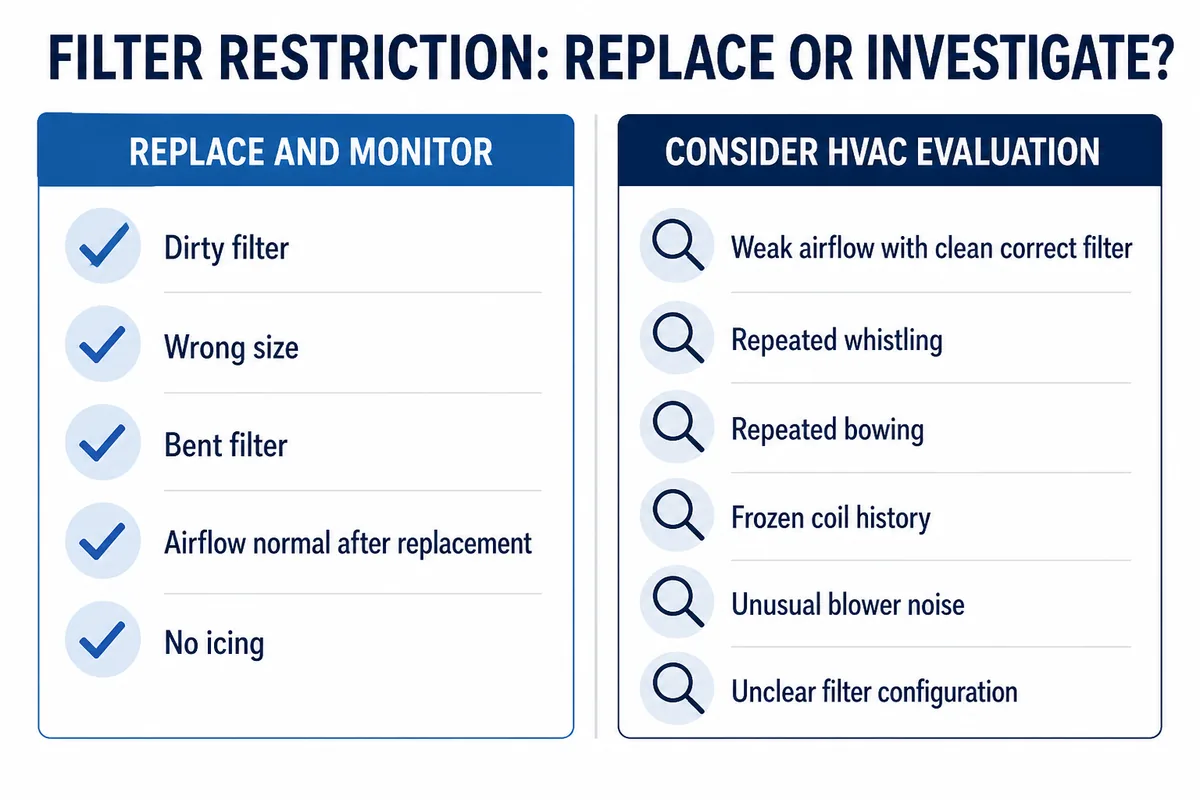
Replace and monitor
- The current filter is dirty.
- The filter is damaged, wet, or bowed.
- An incorrect size can be corrected.
- Airflow improves with a correct replacement.
- The whistle disappears.
- The system runs normally without icing.
Consider HVAC evaluation
- Airflow remains weak with a clean correct filter.
- Multiple correct filters behave the same way.
- Coil freezing recurs.
- The filter repeatedly bows.
- Blower noise is unusual.
- The return path seems blocked.
- The rack or duct configuration is unclear.
- Documentation conflicts with the actual setup.
Filter Wizard Recommendation
Filter Wizard recommends choosing the lowest MERV rating that reasonably meets the household's filtration needs while remaining compatible with the HVAC system. Do not judge restriction by MERV alone. Confirm physical size, thickness, design, condition, and equipment guidance.
Think of restriction as a relationship rather than a label printed on the frame. The same filter may suit a large, correctly designed rack and be less suitable where a smaller filter face must handle substantial airflow. Equipment guidance and published filter performance are more useful than assumptions based on appearance.
If airflow remains weak with a clean, correctly fitted filter, have the system evaluated before repeatedly changing filter ratings. Filter Wizard can provide a cautious starting point after you confirm size, but it cannot measure pressure drop or verify equipment compatibility.
Filter Wizard recommendation
Choose a practical filter starting point
Enter a confirmed three-dimensional size for cautious MERV guidance, replacement timing, household-condition guidance, and current retailer options.
Open the Filter FinderFree Filter Reminders
Replace Before Restriction Builds
Get occasional filter reminders, homeowner maintenance tips, and buying guidance.
Occasional emails only. Unsubscribe anytime.
You're on the list. We'll send practical filter reminders and updates occasionally.
The allergy-focused filter guide explains how to compare MERV 11 and 13 without treating the rating alone as a restriction test.
The smoke-particle filtration guide applies this resistance framework to conditional MERV 11 and MERV 13 choices.
Frequently Asked Questions
Can an air filter be too restrictive?
Yes. A filter can create more resistance than a particular HVAC system handles comfortably, but MERV alone does not determine that resistance.
How do I know if my filter is restricting airflow?
A noticeable airflow drop after replacement, whistling, repeated bowing, longer cycles, or weak airflow at several vents are clues. They do not prove the filter is the cause.
Is MERV 13 too restrictive?
Not inherently. A MERV 13 filter may work well when its actual resistance and dimensions suit the system. Check equipment guidance and the complete filter design.
Does higher MERV always reduce airflow?
No. Media area, pleat design, thickness, face size, construction, loading, and airflow rate also affect restriction. Two filters with the same MERV can differ.
Can a restrictive filter make my AC freeze?
Low airflow from a restrictive or clogged filter can contribute to evaporator-coil icing, but refrigerant, blower, coil, and duct conditions can also cause freezing.
Can a restrictive filter make the filter whistle?
It can contribute by increasing airflow through small gaps, but poor fit, air bypass, loose grilles, and other restrictions can also whistle.
Can a restrictive filter make the filter bend?
Resistance across weak or unsupported media may contribute to bowing. Heavy loading, incorrect size, weak frames, and poor rack support can also cause it.
Is a 4-inch filter more restrictive than a 1-inch filter?
Not automatically. A deeper filter often has more pleated media area, which can reduce resistance for similar efficiency. The cabinet must be designed for its depth.
Can a dirty filter become more restrictive?
Yes. Collected debris fills the media and generally raises resistance. A heavily loaded lower-MERV filter can be more restrictive than a clean higher-MERV filter.
Can two filters restrict airflow?
Two filters placed in series add resistance, although some systems are designed for staged filtration. Separate filtered return paths are different from series filters.
Should I switch to a lower MERV rating?
Do not downgrade automatically. Confirm size, condition, equipment guidance, filter design, and household needs before selecting the lowest compatible MERV that reasonably meets those needs.
Can a restrictive filter damage my furnace?
Excessive long-term resistance can contribute to operation outside ideal airflow conditions, but one filter does not guarantee damage. Persistent symptoms deserve evaluation.
Why did airflow drop after changing filters?
The new filter may differ in size, fit, construction, pleat area, MERV, or airflow direction. A blocked return or unrelated system condition may also be involved.
When should an HVAC professional check airflow?
Request evaluation when airflow remains weak with a clean correct filter, icing recurs, filters repeatedly bow, blower noise changes, or the rack and return configuration are unclear.