Quick Answer
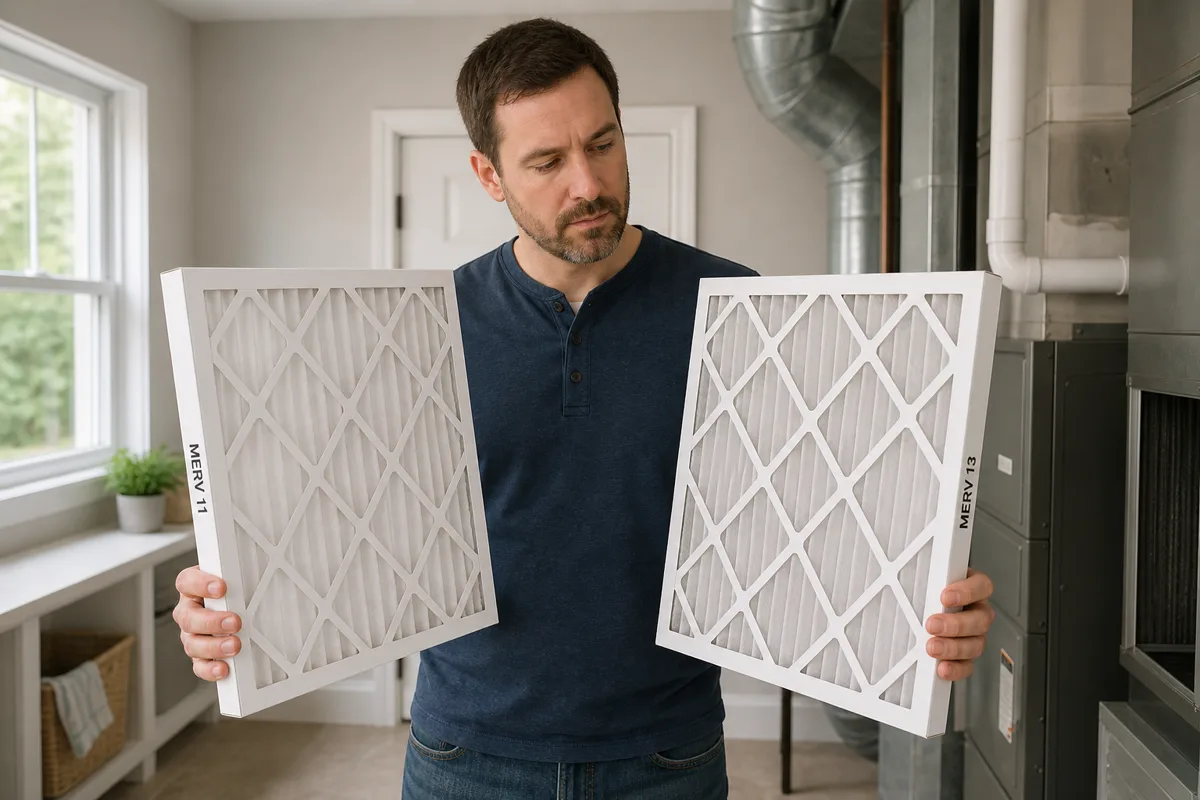
MERV 13 provides stronger capture of smaller airborne particles than MERV 11. That makes it more relevant when finer-particle filtration is the priority and the HVAC system supports the specific filter. MERV 11 remains a legitimate practical choice when equipment guidance, filter depth, airflow margin, or measured product resistance favors it.
The better choice depends on the actual filter, not only its rating. HVAC filtration can reduce some airborne particles associated with pollen, pets, and household dust when those particles pass through the return. It is not treatment for allergies and cannot guarantee symptom improvement.
What Actually Changes From MERV 11 to MERV 13?
MERV ratings come from an ASHRAE test that groups particles into three size ranges. EPA’s published table requires MERV 11 to capture at least 20% of particles from 0.3–1 micrometer, 65% from 1–3 micrometers, and 85% from 3–10 micrometers. MERV 13 raises those minimums to 50%, 85%, and 90%. The ratings therefore represent measured thresholds, not marketing steps.
The largest difference is in the smallest test range: MERV 13’s minimum is more than double MERV 11’s. That can matter when the household prioritizes smaller airborne material rather than only lint, visible hair, or larger pollen grains. It does not mean MERV 11 captures nothing small, nor does it mean every MERV 13 installation removes the same amount from a home.
MERV reports capture efficiency under defined testing. It does not directly report filter pressure drop, installed air leakage, blower runtime, room mixing, or how quickly particles settle before reaching a return. Those variables explain why a rating difference can be technically meaningful without making the higher number the automatic answer.
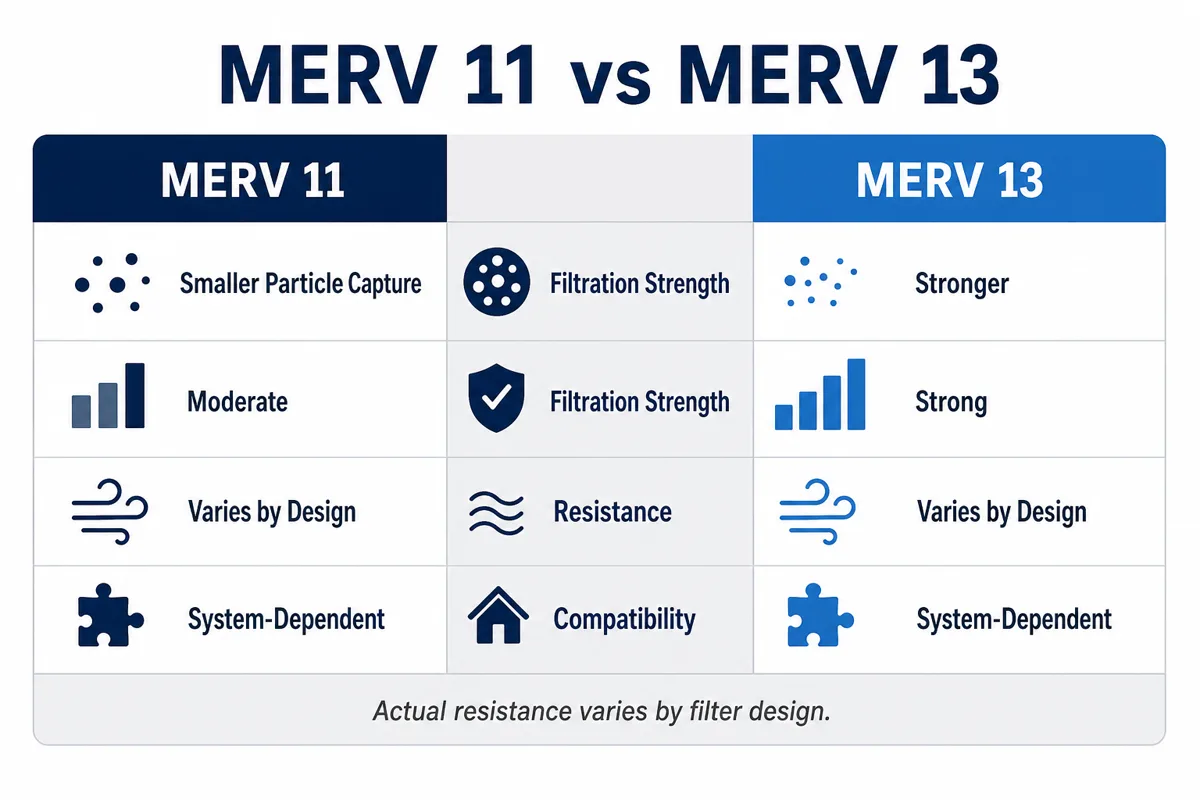
MERV 11 vs MERV 13 at a Glance
| Factor | MERV 11 | MERV 13 |
|---|---|---|
| Larger airborne particles | Strong capture | Stronger minimum |
| Smaller airborne particles | Moderate required capture | Stronger required capture |
| Pollen-oriented filtration | Useful for many pollen sizes | Adds finer-range performance |
| Pet-related fine particles | Practical option | Stronger fine-particle option |
| Relative filtration | High residential range | Higher of the two |
| Airflow resistance | Varies by product | Varies by product |
| Design sensitivity | Media and pleats matter | Media and pleats matter |
| Depth and media area | Can improve design options | Can improve design options |
| Loading impact | Resistance changes as loaded | Resistance changes as loaded |
| Compatibility concern | Confirm support | Confirm carefully |
| Practical use | Balanced filtration choice | Finer-particle priority |
| When to choose | When design or system favors it | When compatible and fine capture matters |
Is MERV 11 Enough for Allergy-Focused Filtration?
For many compatible residential systems, MERV 11 is a meaningful filtration level rather than a reluctant compromise. It is tested in all three particle-size ranges and can be a substantial step from MERV 8 where better smaller-particle capture is wanted. It may make particular sense when a one-inch rack limits media-area options, equipment documentation recommends it, or the available MERV 13 product has materially higher published resistance.
“Enough” depends on the decision target. If larger pollen, ordinary dust, and a broad improvement over basic filtration are the priorities, MERV 11 may reasonably meet them. If capturing a greater share of the smallest tested particles is important, MERV 13 provides a defined performance advantage. The broad allergy-focused filter guide explains where this choice fits alongside media type, fit, circulation, source control, and maintenance.
When MERV 13 Is Worth Considering
MERV 13 is most compelling when finer-particle capture is a clear household priority, equipment or cabinet guidance supports the rating, and the specific product’s resistance is appropriate at the system’s airflow. A deeper media cabinet may offer designs with more surface area, but a well-designed one-inch product can also differ substantially from another one-inch filter.
The upgrade should produce a supported installation, not simply a higher label. Confirm the exact size, supported depth, seating, and airflow behavior. If a clean replacement produces weak airflow, persistent whistling, or repeated bowing, those observations deserve evaluation rather than an assumption that every MERV 13 filter behaves identically.
Which Is Better for Pollen?
Pollen is not one uniform size. Many intact pollen grains are relatively large and can be captured by MERV 11, while smaller fragments and particles associated with outdoor air occupy different ranges. MERV 13 adds stronger required capture in every MERV test range, with its largest advantage over MERV 11 in the 0.3–1 micrometer range.
That advantage applies only when particles enter the HVAC return. Pollen that settles on floors, clothing, bedding, or furniture—or enters continuously through open doors and windows—may never cross the filter. During high-pollen periods, inspect loading and address entry and cleaning rather than expecting a rating change to control the entire source.
Which Is Better for Pet-Related Airborne Particles?
Visible pet hair is not the same target as smaller airborne pet-related material. Hair commonly settles or is caught by basic filtration; the MERV 11-versus-13 decision is more relevant to finer particles that remain airborne and reach the return. MERV 13 provides stronger required fine-particle capture, while MERV 11 can still be useful and may fit the system more comfortably.
Pet homes may also load filters faster because hair, dust, and tracked debris add to the total particle burden. That changes inspection timing and resistance over time. See the dedicated best air filter for homes with pets guide for grooming, hair, loading, media, and replacement considerations beyond this two-rating choice.
Does MERV 13 Restrict Airflow More?
It can, but MERV alone does not determine pressure drop. A filter creates resistance as air moves through its media. The result depends on media fiber and treatment, pleat count and spacing, filter face area, depth, airflow rate, frame design, and accumulated debris. A dense small-area product can behave differently from a larger-area design carrying the same rating.
CDC filtration guidance recommends investigating the pressure-drop rating of the specific filter at the intended airflow before an upgrade. That is more useful than assuming every MERV 13 is too restrictive or every MERV 11 is easy on airflow. Review how an air filter becomes too restrictive for symptoms and safe checks.
Why MERV Alone Cannot Predict Pressure Drop
Two MERV 13 products can achieve the same efficiency category with different media, pleat geometry, and surface area. Their clean resistance can therefore differ. The same is true for MERV 11. Loading then changes each product again as captured material occupies the airflow pathways. When manufacturer data is available, compare pressure drop at a relevant airflow rather than comparing labels in isolation.
1-Inch MERV 13 vs Deeper MERV 11
A one-inch MERV 13 is not automatically a better installed choice than a four-inch MERV 11. The deeper product may fold more media into the same face size, giving air more surface through which to pass and providing more capacity for captured material. The one-inch MERV 13 may still deliver stronger tested capture, but its resistance and loading behavior depend on the exact design.
There is no universal winner without product data and system context. Cabinet compatibility comes first: a four-inch filter belongs only in a rack or media cabinet designed for that depth. Never force a deeper filter into a shallow slot or stack thin filters. The filter thickness comparison explains media area, service conditions, and fit in detail.
When Each Rating Is the Smarter Choice
MERV 11 may be smarter when
- Equipment or filter-cabinet guidance favors it.
- Available airflow margin is limited or already uncertain.
- The shallow rack restricts product-design choices.
- The compared MERV 13 product publishes materially higher resistance.
- The current MERV 11 fits, seals, and meets the household’s particle goal.
MERV 13 may be smarter when
- Finer airborne particle capture is an important objective.
- The system and filter slot support the specific product.
- A suitable deeper-media option is available, or product data shows acceptable resistance.
- Normal airflow continues after installation and as the filter loads.
These conditions make both ratings defensible choices. The decision is not a contest between “good” and “bad”; it is a match between tested particle capture and a real HVAC installation.
Older HVAC Systems: Does Age Decide the Answer?
No. Manufacturing year alone does not establish whether a system supports MERV 13. An older system may have ample return area, an appropriate media cabinet, and adequate blower capability. A newer system may still use a restrictive return layout or shallow filter slot. Duct design, blower performance, filter face area, rack depth, and equipment guidance matter more than age as a shortcut.
When documentation is unclear or airflow is already weak, ask a qualified HVAC professional to evaluate the actual setup. Do not assume an old system must use MERV 11, and do not assume a new system automatically supports every MERV 13 product.
Filter Fit and Air Bypass
An undersized filter, warped frame, loose rack, or visible edge gap can let return air travel around the media. Bowing or movement can open changing bypass paths. In that situation, some air avoids the tested filter entirely, so an impeccably rated product does not deliver its intended installed benefit.
A correctly seated MERV 11 may therefore make more sense than a poorly fitted MERV 13. Confirm dimensions with the filter-size guide, install the airflow arrow in the correct direction, and investigate repeated filter bowing or a filter that moves when the system starts.
Filter Loading and Replacement Timing
Both ratings accumulate particles, and resistance changes as the media loads. The rate depends on HVAC runtime, filter depth, pets, household dust, pollen season, renovation debris, outdoor conditions, and the product itself. A MERV 13 may collect material that a lower-rated filter passes, but that fact does not create one universal replacement interval.
Inspect a new choice more frequently at first and build timing from actual condition and manufacturer guidance. Watch for clogged-filter signs and use the replacement-frequency guide. If filters load unusually fast, investigate household and airflow causes rather than changing ratings by color alone.
What HVAC Filtration Cannot Do
Neither filter captures particles that never reach the return. HVAC media cannot remove settled material from surfaces, stop pollen entering through open doors and windows, repair envelope leakage, or replace cleaning and appropriate ventilation strategies. Blower runtime also limits how much room air crosses the filter.
Most importantly, MERV 11 and MERV 13 are particle-filtration options—not allergy treatments. They cannot eliminate every allergen source, prevent reactions, or guarantee symptom improvement. Seek medical guidance for health concerns.
Practical MERV 11 vs MERV 13 Decision Checklist
- Confirm the exact filter size.
- Confirm the supported thickness.
- Record the current MERV rating.
- Check equipment and filter-cabinet guidance.
- Decide whether finer-particle capture is a real priority.
- Compare specific MERV 11 and MERV 13 products.
- Review manufacturer pressure-drop data when available.
- Consider filter depth and available media area.
- Ensure the frame fits without bypass gaps.
- Install it in the correct airflow direction.
- Record the installation date.
- Monitor supply airflow and comfort.
- Watch for whistling, bowing, weak airflow, or coil icing.
- Inspect actual filter loading.
- Escalate unresolved compatibility questions.
Free homeowner tool
Need Help Choosing Between MERV 11 and MERV 13?
Confirm your exact size first, then use Filter Wizard for cautious MERV guidance and compatible replacement options based on household filtration needs.
Open the Filter FinderFinal Decision Framework
MERV 11 may be the better fit when
- Improved filtration is desired without making finer-particle capture the only priority.
- Airflow margin or the shallow slot constrains options.
- Equipment guidance favors it.
- The installed MERV 11 already performs well.
MERV 13 may be the better fit when
- Finer-particle capture is a priority.
- System compatibility is confirmed.
- The specific product’s resistance is appropriate.
- Supported deeper media is available or airflow remains normal.
Filter Wizard Recommendation
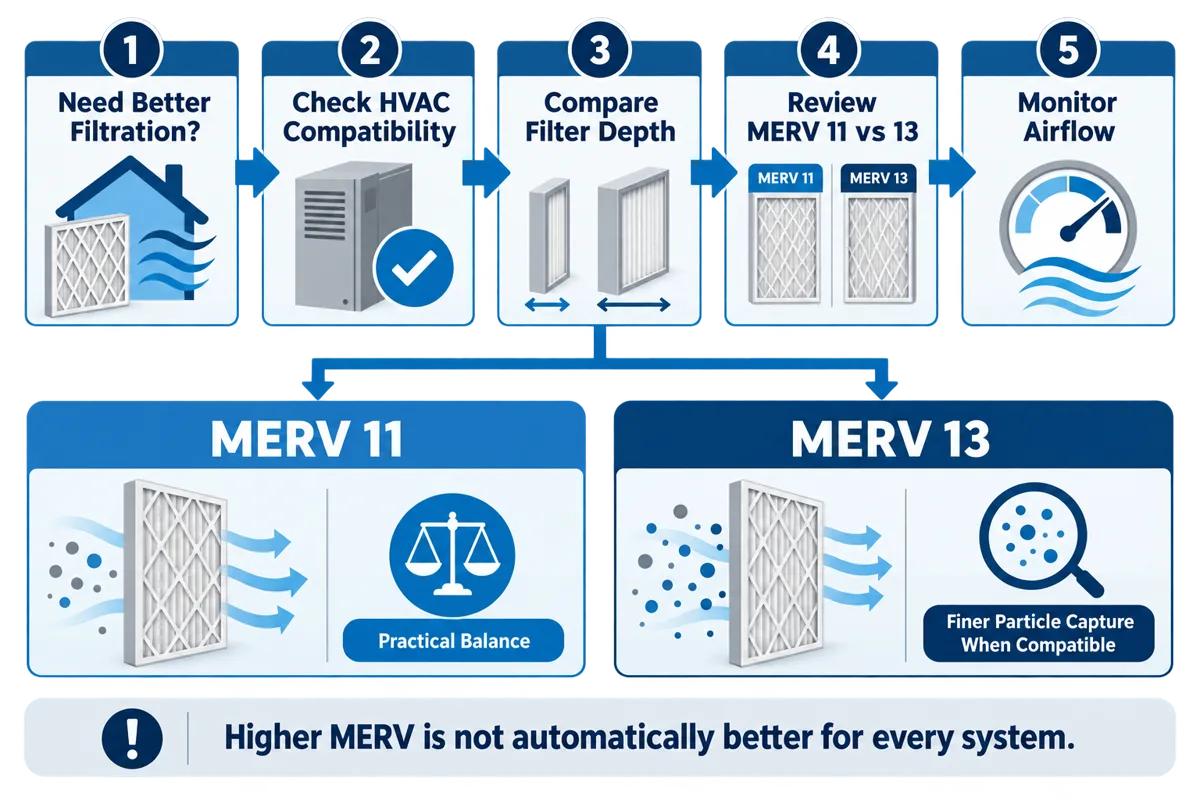
Choose between MERV 11 and MERV 13 based on the actual product and HVAC system rather than the rating alone. MERV 13 provides stronger required capture of smaller airborne particles. MERV 11 may be the better practical choice when resistance, filter depth, or equipment guidance favors it, and it remains a capable filtration option.
For many homes, MERV 11 is a sensible starting point. Consider MERV 13 when finer-particle capture is important, exact size and depth are confirmed, product resistance is appropriate, and system compatibility is supported. Neither option is medical treatment.
Filter Wizard recommendation
Compare a Cautious MERV Starting Point
Enter a confirmed three-dimensional size for household guidance, replacement timing, and current retailer options. Filter Wizard cannot inspect your system or guarantee compatibility.
Start the Filter FinderTechnical Sources
Free Filter Reminders
Remember Your Next Filter Check
Get occasional filter reminders, homeowner maintenance tips, and buying guidance.
Occasional emails only. Unsubscribe anytime.
You're on the list. We'll send practical filter reminders and updates occasionally.
Frequently Asked Questions
Is MERV 11 or MERV 13 better for allergies?
MERV 13 has stronger required capture of smaller airborne particles, while MERV 11 may be the more practical compatible choice for some systems. Neither rating treats allergies or guarantees symptom relief.
Is MERV 11 enough for pollen?
MERV 11 can capture many pollen particles and has tested performance in smaller particle ranges. Whether it is enough depends on the filtration goal, outdoor entry, system support, fit, and runtime.
Is MERV 13 better for pollen?
MERV 13 has stronger minimum performance across the MERV test ranges, including smaller particles and fragments. The practical benefit still depends on fit, circulation, product resistance, and HVAC compatibility.
Is MERV 13 better for pet-related particles?
MERV 13 provides stronger finer-particle capture than MERV 11, but visible pet hair is a different target and often settles before reaching the return. Choose based on the system and household goal.
Does MERV 13 restrict airflow more than MERV 11?
It can, but the rating alone does not determine resistance. Media design, pleat area, filter size, depth, airflow rate, and loading can make two products with either rating behave differently.
Is MERV 13 too restrictive for older HVAC systems?
Not automatically. System age is not a compatibility test. Blower capability, duct and return design, filter face area, cabinet depth, equipment guidance, and actual product resistance matter more.
Can a 1-inch MERV 13 be more restrictive than a 4-inch MERV 11?
Yes, depending on product design and airflow. A deeper filter can provide more media area, but neither depth nor MERV alone predicts resistance. Compare product data and use only the supported cabinet depth.
Does filter thickness matter more than MERV?
They describe different properties. MERV reports particle-capture performance; thickness can affect available media area and loading capacity. Both matter, along with fit and product resistance.
Can MERV 11 still capture smaller airborne particles?
Yes. MERV 11 must demonstrate capture in the 0.3–1, 1–3, and 3–10 micrometer test ranges, though its minimum efficiencies are lower than MERV 13.
Should I upgrade from MERV 11 to MERV 13?
Consider upgrading when finer-particle capture is a meaningful priority and the specific MERV 13 product fits correctly, has acceptable resistance, and is supported by the HVAC system.
Can MERV 13 cause a frozen coil?
A filter that contributes to inadequate airflow can be one factor in coil icing, but MERV 13 alone is not a diagnosis. Loading, sizing, blower, duct, refrigerant, and coil conditions may also matter.
How often should MERV 11 and MERV 13 filters be changed?
There is no universal interval. Inspect actual loading and follow product and equipment guidance while considering filter depth, HVAC runtime, pets, dust, pollen season, and renovations.
Does a poorly fitting filter reduce filtration performance?
Yes. Gaps, an undersized frame, bowing, or poor seating can let some return air bypass the media, reducing the value of either MERV rating.
Can MERV 13 eliminate allergy symptoms?
No. MERV 13 can reduce some airborne particles when they pass through the filter, but HVAC filtration is not medical treatment and cannot eliminate every source or guarantee symptom improvement.