Quick Answer
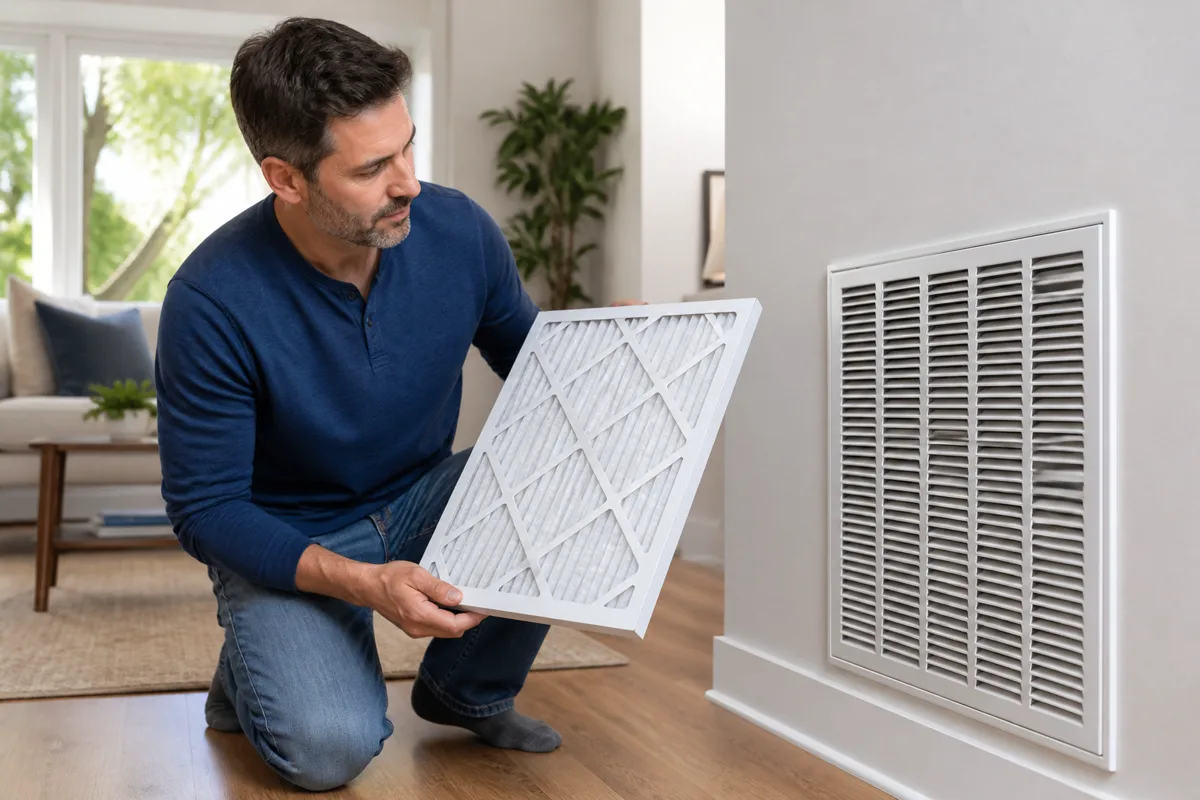
For many homes where airborne particles associated with common allergen sources is the main concern, a pleated MERV 11 filter is a practical starting point because it can capture smaller airborne particles while remaining compatible with many residential HVAC systems. MERV 8 may be sufficient for larger airborne particles associated with common allergen sources, while MERV 13 can provide stronger fine-particle capture when the HVAC system supports the filter's actual resistance.
A better filter may help reduce airborne particles, but it will not eliminate every source of particles in the home. Filter fit, thickness, system airflow, bypass gaps, replacement timing, and the sources creating particles matter just as much as the number on the label.
What “Best for Allergies” Actually Means
Airborne material associated with common allergen sources is a changing mixture rather than one uniform substance. It can include textile fibers, lint, tracked soil, skin flakes, pet-related debris, pollen, outdoor particles, construction material, and miscellaneous settled debris. Cooking and combustion can also contribute finer particles, depending on the home and activities.
Particle sizes vary widely. A visible fiber behaves differently from a much smaller airborne particle. Larger material may settle quickly on a shelf or floor, while smaller material may stay suspended longer and reach a return grille. One filter cannot capture every component equally because only air that enters the return passes through the media.
This distinction matters when someone asks for the best furnace filter for allergy-focused filtration. A filter can collect airborne material without preventing soil tracked through a doorway, fibers shed by a rug, or debris released during renovation. The right goal is useful filtration as one part of particles control, not a promise that every surface will stay clean.
What an HVAC Filter Can—and Cannot—Do About Allergies
An HVAC filter can capture larger particles and lint that reach the return. Depending on its MERV rating and design, it can also capture a greater share of smaller airborne particles. Correct fit matters: if air passes through gaps around an undersized frame, that bypass air avoids the filter regardless of its rating.
The filter cannot collect particles that has already settled, debris entering through open doors and windows, or particles created by flooring, fabrics, pets, and remodeling that settle before reaching a return. It cannot seal leaks around exterior openings or repair return-side duct leakage. It also cannot replace vacuuming, damp dusting, source control, or appropriate ventilation.
Room airflow affects what reaches the HVAC system. A return in a central hallway may see different material than a return near an entry or workshop. Even an excellent HVAC filter for allergy-focused filtration control works only during airflow and only on the air routed through it.
MERV 8 vs. MERV 11 vs. MERV 13 for Allergies
| Feature | MERV 8 | MERV 11 | MERV 13 |
|---|---|---|---|
| Larger airborne particles associated with common allergen sources | Useful basic capture | Stronger capture | Stronger capture |
| Smaller airborne particles | Basic | Moderate | Stronger |
| Relative filtration strength | Basic | Middle ground | Higher |
| Relative airflow resistance | Often lower | Varies by product | Varies; may be higher |
| Allergy-focused usefulness | Basic particle-filtration goals | Useful for many homes | Fine-particle priority |
| Fine-particle priority | Limited | Moderate | Stronger |
| Common residential use | Widely used | Widely available | System-dependent |
| Compatibility concern | Still verify | Verify system guidance | Confirm carefully |
| Loading potential | Household-dependent | May load faster | May load faster |
| Practical starting point | Basic filtration | Many allergy-focused homes | When finer capture is needed and supported |
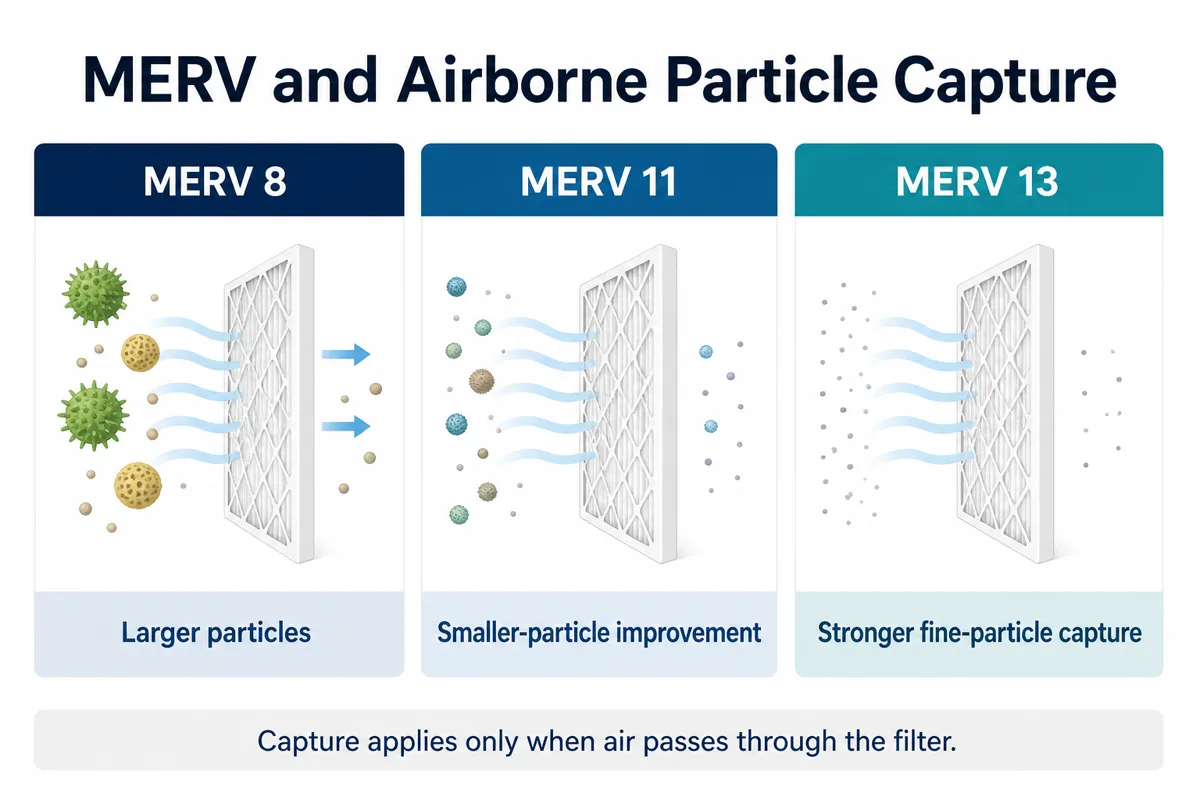
MERV describes standardized particle-capture performance, not the complete pressure drop of every product. Media area, pleat design, face area, depth, construction, airflow rate, and loading all affect real-world resistance.
Already choosing between the two common upgrade levels? Use the focused MERV 11 vs MERV 13 for allergies comparison to compare capture, pressure-drop data, depth, fit, and loading.
What Is the Best MERV Rating for Allergy-Focused Filtration?
MERV 11 is often a useful middle ground for an allergy-focused home because it captures a greater share of smaller airborne material than MERV 8 without assuming every home needs MERV 13. It is a starting point, not a mandate. The system must support the filter's size, depth, and operating resistance.
MERV 8 may be entirely reasonable when larger household particles are the main concern, current performance is satisfactory, or equipment guidance favors a basic filter. MERV 13 offers stronger capture in finer size ranges, but the benefit depends on compatibility, sealing, runtime, and whether those particles would otherwise reach the filter.
Read the full MERV 8, MERV 11, and MERV 13 comparison before changing ratings. If airflow is already weak or system guidance is unclear, review whether an air filter can be too restrictive rather than assuming a higher number is always an upgrade.
MERV 8 vs. MERV 11 for Allergies
MERV 8 captures larger household particles and often has lower resistance when otherwise similar filters are compared. It may cost less and can meet basic filtration needs. MERV 11 generally captures a greater share of smaller airborne particles and is a practical middle ground in many compatible systems.
In a very dusty environment, MERV 11 may load faster because it collects more material, though actual loading depends on sources, media area, and runtime. If both products fit and are compatible, MERV 11 is often the more useful choice when persistent airborne particles are the priority. MERV 8 can still be sufficient for basic filtration.
MERV 11 vs. MERV 13 for Allergies
MERV 13 provides stronger capture of finer particles than MERV 11 under the rating method. That does not guarantee visibly dust-free furniture. Many larger particles settle before reaching the return, while fibers and outdoor material continue entering from non-HVAC sources.
Actual resistance varies among products with the same rating. Choose MERV 13 only when equipment or cabinet guidance supports it and airflow remains normal. If documentation is unclear, a qualified HVAC professional can assess the installed system more reliably than a package label alone.
Pleated, Fiberglass, Washable, or Disposable?
Pleated vs. Fiberglass for Allergy-Focused Homes
Pleated filters generally provide more media area and a broader range of MERV options than basic fiberglass panels. For many allergy-focused homes, a compatible pleated filter is more useful because it offers stronger particle-capture choices. Performance still varies by product, and a pleated frame that fits poorly can allow bypass.
Fiberglass filters are not useless. They commonly focus on larger particles and equipment protection, often with relatively low resistance. They may suit systems or households that need basic filtration. The detailed fiberglass vs. pleated filter guide separates media type from MERV and system compatibility.
Washable vs. Disposable for Allergies
Washable filters are reusable and may catch larger debris, but tested filtration varies significantly. They require regular cleaning and must be fully dry before reinstallation. A reusable label does not reveal MERV performance or resistance.
Disposable pleated filters are available across a broader MERV range and are convenient to replace when loaded. They may provide stronger fine-particle capture, depending on the product. Compare the verified rating, dimensions, and maintenance burden in the washable vs. disposable guide rather than choosing by category alone.
Pollen and Seasonal Conditions
Pollen can enter through doors, windows, clothing, pets, and outdoor-air leakage. Some grains settle before reaching a return; smaller fragments may remain airborne longer. Only the portion carried through the HVAC system can be captured, so filtration is one control rather than a promise of symptom relief.
Seasonal conditions can increase filter loading. Inspect actual media condition and follow equipment and filter guidance instead of assuming one schedule works year-round.
Filter Fit, Air Bypass, and HVAC Runtime
An undersized, damaged, or poorly seated filter can let return air travel around the media. ASHRAE guidance emphasizes sealing because a high rating cannot capture particles in bypass air. A properly fitted MERV 11 can therefore be a more sensible installation than a higher-rated filter with edge gaps. Confirm the exact size before ordering.
Central filtration also works only while air moves through the filter. Blower runtime, return placement, closed doors, and particle settling affect how much room air reaches the media. Do not universally change thermostat fan settings; follow equipment guidance.
Filtration Is Not Allergy Treatment
HVAC filtration can reduce some airborne particles associated with common allergen sources when those particles pass through the system. It does not diagnose, prevent, treat, or cure allergies; it cannot guarantee symptom improvement. Settled particles, moisture or mold-source problems, continuous outdoor entry, cleaning needs, and building-envelope leakage require other responses.
Does Filter Thickness Matter?
A deeper compatible filter often contains more media area. More area can hold more debris before heavy loading and may support useful filtration without concentrating airflow through a small amount of media. That can be valuable where filters collect particles quickly.
Depth is not interchangeable. A 4-inch filter cannot replace a 1-inch filter unless the installed cabinet was designed for it. Deeper does not automatically mean lower resistance, and nominal measurements can differ from actual dimensions. Never force a thicker filter, stack several 1-inch filters, or leave a filter door open.
Use only the thickness the rack or media cabinet supports. The 1-inch vs. 2-inch vs. 4-inch comparison explains media area, service life, fit, and airflow without treating thickness as a universal upgrade.
Why Particles May Remain Even With a Good Filter
Outdoor air enters whenever doors and windows open and through gaps in the building envelope. Shoes and pet traffic carry in soil. Carpets, curtains, upholstery, bedding, and clothing release fibers. Renovations can produce unusually heavy material long after work ends. Attics or crawlspaces may contribute when there are leakage paths.
Return-side duct leakage can draw particles from an unconditioned area, but a dirty house or filter does not prove duct leakage. Similarly, uneven loading can reflect grille geometry, nearby sources, poor fit, bypass, or other airflow patterns. Use the guides on a filter getting dirty unusually fast and being dirty on only one side to identify clues without jumping to a diagnosis.
Housekeeping frequency changes visible particles because much of it has already settled. Vacuuming with appropriate equipment, damp dusting, washing fabrics, using entry mats, and controlling renovation debris address material the HVAC system may never see. A better filter can reduce some airborne particles, but it cannot eliminate every household source.
Does Higher MERV Mean Less Particles on Furniture?
Possibly, but not always noticeably. Higher MERV media may capture more smaller airborne particles that pass through the return. Larger visible particles often settle first, and room airflow may not carry them to the system. Surface particles also comes from activity, fabrics, tracked soil, and outdoor infiltration.
Fit and bypass matter too. A well-sealed MERV 11 filter may be more useful than an undersized MERV 13 filter with edge gaps. Treat cleaner surfaces as a possible benefit, not a guaranteed result.
How Often Should Allergy-Focused Homes Inspect Filters?
Inspect monthly at first, particularly after changing media, MERV, depth, or household conditions. Dusty homes may load filters faster, but there is no universal replacement interval. A deep media filter may hold more debris than a 1-inch filter, while long HVAC runtime can increase collection even in the same house.
Pets, remodeling, open-window seasons, wildfire smoke, nearby construction, and outdoor soil can change loading. Follow equipment and filter guidance, then adjust from actual condition. The guide on how often to change an air filter provides practical starting points, while signs of a clogged HVAC filter helps identify heavy loading.
Signs the Filter May Be Becoming Too Restrictive
Possible clues include weak airflow, whistling near the filter, a bowed frame, heavy visible loading, longer cycles, or recurring coil icing. These symptoms can have other causes, so none proves the filter rating is wrong. Review guides on filter whistling, a bent or bowing filter, and how a dirty filter can contribute to AC freezing. Persistent symptoms with a clean, correctly sized filter deserve qualified evaluation.
Practical Filter Selection Checklist
- Confirm the exact filter size from a properly fitting existing filter or cabinet.
- Confirm the supported filter thickness.
- Record the current MERV rating.
- Check equipment or filter-cabinet guidance.
- Decide whether larger particles or finer airborne particles are the main concern.
- Consider whether pets, open windows, or renovations increase loading.
- Choose the lowest MERV that reasonably meets the need and remains compatible.
- Prefer a properly fitting pleated filter when stronger filtration is desired.
- Install the filter in the correct airflow direction.
- Record the installation date.
- Inspect more frequently at first.
- Watch for weak airflow, whistling, or bowing.
- Adjust replacement timing based on actual loading.
Use the guides to confirm your air filter size and point the airflow arrow in the correct direction. Do not buy a large multipack until the first replacement fits and performs correctly.
Free homeowner tool
Need Help Choosing a Compatible MERV Range?
Confirm your exact size first, then use Filter Wizard for cautious MERV guidance, replacement timing, and retailer options based on airborne particles, pets, and household conditions.
Open the Filter FinderWhich Filter Should an Allergy-Focused Home Choose?
MERV 8 May Fit When
- Basic particles filtration is enough.
- The system favors lower resistance.
- Larger particles are the main concern.
- The current setup fits and performs well.
MERV 11 May Fit When
- Persistent airborne particles is a concern.
- Stronger everyday filtration is desired.
- Pets or household activity increase loading.
- The system supports the specific filter.
MERV 13 May Fit When
- Finer-particle capture is a priority.
- System documentation supports it.
- Airflow remains normal after installation.
- Compatibility has been reasonably confirmed.

Filter Wizard Recommendation
Start with the lowest MERV rating that reasonably addresses the home's particles problem while remaining compatible with the HVAC system. For many allergy-focused homes, a pleated MERV 11 filter is a practical middle ground. MERV 8 may be sufficient for basic filtration, while MERV 13 may make sense when finer-particle capture is needed and the system supports it.
Filter fit, thickness, particles sources, and replacement habits matter as much as the MERV number. If the existing filter fits well and the system performs normally, change one variable at a time. Inspect the new filter and airflow before ordering multiples.
Free homeowner tool
Ready to Narrow the Choice?
Enter your confirmed three-dimensional size and household details for a cautious recommendation, timing guidance, and current retailer options. Filter Wizard cannot physically identify your size or guarantee equipment compatibility.
Open the Filter FinderTechnical Sources
Free Filter Reminders
Remember Your Next Filter Check
Get occasional filter reminders, homeowner maintenance tips, and buying guidance.
Occasional emails only. Unsubscribe anytime.
You're on the list. We'll send practical filter reminders and updates occasionally.
For a separate buying decision involving combustion and wildfire particles, gases, and odor limits, use the best air filter for smoke guide.
Frequently Asked Questions
What is the best air filter for allergies?
A correctly sized pleated MERV 11 filter is a practical starting point for many allergy-focused homes when the HVAC system supports it. MERV 8 may suit basic particles filtration, while MERV 13 offers finer-particle capture when compatible.
What MERV rating is best for allergy-focused filtration?
There is no universal best rating. MERV 11 is often a useful middle ground; choose the lowest rating that reasonably meets the particle-filtration goal while remaining compatible with the system.
Is MERV 8 good for airborne particles associated with common allergen sources?
Yes. MERV 8 can capture larger household particles and may be sufficient for basic filtration, especially when the system specifies it or current airflow is a priority.
Is MERV 11 good for allergy-focused filtration?
MERV 11 generally captures a greater share of smaller airborne particles than MERV 8 and is a practical option for many allergy-focused homes when properly sized and supported.
Is MERV 13 better for allergy-focused filtration?
MERV 13 offers stronger capture of finer particles, but it is not automatically better for every home. The product's resistance, size, depth, loading, and system compatibility matter.
Are pleated filters better for allergy-focused filtration?
Pleated filters generally provide more media area and broader MERV choices than basic fiberglass panels, making a compatible pleated filter useful for many allergy-focused homes.
Are fiberglass filters good for allergy-focused filtration?
Fiberglass filters can capture larger debris and protect equipment, but they usually offer less small-particle capture than higher-rated pleated filters. They are not useless, and may fit basic filtration needs.
Are washable filters good for allergy-focused homes?
Some washable filters can work when their tested performance matches the household need and system. Ratings vary, and they must be cleaned and dried exactly as directed.
Do thicker filters help with allergy-focused filtration?
A deeper compatible filter may provide more media area and hold more debris before heavy loading, but depth is not interchangeable and thicker is not automatically less restrictive.
Why can airborne particles remain with a good filter?
Many airborne particles settle before reaching a return, while others enter from outdoor air, fabrics, flooring, pets, renovations, leaks, and daily activity. HVAC filtration addresses only particles that pass through the filter.
Does higher MERV reduce particles on furniture?
It may reduce some smaller airborne particles, but the visible difference varies. Larger particles often settle before reaching the HVAC system, and surface particles have many non-HVAC sources.
How often should I inspect the filter during pollen season?
Inspect monthly at first and adjust the schedule based on actual loading, filter depth, HVAC runtime, pets, renovations, outdoor conditions, and manufacturer guidance rather than one universal interval.
Can a loaded filter restrict airflow?
Yes. Accumulated debris can increase resistance, but weak airflow, whistling, bowing, long cycles, or icing can have other causes and may require further evaluation.
Can an HVAC filter eliminate allergy symptoms?
No. HVAC filtration can reduce some airborne particles when they pass through the system, but it does not treat allergies, eliminate every allergen source, or guarantee symptom improvement. Seek medical guidance for health concerns.