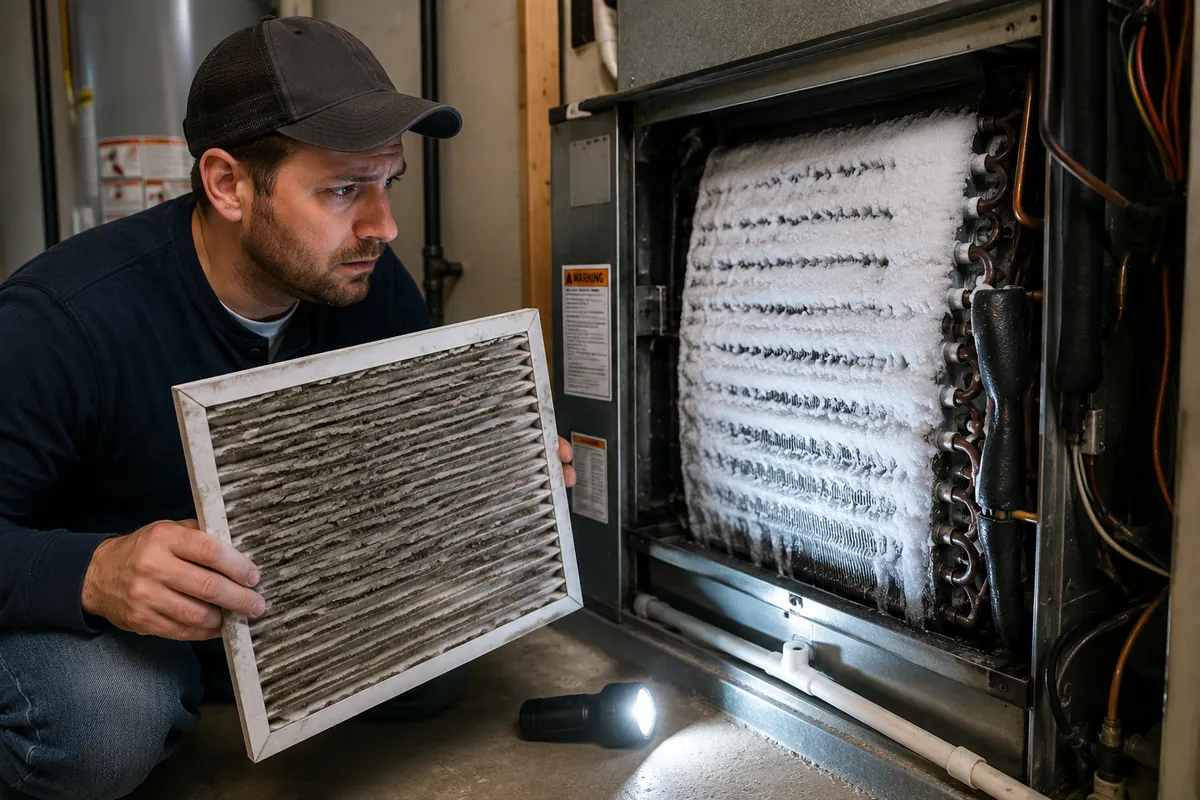
A dirty HVAC filter can contribute to an air conditioner freezing by restricting the amount of warm household air moving across the evaporator coil.
When airflow drops too far, the coil can become colder than intended. Moisture that normally collects and drains away may then freeze on the coil instead.
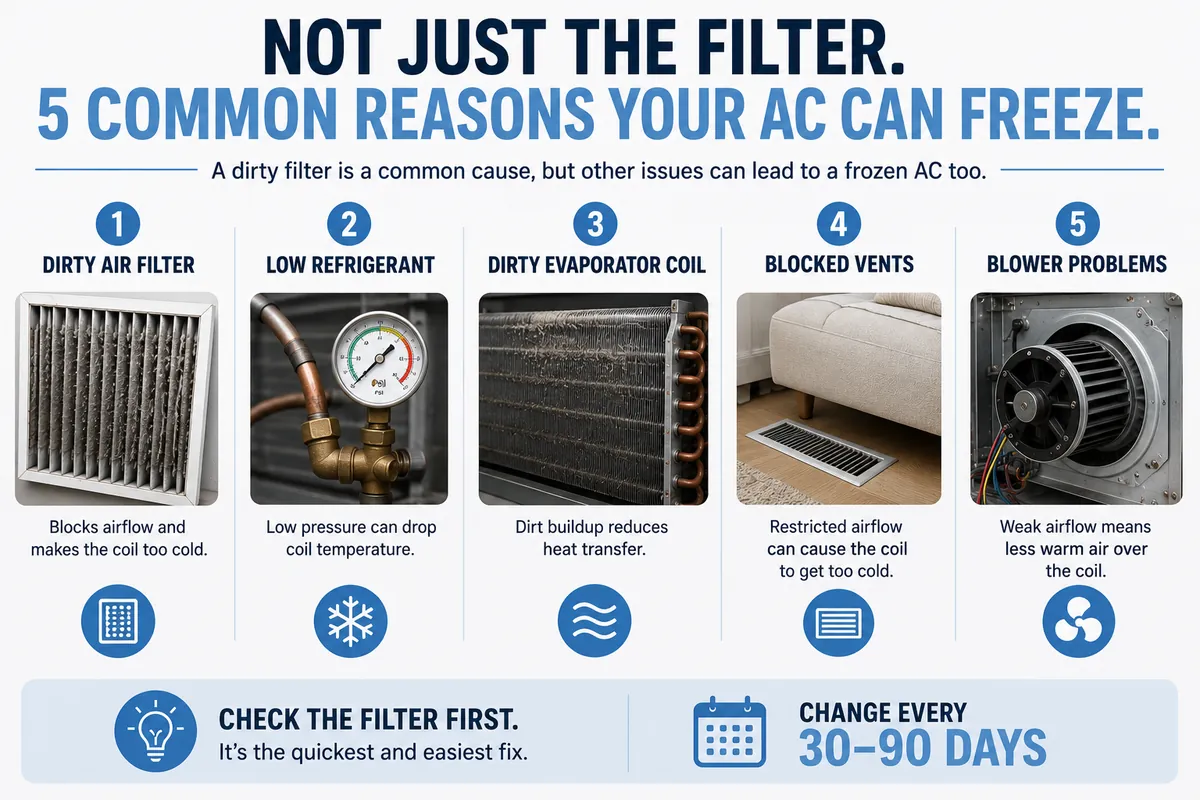
A dirty filter is not the only possible cause of a frozen AC. Low refrigerant, blocked vents, a dirty evaporator coil, blower problems, damaged ductwork, and mechanical faults can create similar symptoms.
If you see ice, stop normal cooling operation and allow the system to thaw before continuing to troubleshoot.
Quick Answer
Yes, a dirty air filter can contribute to your AC freezing, but it is only one possible cause. The filter matters when heavy loading or excessive resistance reduces airflow across the evaporator coil.
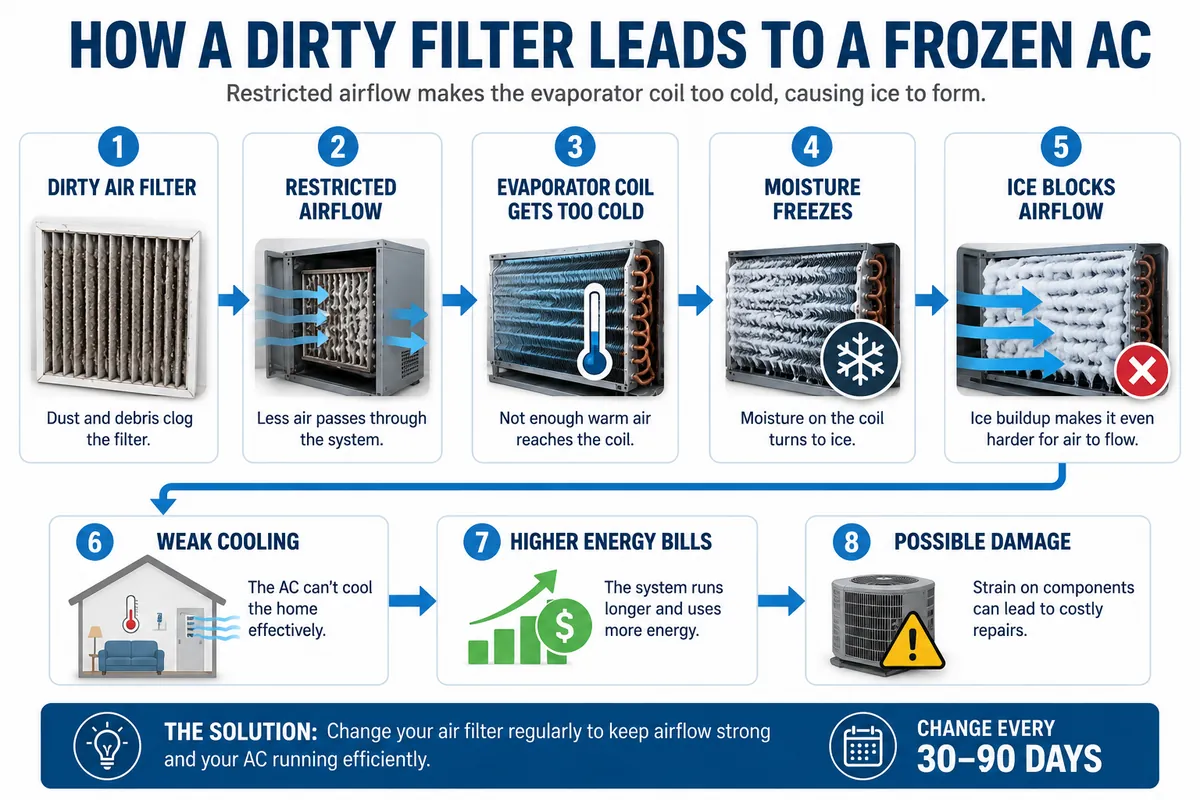
The usual sequence is:
- Dust and debris clog the filter.
- Airflow through the HVAC system decreases.
- Less warm air moves across the evaporator coil.
- The coil becomes unusually cold.
- Moisture freezes onto the coil.
- Ice further blocks airflow.
- Cooling performance continues to decline.
A filter does not need to look completely black before it becomes restrictive. If icing began after a filter change, also check whether the installed filter may be too restrictive for the system or conditions.
If the filter is visibly gray, packed with dust, covered in pet hair, warped, or overdue for replacement, replace it after turning the HVAC system off.
However, changing the filter alone will not immediately melt existing ice. The system must be allowed to thaw.
How an Air Conditioner Removes Heat
Your air conditioner does not create cold air in the same way a furnace creates heat.
Instead, it removes heat from indoor air.
Warm household air moves through the return duct, passes through the filter, and travels across the evaporator coil.
Refrigerant inside the coil absorbs heat from that air.
The blower then sends the cooled air back through the supply ducts and into the rooms of the home.
Moisture from the air may condense on the cold coil and drain into a pan and condensate line.
For this process to work properly, enough warm air must continue moving across the coil.
The filter plays an important role because nearly all return air must pass through it before reaching the equipment.
If the filter becomes heavily clogged, the airflow reaching the coil can drop.
How a Dirty Filter Can Contribute to Freezing
A clogged filter increases resistance in the return-air path.
The blower may continue running, but it cannot move the intended volume of air through a severely restricted filter.
With less warm indoor air passing across the evaporator coil, the coil can become colder than its normal operating range.
Moisture on the coil may begin to freeze.
Once ice develops, the problem can accelerate.
The ice itself blocks additional airflow, causing the coil to become even colder and allowing more ice to form.
This can lead to:
- Weak airflow from vents
- Longer cooling cycles
- Rooms that remain warm
- Ice on refrigerant lines
- Water near the indoor unit after thawing
- Higher energy use
- Increased strain on HVAC components
Restricted airflow can also contribute to longer runtime and increased energy use; learn more in Can a Dirty Air Filter Raise Your Energy Bill?
Signs Your AC May Be Frozen
A frozen air conditioner is not always obvious from the thermostat.
The system may continue running even though cooling performance is getting worse.
Common warning signs include:
Weak Airflow
Air from supply vents feels much weaker than normal.
Warm Air From Vents
The system is running, but the air is not cooling the home effectively.
Ice on the Refrigerant Line
You may see frost or ice on the larger copper line near the indoor or outdoor equipment.
Do not touch electrical components or remove sealed panels to inspect hidden lines.
Ice Near the Indoor Coil
Ice may be visible around accessible areas near the air handler or furnace cabinet.
Do not open panels that require tools unless the equipment instructions explicitly identify them as homeowner-accessible.
Water Near the Indoor Unit
As ice melts, water may collect around the air handler, furnace, drain pan, or nearby floor.
AC Runs Constantly
The thermostat continues calling for cooling because the home is not reaching the selected temperature.
Filter Looks Clogged
The filter is gray, packed with dust, covered with pet hair, or has not been changed in a long time. Review the other Signs Your HVAC Filter Is Clogged.
What Happens if You Keep Running a Frozen AC?
Continuing to operate an AC while the coil is frozen can make the problem worse.
The system cannot move air properly through a coil covered in ice.
Normal cooling performance declines, and the equipment may continue running without effectively lowering the indoor temperature.
Possible consequences include:
- More ice buildup
- Longer system runtime
- Increased energy use
- Water leakage after thawing
- Blower strain
- Compressor strain
- Damage to nearby flooring or ceilings
- Repeated freeze-and-thaw cycles
Do not attempt to solve a frozen coil by repeatedly lowering the thermostat.
A lower temperature setting may keep the system running longer and allow more ice to develop.
Do not use an open flame, heat gun, boiling water, or sharp tool to remove ice.
Those methods can damage coils, wiring, drain pans, insulation, or nearby components.
Other Reasons an AC Can Freeze
A dirty filter is one of the easiest causes to check, but it is not the only explanation.
Low Refrigerant
Low refrigerant can reduce pressure inside the evaporator coil and allow the coil temperature to fall too low.
Refrigerant does not normally get used up. Low refrigerant often indicates a leak that requires professional diagnosis and repair.
Do not attempt to add refrigerant yourself.
Dirty Evaporator Coil
Dust and debris on the coil can reduce heat transfer and airflow.
Coil cleaning may require access to internal HVAC components and is often best handled by a qualified technician.
Blocked Supply Vents
Closing too many supply vents can reduce system airflow.
Keep vents open unless the HVAC system was specifically designed and balanced for zoning.
Blocked Return Grilles
Furniture, curtains, rugs, boxes, or dust buildup can restrict return airflow.
Keep return grilles clear.
Blower Motor or Fan Problem
A weak blower motor, damaged fan, failing capacitor, dirty blower wheel, or electrical issue can reduce airflow.
These are professional repair items.
Collapsed or Restricted Ductwork
Damaged, disconnected, crushed, or blocked ducts can reduce airflow through the system.
Thermostat or Control Problem
A thermostat or control issue may cause the system to run improperly or fail to cycle as intended.
Cool Outdoor Temperatures
Running some air-conditioning systems during unusually cool outdoor conditions may contribute to freezing.
Drainage Problems
A blocked drain does not usually cause the initial airflow restriction, but melting ice can overwhelm a clogged or damaged condensate system and create water damage.
| Possible cause | What a homeowner may notice |
|---|---|
| Dirty filter | Weak airflow and a visibly loaded filter |
| Low refrigerant | Repeated icing even with a clean filter |
| Blocked vents or returns | Reduced airflow in parts of the home |
| Blower problem | Little or no airflow from vents |
| Dirty evaporator coil | Poor cooling and recurring icing |
What to Do When Your AC Is Frozen
Follow these basic homeowner-safe steps.
Step 1: Turn Off Cooling
Set the thermostat system mode to Off.
Do not leave the compressor running while the coil is frozen.
Step 2: Set the Fan to On, if Appropriate
Running the indoor fan without cooling may help circulate warm air across the coil and speed thawing.
However, do not run the fan if:
- Water is leaking near electrical components
- The blower is making unusual noises
- The fan is not operating normally
- The manufacturer instructions warn against it
When uncertain, leave the entire system off.
Step 3: Check the Filter
Remove the filter after turning the system off.
Replace it if it is:
- Heavily coated with dust
- Covered with pet hair
- Packed with debris
- Warped
- Damp
- Damaged
- Overdue for replacement
Confirm the replacement size printed on the old filter frame.
Step 4: Open and Inspect Vents
Make sure supply vents and return grilles are open and not blocked by furniture, curtains, rugs, or stored items.
Step 5: Allow the Ice to Melt
Do not restart cooling until visible ice has melted.
Place towels or a suitable container near the indoor unit if melting water may reach the floor.
Do not open sealed panels or reach into electrical areas.
Step 6: Check for Water
After thawing, inspect the accessible area around the drain pan and condensate line for water.
If water continues leaking, stop and call a professional.
Step 7: Restart Carefully
Once the system has fully thawed and the filter has been replaced, restart cooling at a normal thermostat setting.
Watch for:
- Normal airflow
- Cool air from vents
- Normal system cycling
- No new ice
- No unusual noises
- No water leakage
If the system freezes again, turn it off and contact an HVAC technician.
Do not continue repeated restart attempts.
How Long Does a Frozen AC Take to Thaw?
A frozen evaporator coil may take several hours to thaw.
A mild layer of frost may clear faster.
Heavy ice buildup can take much longer.
Thawing time depends on:
- The amount of ice
- Indoor temperature
- Airflow
- Whether the fan is safely running
- Equipment design
- Humidity
- Whether the indoor unit is in an attic, closet, basement, or garage
Do not assume the coil is thawed just because the visible refrigerant line looks clear.
Ice may remain inside the cabinet.
When practical, allow several hours before restarting the system.
If there was heavy ice buildup or water leakage, professional inspection is the safer option.
Will Changing the Filter Fix a Frozen AC?
Changing a clogged filter may fix the airflow problem that contributed to freezing.
It will not instantly remove ice that has already formed.
The system still needs time to thaw.
A new filter is more likely to solve the problem when:
- The old filter was heavily clogged
- Airflow was weak
- Vents and return grilles are open
- No refrigerant or mechanical issue is present
- Normal airflow returns after thawing
- Ice does not return
A new filter is less likely to be the complete solution when:
- Ice returns soon after restarting
- Airflow remains weak
- The blower makes unusual noises
- Refrigerant lines repeatedly freeze
- Water leaks continue
- The system cannot reach the thermostat setting
- The filter was relatively clean
When to Call an HVAC Technician
Contact a qualified HVAC professional when:
- The system freezes again after thawing and filter replacement
- Airflow remains weak
- The filter was not significantly dirty
- You suspect low refrigerant
- The blower is not operating normally
- Electrical or burning smells are present
- Unusual mechanical noises occur
- Water is leaking near electrical components
- Ice is heavy or repeatedly returns
- The system will not cool after thawing
- The condensate drain appears blocked
- You cannot safely access or identify the filter
Low refrigerant, electrical faults, blower problems, dirty internal coils, duct failures, and refrigerant leaks require professional tools and diagnosis.
Do not attempt to puncture refrigerant lines, open sealed components, bypass switches, or add refrigerant.
How to Help Prevent Your AC From Freezing
Inspect the Filter Monthly
A monthly check helps you notice buildup before the filter becomes severely restricted.
Replace the Filter When Needed
Many one-inch filters last somewhere between 30 and 90 days, but pets, allergies, construction dust, smoking, and heavy HVAC use can shorten that interval. See How Often Should You Change Your Air Filter?
Use the Correct Size
A filter that is too small can allow air and debris to bypass the filter.
A filter that is too large may not fit correctly.
Use an Appropriate MERV Rating
Higher filtration is not automatically better if the filter creates more resistance than the system can handle.
Keep Vents Open
Avoid closing large numbers of supply vents.
Keep Return Grilles Clear
Do not block return-air paths with furniture, curtains, or stored objects.
Schedule Maintenance
Professional maintenance can identify dirty coils, drainage issues, blower problems, refrigerant concerns, and other conditions before they cause a breakdown.
Watch for Changes in Airflow
Weak airflow is an early warning sign worth investigating.
Free Filter Reminders
Never Forget Your Next Filter Change
Get occasional filter reminders, homeowner maintenance tips, and buying guidance before a forgotten filter turns into another HVAC mystery.
Occasional emails only. Unsubscribe anytime.
You're on the list. We'll send practical filter reminders and updates occasionally.
Which MERV Rating Should You Choose?
A filter should capture useful household particles without creating more airflow resistance than the HVAC system can handle.
Always check the equipment manufacturer's guidance.
Standard homes
A practical everyday choice for many standard homes. It captures common dust, pollen, lint, and larger household particles.
Find My FilterPets and dust
Often useful for homes with pets, greater dust levels, or stronger everyday filtration needs.
Find My FilterAllergy-sensitive homes
May be appropriate for allergy-sensitive households and finer-particle filtration when the HVAC system supports it.
Find My FilterDo not assume MERV 13 is automatically the best choice.
A filter that is too restrictive for the equipment can contribute to airflow problems.
Free homeowner tool
Not sure which filter your home needs?
Use Filter Wizard's free Filter Finder to identify your filter-size guidance, recommended MERV rating, replacement schedule, and buying options.
- Correct size guidance
- Recommended MERV rating
- Replacement schedule
- Buying options
Frequently Asked Questions
Can I keep running my AC if it is frozen?
No. Continuing normal cooling operation can allow more ice to develop and may increase strain on the system. Turn cooling off and allow the system to thaw.
Will changing the filter melt the ice?
No. Replacing a clogged filter may correct the airflow restriction, but existing ice still needs time to melt before cooling is restarted.
How long does a frozen evaporator coil take to thaw?
It may take several hours. Heavy ice buildup can take longer depending on indoor temperature, airflow, humidity, and equipment location.
Can low refrigerant cause an AC to freeze?
Yes. Low refrigerant can reduce pressure inside the evaporator coil and allow the coil to become unusually cold. Low refrigerant often indicates a leak that requires professional repair.
Should I turn the thermostat off if the AC is frozen?
Set the thermostat system mode to Off. The indoor fan may sometimes be used to help thaw the coil, but leave the entire system off if there is water near electrical components, unusual noise, or uncertainty about safe operation.
Can a dirty filter damage the compressor?
A dirty filter can contribute to restricted airflow, longer runtime, and system strain. A frozen coil and repeated operation under poor conditions may eventually affect major components, including the compressor.
How do I know whether the evaporator coil is frozen?
Common signs include weak airflow, warm air from vents, ice on accessible refrigerant lines, water near the indoor unit, and an AC that runs without cooling effectively.
Is ice on the refrigerant line normal?
No. Frost or ice on refrigerant lines usually indicates an airflow, refrigerant, or mechanical problem that should be investigated.
How often should I inspect my AC filter?
Inspect a standard one-inch filter monthly. Replacement timing commonly ranges from 30 to 90 days depending on pets, dust, allergies, HVAC runtime, and filter thickness.
When should I call an HVAC technician?
Call a professional if ice returns after thawing and replacing the filter, airflow remains weak, water leaks persist, the blower behaves abnormally, or you suspect a refrigerant or electrical problem.