Quick Answer
Some HVAC systems are designed to use filters at the return grilles, while others use a single filter at the furnace or air handler. You should generally follow the system's intended filter location rather than adding filters to every return vent.
A home may have one central filter, multiple return air filters, or another manufacturer-approved arrangement. Installing extra filters where they were not designed may reduce airflow without improving performance. An empty return grille is not automatically missing a filter.
Why Some Homes Have Filters in Return Vents
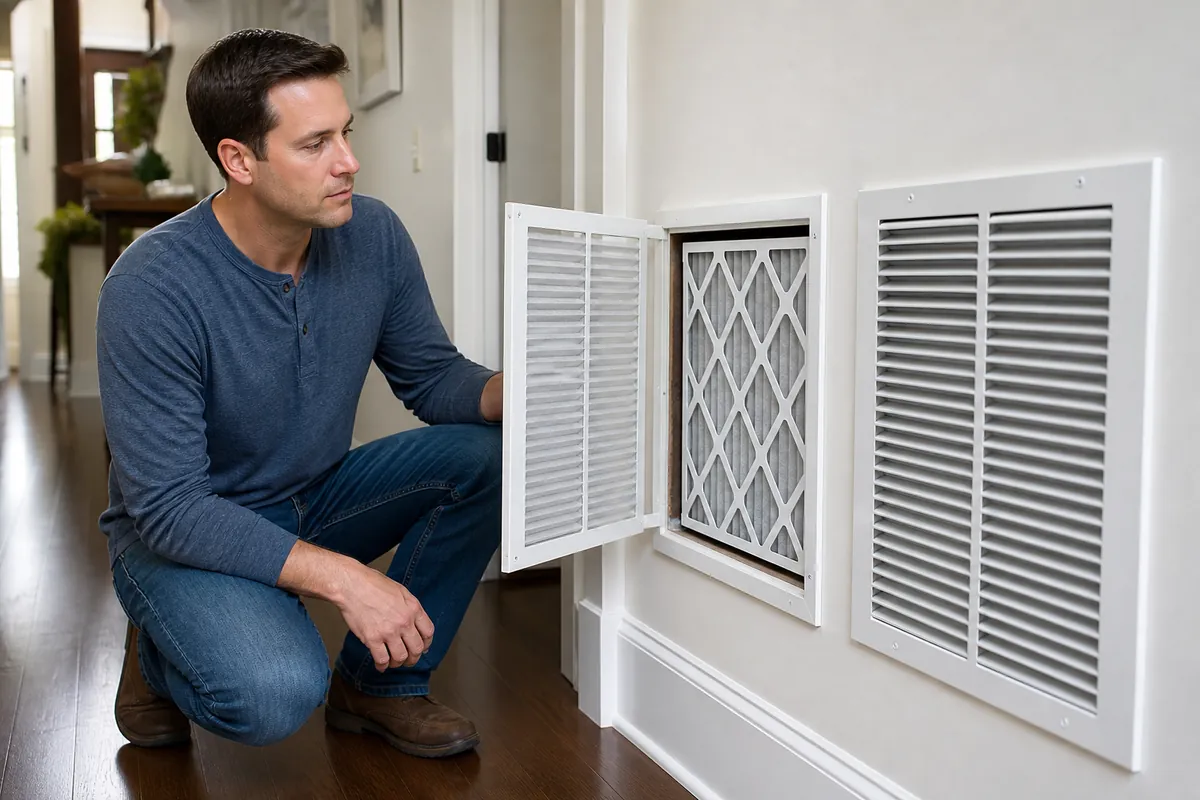
A return vent draws room air back toward the HVAC equipment. Some installations place the filter directly behind a hinged return grille. The filter is easy to reach, and systems with several return branches may use a filter at each designated return intake.
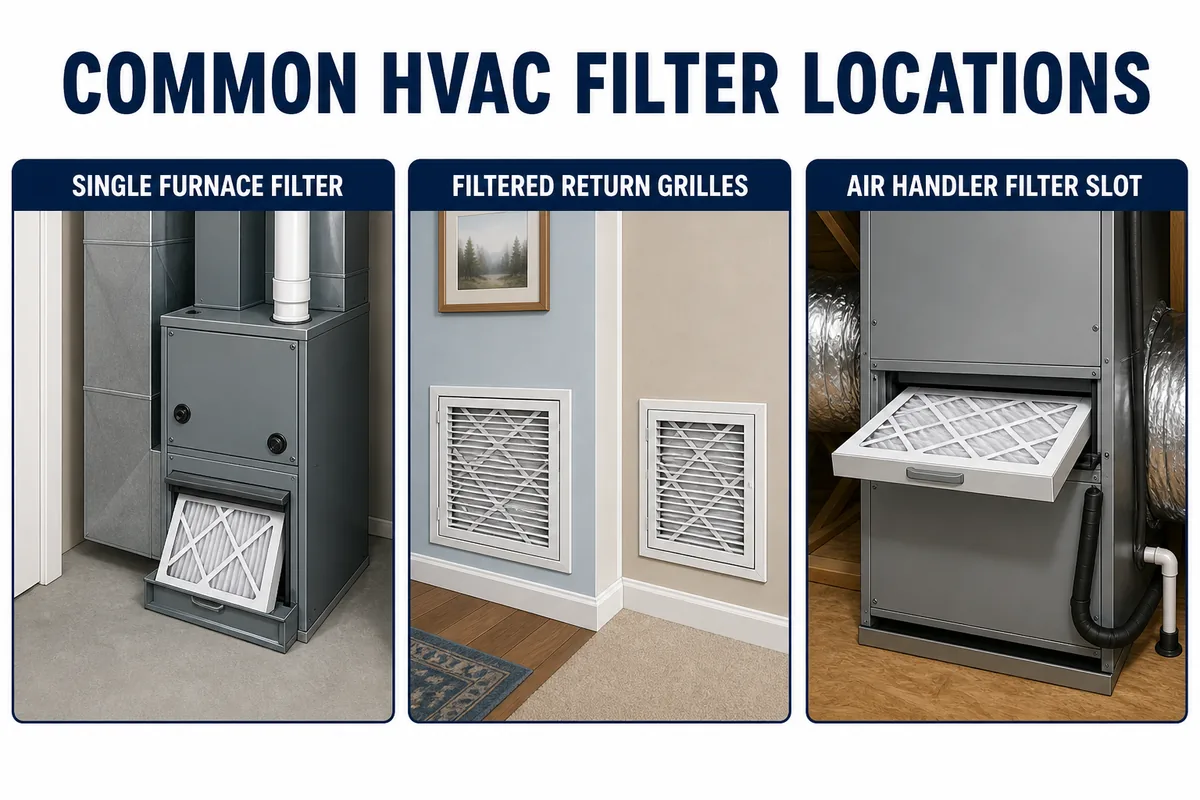
Other systems collect return air first and filter it once near the furnace, air handler, packaged unit, or media cabinet. Ordinary return grilles in those homes may contain no filter because all return air is intended to reach the central filter downstream.
Equipment type alone does not settle the question. In many central systems, furnace filter and AC filter are names for the same shared return-air filter, but furnaces, heat pumps, air handlers, and packaged systems can still have different return layouts. Cabinet accessories, duct design, manufacturer instructions, and installer choices all affect where filtration belongs.
A return grille designed for a filter often has a hinged face, latches, and a frame or ledge sized to support the filter. An ordinary grille may have no safe support. Never force a filter behind a grille that lacks an intended rack.
Do All Return Vents Need Filters?
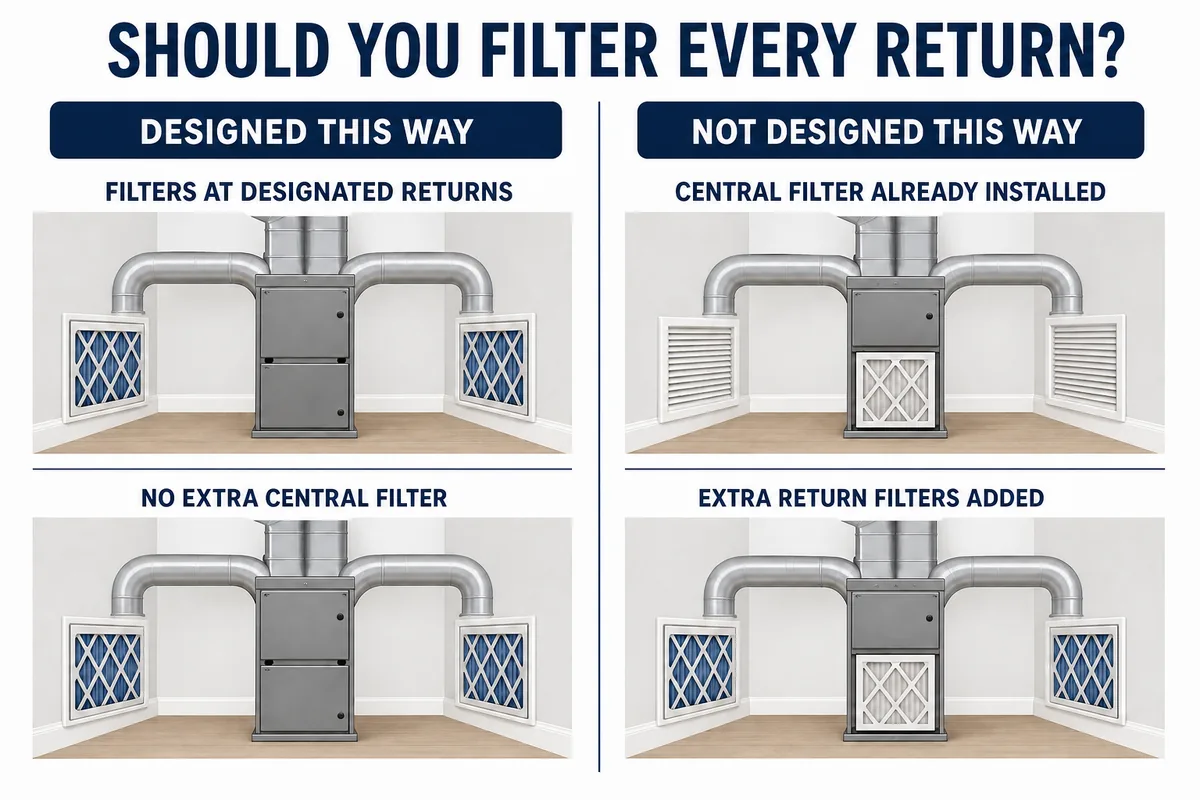
No universal rule says every return vent needs a filter. The goal is for return air to pass through the filtration arrangement the system was designed to use. That may mean one central filter or several filtered returns.
| Configuration | What you may see | Typical filter locations | Homeowner approach |
|---|---|---|---|
| Single central filter | Several ordinary return grilles | Furnace, air handler, or media cabinet | Replace the central filter |
| Filtered return grilles | Hinged grilles with filter racks | Each designated filtered return | Replace all designated filters |
| Single filtered return | One large filter grille; other layout varies | Named return location | Verify that all return air follows that path |
| Intentional staged filtration | Multiple documented filter stages | As specified by system design | Follow equipment guidance |
| Unclear or altered system | Empty racks, mixed filters, no records | Unknown | Confirm before changing the setup |
Do not infer the correct arrangement from grille count alone. A two-story home may have several returns feeding one central filter, while another home may need a separate filter at each return grille.
What Happens If You Install Filters in Every Return?
Adding a return vent filter changes the path air must travel. If the system already has a central filter, extra return filters can add operating resistance. The effect depends on filter construction, size, MERV rating, cleanliness, total surface area, and the system's available airflow.
Extra filters also add maintenance. Each filter loads at a different rate, and forgetting one can restrict a branch even when the central filter looks clean. Filters fitted poorly at multiple grilles may create gaps, vibration, or uneven loading.
These outcomes do not occur in every system. A design with several large filtered returns may provide ample filter area and operate exactly as intended. The problem is adding filters without confirming that design, not the existence of multiple filters itself.
Do not cut filters, wedge them behind unsupported grilles, or cover a return with material sold for unrelated uses. Poorly secured media can move, whistle, or leave bypass gaps.
Is Double Filtering a Good Idea?
Double filtering usually means placing return filters upstream while also keeping a furnace or air-handler filter downstream. Some specialized systems intentionally use prefilters and final filters, but those stages are selected as part of the equipment design.
Adding return filters to an existing central-filter system rarely provides a simple guaranteed upgrade. Air still must cross both stages. If either becomes loaded or restrictive, airflow may change. The guide to using filters at both the return and furnace explains how to distinguish series filtration from separate return paths. Two low-efficiency filters are not automatically equivalent to one correctly selected filter, and two high-MERV filters are not automatically better.
Do not remove an existing central filter merely because you discover one return filter. First determine whether the return filter was intentional, temporary, or added by a previous occupant. Likewise, do not add a central filter to a multiple-return-filter system unless the cabinet is designed to hold one and the arrangement is supported.
How to Determine Where Your HVAC Filter Belongs
Begin with evidence already in the home. Look at every accessible return grille and note whether it opens on hinges, has latches, or contains a filter-support frame. Then inspect the accessible return side of the furnace or air handler for a filter slot, media cabinet, cover label, or existing filter.
Check homeowner documents, equipment manuals, cabinet labels, installation notes, and old replacement receipts. A furnace model number may not reveal the full answer because return grilles and filter cabinets can be installation-specific.
If you find an existing filter that fit properly, record its location, printed dimensions, MERV, and airflow arrow before removal. Use How to Find Your Air Filter Size for nominal and actual dimensions, and Which Way Does the Air Filter Arrow Point? to reinstall it toward the furnace, blower, or air handler.
Photograph each location. A clear overview showing grilles, slots, and filters is more useful to an HVAC professional than a close-up of one filter without context.
Can Multiple Filters Reduce Airflow?
They can, but the number of filters alone is not enough to predict the result. Several large filters installed in parallel at return grilles may offer more total media area than one small central filter. Filters placed in series make the same air cross multiple media layers and can add resistance.
MERV is only one factor. Pleat depth, media area, thickness, frame design, brand, filter condition, and airflow rate also matter. The comparison of MERV 8, MERV 11, and MERV 13 explains why a higher number does not by itself determine system compatibility.
Watch for meaningful changes after a correct replacement: unusually weak airflow, repeated bending, or whistling near a filter or return grille. Those clues justify checking fit and configuration, but they do not diagnose blower failure or measure static pressure.
What If One Return Has a Filter and Another Does Not?
A mixed appearance can be intentional, but it can also reflect a missing filter or a past homeowner modification. One large return may be the designated filter location while a smaller grille serves another purpose. Alternatively, two return grilles may both have racks and one filter was simply forgotten.
Compare the grille construction. Does the empty return have a hinged filter door, a supporting ledge, a size label, or marks showing a frame once sat there? Check replacement history and any spare filters stored nearby. Avoid installing a filter based only on dust around the grille.
Uneven configuration can create different loading patterns. The guide to why a filter gets dirty on only one side explains airflow and bypass clues, while a bent or bowing filter can point to fit, support, loading, or restriction. Neither symptom proves that another return needs a filter.
Choose the Intended Filter Configuration
Replace filters only at locations clearly designed to hold them. If the system uses one central filter, keep ordinary returns unobstructed. If it uses multiple filtered returns, identify every designated grille and maintain all of them on an appropriate inspection schedule.
Before buying replacements, confirm the physical size of each filter. Different returns may use different dimensions. Size-specific guides for 20 × 25 × 1, 16 × 25 × 1, and 20 × 20 × 1 help only after you verify the installed size.
Free homeowner tool
Confirmed the filter location and size?
Use Filter Wizard for cautious MERV guidance, replacement timing, household-condition guidance, and current retailer options.
Open the Filter FinderSafe Homeowner Inspection Checklist
- Turn the HVAC system off at the thermostat and wait for the blower to stop.
- Locate every accessible return grille in the home.
- Look for hinged filter grilles, latches, frames, labels, and existing filters.
- Locate accessible furnace, air-handler, or media-cabinet filter slots.
- Photograph each filter and empty rack in place.
- Check equipment and homeowner documentation for intended locations.
- Record the printed size, MERV, and airflow arrow on each existing filter.
- Replace only filters in designated locations unless guidance confirms a change.
- Keep ordinary return grilles free of furniture, rugs, and household objects.
- Restart the system and monitor noise and airflow after replacement.
Do not open sealed service panels, reach near electrical or moving parts, fabricate filter supports, or run the system without its intended filtration.
Replace and Monitor or Call a Professional?
Replace and monitor
- The intended filter locations are documented or clearly labeled.
- Each replacement matches the confirmed size and supported rating.
- Filters sit flat and secure without being forced.
- Normal airflow returns after replacing loaded filters.
- No unused filter rack or unexplained gap remains.
Consider HVAC evaluation
- The system has filters at returns and at the equipment without documentation.
- An apparent filter rack is empty and its purpose is unclear.
- Airflow remains weak with clean, correctly fitted filters.
- Filters repeatedly bend, move, or whistle.
- Previous occupants altered grilles, cabinets, or filter locations.
- You cannot confirm whether all return air passes through a filter.
Filter Wizard Recommendation
Filter Wizard recommends using filters only where the HVAC system is designed to hold them. Do not assume every return grille needs a filter, and do not remove an existing return filter until another intended filtration location is confirmed.
Confirm each filter's physical size, direction, condition, and supported MERV before replacement. If the configuration remains unclear or airflow problems continue, ask an HVAC professional to identify the return path and designated filter locations rather than experimenting with extra filters.
Filter Wizard recommendation
Find the right replacement after confirming the setup
Enter a valid three-dimensional size for cautious MERV guidance, replacement timing, and retailer options. Filter Wizard cannot determine the physical filter location for your home.
Open the Filter FinderFree Filter Reminders
Remember Every Designated Filter
Get occasional filter reminders, homeowner maintenance tips, and buying guidance.
Occasional emails only. Unsubscribe anytime.
You're on the list. We'll send practical filter reminders and updates occasionally.
Frequently Asked Questions
Do all return vents need filters?
No. Some systems use filters at designated return grilles, while others use one central filter near the furnace or air handler. Follow the system's intended configuration.
Should every return have a filter?
Only when every return is designed as a filtered return. Do not add filters to ordinary return grilles simply because they are empty.
Is one furnace filter enough?
It can be enough when the system is designed so all return air passes through that central filter. Confirm there are no other designated filter locations.
Can I add filters to every return?
Not without confirming the design. Extra filters may add unnecessary resistance, increase maintenance, and change airflow in a system already using a central filter.
Can double filtering hurt airflow?
It can. Two filtration stages may add resistance, depending on filter design, MERV, loading, total filter area, and system capacity. Some systems are intentionally designed for stages, but most homeowners should not improvise them.
Can multiple return filters improve air quality?
Multiple filters can work well in a system designed for filtered returns. Adding them to an existing central-filter system does not guarantee better filtration and may reduce airflow.
Why does one return have a filter?
That grille may be a designated filter location, or it may be the only return intended to hold a filter. Check the other returns, central equipment, and documentation before changing the arrangement.
Why doesn't another return have a filter?
It may be an ordinary unfiltered return feeding a central filter, or a filter may be missing. The grille style, rack, labels, replacement history, and system documentation help distinguish those cases.
Can I remove a return filter?
Do not remove it permanently until you verify that another filter protects the system and that the return grille was not intended as the filter location.
How do I know where my filter belongs?
Look for existing filters, hinged filter grilles, furnace or air-handler slots, media cabinets, labels, and owner documentation. An HVAC professional can confirm an unclear configuration.
Can the wrong filter location damage my HVAC?
An incorrect arrangement can leave equipment unprotected or add airflow resistance, but the result depends on the system. Correct the configuration rather than assuming damage occurred.
When should I call an HVAC technician?
Call when filter locations remain unclear, filters are missing from apparent racks, airflow is weak, filters repeatedly bend or whistle, or the system uses an unusual multi-stage arrangement.