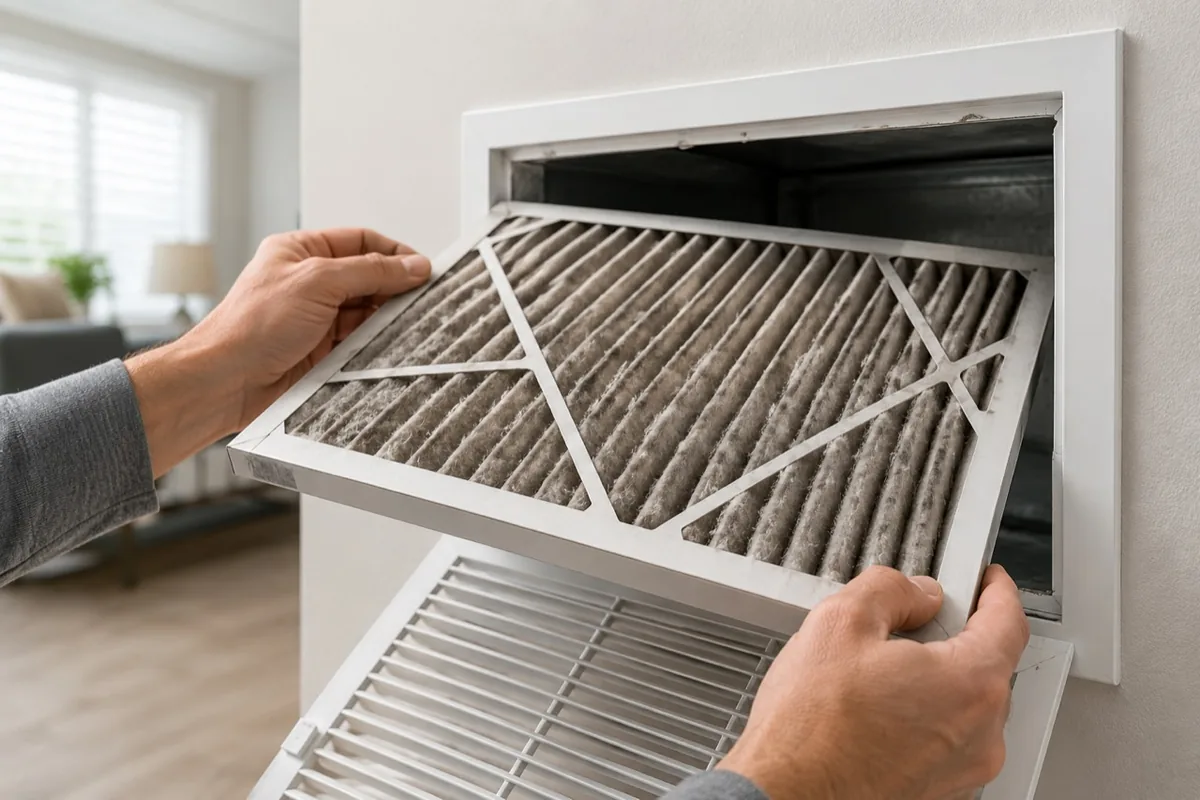
A clogged HVAC filter can reduce airflow, make your heating or cooling system run longer, and allow more dust to collect around your home.
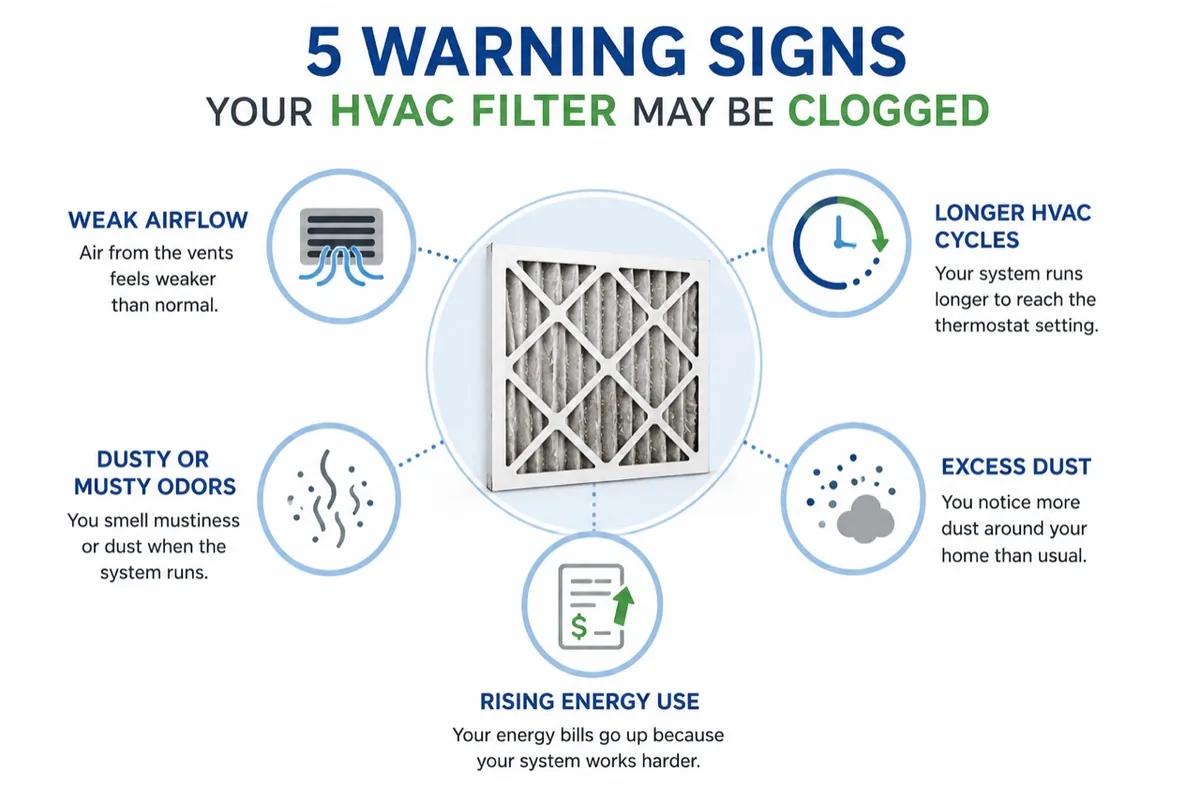
The most common warning signs include weak airflow from vents, unusually long HVAC cycles, more dust than normal, rising energy use, strange smells, allergy flare-ups, and a visibly dirty filter.
The good news is that checking your filter usually takes only a few minutes.
Quick Answer
Your HVAC filter may be clogged if you notice:
- Weak airflow from your vents
- Longer heating or cooling cycles
- More dust around your home
- Higher-than-normal energy use
- Musty or dusty odors
- Increased allergy symptoms
- A gray, dusty, or debris-covered filter
If several of these signs appear at the same time, inspect the filter before assuming the HVAC system has a larger mechanical problem.
Why a Clogged HVAC Filter Matters
Your HVAC system depends on steady airflow.
When the system runs, air is pulled through the return duct, passes through the filter, and then moves across the heating or cooling equipment before being distributed throughout the home.
A clean filter catches dust and debris while allowing air to pass through.
As the filter fills with dust, hair, lint, pollen, and other particles, it becomes harder for air to move through the filter material. The system may still operate, but it may need to run longer to move enough conditioned air through the house.
A clogged filter does not automatically mean your HVAC equipment is damaged. It does mean the system is working with more resistance than intended.
That is why checking the filter is one of the best first steps when airflow, comfort, or dust levels suddenly change.
1. Weak Airflow From Your Vents
Weak airflow is one of the clearest signs that your HVAC filter may be clogged.
Stand near a supply vent while the system is running. If the airflow feels noticeably weaker than normal, the filter may be restricting the amount of air moving through the system.
You may also notice:
- Rooms taking longer to cool or heat
- Upstairs rooms feeling warmer
- Uneven temperatures between rooms
- Air barely moving from certain vents
Weak airflow can also have other causes, including closed vents, duct problems, blower issues, or a blocked return grille.
Still, the filter is the easiest place to begin.
What to Do
Turn the system off and remove the filter.
Compare it with a new filter if possible. If the pleats are heavily coated with gray dust or debris, replacement is usually the safer choice.
2. Your HVAC System Runs Longer Than Usual
A clogged filter can make the system run longer to reach the thermostat setting.
For example, your air conditioner may normally cool the house in a predictable cycle. If it suddenly seems to run almost constantly, restricted airflow may be contributing.
Longer run times can happen because less conditioned air is reaching the rooms.
You may notice:
- The system cycles for longer periods
- The thermostat takes longer to reach the set temperature
- The house feels less comfortable even while the system runs
- The system turns back on shortly after shutting off
Weather conditions matter too. Extremely hot or cold days naturally increase HVAC runtime.
A furnace that stops heating unusually soon and restarts repeatedly is a different symptom. See whether a dirty filter can contribute to furnace short cycling without assuming the filter is the only cause.
The important clue is a change from your home's normal pattern.
3. More Dust Around Your Home
If dust returns soon after cleaning, check the HVAC filter.
A clogged or poorly fitted filter may allow more dust to circulate, especially if air is bypassing the filter around the edges.
Look for dust around:
- Supply vents
- Return grilles
- Ceiling fans
- Shelves
- Furniture
- Electronics
Excess dust does not always mean the filter is clogged. Open windows, pets, construction, and household activity also add dust.
But if dust levels increase at the same time as weak airflow or longer HVAC cycles, the filter becomes a likely suspect.
Check the Fit
Make sure the filter sits securely in the slot.
A filter that is too small can leave gaps where air moves around it rather than through it.
4. Your Energy Use Increases
A clogged filter may cause the blower and HVAC system to run longer than normal.
That can increase energy use.
Do not assume every higher utility bill comes from the filter. Energy costs are also affected by weather, thermostat settings, insulation, equipment condition, and electricity rates.
Instead, look for a combination of clues:
- Higher energy use
- Longer HVAC cycles
- Weak airflow
- A visibly dirty filter
Replacing a clogged filter is inexpensive compared with ignoring a restriction and continuing to operate the system under poor airflow conditions.
5. You Notice Musty or Dusty Odors
A dusty or stale smell when the HVAC system starts may be another warning sign.
Dust and debris trapped in the filter can contribute to unpleasant odors, especially when the filter has been left in place for a long time.
You may notice:
- A dusty smell from vents
- A stale odor when the system starts
- Musty air near the return grille
- Odors that become stronger during HVAC operation
A new filter may help if the old filter is heavily loaded.
However, persistent musty odors can also come from moisture, ductwork, drain pans, coils, or mold growth. A filter replacement should not be treated as a cure for every odor.
If the smell continues after replacing the filter, the system may need professional inspection.
6. Allergy Symptoms Feel Worse Indoors
A clogged filter may be less effective at maintaining useful airflow and trapping particles.
People sensitive to dust, pollen, or pet dander may notice:
- Sneezing
- Itchy eyes
- Congestion
- Throat irritation
- Symptoms that feel worse when indoors
Allergy symptoms have many possible causes, so the filter should not be treated as a diagnosis.
Still, checking the filter is a simple maintenance step, especially if the household has pets, heavy dust, or seasonal pollen.
Homes with allergy concerns may benefit from more frequent filter inspections.
A higher MERV rating may also capture smaller particles, but only if the HVAC system is designed to support that level of filtration.
7. The Filter Looks Gray, Matted, or Covered With Debris
The most direct way to identify a clogged filter is to inspect it.
Remove the filter and hold it near a light source.
A filter may need replacement if:
- The pleats are coated with gray dust
- Pet hair covers the surface
- Debris is packed between the pleats
- Very little light passes through
- The filter looks warped or damaged
- You cannot remember when it was installed
A filter does not need to be black before it becomes restrictive.
Many homeowners wait until the filter looks dramatically dirty. By then, airflow may already be affected.
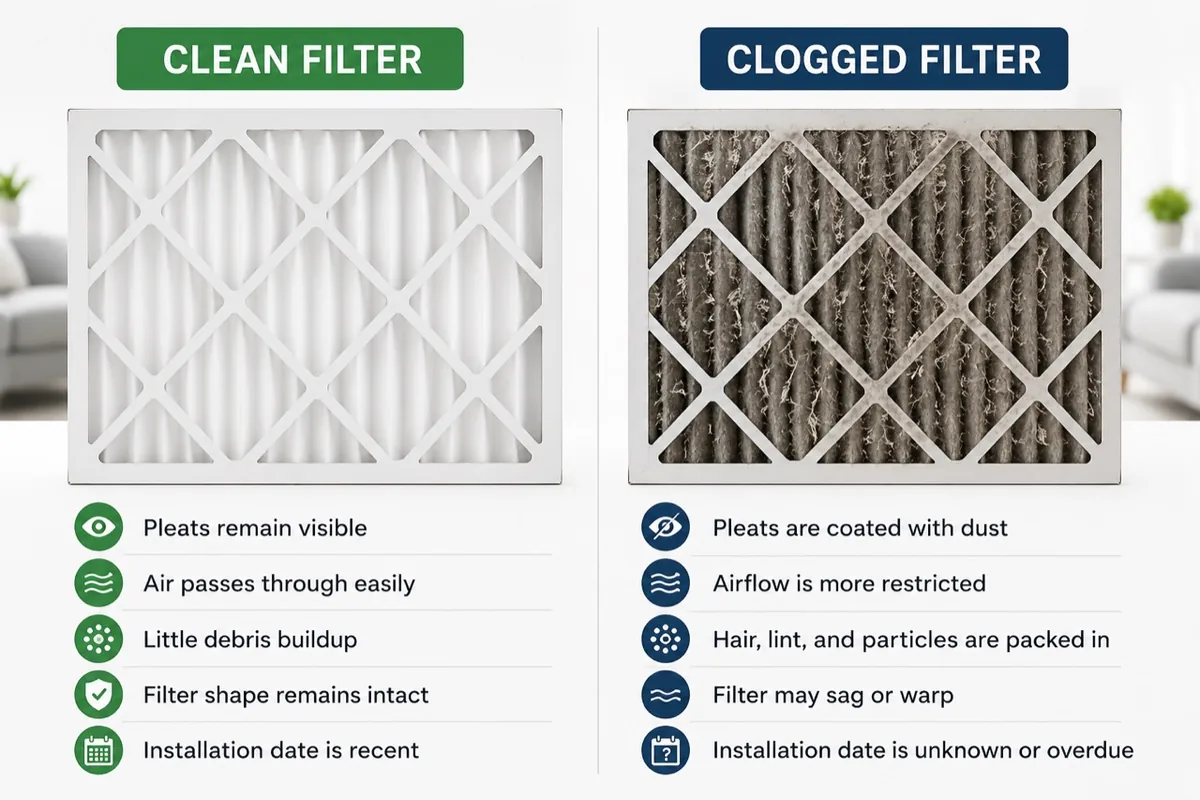
Clean Filter vs. Clogged Filter
| Clean filter | Clogged filter |
|---|---|
| Pleats remain visible | Pleats are coated with dust |
| Air passes through easily | Airflow is more restricted |
| Little debris buildup | Hair, lint, and particles are packed in |
| Filter shape remains intact | Filter may sag or warp |
| Installation date is recent | Installation date is unknown or overdue |
What Causes Filters to Clog Faster?
Some homes load filters much faster than others.
Pets
Pet hair and dander can accumulate quickly, especially in homes with multiple animals.
Heavy HVAC Use
The more the system runs, the more air passes through the filter.
Hot summers and cold winters may shorten replacement intervals.
Construction or Renovation
Drywall dust, sanding, cutting, and demolition can clog filters rapidly.
During renovation, inspect the filter every few weeks.
Smoking Indoors
Smoke particles can add to filter loading and indoor odors.
Open Windows
Open windows can bring in pollen, dust, and outdoor debris.
High Household Activity
Larger households usually generate more lint, dust, hair, and airborne particles.
Thin Filters
One-inch filters generally have less surface area than thicker media filters and often require more frequent replacement.
How Often Should You Check the Filter?
A practical rule is to inspect a standard one-inch filter every month.
That does not mean every home must replace the filter monthly.
Inspection frequency and replacement frequency are different.
| Home situation | Typical replacement timing |
|---|---|
| Light-use home, no pets | 60 to 90 days |
| Average family home | Around 60 days |
| One or more pets | 30 to 60 days |
| Allergies or heavy dust | About 30 days |
| Four- or five-inch media filter | Several months, depending on manufacturer guidance |
Your actual schedule should be based on filter thickness, HVAC runtime, household conditions, and the manufacturer's recommendations.
For a deeper replacement schedule, read How Often Should You Change Your Air Filter?
What to Do When You Find a Clogged Filter
Step 1: Turn Off the HVAC System
Turn the system off before removing the filter.
Step 2: Check the Size
The size is usually printed on the cardboard frame.
Common formats include:
- 16x20x1
- 20x20x1
- 20x25x1
- 16x25x1
Step 3: Check the Airflow Arrow
The arrow on the filter should point toward the HVAC equipment and in the direction of airflow.
Step 4: Install the New Filter
Make sure it sits flat and fits securely.
Step 5: Write Down the Date
Use a marker to write the installation date on the filter edge.
Step 6: Check Airflow Again
Run the system and see whether airflow improves.
If airflow remains weak after replacing the filter, the issue may involve ductwork, vents, the blower, the coil, or another HVAC component.
When a New Filter Does Not Fix the Problem
A clogged filter is only one possible cause of poor HVAC performance.
Contact an HVAC professional if you notice:
- Weak airflow after replacing the filter
- Ice on the air conditioner
- Burning smells
- Unusual mechanical noises
- Frequent system shutdowns
- Water near the equipment
- A system that will not reach the thermostat setting
- Persistent musty odors
Do not continue operating the system if you notice smoke, burning odors, electrical smells, or severe equipment noise.
Which MERV Rating Should You Choose?
Best for many standard homes
It captures common household dust, pollen, and larger particles without jumping immediately to a high-resistance filter.
Find My FilterBest for pets
Often useful for homes with pets, more dust, or stronger everyday filtration needs.
Find My FilterBest for allergies
May be worth considering for allergy-sensitive homes and finer particle filtration. Always verify that the HVAC system supports the selected MERV rating.
Find My FilterA higher number is not automatically better if the filter restricts more airflow than the system can handle.
Free homeowner tool
Not Sure Which Filter You Need?
Don't guess. Use the free Filter Wizard Filter Finder to:
- Find your exact filter size
- Get the right MERV recommendation
- Know exactly when to replace it
- Shop the correct filter
Frequently Asked Questions
Can a clogged air filter stop the AC from working?
A severely clogged filter can restrict airflow enough to reduce cooling performance. It may contribute to longer cycles, weak airflow, or coil-related problems, but other mechanical causes are also possible.
Can a clogged filter cause the AC to freeze?
Restricted airflow can contribute to very cold coil conditions and ice buildup. If you see ice, turn the system off and have the cause inspected.
How dirty is too dirty for an HVAC filter?
Replace it when the pleats are heavily coated, packed with debris, or clearly darker than a clean filter. You do not need to wait until it turns black.
Can I vacuum a disposable filter?
Disposable filters are intended to be replaced. Vacuuming may remove surface dust but does not reliably restore the filter's original performance.
Will changing the filter improve airflow?
It may improve airflow if the old filter was clogged. If airflow remains weak, another issue may be present.
Why does my filter get dirty so quickly?
Pets, construction dust, heavy HVAC use, open windows, smoking, and high household activity can all shorten filter life.
Can I run the HVAC system without a filter?
It is generally not advisable because dust and debris can reach the equipment. Install the correct replacement filter before operating the system normally.
How do I know which direction the filter goes?
Look for the airflow arrow on the frame. It should point toward the blower or HVAC equipment.
Is MERV 13 too restrictive?
It can be for some systems. Check the equipment manufacturer's guidance before installing a higher-rated filter.
Should I call an HVAC technician?
Call a professional if replacing the filter does not restore normal airflow or if you notice ice, burning smells, leaks, unusual noise, or repeated shutdowns.
A heavily loaded filter can be one possible reason an AC runs without cooling adequately, especially when airflow is weak throughout the home.