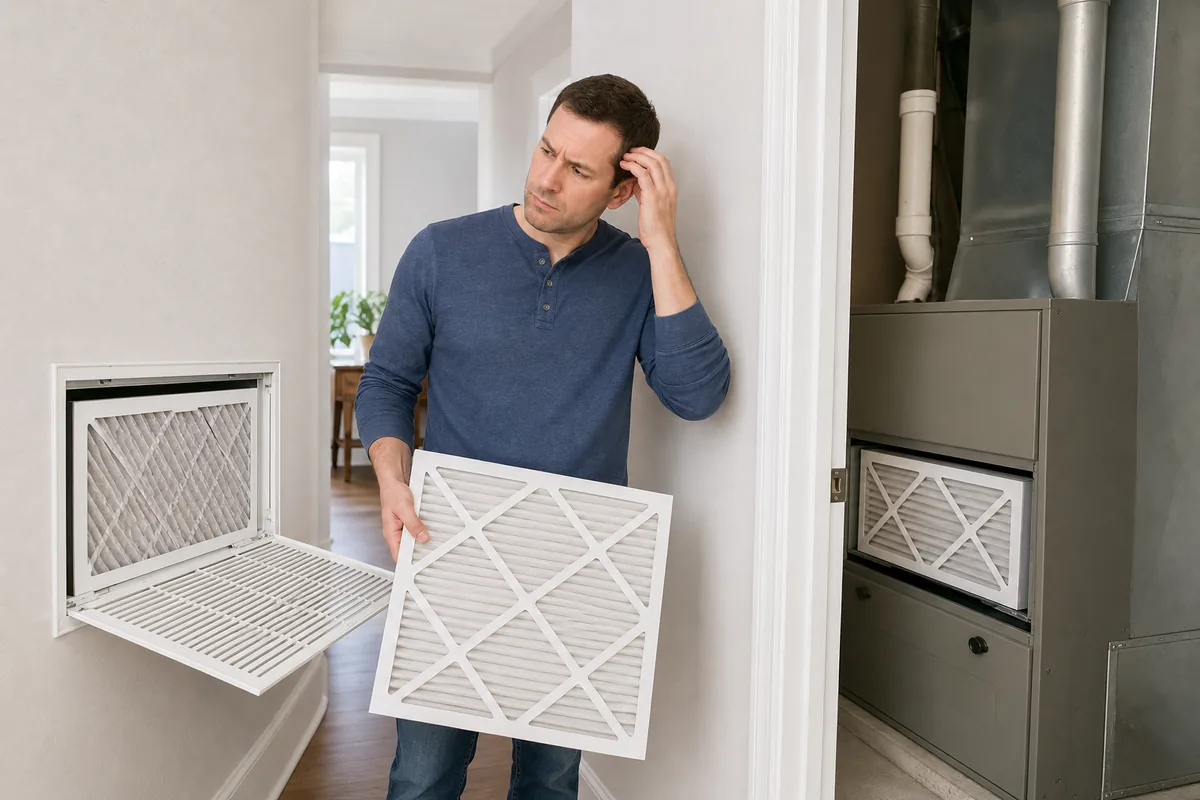
Quick Answer
Most HVAC systems use filters at either the return grilles or the furnace or air handler, not both in the same airflow path. Adding a second filter without confirming the system design may increase resistance and reduce airflow.
However, systems with multiple independent returns or purpose-built filtration may legitimately use more than one filter. Check the existing filter racks, equipment documentation, and airflow path before removing or adding a filter.
What “Double Filtering” Actually Means
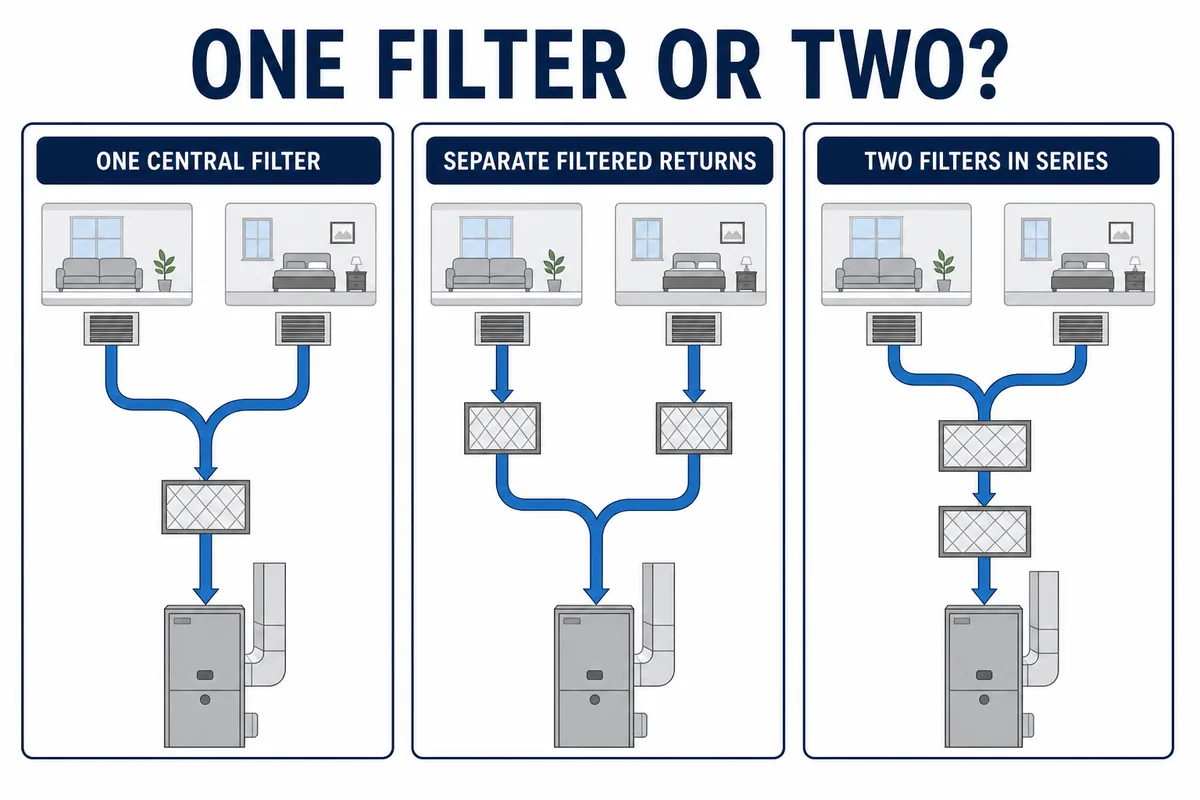
The phrase is useful only when you know how air travels. Filters in series means the same air passes through a return-grille filter and later through a furnace or air-handler filter. Each stage adds some resistance along that one path.
Filters on separate return paths work differently. Air from one part of the home passes through one return filter while air from another area passes through a different filter. The filtered streams combine later. The same air is not necessarily filtered twice.
This distinction separates this question from whether every return vent should contain a filter. Multiple filters are not automatically double filtering, and two filters in series are not automatically unsafe. The concern is whether the arrangement matches the system design.
HVAC Filter Configurations at a Glance
| Configuration | What it means | Usually appropriate? | What to verify |
|---|---|---|---|
| One central furnace filter | All return air reaches one rack near the furnace. | Common when designed that way. | Every return feeds the central rack. |
| One air-handler filter | A single accessible cabinet filters return air. | Common when documented. | Correct rack, fit, and access door. |
| Filtered return grilles only | Designated returns each hold a filter. | Appropriate for filtered-return designs. | Every required return is covered. |
| Multiple filtered returns | Separate return paths use their own filters. | Often normal. | Filters are not merely ordinary grilles. |
| Return plus central filter in series | The same air crosses two filters. | Only when supported by the design. | Documentation and acceptable airflow. |
| Media cabinet plus prefilter | A purpose-built staged setup is installed. | May be intentional. | Manufacturer instructions and correct media. |
| Empty return with central filter | The grille may not be a filter location. | Often normal. | All return air reaches the central filter. |
| Empty central slot with filtered returns | The central track may be intentionally unused. | Can be normal. | All designated returns have filters. |
| Mixed, unclear history | Locations may have changed over time. | Needs confirmation. | Labels, manuals, service notes, and paths. |
| Two filters added later | A previous homeowner may have improvised. | Do not assume either way. | Original racks and installation guidance. |
Why Most Systems Use One Filtration Stage
One correctly sized filtration stage is often enough to protect the blower and coil while capturing household particles. The rack, grille, duct area, and blower selection are planned around a particular arrangement. A central filter can work well when all return air passes through it; filtered grilles can work well when each designated return is covered.
Adding another filter does not automatically improve performance. It adds another item to inspect, another possible bypass gap, and another surface that becomes more restrictive as it loads. A second stage may be reasonable only when the equipment and filter cabinet were designed for it.
The filter itself also matters. MERV rating, thickness, construction, size, and total media area influence resistance. Two products with the same MERV can behave differently, which is why a universal “use two low-MERV filters” rule is not reliable.
When Multiple Filters Are Intentional
A large home may have several return grilles, each connected by a separate return duct and designed to hold a filter. A zoned home may also have more than one return path. These are parallel filters, not necessarily two filters acting on the same air.
Homes with two HVAC systems legitimately have at least one filter arrangement for each system. A downstairs furnace and an upstairs air handler do not share the same airflow simply because their filters look alike. Record which equipment each return serves.
Some systems include a deep media cabinet, manufacturer-approved prefilter, or specialized air-cleaning arrangement. Those configurations should use the specified media and maintenance schedule. Purpose-built stages are different from slipping an extra one-inch filter behind an ordinary grille.
Can Two Filters Reduce Airflow?
Every filter creates some resistance as air moves through it. Two filters in series can create more total resistance than one, especially if either filter is heavily loaded, undersized, unusually restrictive, or poorly fitted. The actual effect depends on construction, MERV, thickness, media area, physical size, condition, and the system design. Review the broader guide to filter airflow resistance for the role of each factor.
A deep pleated filter with a large media area can behave differently from a thin filter even when the ratings look similar. Compare MERV 8, MERV 11, and MERV 13 cautiously rather than assuming the highest number belongs in every rack.
Airflow symptoms can provide clues without proving the cause. A whistling filter may have a gap, heavy loading, or excess resistance. A filter that bends or bows inward may be loaded, weakly supported, poorly fitted, or responding to pressure across the rack. A properly designed multi-filter system may show none of these problems.
Does Double Filtering Improve Indoor Air Quality?
Two filters do not automatically provide cleaner indoor air. A second stage can catch some particles that pass the first, but the outcome depends on airflow, filter efficiency, fit, bypass, loading, and how much air actually moves through the system.
A filter with gaps around its frame may allow air to bypass the media. A dirty first filter may reduce airflow before air reaches the second. Standard residential filters also do not remove every gas, odor, or contaminant. Ventilation, moisture control, cleaning, and reducing pollutant sources remain important.
Use a filtration arrangement that the system supports rather than counting filters. If a household needs finer-particle filtration, confirm equipment compatibility instead of improvising a second stage.
What If the Home Already Has Filters in Both Locations?
- Do not immediately remove either filter.
- Identify whether the filters serve the same airflow path.
- Check whether every return is filtered.
- Inspect the accessible furnace or air-handler rack.
- Review equipment and installation documentation.
- Look for service labels or filter-size notes.
- Note whether one location appears intentionally abandoned.
- Compare how quickly the filters load.
- Note weak airflow, whistling, bowing, or recurring coil ice.
- Ask an HVAC professional when the design remains unclear.
Different loading does not by itself prove that one filter is unnecessary. The upstream filter often catches more material, and separate returns can collect different amounts of dust because rooms and airflow paths differ.
Should You Remove One Filter?
There is no safe universal yes or no. Removing one may be appropriate when someone added two filters in series without design support, but removing the wrong one may leave part of the return path unfiltered.
A central slot may be intentionally empty because every designated return grille is filtered. A return grille may be intentionally empty because all air reaches a central rack. An empty track also may reflect an old configuration, so appearance alone is not enough.
Do not remove a filter solely because two filters are present. First determine whether they filter the same air in series or serve separate return paths. Restore the existing arrangement until documentation or a qualified inspection supports a change.
How to Identify the Intended Filter Location
Look for printed size labels, dedicated tracks, hinged filter grilles, removable filter doors, service stickers, and a filter that fits securely without forcing. Check the furnace, air-handler, media-cabinet, and homeowner manuals. Count HVAC systems as well as returns.
Before ordering, learn how to confirm the physical filter size and record all three dimensions. Follow the airflow arrow toward the furnace, blower, or air handler at the designated location.
If the confirmed size matches an existing pilot guide, see the practical notes for 20 × 25 × 1, 16 × 25 × 1, or 20 × 20 × 1. A size guide cannot determine which rack your system intends to use.
Warning Signs the Setup May Be Wrong
- Airflow weakened after a second filter was added.
- Whistling started near a return grille or filter slot.
- A filter repeatedly bends, bows, or collapses.
- Evaporator-coil freezing keeps returning.
- Heating or cooling cycles seem unusually long.
- Two filters in the same path load very differently.
- Visible gaps let air bypass a filter.
- Filters fit loosely or must be forced into place.
- A filter is taped over an ordinary grille.
- Two filters are stacked in one slot.
These signs do not prove double filtering is the only cause. A clogged filter, blower condition, duct restriction, poor fit, or other equipment issue may create similar symptoms. Restricted airflow can contribute to icing, but a frozen AC coil can have several causes.
Safe Homeowner Inspection Checklist
- Turn the system off at the thermostat.
- Locate every accessible filter.
- Record each filter's size, MERV rating, and location.
- Identify whether filters serve separate returns or the same path.
- Check whether each filter sits in a purpose-built rack or grille.
- Look for unused or empty filter tracks.
- Review equipment documentation and service labels.
- Check whether filters are dirty, bent, wet, or loose.
- Confirm the airflow-arrow direction.
- Do not stack filters or add filters to ordinary grilles.
- Restore the existing configuration until the design is confirmed.
- Ask an HVAC professional when the airflow path remains unclear.
Stay within accessible filter compartments. Do not open blower compartments, remove sealed panels, alter ductwork, bypass equipment doors, fabricate a rack, or run the system without filtration as a test.
Free homeowner tool
Confirmed the correct filter location?
Once you know which location the system is designed to use, confirm the physical size and use Filter Wizard for cautious MERV guidance, replacement timing, and retailer options.
Open the Filter FinderKeep the Current Setup or Request HVAC Evaluation?
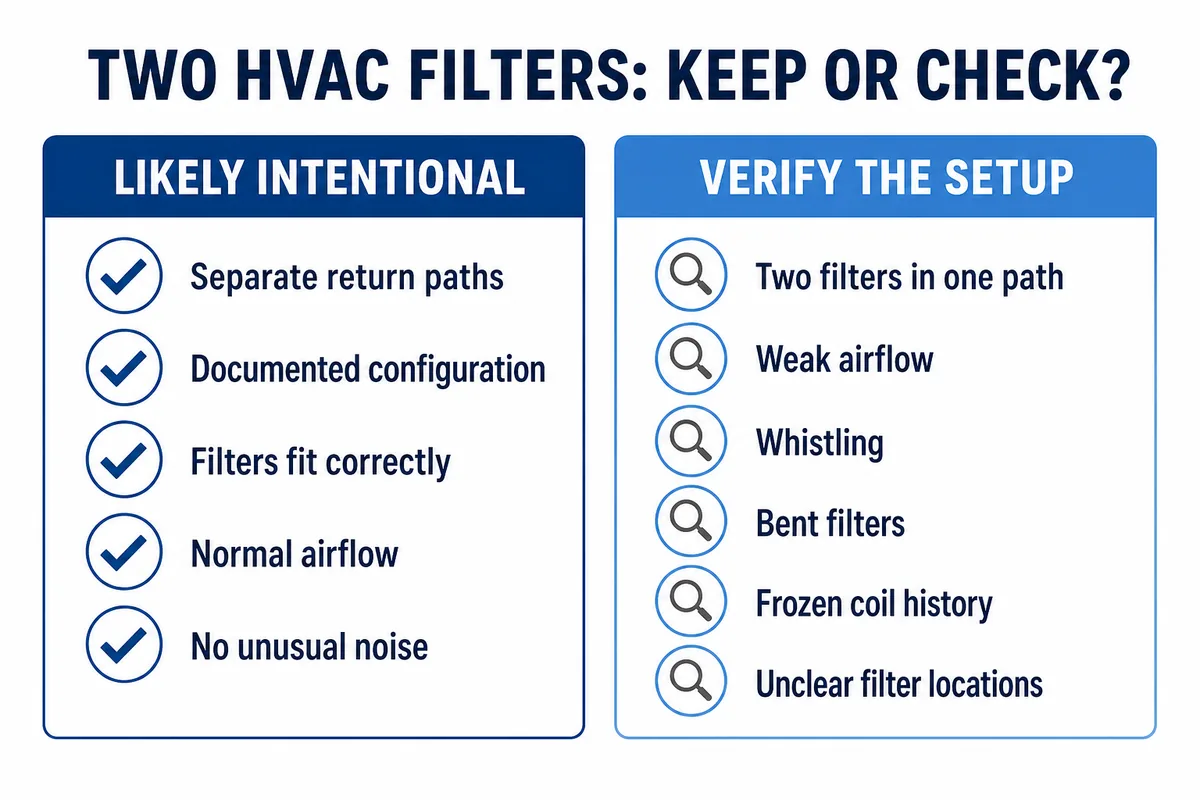
Keep and monitor
- Filters serve separate return paths.
- Documentation supports the configuration.
- Filters fit correctly.
- Airflow is normal.
- There is no whistling or bowing.
- There is no recurring frozen-coil history.
- Replacement intervals are reasonable.
Request HVAC evaluation
- Two filters appear to sit in series without documentation.
- Airflow weakened after a filter was added.
- Filters repeatedly bow or whistle.
- Coil freezing recurs.
- Filter racks appear modified.
- One return may be unfiltered.
- Multiple returns or zones cannot be traced safely.
Filter Wizard Recommendation
Filter Wizard recommends following the HVAC system's intended filtration design rather than automatically adding or removing filters. Confirm whether the filters serve separate return paths or the same airflow in series. Use the designated locations, correct physical sizes, supported MERV ratings, and a practical replacement schedule.
If the configuration remains unclear or airflow symptoms are present, have the system evaluated before changing it. Filter Wizard can guide filter selection after you confirm the physical location and size, but it cannot inspect or verify the duct layout.
Filter Wizard recommendation
Choose a replacement after confirming the configuration
Enter a valid three-dimensional size for cautious MERV guidance, replacement timing, household-condition guidance, and current retailer options.
Open the Filter FinderFree Filter Reminders
Keep the Right Filter Schedule
Get occasional filter reminders, homeowner maintenance tips, and buying guidance.
Occasional emails only. Unsubscribe anytime.
You're on the list. We'll send practical filter reminders and updates occasionally.
Frequently Asked Questions
Should I use a filter at the return vent and furnace?
Usually not in the same airflow path unless the system was designed for two filtration stages. Confirm whether the filters serve separate returns or sit in series before adding or removing either one.
Can an HVAC system use two filters?
Yes. Separate return paths may each use a filter, different HVAC systems may each have one, and some purpose-built setups use more than one stage. The design and documentation determine what belongs.
What is double filtering?
Double filtering generally means the same air passes through one filter and then another, such as a return-grille filter followed by a central furnace filter.
Can two filters reduce airflow?
They can when placed in series because every filter adds some resistance. The effect depends on filter construction, MERV, size, depth, media area, loading, and the HVAC design.
Does double filtering improve air quality?
Not automatically. A second filter may catch some particles, but fit, bypass, condition, airflow, source control, and ventilation also matter. Extra resistance may offset the intended benefit.
Why does my house have a return filter and furnace filter?
The arrangement may be intentional, left from an earlier configuration, or added by a previous homeowner. Filter racks, return paths, labels, manuals, and service records can clarify it.
Should I remove the furnace filter if the return has one?
Do not remove it solely because a return filter exists. First confirm that every return path is filtered and that the central slot is not the designated filtration location.
Should I remove the return filter if the furnace has one?
Not until you confirm the return filter is redundant. Removing the wrong filter could leave a return path or equipment unprotected.
Can separate return vents each have a filter?
Yes. A system designed with filtered return grilles may use one filter at each designated return. Those filters serve parallel paths rather than filtering the same air twice.
Can I stack two filters in one slot?
No. Do not stack filters in a single rack. Use one correctly sized filter that fits the designated slot and follows the equipment guidance.
Can double filtering cause whistling?
It may contribute to airflow noise, but whistling can also come from gaps, loose grilles, loading, fit, or duct conditions. The sound alone does not prove double filtering is the cause.
Can double filtering make a filter bend?
Added resistance may contribute, but poor fit, heavy loading, weak frames, and system airflow can also bend a filter. Repeated bowing deserves a configuration and fit check.
Can two filters contribute to a frozen coil?
Restricted airflow can contribute to coil icing, so two unintended filters in series may be one factor. Refrigerant, blower, coil, and duct issues can also cause freezing.
When should an HVAC professional confirm the filter setup?
Request help when the airflow paths are unclear, racks appear modified, one return may be unfiltered, airflow weakened after a filter change, or whistling, bowing, or coil freezing keeps returning.