
Quick Answer
A thicker HVAC filter is not automatically more restrictive. A 2-inch or 4-inch filter can often contain more pleated media area than a 1-inch filter, which may allow it to capture particles over a longer period without loading as quickly. However, filter thickness must match the HVAC system or filter cabinet. You should not force a 4-inch filter into a 1-inch slot or stack filters to imitate greater depth.
A 1-inch filter can work perfectly well in a system designed for it. Thickness and MERV are separate characteristics, and actual resistance depends on the specific filter design, face size, media, pleats, airflow, and condition.
What Filter Thickness Actually Means
Thickness is the filter's depth inside the rack or media cabinet. It is the third number in a size such as 20 × 25 × 1. Length and width describe the filter's face; depth describes how far it extends into the slot.
These are nominal dimensions used for shopping. A filter labeled one inch may measure somewhat less than one inch. Four-inch products also vary, and some deep media cabinets use brand- or model-specific actual dimensions. A readable size on a properly fitting existing filter is usually the safest reference. See how to find and measure your air filter size before ordering.
Thickness is not MERV. MERV describes particle-capture efficiency under a standard test. A 1-inch filter and a 4-inch filter can both be MERV 8, 11, or 13. Likewise, 20 × 25 × 1 and 20 × 25 × 4 are not interchangeable merely because their face dimensions match.
1-Inch vs 2-Inch vs 4-Inch Filters at a Glance
| Feature | 1-Inch | 2-Inch | 4-Inch |
|---|---|---|---|
| Typical media area | Lower | Moderate | Higher in many designs |
| Required rack | 1-inch rack | 2-inch rack | Deep media cabinet |
| Replacement frequency | Often more frequent | Often intermediate | May be less frequent |
| Upfront cost | Usually lower | Usually moderate | Usually higher |
| Airflow potential | Varies by product | Varies by product | Varies by product |
| Dust-holding capacity | Often lower | Often moderate | Often higher |
| Common use | Standard shallow racks | Dedicated mid-depth racks | Purpose-built media cabinets |
| MERV availability | Broad | Product-dependent | Broad but cabinet-specific |
| Fit flexibility | Only intended depth | Only intended depth | Cabinet-specific |
| Best reason to choose | Correct fit and availability | Correct fit with more media | Correct cabinet with more capacity |
The table describes common tendencies, not guarantees. Published product resistance, equipment guidance, and correct fit matter more than depth alone.
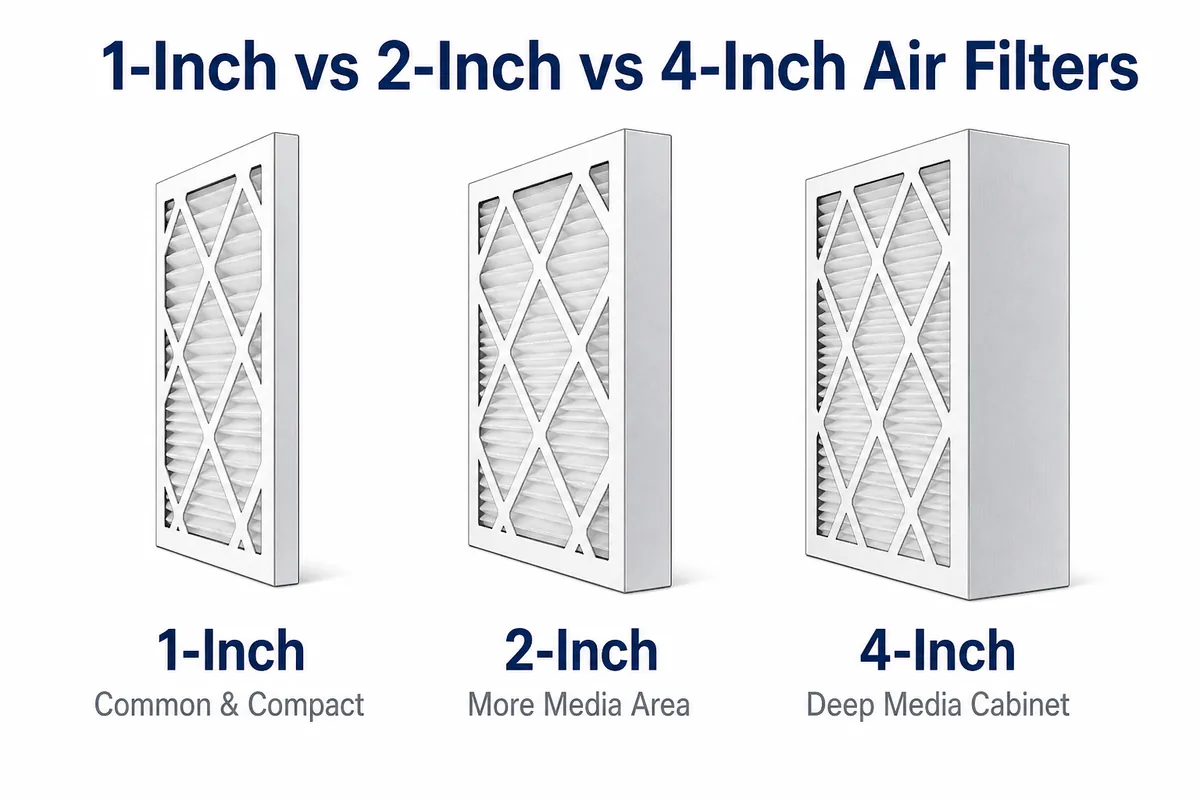
1-Inch Air Filters
One-inch filters are common in standard residential return grilles and furnace racks. They are widely available, generally cost less per filter, are easy to handle, and come in many face sizes and MERV ratings.
Advantages
- Broad availability in stores and online.
- Lower typical upfront cost.
- Common fit in older and standard systems.
- Easy inspection and replacement.
- Many MERV choices.
Tradeoffs
- Less media area than many deeper designs.
- May load faster under the same household conditions.
- May require more frequent replacement.
- Some high-efficiency shallow designs create more resistance than their system supports.
None of this makes a 1-inch filter inherently inferior. A clean, correctly sized, supported filter with an appropriate MERV can perform exactly as intended. Regular inspection matters because its smaller media reserve may show household loading sooner.
2-Inch Air Filters
A 2-inch furnace filter is an intermediate depth. Many designs can fold more media into the same face area than a 1-inch product. That can provide additional dust-holding capacity and may extend service life, depending on runtime, particle sources, MERV, and construction.
Two-inch filters require a rack designed for that depth. Availability can be lower than common 1-inch sizes, and the filter is not automatically the best compromise. A poorly designed or heavily loaded 2-inch filter can still be restrictive. Compare the exact product rather than assuming performance from thickness.
4-Inch and 5-Inch Media Filters
Four- and five-inch filters usually belong in a purpose-built deep media cabinet near the furnace or air handler. Many use the extra depth to hold substantially more pleated media than a shallow filter with the same face dimensions.
That additional area may allow higher dust-holding capacity, longer service intervals, or higher filtration with manageable resistance. These are design possibilities, not universal promises. A deep filter still gains resistance as it loads, and actual performance varies by media, pleat spacing, support, face size, and airflow.
Deep filters usually cost more per unit. Four-inch and five-inch products are not interchangeable, and two filters with the same nominal dimensions can have different actual dimensions. Some cabinets require a specific cartridge shape or seal. Read the existing filter and cabinet label before buying.
Does a Thicker Filter Improve Airflow?
Sometimes, but not automatically. A deeper filter often provides more media area. Spreading the same system airflow across more media can reduce air velocity through each portion, which may reduce resistance for a similarly efficient design.
Construction still matters. Media type, MERV, pleat count and spacing, backing, face size, sealing, and system airflow can make two products of the same depth behave differently. A neglected deep filter can also become restrictive.
If airflow changes after replacement, do not judge by thickness alone. Review what makes an air filter too restrictive, then confirm size, fit, direction, condition, and equipment support.
Do Thicker Filters Last Longer?
Often, because more media area can hold more particles before becoming heavily loaded. That does not create one reliable calendar interval for every 4-inch filter.
Service life changes with HVAC runtime, pets, dust, smoke, renovations, outdoor conditions, filter design, MERV, and how well the filter seals. Follow product and equipment guidance, inspect the filter, and respond to airflow or noise changes. Our guide to how often to change an air filter explains how household conditions affect timing.
Do not leave a deep filter in place solely because it was expensive or because a generic schedule says it should last longer. Conversely, do not replace a clean deep filter on a shallow-filter schedule without considering its guidance and actual condition.
Does Filter Thickness Affect MERV?
No. Thickness and MERV are different characteristics. MERV describes particle-capture efficiency; thickness describes physical depth. A 1-inch and 4-inch filter may both carry MERV 8, MERV 11, or MERV 13.
A deeper product may use more media area to achieve its filtration target while managing resistance, but depth does not grant a MERV rating. Media construction is separate too; compare fiberglass and pleated filters alongside MERV 8, 11, and 13 rather than using depth as a shortcut. The focused MERV 11 versus 13 guide explains why a one-inch MERV 13 is not automatically the better installed choice than a deeper MERV 11.
Which Thickness Costs More?
One-inch filters usually cost less per individual filter. Four-inch filters often cost more, while 2-inch products commonly fall somewhere between. Brand, face size, MERV, construction, specialty media, and multipack quantity can change the comparison.
Annual cost does not necessarily scale with unit price. A more expensive deep filter may need replacement less often, while a lower-cost shallow filter may be purchased more frequently. Because service life varies, compare a reasonable household replacement pattern rather than price per filter alone.
Can You Replace a 1-Inch Filter With a 4-Inch Filter?
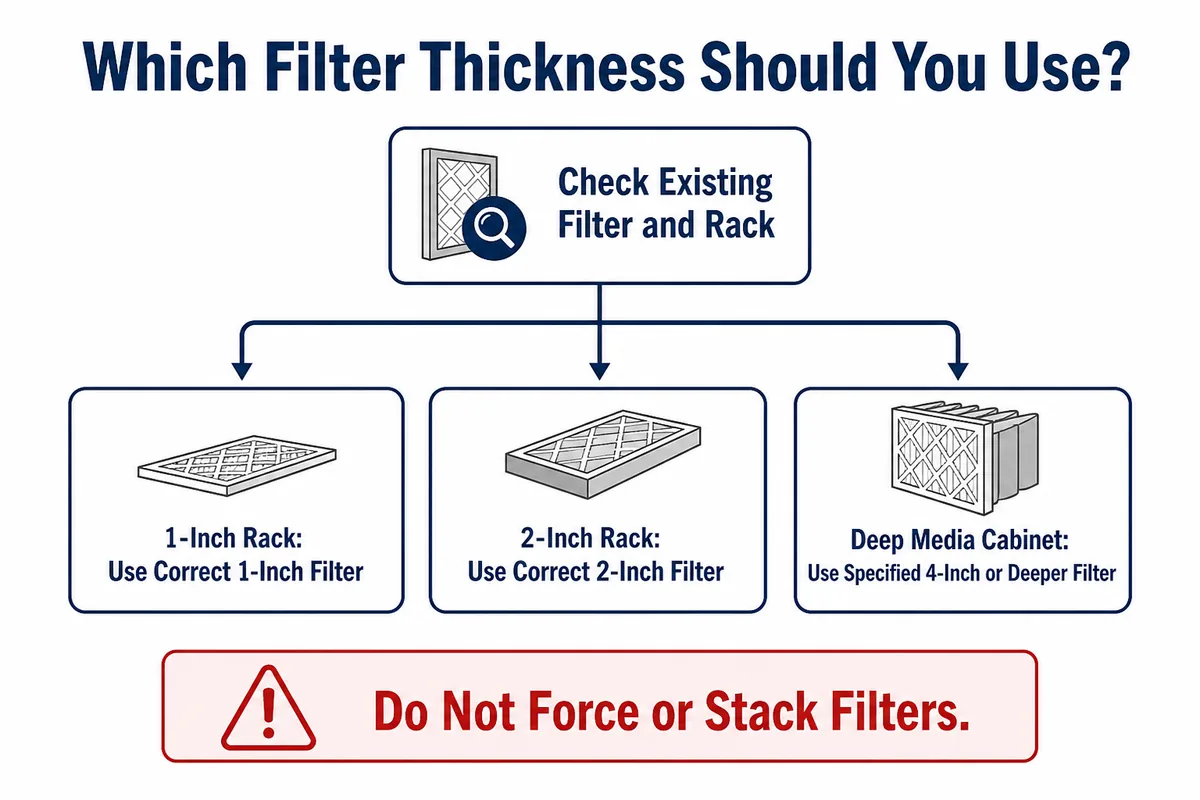
Not unless the filter rack or media cabinet was designed to accept that depth. Slot depth, retaining hardware, access clearance, cabinet doors, and sealing all matter. Never force a deeper filter into a shallow slot or leave a cabinet door open to make it fit.
Using a 1-inch filter in a 4-inch cabinet is not automatically safe either. It may slide inside but fail to sit against the intended sealing surfaces, leaving bypass gaps or allowing the frame to shift. Do not improvise spacers. Follow the cabinet or equipment instructions. The air-filter size substitution guide covers nearby face sizes, temporary questions, and documented alternatives.
A cabinet conversion is not a routine filter swap. If you want a deeper media system, have the existing configuration assessed rather than modifying sheet metal or filter supports yourself.
Can You Stack Filters?
Do not stack multiple filters to imitate a thicker filter. Two filters in one airflow path add resistance. Their frames can shift, gaps can allow bypass, and the rack may not hold them securely.
Some homes intentionally have separate filters on different return branches, which is not the same as stacking. Learn the difference between a return filter and a furnace filter and whether every return vent needs a filter before changing the configuration.
Which Filter Thickness Is Best?
A 1-inch filter may be appropriate when:
- The system is designed for a 1-inch filter.
- Availability and lower upfront cost matter.
- Regular replacement is easy.
- The desired MERV is compatible.
A 2-inch filter may be appropriate when:
- The rack is specifically designed for 2-inch filters.
- More media area is useful.
- A somewhat longer service life is desirable.
A 4-inch or deeper filter may be appropriate when:
- The system has a dedicated media cabinet.
- Longer service intervals are desirable.
- Higher dust-holding capacity is useful.
- The exact product resistance is compatible.
The correct thickness is primarily determined by the existing filter rack or media cabinet. Choose within that compatible format rather than starting with a preferred depth and trying to make it fit.
Safe Homeowner Thickness-Checking Guide
- Turn the HVAC system off at the thermostat.
- Remove the accessible existing filter.
- Read the printed nominal dimensions.
- Record length, width, and thickness.
- Inspect the filter rack or cabinet depth.
- Look for model or filter-size labels.
- Note whether the existing filter fits securely.
- Do not force a deeper filter into the slot.
- Do not stack filters.
- Check equipment documentation when changing filter type.
- Confirm the MERV rating separately from thickness.
- Install the replacement in the correct airflow direction.
Use the detailed guides for measuring all three filter dimensions and pointing the airflow arrow toward the equipment. A filter that whistles, bows, or leaves gaps may be the wrong fit even when two dimensions look correct.
Free homeowner tool
Know your filter size and thickness?
Once you confirm the exact length, width, and thickness, use Filter Wizard for cautious MERV guidance, replacement timing, and retailer options.
Open the Filter FinderUpgrade or Keep Your Current Thickness?
Keep the current thickness
- The rack is designed for it.
- The filter fits securely.
- Airflow is normal.
- The desired MERV is available and supported.
- Replacement frequency is manageable.
Consider professional evaluation
- The correct filter loads extremely quickly.
- Desired filtration creates airflow concerns.
- Documentation supports an alternate cabinet.
- You want a purpose-built deeper media system.
- The current rack is damaged or poorly configured.
Filter Wizard Recommendation
Filter Wizard recommends using the filter thickness the HVAC system or filter cabinet was designed to accept. Do not choose thickness based on the assumption that thicker automatically means better or more restrictive. Confirm the exact physical dimensions, supported MERV rating, filter design, and replacement needs.
A correctly fitted 1-inch filter can be a sound choice. A purpose-built deep media filter can provide more area and capacity. Neither statement establishes compatibility for a particular system. Published filter data and equipment guidance are more useful than depth alone.
If a deeper media filter is desired but the existing rack is not designed for one, have the system evaluated before changing the cabinet. Filter Wizard cannot inspect the physical rack or guarantee a product fit.
Filter Wizard recommendation
Choose after confirming all three dimensions
Enter a confirmed size for cautious MERV guidance, replacement timing, household-condition guidance, and current retailer options.
Open the Filter FinderFree Filter Reminders
Remember Your Next Filter Check
Get occasional filter reminders, homeowner maintenance tips, and buying guidance.
Occasional emails only. Unsubscribe anytime.
You're on the list. We'll send practical filter reminders and updates occasionally.
For smoke events, the smoke filter buying guide explains how depth, media area, loading, and MERV interact.
Frequently Asked Questions
Is a 4-inch air filter better than a 1-inch filter?
Not automatically. A 4-inch filter often provides more media area and dust-holding capacity, but the correct choice must fit the system's rack or media cabinet and meet its airflow requirements.
Does a thicker air filter restrict airflow more?
Not necessarily. Deeper filters may spread airflow across more media area, but resistance depends on the complete product design, MERV rating, airflow rate, and loading.
Do 4-inch filters last longer?
They often can because many contain more media and hold more particles before loading heavily. Actual service life still depends on runtime, pets, dust, smoke, renovations, MERV, and product guidance.
Can I replace a 1-inch filter with a 4-inch filter?
Not unless the rack or media cabinet was designed for that depth. Never force a deeper filter into a shallow slot or modify the cabinet without appropriate evaluation.
Can I use a 1-inch filter in a 4-inch cabinet?
A thinner filter may physically enter some cabinets but may not seat or seal correctly. Follow the cabinet or equipment instructions rather than improvising spacers.
Is a 2-inch filter better than a 1-inch filter?
A 2-inch filter may offer more media area, but it is not universally better. It must fit a dedicated rack, and airflow performance depends on the specific filter.
Does filter thickness affect MERV?
Thickness and MERV are separate characteristics. MERV describes particle-capture efficiency, while thickness describes physical depth. Filters of different depths can share the same MERV rating.
Are 4-inch filters more expensive?
They usually cost more per filter, but they may be replaced less often. Annual cost varies by size, brand, MERV, household conditions, and actual service life.
Can I stack two 1-inch filters?
No. Stacking filters adds resistance and can create sealing, shifting, and bypass problems. Use one correctly specified filter in each intended location.
Why does my furnace use a 4-inch filter?
The system likely has a purpose-built deep media cabinet. This design can provide more pleated media area and dust-holding capacity than many shallow racks.
Do thicker filters improve air quality?
Depth alone does not determine air-cleaning performance. MERV, media design, fit, system runtime, source control, and equipment compatibility all matter.
Are thicker filters better for pets or allergies?
More media area may help a compatible filter handle household loading, but thickness alone is not an allergy or pet recommendation. Choose an appropriate supported MERV and monitor loading.
How do I know which filter thickness I need?
Read the existing filter's three dimensions, inspect the rack or cabinet label, and check equipment documentation. The intended rack depth is the primary guide.
When should I consider a deeper media cabinet?
Consider professional evaluation when a correct shallow filter loads unusually quickly, desired filtration creates airflow concerns, documentation supports another cabinet, or the existing rack is damaged or poorly configured.