Quick Answer
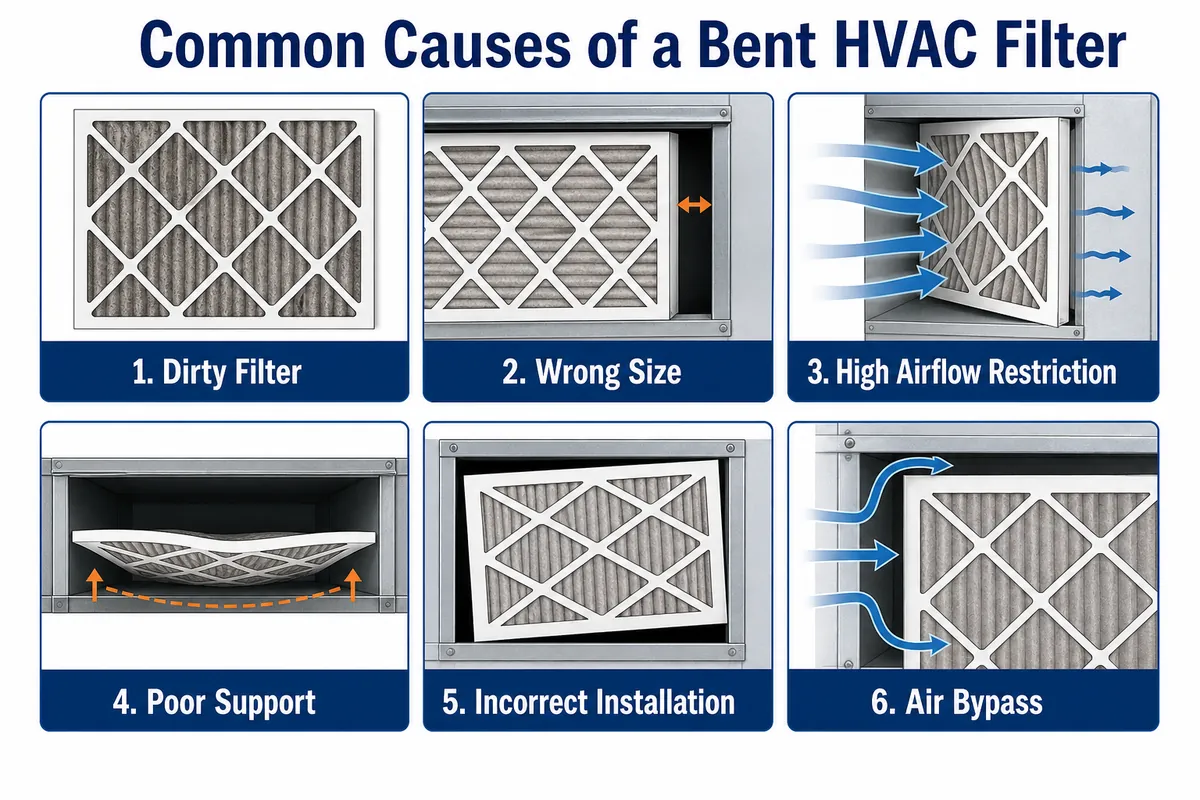
An HVAC filter may bend inward because it is heavily loaded, too restrictive for the airflow, incorrectly sized, poorly supported by the filter rack, installed incorrectly, or exposed to unusually high pressure on the return side. A bent filter should be replaced if damaged, and the underlying airflow or fit issue should be investigated.
Bent filters are not normal maintenance wear. Do not simply flatten a damaged disposable filter and put it back. Confirm its size, direction, condition, and support, then monitor a new filter to see whether the bowing returns. A replacement that stays flat helps confirm that the immediate cause may have been corrected.
Free homeowner tool
Need a correctly sized replacement?
Confirm the physical size first, then use Filter Wizard for cautious MERV guidance, replacement timing, and retailer options.
Open the Filter Finder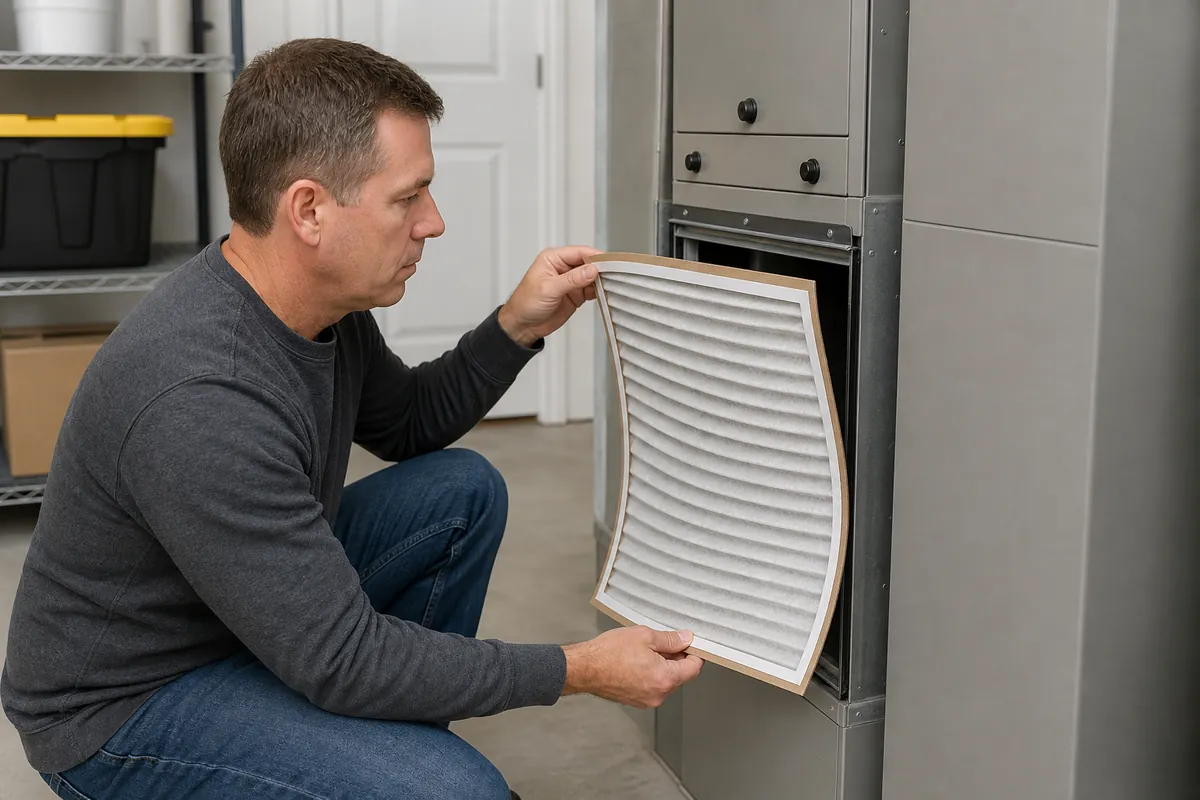
Is a Bent Air Filter Normal?
A slight amount of frame flex while you handle a thin one-inch filter is different from a filter that stays curved after removal. Once installed, the frame should sit evenly in its track and the media should remain supported. It should not pull loose, fold across the middle, rub the blower area, or leave open gaps around its edges.
Filter construction varies. A low-cost cardboard frame may flex more readily than a rigid frame, while a large return-grille filter has a broader span than a small furnace-slot filter. Those differences explain why some filters show deformation sooner, but they do not make repeated bowing normal.
Use the pattern and timeline. A filter that bows only after months of heavy loading presents a different clue from a clean replacement that collapses on its first day. Repeated deformation, a loud whistle, weak airflow, a frozen coil, or a frame pulled out of its track deserves investigation rather than another identical replacement.
If the filter is wet as well as bent, treat moisture as a separate problem. The guide to why an HVAC filter gets wet covers drainage, condensation, thawing coils, and nearby leaks. Moisture can soften cardboard and adhesives enough to make an otherwise supported frame buckle.
1. The Filter Is Dirty or Clogged
A filter catches particles while air moves through its media. As dust and debris accumulate, the open paths through that media can become more restricted. The blower continues pulling return air, so the pressure difference from one side of the filter to the other may increase. A lightly built or poorly supported frame can then bow toward the blower.
Look at actual condition rather than color alone. Even gray loading across deep pleats may be ordinary after service, while a matted surface, packed debris, inward-curving pleats, or weak airflow suggests greater restriction. A black filter needs context because soot and fine particles can darken media before its physical loading is obvious.
Replace a heavily loaded disposable filter rather than vacuuming, washing, shaking, or beating it clean. Then record the date and inspect the new one earlier than usual. If the replacement bows while still clean, dirt was not the whole explanation. Review the signs of a clogged HVAC filter and the factors that explain why a filter gets dirty unusually quickly.
2. The Filter Is Too Restrictive for the System or Conditions
“Too restrictive” does not mean that every high-MERV filter is bad. It means the installed filter, in its current condition, may create more resistance than the system and filter rack can handle comfortably. MERV rating is one part of that relationship, not a complete diagnosis.
Filter construction matters. Two filters with the same MERV can use different media, pleat counts, pleat depth, frame stiffness, and surface area. A properly designed four-inch media filter may offer more surface area than a one-inch filter, but it belongs only in a cabinet designed for that thickness. A dense one-inch filter should not be judged only by the number printed on the package.
Equipment compatibility also matters. Some systems support MERV 13; others have manufacturer or installer limits, small filter areas, return restrictions, or rack designs that make a different choice more appropriate. Do not assume MERV 13 always causes bowing, and do not automatically drop to the lowest rating without understanding household filtration needs.
Thickness is not a shortcut to lower restriction. A deeper filter may offer more media area when the matching cabinet is designed for it, but a four-inch filter cannot substitute for a one-inch filter merely because the nominal length and width match. Forcing any filter into the wrong depth can distort the frame before airflow begins.
Start with the equipment and filter-cabinet guidance if available. Compare the new filter with one that previously fit and performed normally. If you change brands or MERV levels, change one variable at a time and watch the replacement’s shape. The guide MERV 8 vs. MERV 11 vs. MERV 13 explains household tradeoffs and why compatibility should be confirmed before upgrading.
3. The Air Filter Is the Wrong Size
An undersized filter may appear to fit because it enters the opening easily, yet it can lack support along one or more edges. Air can pull the loose frame toward the blower, shift it sideways, or pass around the gap instead of through the media. This air bypass reduces filtration and can produce uneven dirt patterns.
An oversized filter creates a different problem. Forcing it into a slot can crease the cardboard, distort the pleats, or prevent the frame from seating against the rack. A filter that begins bent may continue flexing when the system turns on.
Check all three dimensions: length, width, and thickness. The printed size is usually a nominal shopping size, while the actual dimensions are slightly smaller and vary by manufacturer. A 20 × 25 × 1 label does not mean every brand has identical exact measurements.
For related startup symptoms, see why an HVAC filter moves when the blower starts. Fit should be secure without requiring force. A small amount of installation clearance is normal, but the filter should not rattle freely, fall out of the track, or leave a broad open channel around its frame. Likewise, an access cover should close normally without crushing the filter edge. Different cabinets use different retainers, so there is no universal acceptable gap.
Use the size printed on a properly fitting existing filter when readable. Otherwise, follow How to Find Your Air Filter Size and compare the old filter, rack opening, cabinet label, and equipment documentation. Size-specific pages such as the 20 × 25 × 1 filter guide, 16 × 25 × 1 filter guide, and 20 × 20 × 1 filter guide are useful only after the physical size is confirmed.
4. The Filter Rack Does Not Support the Frame Evenly
A filter rack or return grille should support the frame around the intended edges. Missing rails, a damaged guide, a bent retaining tab, an unusually broad unsupported opening, or a frame resting on only two corners can let the center pull inward.
Support problems can be easy to confuse with sizing problems. A correctly labeled filter may still be wrong for the actual rack, or the rack itself may have been altered or damaged. Compare how the filter sits with the system off. It should not rock, drop through the opening, or rely on tape or improvised objects to stay in place.
Do not add screws, wire, mesh, brackets, or other homemade supports inside HVAC equipment. Those changes can interfere with service access or moving and electrical components. If rails or cabinet hardware are missing or damaged, have a qualified professional evaluate the rack and identify an appropriate repair.
5. The Filter Is Installed Backward or Seated Incorrectly
The printed airflow arrow should point in the direction air moves—usually toward the furnace, blower, or air handler and away from the room-facing return grille. Many disposable filters include downstream support intended to help the media resist airflow in that direction.
Installing a filter backward can place its support differently than intended, but wrong direction alone does not always make a filter bow. A backward filter can remain flat, while a correctly oriented filter can bend because it is dirty, loose, wet, restrictive, or poorly supported.
Orientation and seating are separate checks. A filter can point the correct way but sit diagonally, miss a rail, catch on a cabinet edge, or leave the access cover partially open. Turn the system off before adjusting an accessible filter and use the steps in Which Way Does the Air Filter Arrow Point?. Do not open sealed service panels or reach near electrical or moving components.
6. Return-Side Pressure Is Pulling Hard on the Filter
The blower creates a lower-pressure area on the return side so air moves from rooms, through return ducts and the filter, and into the equipment. Homeowners often describe the resulting force as “suction.” Some pull at the filter is expected; enough pull to repeatedly collapse a correctly sized clean filter is not.
Resistance can come from more than the filter. Blocked return grilles, furniture or rugs over returns, closed or obstructed registers, a dirty filter, a restrictive filter-system combination, or duct and equipment conditions can change airflow. The filter’s bow shows that force is acting on it, but it cannot measure static pressure or diagnose the blower.
Keep accessible return grilles and supply registers unobstructed. Check the entire home rather than closing many supply registers in an attempt to redirect air; systems and balancing needs vary. Note whether the bowing appears during heating, cooling, or continuous-fan operation. That timeline can help a professional without turning it into a homeowner diagnosis.
Do not dismantle ducts, change blower settings, enlarge openings, or make duct modifications based on a bent filter. If a clean, compatible, correctly fitted replacement bows again, a professional can assess airflow, pressure, rack support, and equipment operation with appropriate instruments. Static-pressure readings and blower adjustments require system-specific knowledge and should not be inferred from a photograph.
| What you notice | What it may suggest | Practical response |
|---|---|---|
| Old, heavily loaded filter bows | Added resistance from accumulated debris | Replace and inspect the next filter sooner |
| Clean filter shifts or leaves gaps | Wrong size, poor seating, or weak edge support | Confirm dimensions and rack contact |
| New filter bends within days | Restriction, support, fit, or airflow issue remains | Recheck installation; call if it repeats |
| Bowing with whistling | Air moving through a gap or restricted area | Inspect fit and damage with system off |
| Wet cardboard bends | Moisture weakened the frame | Replace and correct the water source |
| Bowing with frozen coil or weak airflow | Broader HVAC problem may be present | Turn off cooling if iced and request service |
Why Does My Air Filter Whistle?
A whistle usually forms when air accelerates through a narrow opening. At a filter, that opening may be a gap along an undersized frame, a torn corner, a warped access cover, a loose return grille, or a small remaining pathway through heavily loaded media. Vibration can add a fluttering or humming sound.
Listen for when the sound starts and stops. A whistle that begins only when the blower runs points to moving air. If gently pressing the closed grille or access cover changes the sound, a loose fit may be involved—but keep hands away from internal equipment and do not operate the system with a panel removed.
Noise is useful evidence, not a diagnosis. Severe or recurring whistling after a correctly sized clean filter is installed deserves professional attention. A future dedicated whistling guide may cover grille, filter, and return-noise patterns in more depth; this article focuses on whistling that accompanies deformation.
Can You Keep Using a Bent Filter?
Generally, replace a disposable filter when its frame has collapsed, pleats are crushed or pulled loose, cardboard is torn, the filter no longer stays seated, or air is visibly bypassing the media. A damaged filter cannot be assumed to provide its intended fit or filtration.
Do not flatten the frame and reinstall it. Bending it back may hide the visible curve without restoring the frame joints, adhesive, support grid, or pleat spacing. Do not tape damaged media, add makeshift braces, or run without a filter unless an HVAC professional or equipment documentation specifically directs a temporary procedure.
Disposable pleated and fiberglass filters should be replaced rather than vacuumed or washed. Only filters explicitly labeled washable or reusable should be cleaned as directed and reinstalled completely dry. The guide Can You Vacuum and Reuse an Air Filter? explains the difference.
After replacing it, use actual condition alongside the schedule in How Often Should You Change Your Air Filter?. A new filter is also a diagnostic reference: date it, photograph it flat, and compare its shape after several cycles and again over the next few days.
Safe Inspection Checklist for a Bowed Filter
- Turn the HVAC system off at the thermostat. Wait for the blower to stop before opening an accessible filter grille or cover.
- Photograph the filter in place. Capture the direction of the curve, edge gaps, printed size, and airflow arrow.
- Remove the filter carefully. Do not force it past wiring, internal parts, or a sealed service panel.
- Inspect the frame and media. Look for tears, crushed corners, loose pleats, moisture, deep dirt loading, and permanent curvature.
- Confirm all three dimensions. Compare the printed nominal size and actual fit; do not use only length and width.
- Confirm the airflow arrow. It should point toward the furnace, blower, or air handler.
- Inspect accessible rack support. Check whether the frame rests evenly on intact rails without modifying hardware.
- Check visible returns and registers. Move ordinary household objects blocking them; do not alter ducts or equipment settings.
- Install one new correctly sized filter. Use an appropriate MERV and do not force the frame into place.
- Monitor the replacement. Note noise and airflow, then recheck the filter after several cycles and within a few days.
If cooling airflow is weak or ice is visible, turn cooling off and review how restricted airflow can contribute to a frozen AC coil. Do not chip or heat ice. A technician should evaluate repeated icing or airflow problems.
Replace and Monitor—or Investigate Further?
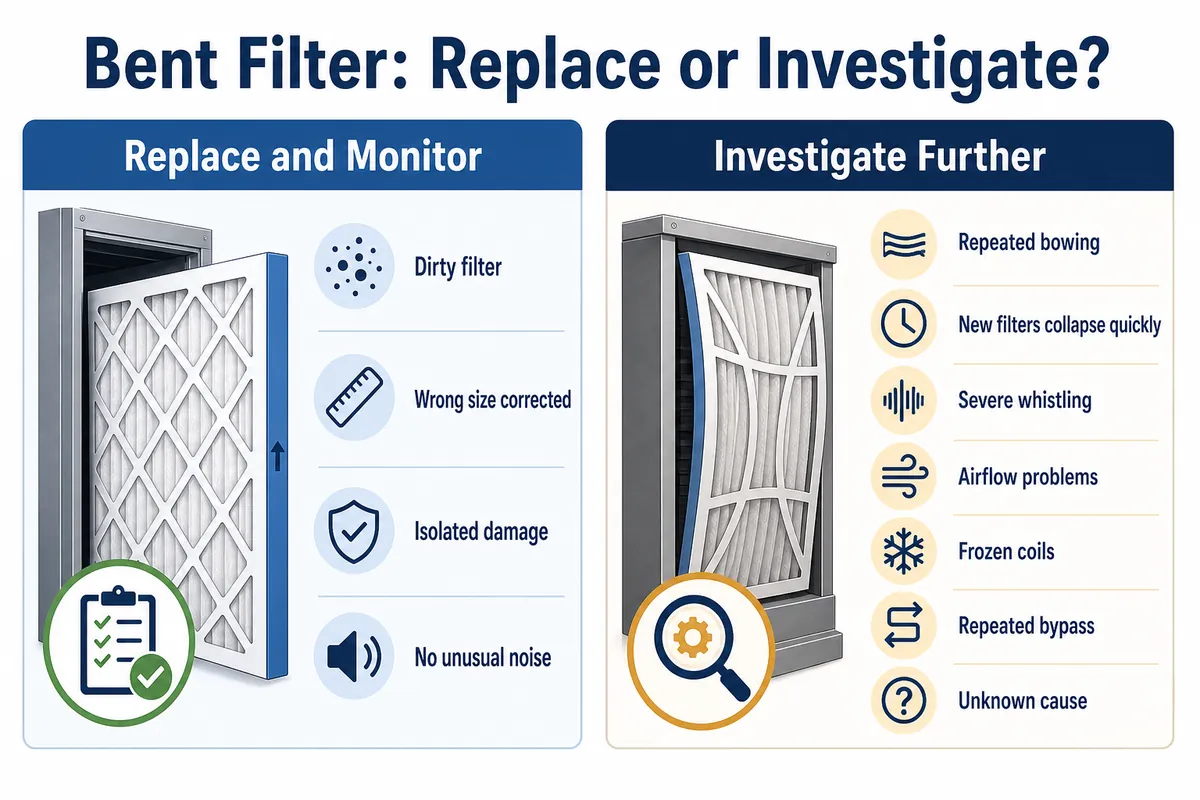
Replacing and monitoring may be reasonable when the old filter was clearly dirty, a wrong size has been corrected, the damage appears isolated, the rack supports the new filter evenly, airflow seems normal, and no unusual noise occurs. Check the replacement soon; a flat new filter is the evidence that the immediate correction may have worked.
Call an HVAC professional when bowing repeats, a new filter collapses quickly, whistling is severe, airflow remains weak, the evaporator coil freezes, edge bypass continues with the confirmed size, rack hardware is damaged, or the cause remains unknown. Describe the exact filter model, MERV, thickness, installation date, noise, and deformation timeline rather than asking for one assumed repair.
Bring photographs of the old filter while it was installed and the replacement before use. Note whether household returns were blocked, whether the problem began after changing filter type, and whether it occurs in one operating mode. These observations help narrow the inspection without presuming a duct, blower, or pressure repair.
Filter Wizard Recommendation
- Replace a damaged, collapsed, torn, wet, or heavily loaded disposable filter.
- Confirm the exact nominal size, actual fit, and thickness before shopping.
- Point the airflow arrow toward the furnace, blower, or air handler.
- Choose a MERV level appropriate for household needs and equipment guidance.
- Confirm the rack supports the frame evenly without improvised modifications.
- Date and photograph the replacement while it is flat.
- Monitor it after several operating cycles and again within a few days.
- Request professional evaluation if bowing, noise, bypass, weak airflow, or icing returns.
Filter Wizard can help you compare a cautious MERV starting point, replacement timing, household conditions, and current retailer options after you confirm the physical size. It cannot measure pressure, diagnose a blower, inspect the rack, or guarantee compatibility.
Filter Wizard recommendation
Confirm the fit before choosing a replacement
Enter a valid three-dimensional size to receive MERV guidance, replacement timing, and retailer options through the existing Filter Finder.
Open the Filter FinderFree Filter Reminders
Remember Your Next Filter Check
Get occasional filter reminders, homeowner maintenance tips, and buying guidance.
Occasional emails only. Unsubscribe anytime.
You're on the list. We'll send practical filter reminders and updates occasionally.
Frequently Asked Questions
Why is my air filter bending?
An HVAC filter may bend inward because it is heavily loaded, too restrictive for the available airflow, incorrectly sized, poorly supported, improperly seated, or exposed to unusually high return-side pressure. The pattern is a symptom rather than proof of one cause.
Why is my filter getting sucked inward?
The blower pulls return air through the filter. If resistance is high or the frame lacks adequate fit and support, the pressure difference across the filter can pull it toward the blower. Replace a damaged filter and investigate fit, loading, returns, and recurrence.
Can a dirty filter bend?
Yes. As dust loads the media, airflow resistance can increase. Some lightly constructed or poorly supported filters may bow under that added pressure, although dirt is not the only possible cause.
Is my MERV rating too high if the filter bends?
Not necessarily. MERV is only one factor. Filter construction, thickness, pleat design, actual condition, system compatibility, rack support, return restrictions, and airflow all matter. Do not assume MERV 13 is always the cause.
Can the wrong air filter size cause bending?
Yes. An undersized filter may shift, leave bypass gaps, or lack edge support. An oversized filter forced into a slot may start deformed. Confirm nominal and actual dimensions using a properly fitting reference.
Why does my air filter whistle?
Whistling often comes from air accelerating through a small gap, around a loose frame, or across a damaged or heavily restricted filter. The sound helps identify a leak or restriction but does not diagnose the blower.
Should I keep using a bent air filter?
Generally not when the frame has collapsed, the pleats are damaged, the filter is bypassing air, or the cardboard is torn. Replace the disposable filter and correct the likely fit or airflow issue.
Can I flatten a bent filter and put it back?
Do not flatten and reinstall a damaged disposable filter. Its frame, media, adhesive, or pleats may no longer hold their intended shape. Install a new correctly sized filter instead.
Does airflow direction matter when a filter bends?
Yes, because many filters are designed with downstream support, but backward installation alone does not always cause bowing. Follow the printed airflow arrow and seat the filter correctly.
Can a wet air filter bend or collapse?
Yes. Moisture can soften a cardboard frame, deform media, and weaken adhesives. Replace a wet disposable filter and correct the moisture source before installing another.
Should I replace a bent filter immediately?
Replace it promptly if it is collapsed, torn, wet, heavily loaded, no longer seated, or allowing bypass. If the bow is slight, still inspect the fit and monitor a new filter rather than reusing the damaged one.
Why does a new air filter bend within days?
Rapid bowing can point to wrong sizing, weak support, improper seating, a very restrictive filter-system combination, blocked returns, or another airflow issue. Repeated quick deformation deserves professional evaluation.
Can blower suction bend an air filter?
Return-side pressure created by blower operation is what moves air through the filter. A filter may bow when that pressure acts on loaded, restrictive, poorly fitted, weak, or unsupported media. The filter alone cannot diagnose blower performance.
Can poor filter-rack support cause bowing?
Yes. Missing or damaged rails, an oversized unsupported span, or a frame that does not rest evenly can let the filter flex. Have a qualified professional evaluate damaged rack hardware rather than modifying the cabinet yourself.
When should I call an HVAC professional about a bending filter?
Call when replacement filters bow repeatedly, new filters collapse quickly, whistling is severe, airflow is weak, a coil freezes, bypass continues after the correct size is installed, the rack is damaged, or the cause remains unknown.
When the frame remains flat but the media loads unevenly, use the guide to uneven dirt on an HVAC filter to check airflow patterns, fit, and possible bypass. For noise without visible deformation, review why an air filter may whistle.