Quick Answer
An HVAC filter may whistle because it is loose, incorrectly sized, heavily loaded, bent, vibrating in the rack, or allowing air to bypass around its edges. A newly installed filter may also create more noise if its design or resistance differs from the previous filter.
Confirm the exact size, seating, airflow direction, condition, and supported MERV rating before assuming there is a larger HVAC problem. The sound may come from the return grille, filter rack, or nearby ductwork rather than the filter itself.
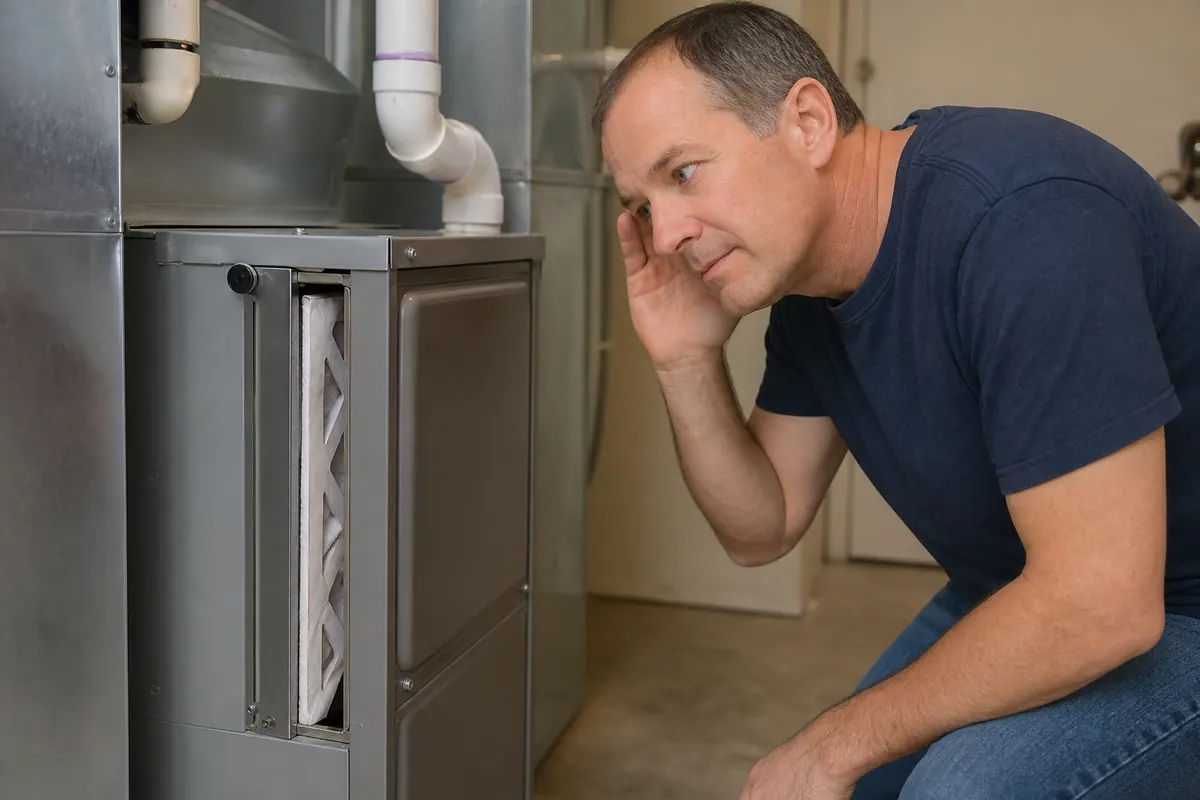
Is a Whistling Air Filter Normal?
A brief change in sound as the blower starts does not always indicate a problem. Airflow rises quickly, a filter may settle against its support, and a grille can produce a short tone. A persistent high-pitched whistle throughout the cycle deserves inspection.
The sound location can be deceptive. Return ductwork carries noise, so a whistle heard at the filter may begin at a grille, narrow rack gap, loose cover, or nearby duct seam. The filter itself has no moving parts; it makes noise only when moving air creates vibration or turbulence around it.
A steady whistle is not a normal feature to ignore. Start with safe, accessible checks instead of diagnosing the blower from sound alone.
Air Filter Whistling Causes at a Glance
| Possible cause | Common clue | What to check | Next step |
|---|---|---|---|
| Gap around filter frame | Clear high tone near one edge | Visible edge spaces | Reseat correct size |
| Incorrect filter size | Frame shifts or does not sit square | All three dimensions | Install confirmed size |
| Loose or vibrating filter | Noise begins at blower startup | Movement in accessible rack | Use existing retainer |
| Heavily loaded filter | Gray media and weaker airflow | Condition and change date | Replace disposable filter |
| More restrictive replacement | Noise began after a filter change | Design, MERV, thickness | Check system guidance |
| Bent or bowed filter | Distorted edge or new gap | Frame and support | Replace; monitor recurrence |
| Return grille restriction | Sound strongest at grille | Dust and nearby objects | Clear accessible blockage |
| Damaged or unsupported rack | Correct filter will not stay seated | Visible rails and retainers | Arrange evaluation |
| Nearby ductwork noise | Sound travels or changes by location | Accessible grille and seams | Service if persistent |
| Whistle after every replacement | Multiple correct filters sound alike | Rack, return path, airflow | Professional evaluation |
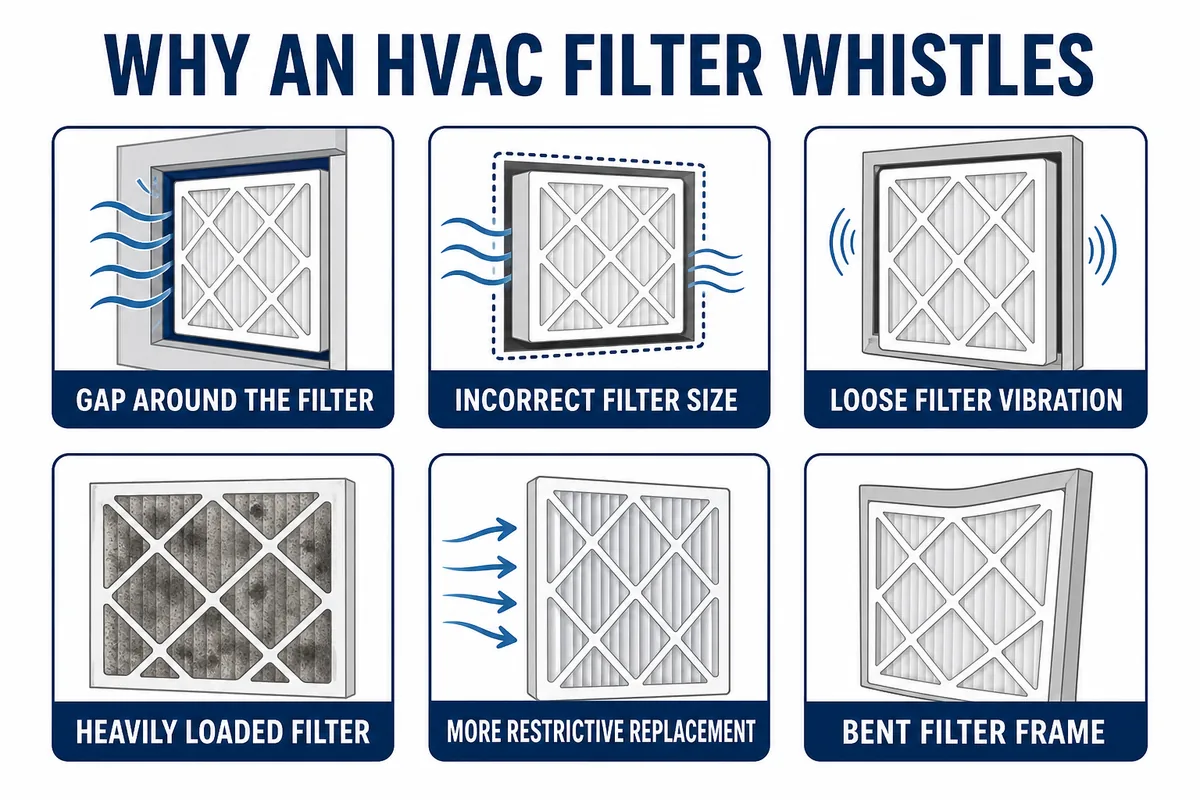
Air Bypass Around the Filter
Moving air can whistle when it squeezes through a narrow opening. An undersized filter, tilted frame, damaged edge, or poorly seated replacement may leave a small channel between the frame and rack. Dust may then miss part of the media, reducing effective filtration.
Look for obvious gaps and clean strips beside them. The guide to uneven dirt on one side of a filter explains why a clean edge can be a bypass clue without proving a duct problem. Correct the physical fit using the intended filter size and existing rack or retainer. Do not permanently tape a filter into equipment or cover permanent openings.
Incorrect Filter Size or Poor Fit
Nominal size is the shopping label, while actual dimensions are usually slightly smaller and vary by brand. Two filters labeled 20 × 25 × 1 may not fit identically. An undersized replacement can move or leave gaps; an oversized one may bend when forced.
The printed size on a properly fitting old filter is usually the best buying reference. If it is unreadable, measure length, width, and thickness, then compare with common nominal sizes. The complete guide to finding an HVAC filter size explains nominal and actual measurements. Confirm physical fit before using a size page such as the 20 × 25 × 1 guide, 16 × 25 × 1 guide, or 20 × 20 × 1 guide.
A filter should sit flat and secure without being crushed, trimmed, or forced. If a brand change starts the whistle, compare the exact actual dimensions and frame construction with the old filter.
Loose Filter Vibration
Some filters rattle, flutter, or hum rather than produce a pure whistle. The blower can pull a loose frame against the rack when it starts, and flexible media may change the pitch as airflow builds. Missing retainers, bent tracks, or a large unsupported span can contribute.
Turn the system off before touching the accessible filter. It should remain seated with the rack's normal support and should not require force. Do not fabricate clips or reach into sealed equipment. If the correct filter repeatedly moves, have the support arrangement evaluated.
Dirty or Clogged Filter
As a disposable filter loads with dust, its resistance increases. Air may then move faster through any available edge gap, and a loaded frame may bow or vibrate. Weak airflow, visible heavy loading, and a whistle that developed gradually all support checking condition.
Replace a heavily loaded disposable filter. Do not vacuum it and put it back; vacuuming does not restore the media and can damage it. Review the signs of a clogged HVAC filter, why disposable filters should not be vacuumed and reused, and how often to check and change a filter.
Is the MERV Rating Too High?
A more efficient filter can create more resistance, depending on its design. MERV alone does not determine pressure drop. Thickness, media area, pleat design, brand, loading, and the HVAC system's supported airflow all matter. The airflow pillar explains whether an air filter can be too restrictive without treating MERV as the only factor.
A whistle that begins after switching filters is useful evidence, but it is not proof that the new MERV rating is unsuitable. First confirm size, seating, direction, and condition. Compare MERV 8, MERV 11, and MERV 13, then follow equipment or filter-cabinet guidance. Do not automatically downgrade filtration without considering both system support and household needs.
Bent or Bowed Filters
A distorted frame can open a narrow gap that whistles or can vibrate against a track. Replace a damaged disposable filter rather than flattening and reinstalling it. A single bent filter may have been mishandled, but repeated deformation needs more investigation.
The guide to why an air filter bends or bows inward covers loading, wrong size, support, installation, and airflow restriction. Repeated bowing with a correct clean filter can justify evaluation of the rack and return side.
Return Grille, Filter Rack, or Support Noise
A whistling return vent may be the actual source. Dust buildup on a grille, a partially blocked return, furniture, rugs, boxes, or another object can change airflow across the opening. Keep return grilles clear. Do not remove permanent grille parts without understanding their purpose.
Bent tracks, missing retainers, loose access covers, cabinet gaps, or large unsupported filter spans can also create noise. Check only visible, accessible parts. If the rack is damaged or an intact correct filter cannot stay seated, arrange professional evaluation rather than attempting sheet-metal repair. Before adding media to an empty grille, confirm whether every return vent is designed to have a filter and whether two filters share the same airflow path.
Could the Noise Come From the Duct or Blower?
Yes. Sound can travel through return ductwork. A seam, grille, transition, cabinet cover, or blower operation may create a tone that seems to originate at the filter. A filter change can also make an existing sound more noticeable without being its only cause.
Do not diagnose blower failure from the whistle. If multiple clean, correctly sized and supported filters produce the same sound, or the noise is accompanied by severe vibration or weak airflow, service is reasonable. Never operate the system without a filter as a test.
Can You Keep Using a Whistling Filter?
Replace the filter when it is dirty, bent, torn, wet, collapsing, incorrectly sized, moving in the rack, or leaving obvious gaps. A clean correct filter that sits securely and produces only a brief startup sound can be monitored, but a persistent whistle should not be treated as normal.
Professional evaluation may be appropriate when a clean correct filter still whistles, airflow is weak, the filter repeatedly deforms, the sound becomes severe, the rack is damaged, frozen coils recur, or the source cannot be located safely. A dirty filter can contribute to restricted airflow and, with other conditions, an AC coil freezing, but a whistle alone cannot diagnose that problem.
Safe Homeowner Inspection Checklist
- Turn the system off at the thermostat and wait for the blower to stop.
- Photograph the filter in place before moving it.
- Confirm the printed length, width, and thickness.
- Check whether the filter sits flat and secure without force.
- Look for visible gaps around the frame.
- Check for bending, tears, moisture, or heavy loading.
- Confirm the airflow arrow points toward the furnace, blower, or air handler. See the air-filter arrow direction guide.
- Inspect the accessible return grille for dust or blockage.
- Install a clean, dry, correctly sized replacement if needed.
- Restart the system and listen from a safe position.
- Note whether the noise happens only at startup or continues.
- Arrange service if the whistle persists with the correct replacement.
Do not open blower or electrical compartments, alter ducts, trim a filter, or run the system without filtration.
Free homeowner tool
Need help confirming the replacement size and MERV?
Confirm the physical size first, then use Filter Wizard for cautious MERV guidance, replacement timing, and current retailer options.
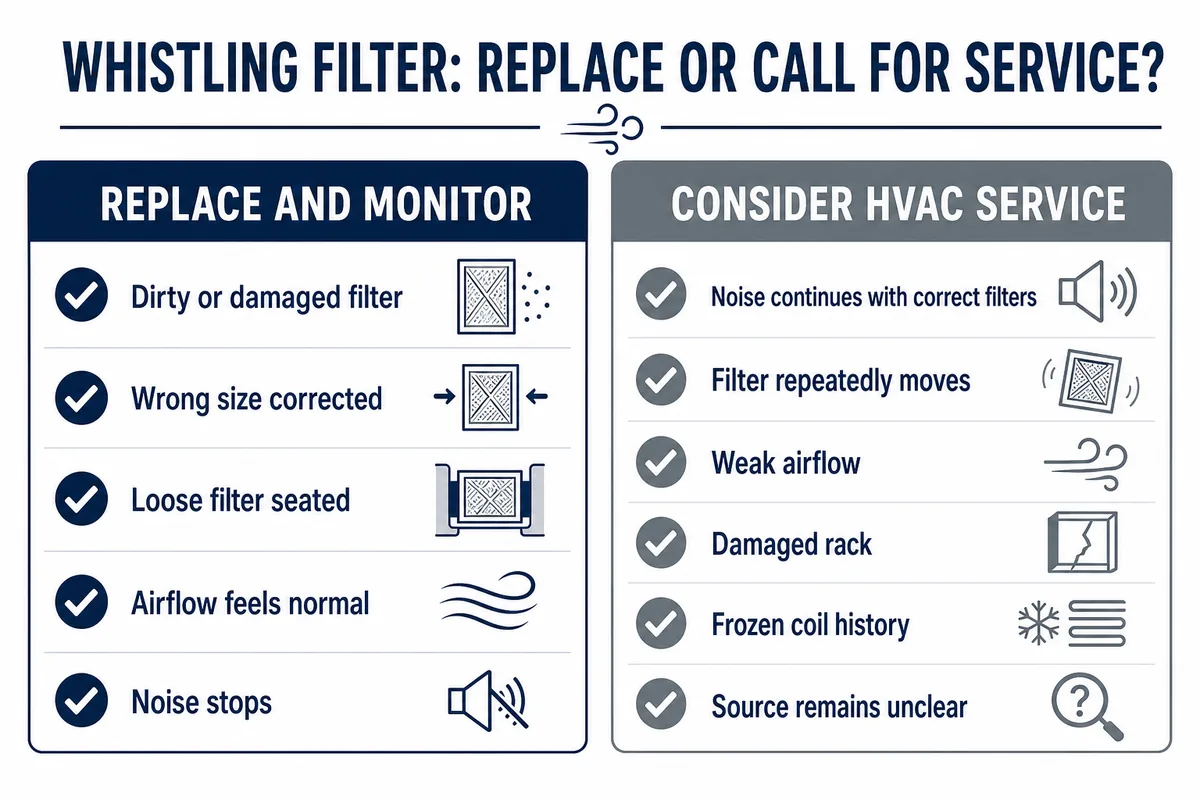
Open the Filter FinderReplace and Monitor or Call for Service?
Replace and monitor
- The current filter is dirty or damaged.
- An incorrect size has been corrected.
- A loose filter now sits securely.
- The whistle stops with the correct replacement.
- Airflow feels normal, with no bending, water, or ice.
Consider HVAC evaluation
- Whistling continues with multiple correct clean filters.
- The filter repeatedly moves or bends.
- Airflow is noticeably weak.
- The rack or return opening is damaged.
- Frozen coils recur or severe vibration develops.
- The source cannot be located safely.
Filter Wizard Recommendation
Filter Wizard recommends checking the filter's exact size, fit, condition, airflow direction, and MERV rating before assuming the HVAC equipment is failing. Replace dirty, bent, wet, torn, or loose disposable filters. If a correctly sized clean replacement still whistles, or the filter repeatedly moves or deforms, have the return side and filter rack evaluated.
Filter Wizard recommendation
Confirm the replacement before ordering
Enter a valid three-dimensional size for cautious MERV guidance, replacement timing, household-condition guidance, and retailer options.
Open the Filter FinderFree Filter Reminders
Remember Your Next Filter Check
Get occasional filter reminders, homeowner maintenance tips, and buying guidance.
Occasional emails only. Unsubscribe anytime.
You're on the list. We'll send practical filter reminders and updates occasionally.
Frequently Asked Questions
Why does my air filter whistle?
Air may be squeezing through a narrow gap, moving a loose filter, passing through heavily loaded media, or meeting more resistance than before. The sound can also come from the grille, rack, or nearby ductwork.
Is a whistling HVAC filter dangerous?
A whistle is not automatically dangerous, but persistent noise deserves inspection. Turn the system off and replace a filter that is dirty, wet, torn, bent, collapsing, or incorrectly sized.
Can the wrong filter size cause whistling?
Yes. An undersized filter may leave gaps or move, while an oversized filter may bend when forced. Confirm length, width, thickness, and actual fit.
Can a dirty filter make a whistling noise?
Yes. Loaded media adds resistance and may make air move faster through available gaps. Replace a heavily loaded disposable filter rather than vacuuming and reinstalling it.
Can a high-MERV filter whistle?
A more efficient replacement may change airflow resistance, but MERV alone does not prove the cause. Media area, thickness, design, loading, fit, and system guidance also matter.
Why did the noise start after changing the filter?
The new filter may fit differently, sit loosely, have a different construction, or add more resistance than the previous filter. Recheck its exact size, seating, arrow direction, and rating.
Can air bypass around the filter make noise?
Yes. Air squeezing through a narrow edge gap can whistle. Use the correct filter size and the rack's existing retainer rather than permanently taping the filter in place.
Why does my filter whistle only when the blower starts?
Startup airflow may pull a loose filter against its rack or expose a narrow gap. A brief sound can be less concerning than a whistle that continues throughout the cycle.
Can a bent filter whistle?
Yes. A bent frame can open a narrow gap or vibrate. Replace a damaged disposable filter and investigate when correctly sized replacements repeatedly deform.
Can I keep using a whistling filter?
Do not keep using it if it is dirty, wet, torn, bent, collapsing, moving, or leaving obvious gaps. Persistent noise with a clean correct filter may need professional evaluation.
Should I use tape to stop the whistle?
Do not permanently tape a filter into the equipment or cover permanent openings. Use the correct size and existing rack or retainer; have damaged support hardware evaluated.
Does the airflow arrow affect the noise?
Incorrect direction can affect support and seating on some filters. Point the arrow toward the furnace, blower, or air handler and away from the return grille.
Why does the return vent whistle with a new filter?
The new filter may change resistance or fit, but the sound may come from the grille, a blocked return, the rack, or nearby ductwork. Confirm the filter before blaming one component.
When should I call an HVAC professional?
Arrange service when whistling continues with multiple correct clean filters, airflow is weak, filters repeatedly move or bend, the rack is damaged, coils freeze again, or the source cannot be located safely.