Quick Answer
For many homes, MERV 11 can offer a useful balance between particle filtration and airflow. MERV 8 is often sufficient for basic dust and pollen control, while MERV 13 may be useful for smoke-related particles, finer particles, or stronger filtration needs when the HVAC system is designed to handle it.
This is a starting point, not a universal prescription. The correct choice depends on the equipment guidance, filter size and construction, household conditions, and current airflow. If the existing filter works well and the system documentation specifies a maximum rating, follow that information before upgrading.
Free homeowner tool
Want a household-based starting point?
Confirm the physical filter size first, then use Filter Wizard for cautious MERV guidance, replacement timing, and current retailer options.
Open the Filter Finder
MERV 8 vs MERV 11 vs MERV 13 at a Glance
The table uses relative descriptions because pressure drop, price, and real-world performance vary by brand, filter depth, pleat design, media area, and system. It should help narrow the decision, not replace equipment guidance.
| Consideration | MERV 8 | MERV 11 | MERV 13 |
|---|---|---|---|
| General household dust | Basic capture | Stronger capture | Stronger capture |
| Pollen and mold spores | Useful for many larger particles | Greater share of smaller particles | Greater share of finer particles |
| Pet-related particles | Basic starting point | Common middle-ground option | Finer-particle option when supported |
| Fine particles | More limited | Moderate | Stronger |
| Smoke-related particles | More limited | Some improved capture | Often the strongest of these three |
| Relative airflow resistance | Often lower | Often moderate | Potentially higher |
| Typical price level | Often lower | Often midrange | Often higher |
| Common household use | Basic everyday filtration | Stronger everyday filtration | Higher filtration needs |
| Compatibility check | Confirm size and equipment guidance | Confirm system support | Compatibility is especially important |
A particulate filter does not remove every gas, odor, chemical, or indoor-air contaminant. It also does not guarantee a health outcome. Treat MERV as one piece of a broader ventilation and maintenance decision.
What Does MERV Mean?
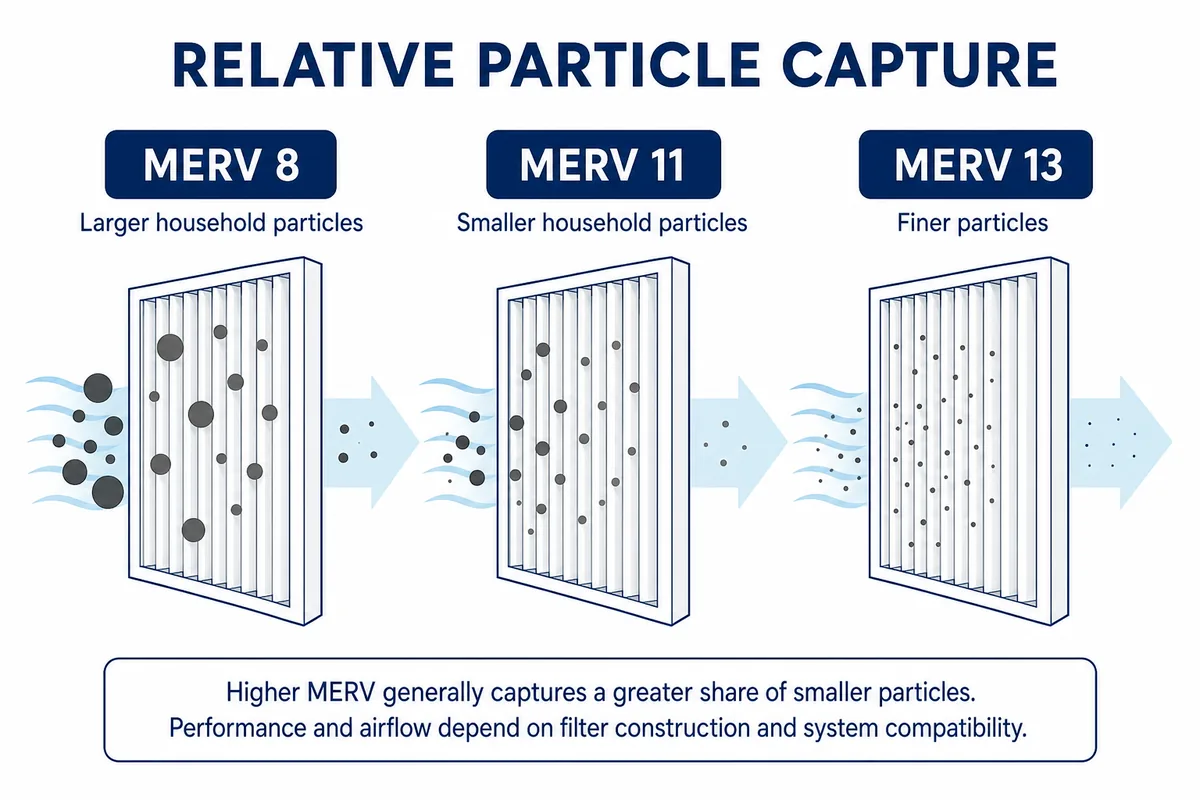
MERV stands for Minimum Efficiency Reporting Value. It is a performance rating used to describe how effectively a filter captures particles across defined size ranges. In general, a higher MERV value means the filter captures a greater share of smaller particles under the rating test.
MERV is not a complete quality score. It does not tell you how well the frame fits, how much media surface area the filter has, how long it will last in your home, or whether your blower can handle its resistance. It also does not directly measure energy savings, odor removal, or compatibility with a particular furnace or air handler. True HEPA uses a different performance framework; read whether a furnace can use a true HEPA filter before treating HEPA as another MERV option.
Two filters with the same MERV rating can have different pressure-drop characteristics because their thickness, pleat count, media, and construction differ. A four-inch media filter may provide more surface area than a one-inch filter, but that does not mean a thicker filter can be installed in a rack designed for one inch. Compare air filter thickness differences, and always use the correct dimensions from a properly fitting filter; see how to find your air filter size if the label is unclear.
If a filter package uses an MPR or FPR label instead, compare how MERV, MPR, and FPR ratings differ before treating the numbers as interchangeable.
MERV 8 Explained
MERV 8 is a common basic pleated-filter category. It can capture many larger household particles such as visible dust, lint, and pollen while often presenting less resistance than higher-efficiency options of otherwise similar construction. That makes it a practical starting point when maintaining airflow is the main concern.
Its tradeoff is less effective capture of finer particles compared with MERV 11 or MERV 13. Homes dealing with persistent fine dust, smoke-related particles, or a desire for stronger filtration may prefer a higher rating if the system supports it. A clean, properly fitted MERV 8 filter is still more useful than a higher-rated filter that is the wrong size, heavily loaded, or incompatible.
Choose MERV 8 if:
- The household has no unusual filtration priorities.
- The current HVAC documentation or properly fitted filter specifies MERV 8.
- Maintaining relatively low airflow resistance is a priority.
- You want an affordable basic pleated filter and will inspect it regularly.
- An older or airflow-sensitive system has not been approved for a higher rating.
Do not assume all MERV 8 filters behave identically. Compare actual dimensions, construction, and manufacturer pressure-drop information when it is available.
MERV 11 Explained
MERV 11 generally captures a greater share of smaller household particles than MERV 8. It is often considered a middle-ground option for homeowners who want stronger filtration without immediately moving to MERV 13. Homes with pets, recurring dust, or moderate pollen concerns may find that balance useful.
The upgrade is not free of tradeoffs. MERV 11 may cost more and may create more resistance than a comparable MERV 8 filter. The actual difference depends on the product and system. If airflow is already weak or the existing filter bows inward, changing ratings without understanding the cause is not a good experiment.
Choose MERV 11 if:
- The household has pets or wants stronger everyday particle capture.
- MERV 8 does not meet the household’s reasonable filtration goals.
- The equipment documentation supports MERV 11.
- You want a middle ground between basic filtration and finer-particle capture.
- You can inspect the filter and monitor airflow after changing ratings.
MERV 11 is not universally “best.” It is simply a reasonable candidate for many households when it fits both the filtration need and the equipment.
MERV 13 Explained
MERV 13 provides stronger capture of finer particles than MERV 8 or MERV 11 under the rating framework. It may be useful when wildfire smoke or other fine particle exposure is a concern, or when a household wants higher-efficiency filtration and the HVAC system is designed to support it.
Compatibility deserves more attention at this level. Some systems can use an appropriately designed MERV 13 filter without a problem; others may experience excessive resistance, especially with a restrictive one-inch filter, an undersized rack, weak existing airflow, or a filter allowed to become heavily loaded. The rating number alone cannot settle that question.
MERV 13 does not remove every smoke component, gas, odor, chemical, microorganism, or health risk. Standard HVAC filters address airborne particles passing through the system. They are not a substitute for source control, ventilation guidance, or professional advice for serious indoor-air concerns.
Choose MERV 13 if:
- Finer-particle filtration is a clear priority.
- Smoke-related particle exposure is a recurring concern.
- The equipment manufacturer or system documentation supports it.
- The filter cabinet and blower provide adequate airflow capacity.
- A knowledgeable HVAC professional has recommended it for the installation.
Inspect a MERV 13 filter regularly. As dust accumulates, restriction generally rises, so replacement timing remains important even when the filter began as a compatible choice.
MERV 8 vs MERV 11: Which Should You Choose?
Choosing specifically for cats or dogs? The best air filter for pets guide adds filter type, hair, smaller pet-related particles, and replacement timing. For broader household sources, the dust-focused HVAC filter guide compares surface dust, airborne material, media, depth, and loading.
Between MERV 8 and MERV 11, MERV 11 generally captures a greater share of smaller particles. MERV 8 often costs less and may offer lower resistance when comparing otherwise similar one-inch filters. For an average home that only needs basic dust and pollen control, MERV 8 may be enough.
MERV 11 may make sense when pets, recurring household dust, or stronger everyday filtration are priorities. Before upgrading, confirm that the system supports the rating and that the replacement has the correct physical dimensions. Monitor airflow after the change rather than assuming a higher number must be an improvement in every respect.
Conditional verdict: choose MERV 8 for basic filtration and lower-resistance priorities; consider MERV 11 for stronger everyday capture when the system supports it.
MERV 11 vs MERV 13: Is the Upgrade Worth It?
The improvement can be meaningful when finer-particle capture is the goal. MERV 13 generally performs better for smaller particles, including fine smoke-related particles, while MERV 11 remains a capable middle-ground option for many pet and dust concerns.
Whether MERV 13 is worth it depends on more than filtration. Consider the product’s pressure drop, depth, price, replacement availability, and system support. A well-designed deeper MERV 13 filter may have different airflow behavior than a one-inch version, and two brands at the same rating may not perform identically. For the narrower pollen and allergy-focused choice, compare MERV 11 versus MERV 13 directly.
Conditional verdict: MERV 11 is often the practical everyday choice. MERV 13 is the stronger fine-particle choice when the system is compatible and the added filtration meets a real household need.
Is MERV 13 Too Restrictive?
Sometimes—but not because every MERV 13 filter behaves the same. Total pressure drop depends on filter construction, media surface area, thickness, face area, airflow rate, loading, and the system’s duct and blower design. MERV is an efficiency rating, not a complete resistance specification.
A deeper pleated media filter can sometimes provide more surface area and lower resistance than a thin filter with similar efficiency. That benefit applies only when the system has the correct cabinet. Never stack one-inch filters, trim a frame, or force a deeper filter into a slot that was not designed for it.
A dirty filter also creates more restriction than a clean one. A compatible MERV 13 filter can become a problem if it is neglected, just as a heavily clogged MERV 8 filter can. Check the signs of a clogged HVAC filter and replace the filter before it becomes heavily loaded.
Professional inspection may be appropriate if you notice persistent weak airflow, unusually long heating or cooling cycles, repeated coil icing, unusual blower noise, or filters bowing or being pulled inward. Those symptoms do not prove the filter rating is the cause. Read the frozen AC coil guide for other possibilities and safe next steps.
Which MERV Rating Is Best for Different Households?
Average household
A reasonable starting point is MERV 8 or MERV 11, depending on equipment guidance and the desired level of everyday particle capture. There is no need to choose MERV 13 merely because it is available.
Homes with pets
MERV 11 is often a useful middle ground for pet-related particles and household dust. Frequent inspection may matter as much as the rating because fur and debris can load a filter faster.
Seasonal allergy concerns
MERV 11 or MERV 13 may capture a greater share of smaller airborne particles, but results vary and filtration is not medical treatment. Choose a supported rating and seek appropriate professional advice for significant health concerns.
Smoke or wildfire concerns
MERV 13 can be a reasonable option for fine smoke-related particles when the HVAC system supports it. Remember that particle filtration does not remove every gas or odor associated with smoke.
Older HVAC systems
Start with the existing filter specification and equipment documentation. Older does not automatically mean incompatible, but weak airflow or unclear guidance deserves caution before increasing resistance.
Newer compatible systems
If documentation explicitly supports MERV 13 and the filter cabinet is designed for it, the stronger fine-particle capture may be useful. “Newer” alone is not approval; use the actual model guidance.
Households prioritizing low cost
MERV 8 often has a lower purchase price. Buying the correct size and replacing it when loaded is generally more practical than stretching a higher-priced filter past a reasonable service condition.
Homes with frequent dust buildup
MERV 11 may be a reasonable starting point, but also check filter fit, gaps, return grilles, duct leakage concerns, and cleaning sources. A higher MERV number cannot correct air bypass around an undersized filter.
Does a Higher MERV Rating Save Energy?
No rating automatically saves energy. Clean filters and appropriate airflow matter. If a filter creates excessive restriction, the system may run longer or operate outside its intended airflow range. A clogged filter can contribute to operating problems regardless of its original MERV rating.
Replacement timing and system condition are more important than buying the highest rating and neglecting it. A utility bill also reflects weather, thermostat settings, rates, insulation, equipment condition, and household use. See whether a dirty filter can contribute to a higher energy bill without assuming a specific savings amount.
Does a Higher MERV Filter Last Longer?
MERV rating does not determine replacement life by itself. Pets, smoke, construction dust, occupancy, season, HVAC runtime, filter thickness, face area, and media design all affect how quickly a filter loads. A high-rated one-inch filter in a busy home may need attention sooner than a deeper filter in a lightly used system.
Inspect the filter regularly and follow product and equipment guidance. Use the condition of the filter and household circumstances rather than relying only on a calendar. For practical starting intervals, read how often to change an air filter.
Which MERV Rating Does Filter Wizard Recommend?
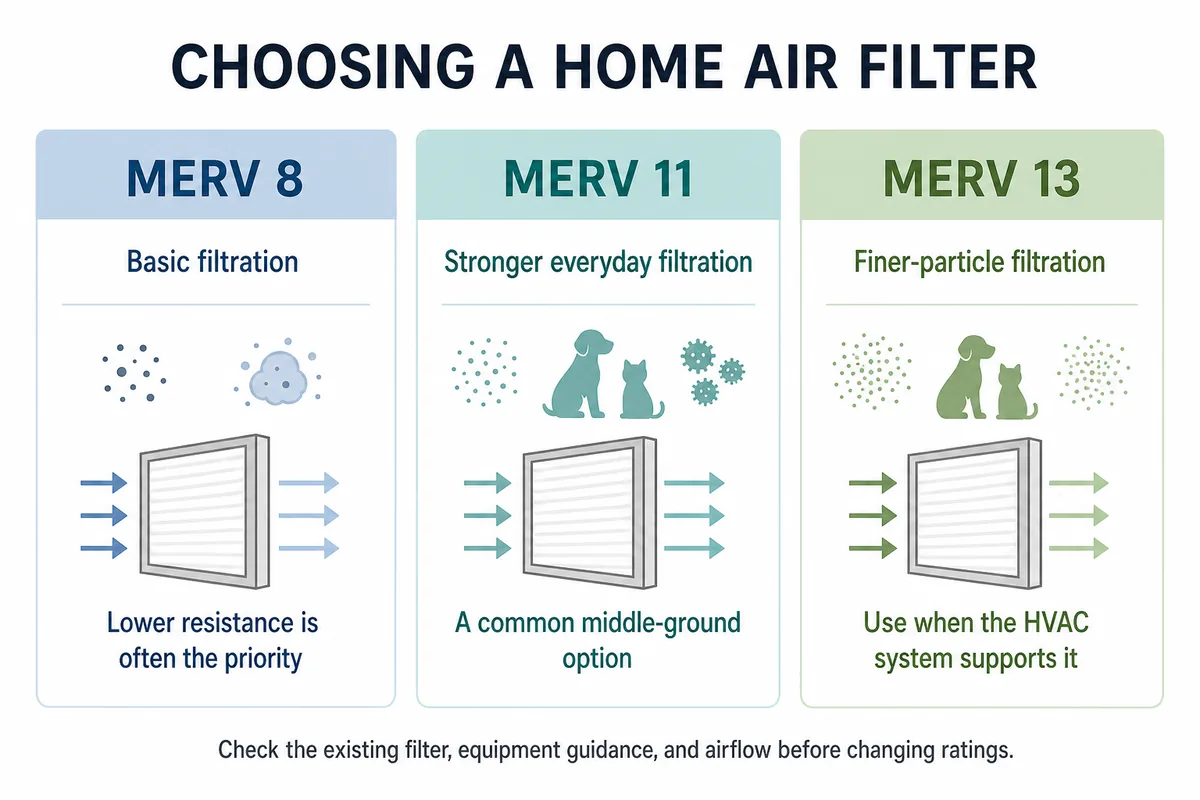
Filter Wizard recommends using the lowest MERV rating that meets the household’s filtration needs while remaining compatible with the HVAC system.
- MERV 8: basic filtration and relatively low-resistance priorities.
- MERV 11: a stronger everyday balance for many homes.
- MERV 13: higher fine-particle filtration needs when the system supports it.
This is household guidance, not equipment-specific engineering approval. Confirm the physical size, equipment documentation, and manufacturer guidance. If you also need help orienting the replacement, review which way the air filter arrow points.
Free homeowner tool
Compare a recommendation for your household
Use the Filter Finder after confirming your physical size. It can suggest a cautious MERV starting point and replacement schedule, then show current retailer options. It cannot inspect your HVAC system or guarantee compatibility.
Start the Filter FinderStep-by-Step MERV Decision Guide
- Check the filter currently installed. Record its size, MERV rating, thickness, and airflow-arrow direction.
- Read the HVAC guidance. Check the furnace, air-handler, or filter-cabinet documentation for supported filter specifications.
- Identify the household need. Consider pets, recurring dust, pollen, smoke-related particles, budget, and filter availability.
- Choose the lowest rating that reasonably meets that need. Avoid upgrading only because a larger number sounds better.
- Monitor airflow and filter condition. Watch for meaningful changes after switching ratings without treating one symptom as a diagnosis.
- Replace the filter before it becomes heavily loaded. Record the installation date and inspect it regularly.
If the system guidance is unclear or airflow is already weak, ask a qualified HVAC professional before moving to a more restrictive filter. Also verify whether the system uses one central filter or multiple filtered returns and whether return-grille and furnace filters are installed together before changing several filter ratings at once.
Free Filter Reminders
Remember Your Next Filter Check
Get occasional filter reminders, homeowner maintenance tips, and buying guidance.
Occasional emails only. Unsubscribe anytime.
You're on the list. We'll send practical filter reminders and updates occasionally.
Homeowners prioritizing pollen and other smaller airborne particles can apply these ratings with the allergy-focused MERV buying guide.
For a smoke-specific application of these ratings, including wildfire particles and odor limits, read MERV ratings for smoke filtration.
Frequently Asked Questions
Is MERV 8 good enough for most homes?
MERV 8 can be a reasonable basic option when it matches the equipment guidance and the household does not need stronger fine-particle filtration. It is not automatically sufficient for every home.
Is MERV 11 better than MERV 8?
MERV 11 generally captures a greater share of smaller particles than MERV 8, but better depends on household needs, filter construction, price, airflow, and HVAC compatibility.
Is MERV 13 too restrictive for residential HVAC systems?
It can be too restrictive for some systems, but MERV alone does not determine pressure drop. Filter thickness, media area, construction, condition, rack size, and system design also matter. Follow equipment guidance.
Is MERV 11 good for homes with pets?
MERV 11 is often a practical starting point for homes with pets because it offers stronger particle capture than MERV 8. Confirm that the HVAC system supports the filter.
Which MERV rating is best for allergies?
There is no universal allergy filter. MERV 11 or MERV 13 may capture a greater share of smaller airborne particles than MERV 8, but filtration is not medical treatment and the system must support the chosen filter.
Which MERV rating is best for smoke?
MERV 13 may offer stronger capture of fine smoke-related particles when the system supports it. A standard particulate filter does not remove every gas, odor, or indoor-air contaminant.
Can I replace a MERV 8 filter with MERV 13?
Do not assume the upgrade is compatible. Check the equipment documentation, filter rack, manufacturer guidance, and airflow before changing ratings. Ask an HVAC professional if guidance is unclear.
Does a higher MERV rating reduce airflow?
Higher-efficiency media can increase resistance, but total pressure drop depends on the complete filter design and its condition. Two filters with the same MERV rating can behave differently.
Does a higher MERV filter last longer?
No. MERV does not determine service life by itself. Pets, dust, smoke, occupancy, season, HVAC runtime, filter size, and media area all affect how quickly a filter loads.
What MERV rating do most furnaces use?
Residential systems use a range of ratings, and repository evidence does not support one universal value. Use the existing properly fitted filter and equipment documentation as your starting references.
Can the wrong MERV rating cause a frozen coil?
Excessive airflow restriction can contribute to coil icing, but MERV rating alone does not diagnose the cause. A dirty filter, blocked airflow, blower problems, coil condition, and refrigerant issues may also be involved.
Is a thicker filter better than a one-inch filter?
A deeper pleated filter can provide more media area and sometimes lower resistance at a similar efficiency, but only when the equipment and filter cabinet are designed for that thickness. Never force a thicker filter into a one-inch rack.