Quick Answer
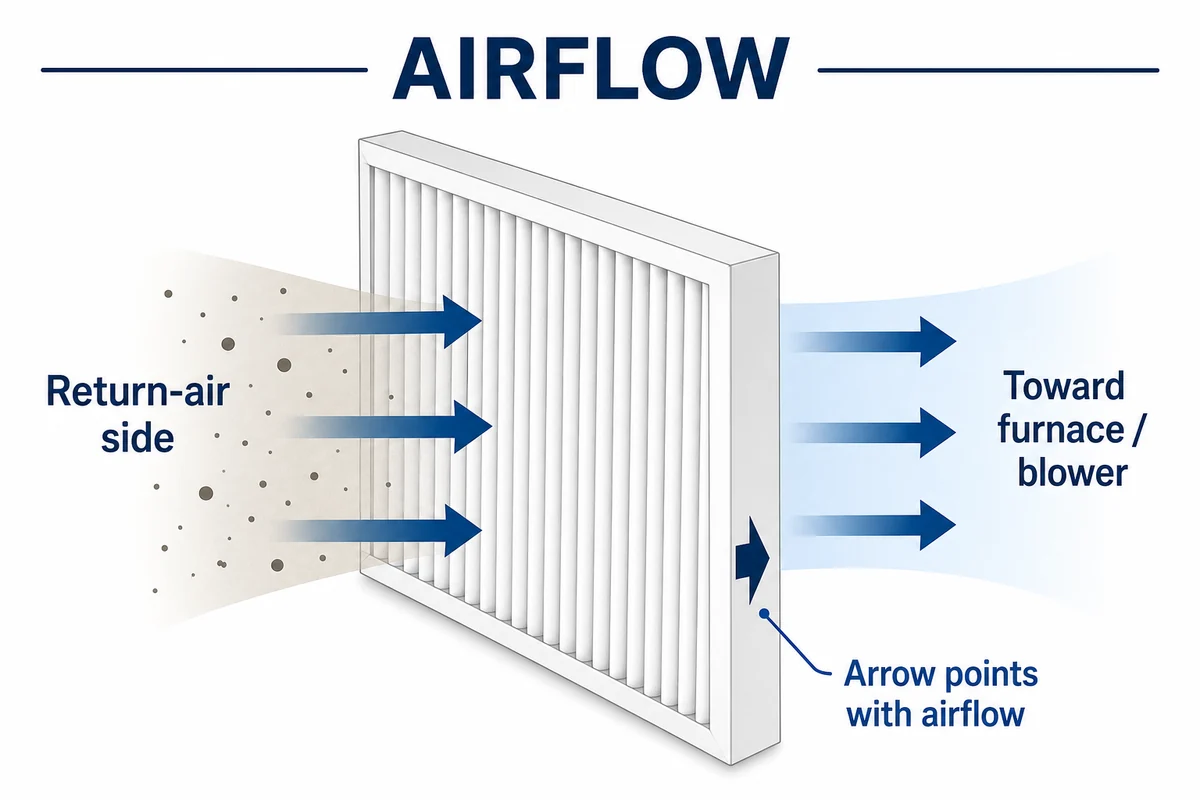
Point the arrow with the airflow. In most homes, return air travels from the room, through the filter, and toward the furnace, blower, or air handler. That means the arrow usually points away from the return grille and toward the HVAC equipment.
For a filter behind a wall or ceiling return, the arrow normally points into the duct. For a filter in a slot beside the furnace, it normally points into the furnace. The physical direction can be sideways, up, or down depending on the installation.
Do not use “up,” “down,” or “toward the wall” as a universal rule. HVAC layouts differ. Find the equipment side of the filter, check the rack label or previous installation, and follow the printed arrow. If the direction remains unclear, use the equipment instructions or ask a qualified HVAC professional.
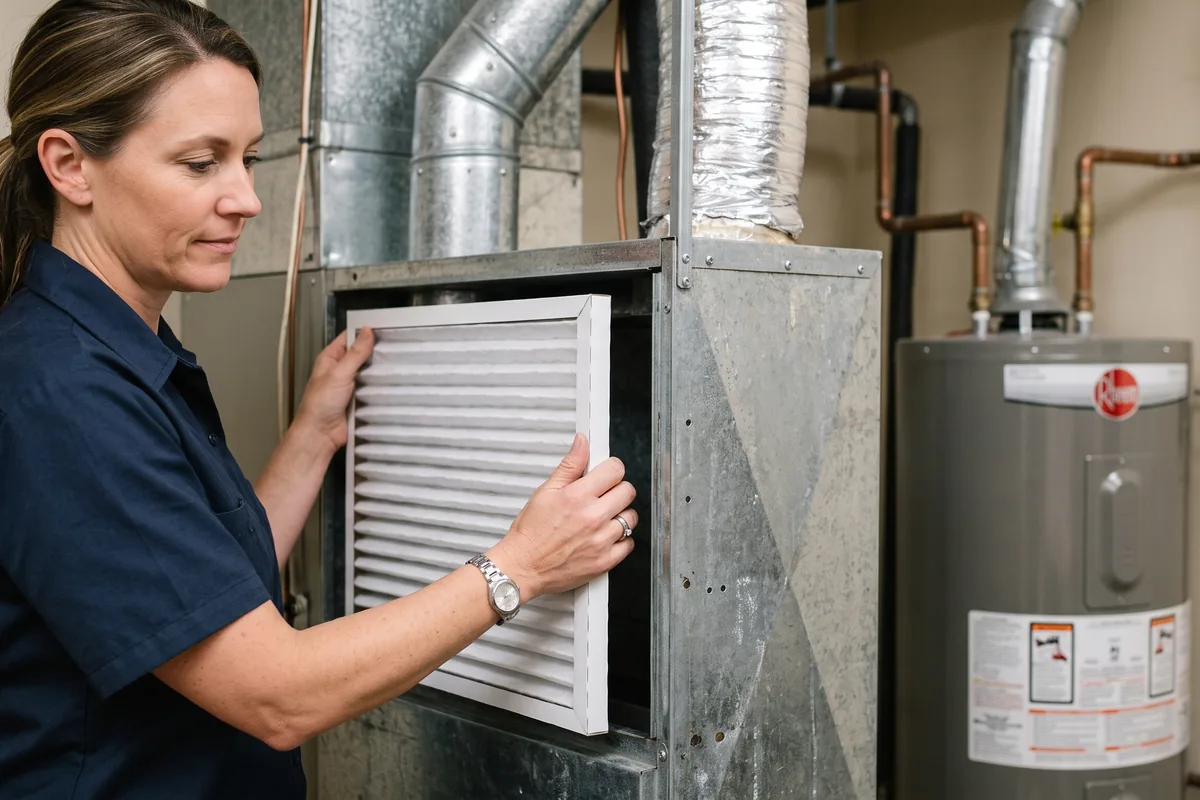
What the Arrow Actually Means
The arrow printed on a disposable HVAC filter is an airflow-direction marker. It does not tell you which edge goes on top, which side should face the room, or whether the filter is the correct size. It answers one question: which way should air pass through this filter?
Many pleated filters are designed with a downstream support structure that helps the media hold its shape as air pulls through it. Construction differs by product, so visual clues such as wire, cardboard strips, pleat shape, color, or printed branding are secondary. The manufacturer’s arrow is the clearest reference.
The two sides are often described as upstream and downstream. The upstream side meets returning household air first. The downstream side faces the blower and equipment. For a typical return-side filter, the arrow runs from upstream to downstream: room or return duct → filter → furnace or air handler.
Size and direction are separate checks. A correctly oriented filter can still be the wrong size, and a correctly sized filter can still be backwards. Before ordering, use the printed dimensions from a properly fitting filter or follow the methods in the air filter size guide. Filter Wizard also has specific references for 20x20x1, 20x25x1, and 16x25x1 filters.
How Air Moves Through Your HVAC System
A central forced-air system works as a loop. The return side pulls air from occupied rooms. That air travels through return grilles and ducts toward the equipment. The blower then moves conditioned air through supply ducts and back into the rooms through supply registers.
Most common household filters sit on the return side so dust and debris are captured before air reaches the blower and other accessible equipment. When the filter is behind a return grille, the room is upstream and the duct is downstream. When it is in a slot next to the furnace, the return duct is upstream and the furnace is downstream.
This explains why the arrow usually points toward equipment. The arrow follows the air being drawn into the system; it does not point toward the source of the returning air. Supply registers are different: they deliver air into rooms and ordinarily do not contain the system’s main disposable return filter.
Arrow Direction by Filter Location
The equipment side is not always physically obvious, especially when the filter is overhead or installed in a closet. Use the location-specific patterns below as guidance, then confirm the actual system.
| Filter location | Typical airflow | Arrow usually points |
|---|---|---|
| Wall or floor return grille | From the room into the return duct | Away from the room and into the duct |
| Ceiling return grille | Up from the room into the return duct | Up into the ceiling return |
| Slot beside a furnace | From the return duct into the furnace/blower | Toward the furnace |
| Air-handler filter rack | From the return duct into the air handler | Toward the air handler/blower |
| Media-filter cabinet | Through the cabinet toward the equipment | In the cabinet’s labeled airflow direction |
Return grille
A large grille on a wall, floor, or ceiling may hold the filter directly behind a hinged cover. Air is pulled from the room into that grille. The filter arrow therefore points into the opening, away from the room. Support ceiling grilles carefully, turn the system off first, and do not force unfamiliar latches.
Furnace slot
A narrow slot may sit between the return duct and furnace cabinet. Here the arrow commonly points from the duct toward the furnace and blower. Look for a label on the slot cover or nearby duct. Do not open sealed service panels just to find the blower.
Air handler
An air handler may be in a closet, attic, garage, basement, or utility area. Its accessible filter rack can be beneath, beside, or within a specifically labeled filter compartment. The arrow follows air toward the blower section. If identifying that path requires removing a service panel or approaching electrical components, stop and consult the manual or a professional.
Ceiling return
At a ceiling return, air normally rises from the room through the grille, so the arrow often points upward. This is one case where “arrow up” may be correct—but it is correct because the air moves up, not because filters always point up.
How to Tell Which Way Air Is Moving
Start with evidence that does not require opening equipment. Photograph the old filter before moving it, including the arrow and surrounding rack. Check the rack cover, duct, grille frame, or cabinet for words such as “airflow,” “return,” or an arrow. Review the homeowner or installation manual if it identifies the filter location.
If the system is operating and the return grille is safely accessible, hold a single lightweight tissue near—not inside—the grille. A return pulls the tissue toward it; a supply register blows it away. Keep fingers, paper, tools, and loose objects out of the grille and equipment. Turn the system off before opening the filter compartment.
At a furnace or air handler, trace the return duct toward the equipment without dismantling anything. The filter is usually before the blower along that path. Air travels from the return duct through the filter and into the equipment. A clearly labeled cabinet arrow overrides assumptions based only on which side looks dirty.
Dirt patterns can provide context, but they are not a reliable stand-alone direction test. The upstream face often collects more visible dust because it meets return air first. However, an old filter may have been reversed, handled, or exposed to debris during removal. Use dirt only as a supporting clue after checking the printed arrow, rack label, and equipment path.
Also distinguish airflow direction from the position of the access door. A filter may slide into a horizontal slot even when air moves vertically, or sit vertically while air travels sideways. The way you insert the frame into the opening does not necessarily match the way air passes through its media. Follow the arrow across the filter’s thickness, from one broad face to the other.
The old filter can help, but it is not absolute proof. Someone may have installed it backwards. If the old arrow conflicts with a rack label or the equipment manual, rely on the documented airflow path. When evidence conflicts or the installation is unusual, contact the installer or a qualified HVAC professional.
What Happens if the Filter Is Installed Backwards?
A backwards filter does not automatically mean the HVAC system has been damaged. The system may continue to run, and the immediate effect varies with the filter’s construction and the equipment. Avoid panic or unsupported diagnosis.
The practical concern is that the media may not receive support in the direction intended by its manufacturer. Over time, that can allow the pleats or frame to behave differently under airflow. A filter that is already bent, collapsed, torn, wet, or pulled out of its frame should be replaced with a correctly sized, compatible filter rather than simply turned around.
If you notice the mistake during installation, remove the filter and reinstall it with the arrow following airflow. If you discover it later, turn the system off at the thermostat when appropriate, inspect the accessible filter, and correct or replace it. Do not reach into moving equipment.
Direction is only one maintenance factor. A heavily loaded filter can restrict airflow regardless of orientation. Review how often to change an air filter and the signs a filter may be clogged. Restricted airflow can also be relevant when investigating a frozen AC coil or whether a dirty filter may contribute to higher energy use, but those symptoms can have other causes.
Common Air Filter Direction Mistakes
- Always pointing the arrow up. Direction follows airflow, which can be horizontal, upward, or downward.
- Pointing toward the room. Behind a return grille, air generally leaves the room and enters the duct.
- Following printed text instead of the arrow. Branding can be oriented for readability and is not a direction marker.
- Using the wire side as the only clue. Filter construction varies; use the manufacturer’s arrow.
- Copying an old filter without checking. The previous installation may have been wrong.
- Confusing a supply register with a return. Supply registers blow conditioned air into the room; returns pull room air back.
- Forcing a filter that does not fit. Direction cannot correct the wrong length, width, or thickness.
- Opening sealed equipment panels. Homeowner work should remain limited to accessible filter compartments.
- Ignoring multiple filters. Homes with multiple systems or return grilles may have more than one filter, sometimes in different orientations.
Step-by-Step: Install the Filter in the Correct Direction
- Confirm the replacement. Match all three nominal dimensions and, when changing brands, compare listed actual dimensions.
- Turn the system off at the thermostat. Wait for the blower to stop before opening an accessible grille or filter cover.
- Photograph the existing setup. Capture the arrow, slot, cover, and nearby equipment.
- Remove the old filter carefully. Note its direction, but check for a rack label or documented airflow arrow as well.
- Identify the downstream side. Determine which side leads toward the furnace, blower, or air handler.
- Align the printed arrow. Point it from the return-air side toward the downstream equipment side.
- Slide the filter in without force. The frame should sit in its intended track without bending, trimming, stacking, or leaving a large gap.
- Close the cover or grille. Make sure latches engage and the filter does not interfere with the door.
- Restore normal operation. Listen for obvious rattling and verify the cover remains secure. If anything appears wrong, turn the system off and recheck the installation.
- Record the date. Use the manufacturer’s guidance and household conditions to plan inspection and replacement.
Before disposing of the old filter, copy the size, MERV rating, brand or product identifier, and installation date into a phone note. Add a simple note such as “arrow points toward furnace” or “arrow points into ceiling duct.” That record makes the next change easier and reduces the chance that a different household member has to rediscover the airflow path.
If the replacement seems loose, leaves a large opening, bows noticeably, or prevents the cover from closing, do not treat the arrow as the solution. Recheck the size and actual dimensions. Likewise, do not stack filters or substitute a thicker filter unless the rack and equipment documentation allow it. A snug, intended fit and correct airflow direction are separate requirements.
If you cannot locate the filter, cannot identify the equipment side, or find a damaged rack, pause rather than improvise. The installer, equipment manufacturer, or a qualified HVAC professional can confirm the arrangement.
Free homeowner tool
Get Filter Guidance for Your Household
After you confirm the physical size and arrow direction, use the Filter Wizard Filter Finder for household-based MERV guidance, replacement timing, and retailer options. The Finder cannot inspect your equipment or guarantee compatibility.
- MERV guidance
- Replacement timing
- Household-condition recommendations
- Retailer options after size confirmation
Free Filter Reminders
Remember Your Next Filter Check
Get occasional filter reminders, homeowner maintenance tips, and buying guidance.
Occasional emails only. Unsubscribe anytime.
You're on the list. We'll send practical filter reminders and updates occasionally.
Frequently Asked Questions
Which way should the arrow point on an air filter?
The arrow should point in the direction air moves through the system—usually toward the furnace, blower, or air handler and away from the return grille or room.
Does the air filter arrow point up or down?
Not always. Up or down depends on the installation. Follow the airflow path toward the blower or equipment instead of using gravity as the rule.
Which way does a furnace filter arrow point?
For a filter in the return duct beside a furnace, the arrow usually points toward the furnace and blower compartment.
Which way does the arrow point behind a return grille?
The arrow normally points away from the room and into the return duct because air is being pulled from the room toward the HVAC equipment.
What happens if an HVAC filter is installed backwards?
The system may still run, but the filter may not be supported in the way its manufacturer intended. Correct the direction at the next safe opportunity and inspect the frame for damage.
How can I tell which way air is moving?
Look for the blower or air handler, check labels on the filter rack, note the previous filter direction, or use a lightweight tissue near an accessible return grille while the system is operating. Keep hands and objects out of equipment.
Does the wire or support grid face the furnace?
Often the support side faces downstream toward the blower, but construction varies. The printed airflow arrow and manufacturer instructions are the better reference.
Should I turn off the HVAC system before changing the filter?
Turning the system off at the thermostat before opening an accessible filter compartment helps keep air from pulling at the filter. Do not open sealed service panels or handle electrical components.
The dirty face is not a stand-alone direction test. If loading is concentrated in one area, review uneven filter dirt patterns alongside the printed arrow and fit. If noise begins after installation, check why the new filter may whistle. In homes with several returns, verify whether every return is intended to have a filter and whether a return filter and central filter belong together.