Quick Answer
For airborne smoke particles, a compatible pleated MERV 13 filter is generally the residential HVAC option most worth considering because it has stronger required capture of smaller particles than MERV 8 or MERV 11. MERV 11 can be a reasonable compromise when equipment guidance, filter design, or airflow concerns make MERV 13 uncertain. MERV 8 is more limited for the fine-particle objective.
This recommendation applies to particles—not every part of smoke. MERV does not measure gas or odor removal, and a standard pleated filter should not be expected to eliminate smoky smells. Size, depth, fit, actual product resistance, system airflow, smoke source, outdoor infiltration, runtime, and loading all affect the installed result.
What Exactly Are You Trying to Remove From Smoke?
“Smoke” is not one filtration target. It is a changing mixture of airborne particles and gas-phase compounds. The visible haze, the particles measured as fine particulate matter, and the odor a person notices are related, but they are not interchangeable. A homeowner choosing only by the word “smoke” may buy a good particle filter while expecting it to solve an odor problem that requires a different mechanism.
Start with the source and goal. Wildfire smoke often creates a temporary but intense outdoor fine-particle problem that infiltrates the home. Indoor tobacco smoke repeatedly adds particles, gases, and surface residue. Wood smoke can point to both particle exposure and a combustion or draft concern. Cooking produces particles, grease aerosols, moisture, and odors near the source. The right response changes with that context.
Smoke Particles vs. Smoke Gases vs. Smoke Odor
Smoke particles
Particles are solid or liquid material suspended in air. Mechanical HVAC media can capture a portion when airflow carries it through the return and across the filter. MERV is relevant because it describes tested particle-capture performance in defined size ranges.
Smoke gases
Gas-phase pollutants pass through ordinary particulate media differently from particles. Raising a pleated filter from MERV 11 to MERV 13 does not turn it into a gas-removal system. MERV does not rate adsorption of gas molecules.
Smoke odor
Odor often comes from gas-phase compounds, though a loaded filter and deposited residue can also smell. Particle concentrations may fall while an odor remains. That is why “MERV 13 for smoke” is incomplete advice when the actual complaint is a persistent smoky smell.
How MERV Ratings Apply to Smoke Particles
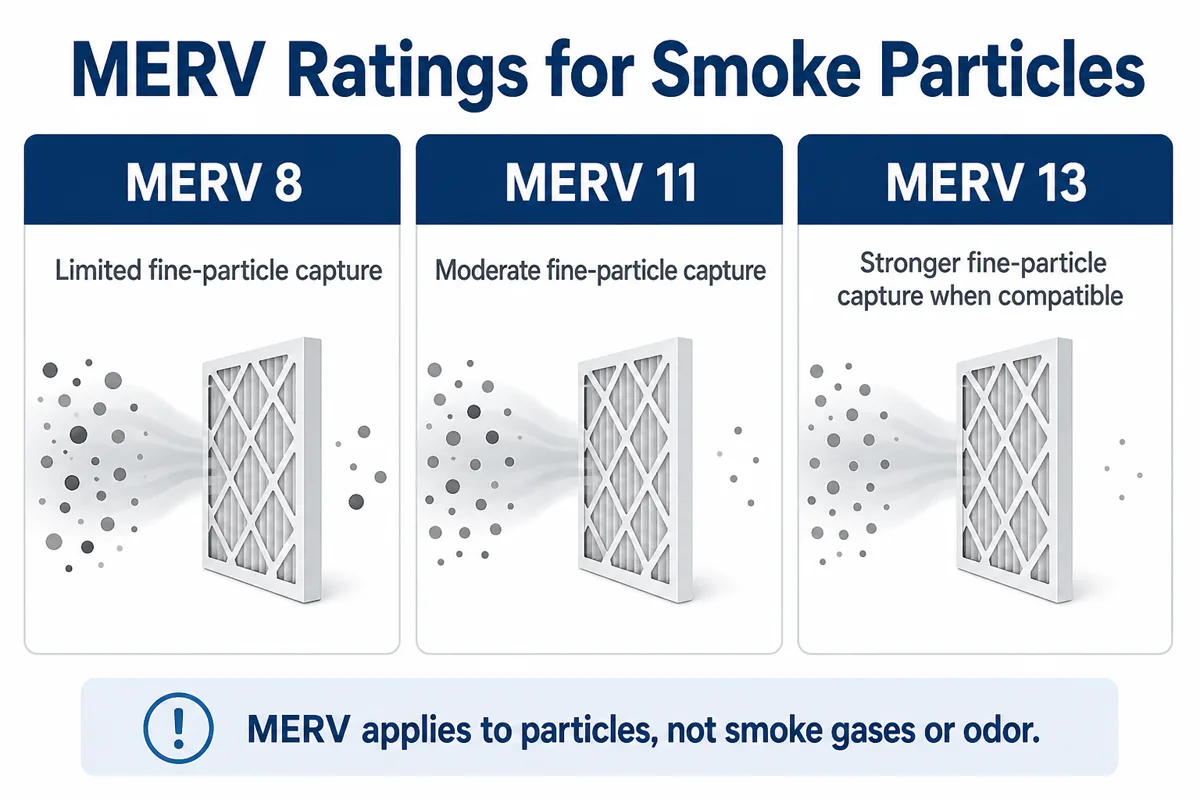
MERV is derived from ASHRAE testing and reports how efficiently a filter captures particles between 0.3 and 10 micrometers across three ranges. EPA’s published table shows MERV 13 has a minimum 50% efficiency in the smallest 0.3–1 micrometer test range, compared with lower minimums for MERV 11 and no minimum in that range for MERV 8. Those categories make MERV 13 more relevant where fine smoke particles are the target.
MERV does not state every product’s pressure drop. Media construction, pleat count, face area, depth, airflow rate, electrostatic properties, and accumulated loading change resistance. Compare the existing MERV 8, 11, and 13 guide and the explanation of filter restriction before treating the rating as the only specification.
MERV 8 vs. MERV 11 vs. MERV 13 for Smoke
| Factor | MERV 8 | MERV 11 | MERV 13 |
|---|---|---|---|
| Larger particles | Basic capture | Stronger | Stronger |
| Smaller smoke particles | Limited | Moderate | Stronger |
| Relative filtration | Basic | Middle range | Highest of these three |
| Resistance | Often lower; varies | Product-dependent | Product-dependent; verify |
| Smoke-particle use | Not the main fine-particle choice | Practical compromise | Most relevant when compatible |
| Wildfire relevance | Limited fine-particle performance | Useful improvement | EPA-preferred range when supported |
| Compatibility | Still confirm size | Confirm product and system | Confirm product and system carefully |
| Loading | May collect less fine material | Inspect during events | Inspect frequently during events |
Why MERV 13 Is More Compelling for Smoke Particles
Smoke includes particles small enough that performance in MERV’s lower size ranges becomes important. A filter that mainly handles larger lint and dust can miss more of the fine-particle fraction on each pass. MERV 13’s stronger minimum performance in the smaller test ranges is the reason EPA wildfire guidance commonly points homeowners toward MERV 13 or the highest compatible efficiency—not because the number makes smoke harmless.
The gain depends on air actually crossing the media. A high-efficiency filter with edge gaps, an undersized frame, short blower runtime, or a heavily loaded surface will not deliver its laboratory category as a whole-home guarantee. Product resistance and HVAC capability remain installation questions, so MERV 13 is a conditional smoke-particle recommendation rather than a universal mandate.
When MERV 11 May Still Make Sense
MERV 11 adds meaningful required performance in smaller particle ranges compared with MERV 8. It may be the practical choice when the system’s documentation favors it, the available MERV 13 product has substantially higher resistance, the rack accepts only a constrained one-inch design, or an HVAC professional has identified limited airflow margin.
Duration also changes the decision. A household preparing for recurring wildfire seasons may place greater value on the strongest compatible fine-particle option. A brief, infrequent cooking episode is better addressed at the source with kitchen exhaust than by permanently changing the central filter. MERV 11 is not useless for smoke; it is a compromise between particle capture and the realities of a specific system.
Wildfire Smoke: Filtration, Infiltration, and Loading
Wildfire smoke is an outdoor source that can enter through open doors and windows, leakage paths, and outdoor-air intakes. EPA recommends a high-efficiency HVAC filter—MERV 13 or higher—when the system can accommodate it, a snug fit, and frequent checks during heavy smoke. A central system can reduce indoor particles only while it is processing indoor air.
Find out whether the HVAC system has a fresh-air intake and follow current EPA, AirNow, equipment, and local guidance about recirculation. Do not close, cover, or reconfigure unfamiliar equipment blindly. Window units, portable air conditioners, evaporative coolers, and central systems handle outdoor air differently.
High outdoor concentrations can load media faster than an ordinary season. Keep an appropriate spare, inspect during the event, and replace based on condition, odor, airflow, and manufacturer guidance. A portable air cleaner with a smoke CADR sized for a room may complement central filtration; it is not the same product category as a furnace filter.
Cigarette and Tobacco Smoke
Tobacco smoke contains particles and gas-phase compounds and leaves residue on indoor surfaces. An HVAC filter may capture some airborne particles that reach the return, but standard particulate media does not eliminate the gas mixture, persistent odor, or residue deposited on walls, fabrics, coils, and furnishings.
Replacing a filter after indoor smoking removes captured material from that filter; it does not make indoor smoking safe or reverse surface contamination. Source control is central. A higher MERV rating should not be marketed as protection that makes continued indoor smoking acceptable.
Wood Stove and Fireplace Smoke
Wood smoke contains particulate matter and combustion gases. Particles that escape into the room and enter a return may be captured, but a furnace filter cannot correct poor draft, backdrafting, chimney problems, combustion-air problems, or gas hazards. Those are appliance, venting, and safety matters.
If smoke visibly enters the room, soot appears outside the expected area, or odors recur during operation, use the appliance according to its instructions and seek an appropriately qualified inspection. Do not respond only by installing a denser filter. The black-filter guide helps interpret captured soot without diagnosing combustion equipment from color.
Cooking Smoke and Grease Aerosols
Searing, frying, broiling, and burned food can create fine particles, grease aerosols, moisture, gases, and odor close to the cooking surface. Some particles may circulate to the HVAC filter, but grease can also deposit on nearby cabinets and surfaces before reaching a return.
Effective local exhaust used according to its instructions addresses the source before contaminants spread through the home. A central furnace or AC filter does not replace a properly vented range hood. Raising MERV may improve capture of the portion that circulates, but it does not solve cooking odor or ventilation by itself.
Can an HVAC Filter Remove Smoke Smell?
Not reliably with standard particulate media alone. MERV rates particles, while much smoke odor involves gas-phase compounds. A room can smell smoky after particle levels decline because gases or deposited residue remain. Conversely, a loaded filter may hold captured material and release an odor that signals it needs inspection or replacement.
Packaging that combines pleated media with a thin carbon layer should not be assumed to equal a dedicated gas-phase system. The quantity of sorbent and how long contaminated air contacts it matter. No ordinary replacement filter should be described as eliminating all smoke odor.
What Activated Carbon Does Differently
Particle media primarily intercepts particles; activated carbon and other sorbents work through adsorption, in which certain gas molecules adhere to media surfaces. Effectiveness depends on the contaminant, carbon type and quantity, contact time, airflow, humidity, media design, and how saturated the sorbent has become.
MERV does not express gas-removal capacity. A “carbon” label alone does not prove meaningful odor control, and a thin carbon coating may have much less capacity than a purpose-built bed of gas-phase media. Carbon also does not replace particle filtration. A smoke problem involving both particles and odor may require separate, appropriately selected particle and gas-phase strategies.
Filter Thickness and Media Area During Smoke Events
A deeper compatible filter often has more media area than a one-inch panel. More area can distribute airflow, provide loading capacity, and support higher efficiency with manageable resistance—but only when the rack or media cabinet was designed for that depth. Deeper is not automatically lower resistance or better.
Never force a two-inch or four-inch filter into a one-inch slot or stack filters. Confirm the cabinet in the filter-thickness guide. Smoke events can fill available media faster, making usable area and inspection more important than a long calendar claim printed for ordinary conditions.
Filter Fit and Air Bypass
An undersized filter, loose frame, damaged rack, edge gap, or bowed panel gives return air a route around the media. Bypass air does not receive the filter’s rated particle capture. That is why a properly seated MERV 11 can perform more sensibly in the installed system than a MERV 13 filter with large gaps.
Use a properly fitting existing frame or confirm the exact filter size. Install it in the correct airflow direction. If the filter repeatedly shifts or bows, investigate size, support, loading, and restriction rather than hiding the symptom.
HVAC Runtime and Recirculation
A central filter captures particles only while air moves through it. Filter efficiency describes each pass through the media; whole-room particle reduction also depends on airflow volume, mixing, return placement, outdoor entry, and time. Particles can settle before reaching the return, and new smoke can enter faster than the system processes indoor air.
EPA wildfire guidance often recommends running a compatible filtered system fan more frequently during an event, but system designs and energy implications differ. Do not prescribe one thermostat setting universally. Follow current official guidance and equipment instructions, and ask an HVAC professional when fan or outdoor-air controls are unclear.
Why Smoke Can Load Filters Faster
During a smoke event, airborne particle concentration may rise sharply. More particles crossing the filter means faster accumulation, and loading can increase resistance. The rate depends on outdoor infiltration, indoor source strength, runtime, filter area, efficiency, and duration.
Inspect more often rather than relying on one universal replacement interval. Appearance alone is imperfect, but heavy soiling, smoke odor from the filter, weak airflow, whistling, or bowing provides useful context. See replacement timing, clogged-filter signs, and fast loading causes.
What an HVAC Filter Cannot Solve
A particulate filter cannot remove every smoke gas, all odor, residue already deposited on surfaces, or particles that never reach a return. It cannot stop an active indoor smoke source, seal a leaky building, repair ventilation, correct fireplace draft, or make wildfire or tobacco exposure safe.
It also cannot replace source control, appropriate local exhaust, current public guidance, combustion-appliance inspection, or a room-sized portable cleaner where those are the relevant measures. Buying the highest MERV number is not a universal response to every smoky condition.
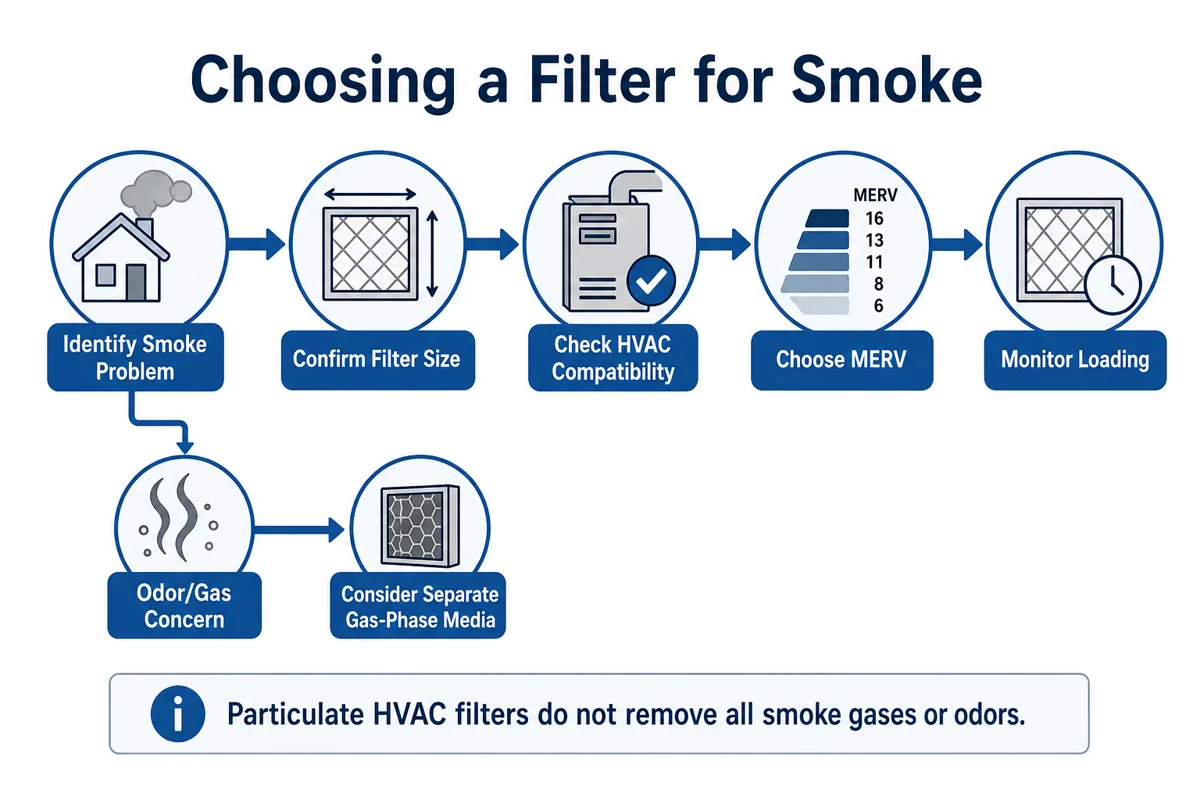
Smoke-Specific Filter Selection Checklist
- Identify the smoke source.
- Decide whether the concern is particles, odor, or both.
- Confirm the exact filter size.
- Confirm supported thickness.
- Record the current MERV.
- Check system and cabinet guidance.
- Compare MERV 11 and MERV 13 choices.
- Review product resistance data when available.
- Ensure the frame fits without bypass gaps.
- Install it in the correct airflow direction.
- Record the installation date.
- Inspect more frequently during heavy smoke.
- Watch for restriction, whistling, or bowing.
- Consider separate gas-phase media for an odor/gas concern.
- Escalate unresolved compatibility questions.
Free homeowner tool
Need Help Choosing a Smoke-Focused MERV Range?
Confirm your exact size first, then use Filter Wizard for cautious MERV guidance and compatible replacement options based on smoke-particle filtration needs.
Open the Filter FinderA Conditional MERV Decision Guide
MERV 8 may make sense when
- Basic filtration is the priority.
- System guidance strongly favors a lower-resistance option.
- Smoke-particle capture is not the main objective.
MERV 11 may make sense when
- Improved fine-particle capture is desired.
- The system supports the selected product.
- A practical compromise is needed.
MERV 13 may make sense when
- Smoke-particle filtration is a priority.
- Finer-particle capture matters.
- System compatibility and fit are confirmed.
- An appropriate design and depth are available.
- Airflow remains acceptable as the filter loads.
Filter Wizard Recommendation
When smoke-particle capture is the main goal, consider a compatible MERV 13 filter because it provides stronger required capture of smaller particles than MERV 8 or MERV 11. MERV 11 may still be appropriate when system guidance, actual resistance, or available filter design makes it the better installed compromise.
Match the filter to the actual problem. Standard particulate HVAC filters should not be expected to eliminate smoke gases or odor. Confirm size and depth, prevent bypass, monitor loading during smoke events, and use separate source-control, ventilation, portable particle filtration, or gas-phase strategies when those are the relevant tools.
Filter Wizard
Ready to Compare Compatible Options?
Use the Filter Finder after confirming size to get cautious MERV guidance, replacement timing, and correctly sized retailer options.
Open the Filter FinderTechnical Sources
Free Filter Reminders
Remember Your Next Filter Check
Get occasional filter reminders, homeowner maintenance tips, and buying guidance.
Occasional emails only. Unsubscribe anytime.
You're on the list. We'll send practical filter reminders and updates occasionally.
Frequently Asked Questions
What is the best air filter for smoke?
For smoke particles, a correctly sized pleated MERV 13 filter is generally the strongest of the common residential choices when the HVAC system supports the specific product. It does not remove every smoke gas or odor.
What MERV rating is best for smoke?
MERV 13 is the most relevant of MERV 8, 11, and 13 for fine smoke-particle capture. MERV 11 can be a practical compromise when system guidance or actual product resistance makes MERV 13 uncertain.
Is MERV 13 good for wildfire smoke?
EPA guidance recommends MERV 13 or higher for wildfire-smoke particle filtration when the central HVAC system can accommodate it. Fit, runtime, outdoor infiltration, and filter loading still affect performance.
Is MERV 11 good for smoke?
MERV 11 improves smaller-particle capture over MERV 8 and may be useful when compatible. It is less efficient than MERV 13 in the smallest MERV test range, so it is a compromise rather than the strongest smoke-particle choice.
Is MERV 13 too restrictive?
Not automatically. Resistance varies with product construction, size, depth, airflow, and loading. Check equipment guidance and product pressure-drop data rather than judging every MERV 13 filter by its rating alone.
Can a furnace filter remove wildfire smoke?
A compatible high-efficiency furnace filter can reduce some wildfire-smoke particles that enter the home and pass through the HVAC system. It cannot stop infiltration or remove all smoke gases and odors.
Can an HVAC filter remove cigarette smoke?
It can capture some airborne tobacco-smoke particles that reach the return. It does not remove all gas-phase compounds, persistent odor, or residue already deposited on indoor surfaces, and it does not make indoor smoking safe.
Can an HVAC filter remove smoke odor?
A standard particulate filter cannot reliably eliminate smoke odor because MERV applies to particles and much odor is gas-phase. A loaded filter may also retain smoky material and need replacement.
Does activated carbon help with smoke smell?
Activated carbon can adsorb some gas-phase compounds and odors, but effectiveness depends on carbon quantity, contaminant, contact time, airflow, design, and saturation. A thin carbon label does not guarantee strong odor removal.
Can a filter remove fireplace smoke?
An HVAC filter may capture some fireplace-smoke particles that reach the return. It cannot correct draft, venting, combustion, or gas problems; recurring indoor smoke or soot deserves qualified evaluation.
Can an HVAC filter help with cooking smoke?
It may capture some cooking particles and aerosols after they spread into the home. It does not replace effective local kitchen exhaust or reliably remove cooking gases and odors.
How often should I inspect my filter during wildfire smoke?
Inspect it more frequently during and after heavy smoke and follow current EPA, equipment, and filter-manufacturer guidance. Replace based on loading, odor, airflow, and condition rather than one universal interval.
Does filter thickness matter for smoke?
A deeper compatible filter may provide more media area and loading capacity, but depth is not interchangeable and deeper is not automatically better. Use only the thickness the installed rack or cabinet supports.
Should I use MERV 13 if my house smells smoky?
Not solely because of odor. MERV 13 can improve smoke-particle capture when compatible, but odor and gases are separate concerns that may require source control, cleaning, ventilation guidance, or purpose-built gas-phase media.