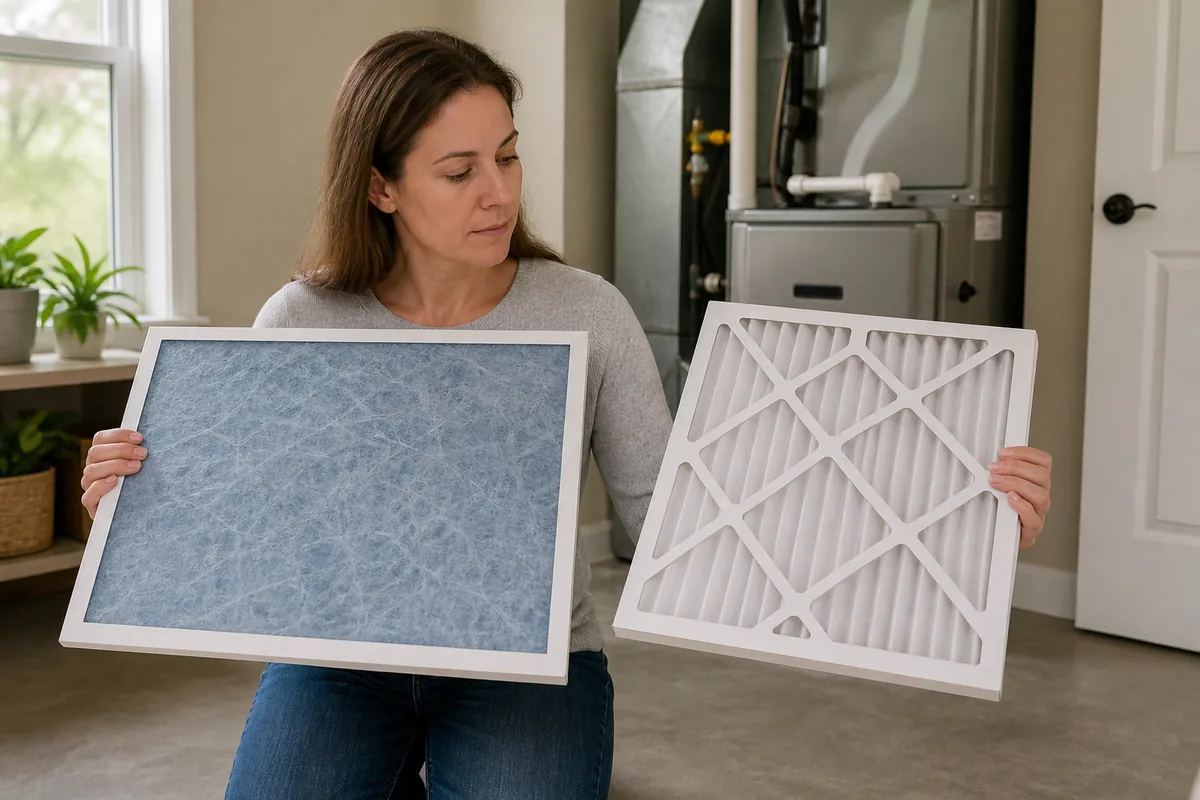
Quick Answer
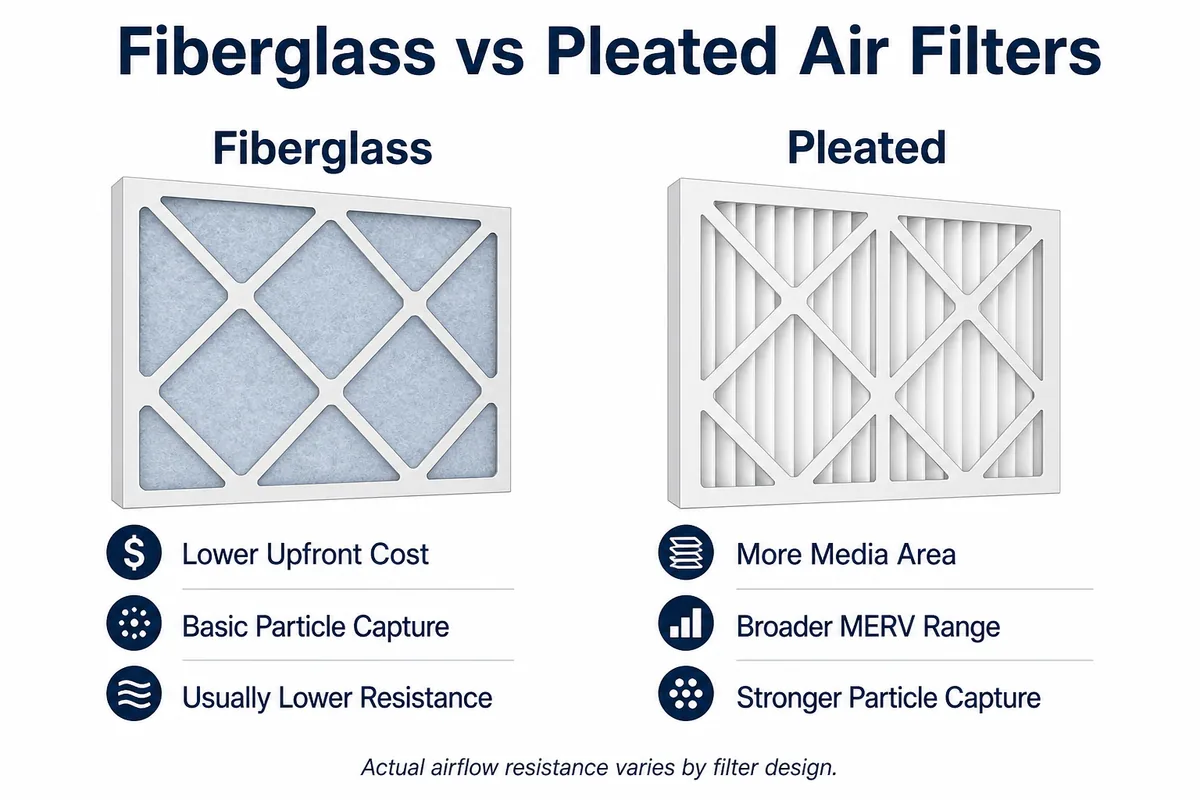
Fiberglass filters are usually inexpensive and low-resistance, but they generally capture fewer small particles. Pleated filters typically capture more particles and are available in a much wider range of MERV ratings, but airflow resistance varies by design. Neither type is automatically right for every home. The best choice depends on the HVAC system, desired filtration, household conditions, filter size, and replacement habits.
Pleated filters are not automatically too restrictive, and fiberglass filters are not automatically sufficient. Compare the MERV rating, media area, thickness, fit, cost, and equipment support rather than choosing by appearance alone.
What Is a Fiberglass Air Filter?
A fiberglass HVAC filter is usually a basic disposable filter with flat or lightly structured spun-glass media held in a cardboard or lightweight frame. Many common versions are one inch deep and designed primarily to catch larger debris before it reaches indoor HVAC components.
Fiberglass filters are widely available and typically inexpensive. Their open media often creates relatively low initial resistance. That can make them a reasonable basic-filtration option when the equipment guidance supports the product and frequent inspection is practical.
Fiberglass filter advantages
- Low typical upfront cost.
- Often relatively low initial airflow resistance.
- Common sizes are widely available.
- Simple and lightweight to replace.
- Can be suitable when only basic large-particle capture is needed.
Fiberglass filter tradeoffs
- Generally less effective for smaller particles.
- Usually limited to lower MERV choices.
- Often holds less debris than pleated media.
- May require more frequent replacement.
Fiberglass filters do not “do nothing.” They can catch larger lint and debris and serve the basic role their product was designed for. They simply should not be presented as equivalent to stronger particle-capture products without comparing their actual rating.
What Is a Pleated Air Filter?
A pleated HVAC filter folds synthetic, cotton-blend, or other media into repeated ridges. Those folds create more surface area than a flat sheet inside the same face dimensions. More area can support stronger particle capture, greater dust-holding capacity, or manageable resistance depending on the complete design.
Pleated filters are available across a broad range of MERV ratings and depths. They often cost more per filter than fiberglass products. Airflow resistance varies: pleat spacing, media density, MERV, depth, face size, support, and airflow rate all matter. Some pleated filters also use charged media; the guide to electrostatic and pleated filter terminology explains why those labels can overlap.
Pleated filter advantages
- Generally stronger particle capture.
- Broader MERV selection.
- More media area than many flat filters.
- Often greater dust-holding capacity.
- Available in shallow and deep formats.
Pleated filter tradeoffs
- Usually higher upfront cost.
- Some products create more resistance than a system supports.
- Higher-MERV choices require compatibility attention.
- Heavy loading still increases restriction.
“Pleated” is a construction description, not a MERV rating or guarantee. Not every pleated filter is high efficiency, and not every pleated filter is restrictive.
Fiberglass vs. Pleated Filters at a Glance
| Feature | Fiberglass | Pleated |
|---|---|---|
| Typical filtration | Basic | Moderate to higher |
| Fine-particle capture | Typically lower | Typically higher |
| Airflow resistance | Often lower initially | Varies by product |
| Media area | Typically lower | Typically higher |
| MERV availability | Commonly lower ratings | Broader range |
| Upfront cost | Usually lower | Usually higher |
| Replacement frequency | Often more frequent | May be less frequent |
| Dust-holding capacity | Usually lower | Usually higher |
| Pet-related particles | Basic capture | Stronger potential |
| Common use | Basic equipment protection | Broader household filtration |
| Thickness options | Often one inch | One inch through deep media |
| Best reason to choose | Basic compatible filtration | Stronger compatible capture |
These are general tendencies, not universal specifications. Compare the exact product label, dimensions, resistance information when available, and HVAC guidance.
Which Captures More Particles?
Pleated filters generally capture more particles because their folded media provides more area and they are offered at higher MERV ratings. Fiberglass filters commonly focus on larger lint and debris and let a greater share of smaller particles pass.
The exact result depends on the filter's tested rating and construction. A low-MERV pleated filter is not the same as a higher-MERV pleated product, and fiberglass ratings vary. No residential HVAC filter captures every particle, odor, gas, or contaminant.
Use the MERV 8, MERV 11, and MERV 13 comparison to match a reasonable particle-capture goal with system support rather than treating media appearance as a complete performance score.
Which Provides Better Airflow?
Fiberglass filters often have lower initial resistance because their media is relatively open. That does not mean every pleated filter restricts airflow excessively or that fiberglass is always the correct airflow choice.
Pleated media can create more resistance depending on its density and MERV, but additional pleat area spreads air across more material. Filter depth can provide even more area. A well-designed pleated product may offer useful capture while operating normally in a compatible system.
Condition matters too. A dirty filter of either type becomes more restrictive as debris occupies airflow pathways. Read what makes an air filter too restrictive before blaming one construction type.
Do Pleated Filters Restrict Airflow?
They can, but not always. The word “pleated” alone does not tell you whether a filter is too restrictive. MERV, media density, pleat number and spacing, face area, thickness, airflow rate, loading, and HVAC design all contribute.
A clean, correctly fitted pleated filter may operate normally. A heavily loaded fiberglass filter can also create significant resistance. If airflow drops after a filter change, confirm the exact size, depth, arrow direction, MERV, and product before assuming the pleats are the cause.
Weak airflow, whistling, bowing, or repeated coil icing deserve attention, but none diagnoses the filter by itself. Compare the replacement with the previous product and review equipment guidance.
Which Type Lasts Longer?
Pleated filters often have more media area and greater dust-holding capacity, so they may serve longer before heavy loading. Fiberglass filters often require more frequent replacement. Neither statement creates a universal calendar interval.
HVAC runtime, pets, smoke, dust, renovations, season, face size, thickness, MERV, media design, and bypass all affect loading. Follow manufacturer guidance and inspect the actual condition. The guide to how often to change an air filter provides practical starting points without promising one schedule for every home.
Replace damaged, wet, collapsed, or heavily loaded media regardless of its expected service life. Do not keep an expensive filter installed simply to reach a marketing interval.
Which Type Costs More?
Fiberglass usually costs less per filter. Pleated filters generally cost more because of their media, construction, rating, and sometimes greater depth. Size, MERV, brand, specialty features, and multipack quantity can change the comparison substantially.
Unit price is not annual cost. A lower-cost filter replaced frequently may approach the annual cost of a more expensive filter that loads more slowly. Conversely, a costly pleated filter is not automatically a better value if it is unsupported, poorly fitted, or purchased at an unnecessary rating.
Confirm one replacement fits before buying a large multipack, especially when changing media type, depth, or manufacturer.
Which Is Better for Dust?
Pleated filters generally capture smaller dust particles more effectively, particularly when their MERV rating is higher than the fiberglass alternative and the system supports it. Fiberglass filters can catch larger debris but typically allow more fine dust to pass. The guide to choosing a filter for a dusty home compares MERV 8, 11, and 13 alongside media type, thickness, and loading.
Filters alone do not eliminate household dust. Clothing fibers, skin flakes, outdoor soil, cooking particles, open windows, renovations, and air leaks continue to add material. Poor fit can let air bypass either filter.
If a filter loads unusually quickly, review why filters get dirty fast. If loading is concentrated, inspect the guide to one-sided filter dirt rather than assuming the media type caused the pattern.
Which Is Better for Homes With Pets?
Pleated filters generally offer better capture for pet-related debris and smaller airborne particles because they provide more media area and broader MERV choices. Visible pet hair may settle on floors, furniture, grilles, or larger surfaces before reaching the filter.
More capture also means the filter may load faster in a busy pet household. Choose a compatible MERV, inspect it regularly, and keep up with normal household cleaning. This is practical filtration guidance, not a medical claim or guarantee about allergy symptoms.
Which MERV Ratings Are Available?
Fiberglass filters are commonly sold at lower MERV ratings. Pleated filters span a much wider range, from basic residential capture through higher-efficiency choices. Actual products vary, so check the label rather than assigning a rating based on color, price, or appearance.
Filter type does not determine MERV, and MERV does not describe every aspect of airflow. Two pleated filters with the same rating can differ in area, depth, pressure drop, and loading behavior. Select the lowest compatible rating that reasonably meets the household need.
Does Filter Thickness Change the Comparison?
Yes. A 1-inch pleated filter behaves differently from a 4-inch pleated media filter. A deeper design can contain more folded media, hold more debris before loading heavily, and sometimes manage resistance differently at a similar efficiency.
Thickness does not automatically mean higher or lower restriction. The rack must be designed for the selected depth. Never force a deeper filter into a shallow slot or stack filters. See the full guide to 1-inch, 2-inch, and 4-inch filters before changing depth.
Which Should You Choose?
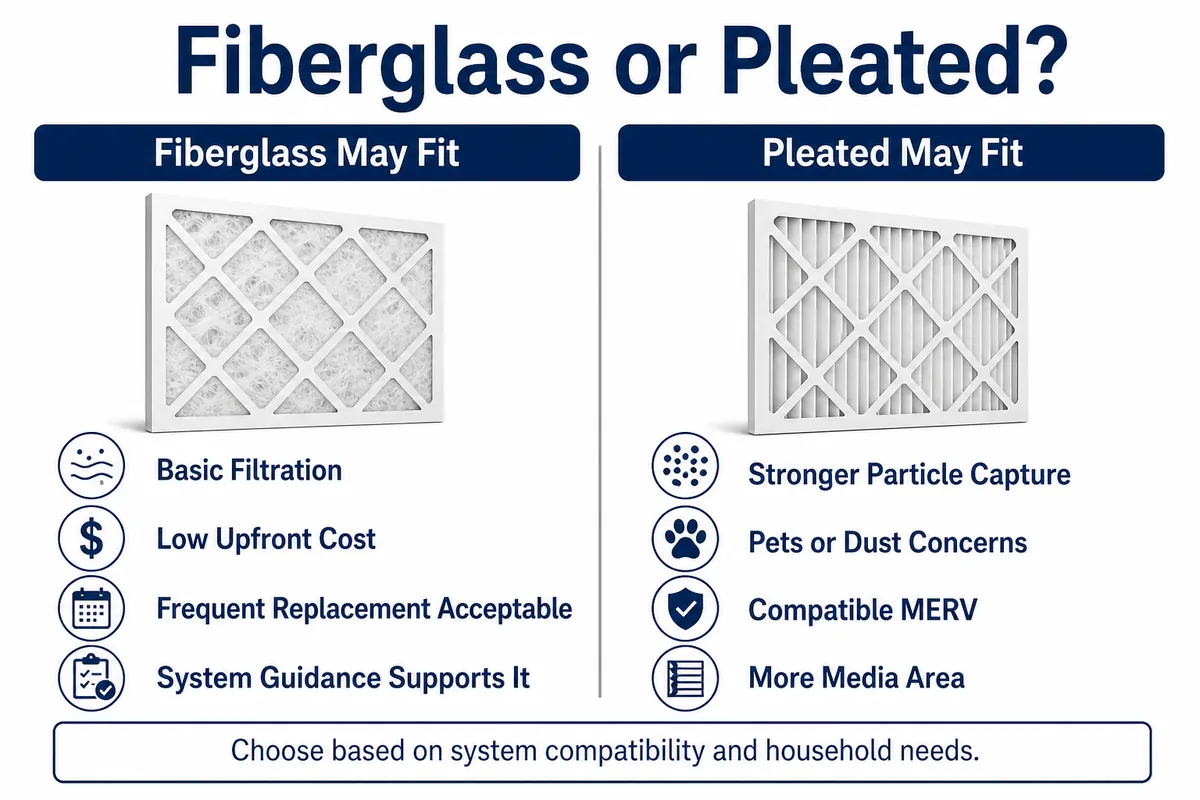
Fiberglass may make sense if:
- The system guidance supports basic low-resistance filtration.
- Low upfront cost is the priority.
- Only basic large-particle capture is needed.
- Frequent inspection and replacement are acceptable.
Pleated may make sense if:
- Stronger particle capture is desired.
- Pets or recurring household dust are concerns.
- The system supports the chosen MERV and design.
- Greater media area or dust-holding capacity is useful.
Neither list overrides the existing rack, exact dimensions, or equipment guidance. Compatibility matters more than choosing the cheapest-looking or most substantial-looking filter.
Free homeowner tool
Need help choosing a practical filter type and MERV?
Confirm the exact size first, then use Filter Wizard for a cautious MERV starting point, replacement timing, and retailer options based on household conditions.
Open the Filter FinderSafe Replacement Checklist
- Turn the system off at the thermostat.
- Confirm the exact filter size.
- Check the current filter type.
- Record the MERV rating.
- Confirm filter thickness.
- Check equipment or cabinet guidance.
- Do not force a deeper or denser filter into the slot.
- Install the replacement in the correct airflow direction.
- Monitor airflow after changing filter type.
- Check for whistling, bowing, or weak airflow.
- Replace before heavy loading develops.
- Seek HVAC guidance if airflow problems continue.
Use the detailed guides to confirm all three filter dimensions, point the airflow arrow toward the equipment, and recognize signs of a clogged filter.
Fiberglass or Pleated: Quick Decision Guide
Fiberglass may be appropriate
- Basic filtration is sufficient.
- Low initial cost matters.
- System guidance supports it.
- Frequent replacement is acceptable.
Pleated may be appropriate
- Stronger filtration is desired.
- Pets or more dust are concerns.
- The selected MERV is supported.
- Additional media area is useful.
- Longer potential service life is desirable.
Filter Wizard Recommendation
Filter Wizard generally favors pleated filters when the HVAC system can support the selected design and MERV rating because they typically offer stronger particle capture and greater media area. Fiberglass filters can still be appropriate for systems or households that prioritize basic filtration and low resistance.
The correct choice depends on exact size, MERV, thickness, airflow compatibility, household conditions, and replacement habits. A well-designed compatible pleated filter is not automatically restrictive. A low-cost fiberglass filter is not automatically adequate for every filtration goal.
If airflow changes after switching media types, confirm fit, direction, condition, depth, and equipment guidance. Filter Wizard cannot inspect the physical system or guarantee product compatibility.
Filter Wizard recommendation
Choose after confirming size and system support
Enter a confirmed three-dimensional size for cautious MERV guidance, replacement timing, household-condition guidance, and current retailer options.
Open the Filter FinderFree Filter Reminders
Remember Your Next Filter Check
Get occasional filter reminders, homeowner maintenance tips, and buying guidance.
Occasional emails only. Unsubscribe anytime.
You're on the list. We'll send practical filter reminders and updates occasionally.
For a particle-focused application of pleated media, see how MERV ratings relate to pollen and allergy-associated airborne particles.
Frequently Asked Questions
Are pleated air filters better than fiberglass?
Pleated filters generally capture more particles and offer more MERV choices, but they are not automatically best for every system. Fit, product resistance, household needs, and equipment support matter.
Are fiberglass air filters good?
Fiberglass filters can provide basic large-particle filtration with relatively low resistance and low upfront cost. They generally capture fewer small particles than pleated filters.
Do pleated filters restrict airflow?
They can, but pleated construction alone does not determine restriction. MERV, media area, depth, pleat design, airflow rate, loading, and system design all matter.
Which filter type has better airflow?
Fiberglass filters often have lower initial resistance, while a well-designed pleated filter may also provide acceptable airflow. Compare the actual product and system requirements.
Which filter catches more dust?
Pleated filters generally capture a wider range of dust particles, especially at higher MERV ratings. Fit and bypass gaps can reduce the benefit of either type.
Are pleated filters better for pets?
Pleated filters usually provide stronger capture for pet-related debris and smaller airborne particles, but the selected MERV and filter must remain compatible with the HVAC system.
How long do fiberglass filters last?
There is no universal interval. Fiberglass filters often require more frequent replacement, but runtime, pets, dust, smoke, season, size, and product guidance determine actual service life.
How long do pleated filters last?
Pleated filters often hold more debris before heavy loading, but service life varies with media area, depth, MERV, runtime, household conditions, and manufacturer guidance.
Which filter type costs more?
Pleated filters usually cost more per filter. Annual cost also depends on size, MERV, depth, brand, multipack quantity, and how often each filter requires replacement.
What MERV rating are fiberglass filters?
Fiberglass filters are commonly sold at lower MERV ratings, but ratings vary. Check the specific product label instead of assuming a rating from its appearance.
Can pleated filters cause a frozen coil?
A filter that creates excessive resistance or becomes heavily clogged can contribute to low airflow and coil icing. Pleated construction alone does not prove the filter is responsible.
Is a fiberglass filter better for an older furnace?
Not automatically. Equipment age alone does not identify the right filter. Follow furnace and cabinet guidance and compare size, MERV, resistance, and current airflow.
Does filter thickness matter more than filter type?
Neither factor works alone. Depth affects available media area, while media type and MERV affect capture and resistance. The filter must match the intended rack or cabinet.
Which filter should I buy for my home?
Confirm the exact size and thickness, review system guidance, identify the household filtration need, and choose a compatible product and MERV you can replace consistently.