Buying the wrong HVAC filter is more than an inconvenient return. A filter that is too small can leave gaps around the frame, allowing air and dust to bypass the filter media. One that is too large or too thick may not fit the slot at all. Guessing can reduce filtration, create avoidable airflow problems, and leave you with an unusable multipack.
The goal is not to choose the most common size. It is to identify the size that fits your particular return grille, furnace slot, air handler, or media cabinet. Every installation can be different, even when two homes use similar HVAC equipment.
Quick Answer
The easiest way to find your air filter size is to turn off the HVAC system, remove the existing filter, and read the dimensions printed on its cardboard frame. A marking such as 20 × 25 × 1 is usually the nominal size used when shopping for a replacement.
If the printing is missing or unreadable, measure the old filter's length, width, and thickness in inches. Compare those measurements with common nominal sizes, but remember that measurements alone do not guarantee compatibility. Confirm the fit before ordering several filters.
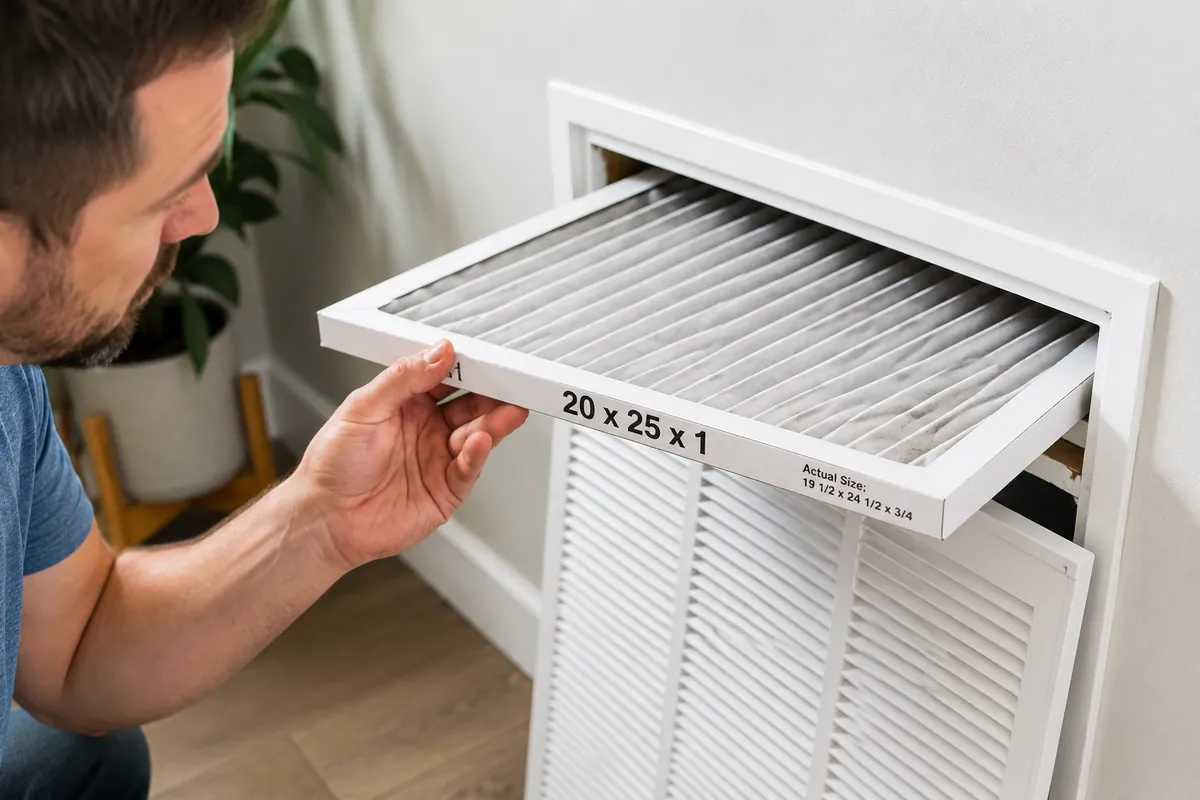
Method 1: Read the Existing Filter
Most disposable furnace and air-conditioner filters have their dimensions printed along one or more edges of the cardboard frame. Pull the filter far enough out to inspect every side. The size may be next to the brand name, MERV rating, airflow arrow, or product information.
Common printed examples include:
- 20 × 25 × 1
- 16 × 20 × 4
- 14 × 25 × 1
These numbers normally represent length, width, and thickness as a nominal size. Nominal dimensions are rounded shopping labels, not necessarily the exact measurements you would see on a tape measure.
Do not confuse the size with the MERV rating, model or item number, airflow arrow, or a smaller line labeled “actual size.” MERV describes filtration performance, while the arrow shows installation direction. Neither tells you the physical size.
If the existing filter slid into place without being forced and did not leave large gaps, its printed nominal size is generally your best buying reference. Photograph the label before discarding the old filter so you have it available at the store or while shopping online.
Method 2: Check the Return Air Grille
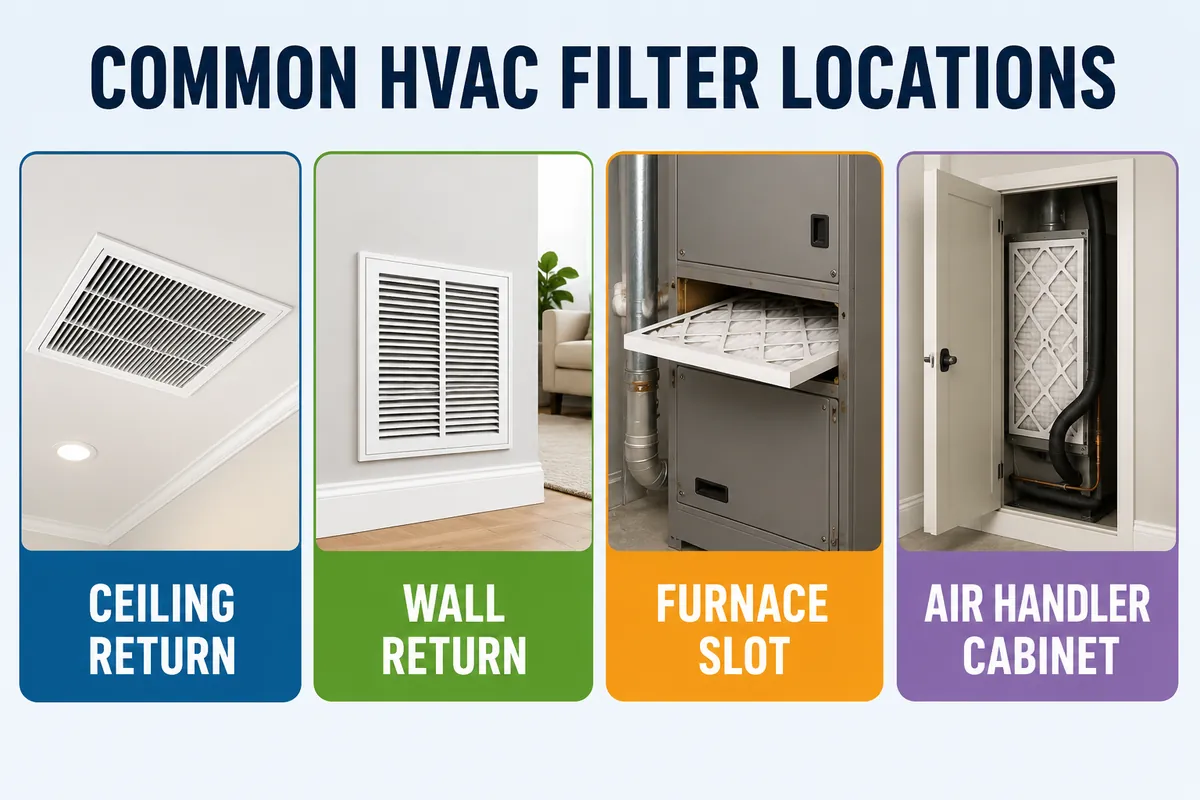
If you are wondering where your air filter is located, start with the large return-air grilles that pull room air back toward the HVAC system. Unlike smaller supply vents that blow conditioned air into rooms, returns are often larger and may sit on a ceiling, wall, or occasionally the floor.
Some return grilles hinge open and hold a filter directly behind them. Before opening one, turn off the HVAC system at the thermostat so the blower does not pull against the filter. Support a ceiling grille with one hand, release its latches carefully, and do not force painted or stuck hardware. Note which direction the airflow arrow points before removing the filter; it should point toward the return duct and equipment.
A home may have several return grilles but only one filtered return, or it may use a filter at each return. Do not assume matching-looking grilles use matching sizes. Check each accessible filter individually.
Method 3: Look Near the Furnace or Air Handler
When a return grille does not contain a filter, follow the return-air path toward the indoor equipment. The filter may slide into a narrow slot beside the furnace, sit between the return duct and furnace cabinet, or rest inside an accessible air-handler or media-filter compartment.
Common equipment-area locations include a utility closet, basement, attic platform, garage installation, or a dedicated media-filter cabinet. Thicker four- and five-inch filters are often found in media cabinets, but thickness varies and should never be assumed from location alone.
Limit your search to clearly accessible filter doors, racks, and slots. Do not remove sealed service panels, reach around wiring, or handle electrical components. If a panel requires tools and is not identified as a homeowner filter compartment, leave it closed and consult the equipment instructions or an HVAC professional.
Some homes have more than one HVAC system, zone, or return-filter location. Make a simple list of each filter and its size so future replacement is easier.
Method 4: Measure the Old Filter
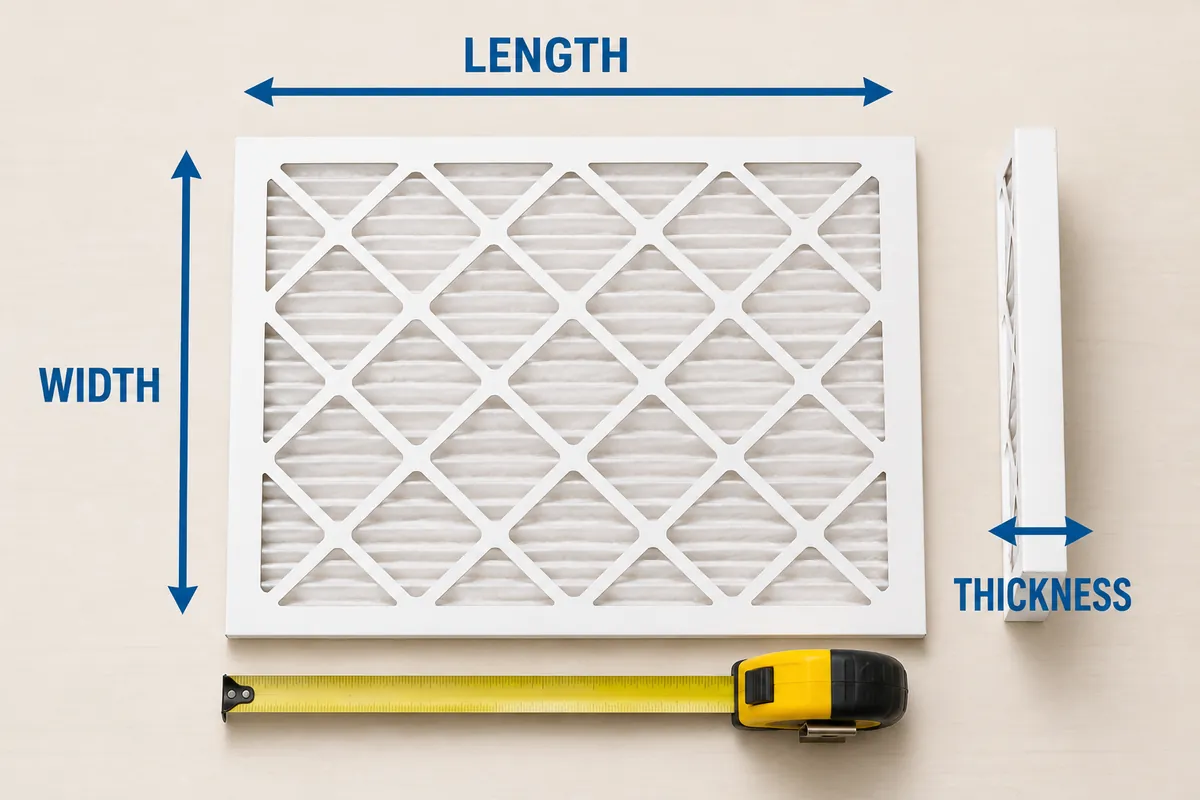
Measure only when the printed size cannot be read or no reliable label is available. Remove the old filter, place it on a flat surface, and use a tape measure to record all three dimensions in inches:
- Length: measure one long face from edge to edge.
- Width: measure the other face dimension.
- Thickness: measure the depth of the frame from front to back.
Write down the dimensions in the same order and include fractions or decimals. Using only two numbers is a common mistake because a 20 × 25 × 1 filter is not interchangeable with a 20 × 25 × 4 filter.
Actual dimensions are often slightly smaller than the printed nominal size. For example, a filter sold as 20 × 25 × 1 might measure about 19.5 × 24.5 × 0.75 inches. Exact measurements vary by manufacturer and product line.
When a readable printed size exists on a filter that fits properly, use that printed size rather than rounding your own measurement. When it does not, compare the old filter's measurements with manufacturer specifications or common nominal sizes, then test one replacement before buying a multipack.
Method 5: Check the Manual, Cabinet Label, or Model Information
If the old filter is missing, damaged, or clearly the wrong fit, check the documentation that came with the home or equipment. Useful sources include the furnace manual, air-handler manual, filter-cabinet label, installation guide, homeowner maintenance folder, or model-specific documentation from the manufacturer.
Look first for information about the filter rack or media cabinet rather than assuming the main HVAC unit model determines the answer. Installers can pair the same furnace or air handler with different return ducts and filter cabinets, so a model-number lookup does not always identify the installed filter size.
If documentation lists several options, compare it with the physical slot dimensions and cabinet label. An installer, previous service company, or qualified HVAC technician may also have the original installation record.
Nominal Size vs. Actual Size
The distinction between nominal and actual dimensions causes many ordering mistakes. The nominal size is the rounded label used for shopping. The actual size is the filter's precise physical measurement.
| Printed nominal size | Typical actual size |
|---|---|
| 20 × 25 × 1 | About 19.5 × 24.5 × 0.75 inches |
| 16 × 20 × 1 | About 15.5 × 19.5 × 0.75 inches |
| 14 × 20 × 1 | About 13.5 × 19.5 × 0.75 inches |
Important: Actual measurements vary by brand. These examples are approximate and should not override the dimensions printed on a properly fitting existing filter or the specifications for your filter cabinet.
When changing brands, compare the listed actual dimensions if the fit is unusually tight. Two filters with the same nominal label can differ slightly. The guide to air filter fit and clearance explains how to distinguish normal installation room from loose bypass or binding.
Common Home Air Filter Sizes
The following sizes are widely available, but the list is not exhaustive and popularity does not establish compatibility with your system:
- 14 × 20 × 1 — View Size Guide
- 14 × 25 × 1 — View Size Guide
- 16 × 20 × 1 — View Size Guide
- 16 × 24 × 1 — View Size Guide
- 16 × 25 × 1 — View Size Guide
- 18 × 20 × 1 — View Size Guide
- 20 × 20 × 1 — View Size Guide
- 20 × 25 × 1 — View Size Guide
- 20 × 30 × 1
- 24 × 24 × 1 — View Size Guide
- 16 × 20 × 4
- 20 × 25 × 4
Custom, half-inch, and manufacturer-specific sizes also exist. Confirm the physical size instead of choosing the closest popular option.
What to Do If You Still Cannot Find the Size
Pause before ordering if the label, measurements, and documentation do not agree. Take clear photographs of the old filter, both sides of its frame, the empty slot, and any cabinet label. Measure the opening and old filter carefully, but do not treat the slot measurement alone as a guaranteed shopping size.
Contact the installer, previous HVAC service company, equipment manufacturer, or a local HVAC professional when the arrangement is unclear. Confirm one replacement fits without force or large gaps before buying a multipack. If the intended size is known but unavailable, review whether a nearby air-filter size can be substituted before ordering.
Filter Wizard can help after you confirm the physical size. The Filter Finder provides MERV guidance, replacement timing based on household conditions, and current retailer options. It cannot physically inspect your equipment or guarantee dimensions that have not been confirmed at the system.
Free homeowner tool
Still Not Sure What Filter You Need?
Confirm the physical size first, then use the free Filter Wizard Filter Finder for recommended MERV level, replacement timing, household-condition guidance, and current retailer options.
- MERV guidance
- Replacement timing
- Household-condition recommendations
- Retailer options after size confirmation
Air Filter Size Mistakes to Avoid
- Buying by appearance: Similar-looking filters can have different dimensions.
- Assuming every return matches: A home can use multiple sizes.
- Using only two dimensions: Thickness is part of the size.
- Confusing actual and nominal dimensions: Use the correct number for the product listing.
- Forcing a filter: A filter should slide into its intended rack without crushing the frame.
- Accepting large gaps: Gaps can allow air to bypass the media.
- Buying a large multipack first: Test the fit when there is uncertainty.
- Assuming thicker is better: A thicker filter must match the cabinet and system requirements.
Once the size is confirmed, review how often to change your filter and watch for signs that a filter is becoming clogged. Restricted airflow can contribute to longer HVAC runtime and higher energy use and, in some circumstances, evaporator-coil icing.
Free Filter Reminders
Remember the Size and the Next Change
Get occasional filter reminders, homeowner maintenance tips, and buying guidance.
Occasional emails only. Unsubscribe anytime.
You're on the list. We'll send practical filter reminders and updates occasionally.
Frequently Asked Questions
What if my air filter has no size printed?
Measure the old filter's length, width, and thickness in inches, compare those measurements with common nominal sizes, and confirm the fit before ordering more than one replacement.
Are air filter actual dimensions different from the printed size?
Often, yes. The printed nominal size is commonly larger than the exact actual dimensions. The difference varies by manufacturer, so use the printed size from a properly fitting filter when it is readable.
What happens if I use the wrong filter size?
A filter that is too small can leave gaps that allow air to bypass the media. One that is too large or thick may not fit. Either problem can waste money and interfere with proper filtration or airflow.
Can I use a smaller air filter?
Do not intentionally use a smaller filter unless the equipment or cabinet instructions specify it. Large gaps can let unfiltered air pass around the filter.
Is a thicker air filter better?
Not automatically. A thicker media filter may last longer in a cabinet designed for it, but it must match the slot depth and system requirements. Never force a thicker filter into a one-inch slot.
Where is the air filter usually located?
Common locations include behind a ceiling, wall, or floor return grille; in a slot beside the furnace; or in an accessible air-handler or media-filter cabinet.
Can my home have more than one air filter?
Yes. Homes with multiple return grilles, HVAC systems, or zones may use more than one filter, and the filters are not always the same size.
Can I find the filter size from the HVAC model number?
Sometimes documentation helps, but the model alone may not identify the installed size because filter cabinets and ductwork can differ between installations.
A loose size can leave gaps; the guide to signs of air bypass around a filter explains how uneven loading may reveal a fit issue without proving one. Narrow gaps can also cause whistling after replacing an HVAC filter. If the home has several returns, first confirm which return grilles are designed to hold filters.