Quick Answer
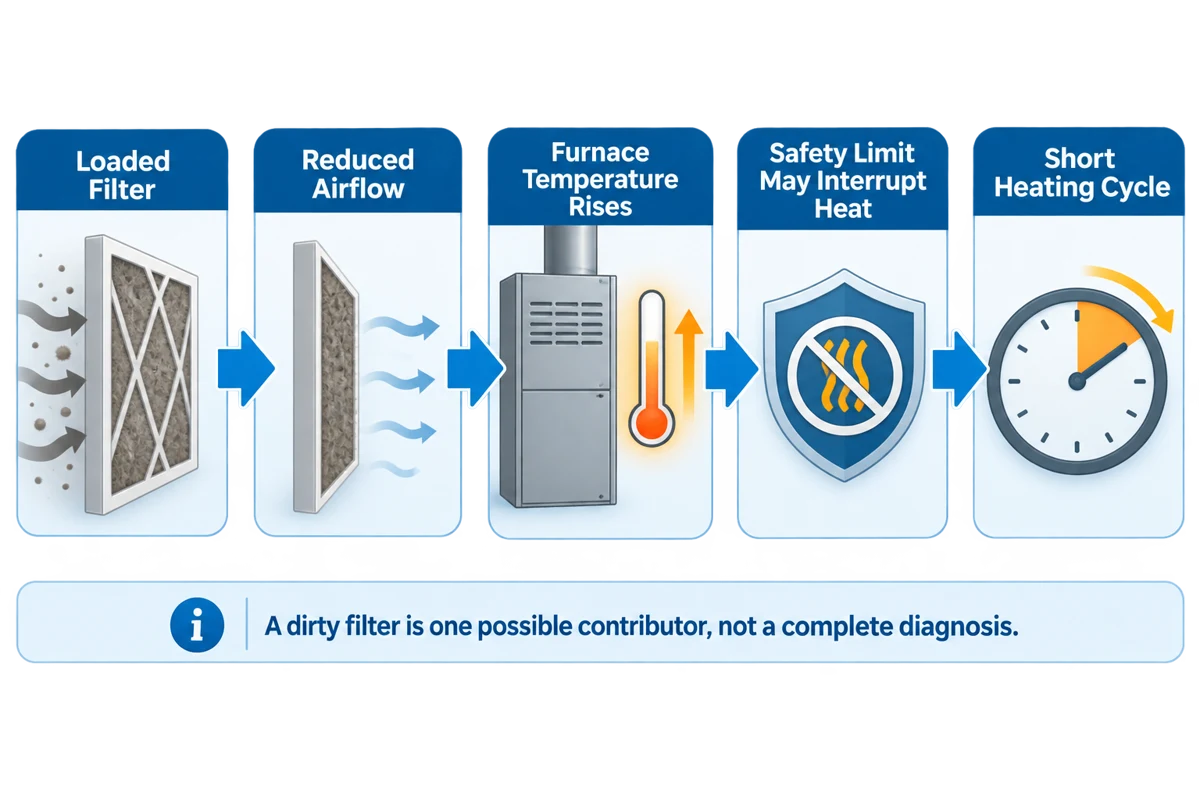
Yes. A dirty or overly restrictive air filter can contribute to furnace short cycling by reducing airflow. In some furnaces, insufficient airflow can allow internal temperature to rise until a protective limit interrupts the heating cycle. The furnace may cool, restart, and stop again.
That sequence is plausible, not guaranteed. Replacing a genuinely loaded filter is a sensible first check, not a promised repair. If the filter is clean, dry, correctly sized, and properly seated—or if short cycling continues after replacement—the source likely requires diagnosis beyond the filter.
What Does Furnace Short Cycling Mean?
Short cycling describes a furnace that begins a heating cycle, stops sooner than expected, and may restart repeatedly. The home may struggle to reach the thermostat setting, or the furnace may appear to quit shortly after heat begins. This is different from normal cycling after the home reaches its target temperature.
There is no universal number of minutes that defines a short cycle for every furnace and home. Weather, equipment capacity, thermostat settings, building heat loss, and furnace design all affect cycle length. The useful clue is a repeatable change from the system's normal behavior, especially when rooms are not warming as expected.
Short cycling is also different from the longer run times associated with many clogged-filter symptoms. A restricted furnace may stop heat through a protective response, while a cooling system with weak airflow may run longer trying to satisfy the thermostat. Equipment type and controls matter.
How Can a Dirty Filter Contribute?
A forced-air furnace depends on air moving through the return path, filter, blower, heat exchanger area, supply ducts, and registers. As a filter collects dust, fibers, and other debris, its resistance generally increases. If loading becomes severe enough, the system may move less air.
In some furnaces, reduced airflow can mean less heat is carried away from the furnace during operation. Temperature may rise until a safety limit interrupts burner operation. After the furnace cools, heating may resume. If the airflow problem remains, that stop-and-restart pattern can repeat.
Manufacturers including Trane, Carrier, and Lennox identify dirty-filter or airflow restriction as a possible short-cycling contributor. None of that means the cycle pattern proves the filter is responsible.
When Is the Filter a More Plausible Contributor?
The filter explanation becomes more credible when several observations line up:
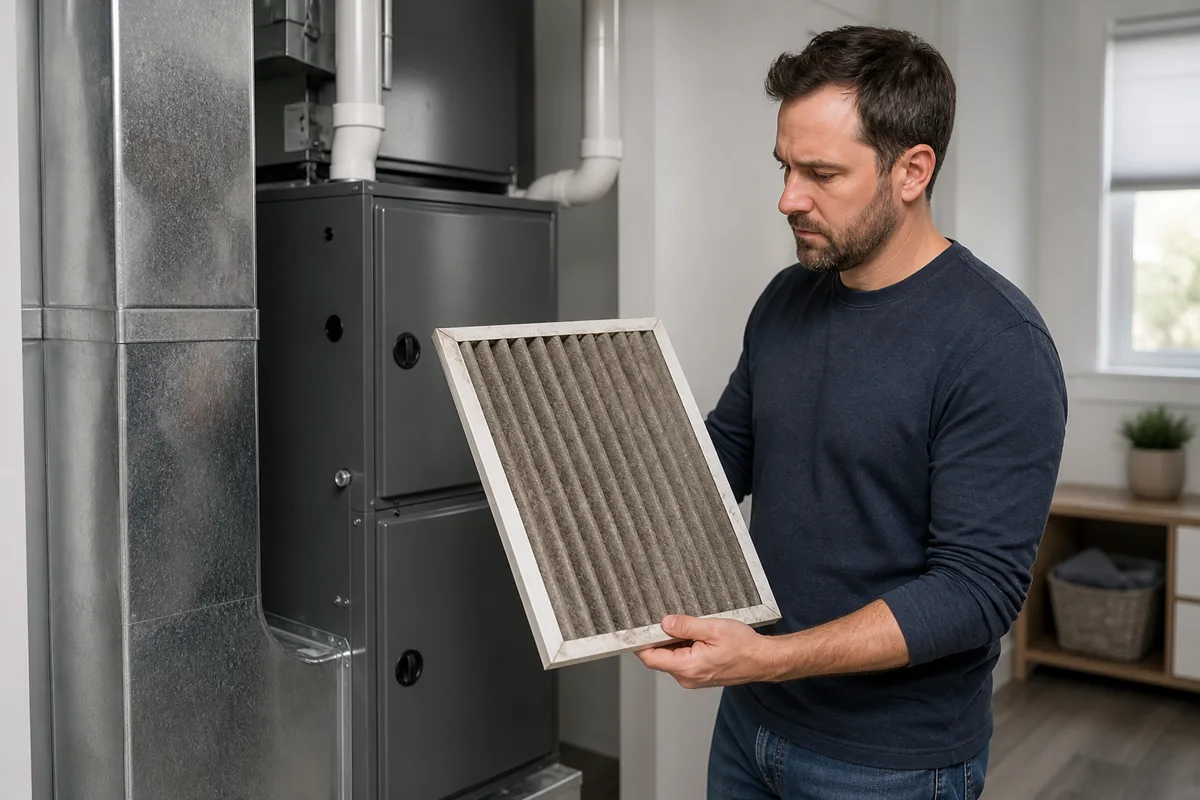
- The filter is visibly matted or heavily loaded, not merely a little gray.
- The frame or media is bent, collapsed, damp, torn, or out of its track.
- Airflow has weakened at several supply vents.
- Short cycling appeared as the filter became loaded.
- The filter is the wrong size, is forced into the rack, or does not sit correctly.
- A different filter product was installed just before the behavior changed.
- Normal operation returns after a correct clean replacement is installed.
Each clue changes plausibility; none proves a cause by itself. A dirty filter may be present while a separate thermostat, ignition, airflow, or furnace problem causes the cycling.
When Is the Filter a Weaker Suspect?
The filter hypothesis becomes weaker when the filter is clean, dry, undamaged, correctly sized, correctly oriented, and seated in its intended track. It also weakens when airflow seems normal at multiple vents, short cycling began independently of a filter change, or a clean correct replacement makes no difference.
Do not keep changing MERV ratings or buying filters as an experiment. If the same behavior continues with the intended filter, treat the cycle as a furnace problem that needs appropriate evaluation.
Can a Clean Filter Be Too Restrictive?
It can be too restrictive for a particular system, but MERV alone does not determine pressure drop. Filter depth, face size, pleat design, media area, construction, airflow, and the furnace/filter-cabinet design all matter. Two filters carrying the same MERV rating can behave differently.
If short cycling began immediately after switching filter products, confirm that the dimensions, depth, and rating agree with equipment or filter-cabinet guidance. Review whether an air filter can be too restrictive and the comparison of MERV 8, 11, and 13. Do not assume the highest number is automatically best or automatically harmful.
Can the Wrong Filter Size Matter?
A filter that is too large may bind, crush, or deform. An undersized filter may sit incorrectly or leave gaps. Either situation means the installation is not behaving as intended, but it does not establish why the furnace is cycling.
Use the exact intended three-dimensional size and check how tightly the filter should fit. Do not trim, fold, stack, tape, or force filters to improvise compatibility.
Safe Homeowner Filter Check
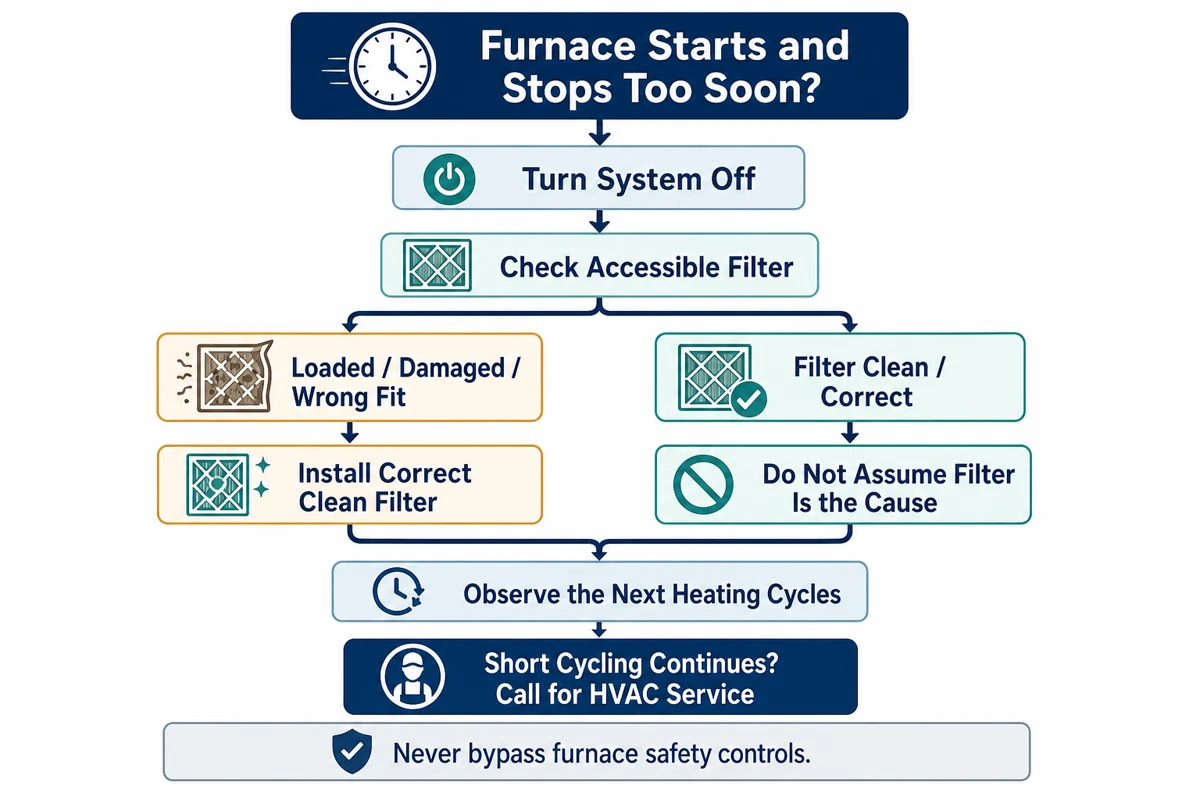
- Set the thermostat so the furnace stops and wait for the blower to stop.
- Use only the normal accessible filter slot, return grille, or media-cabinet door intended for routine filter changes.
- Record the filter's printed size, depth, MERV, and airflow arrow.
- Inspect the incoming-air face for heavy loading or matting.
- Check the frame and media for bending, collapse, tears, or moisture.
- Confirm the filter sits in its intended track without being forced or leaving obvious gaps.
- Replace it if it is genuinely loaded, damaged, wet, the wrong size, or due under equipment and product guidance.
- Confirm accessible supply registers and return grilles are not intentionally blocked by furniture, rugs, or stored items.
- Restart normally and observe whether the next heating cycles still stop unusually soon.
Do not run the furnace without its required filter as a test. Do not remove service panels, enter combustion or blower compartments, touch wiring, or manipulate safety controls.
Free homeowner tool
Need a Correct Replacement?
If the old filter is genuinely loaded or incorrect, confirm the full three-dimensional size first. Filter Wizard can narrow replacement options without assuming the highest MERV is right for every furnace.
Open the Filter FinderWhat Should Happen After Replacing a Loaded Filter?
If filter restriction was the main contributor and no other fault exists, airflow and heating behavior may improve after a clean correct replacement is installed. Observe several normal calls for heat rather than promising an immediate fixed timeline. The furnace should not be repeatedly started and stopped manually for testing.
Improvement supports the filter explanation, but it does not prove that no other condition exists. If the old filter became heavily loaded unusually quickly, investigate household dust sources and replacement habits. Use replacement timing guidance as a starting point, then adjust inspection frequency to actual loading and equipment guidance.
If short cycling continues, stop treating the filter as the complete answer. A clean replacement cannot correct a thermostat, ignition, combustion, equipment-sizing, duct, blower, or safety-control problem.
What If the Filter Is Not the Cause?
Short cycling can have several non-filter causes. High-level categories include thermostat location or control problems, ignition or flame-sensing faults, overheating caused by restrictions elsewhere, blower or duct issues, equipment sizing, and other furnace or safety-control faults. A homeowner cannot identify those causes from cycle length alone.
This guide does not turn those possibilities into repair instructions. Combustion appliances use protective controls because unsafe operation can involve heat, fuel, combustion gases, electricity, or moving equipment. Once the accessible filter and obvious register blockage are ruled out, diagnosis belongs with a qualified HVAC professional.
| Observation | Filter more plausible? | Next step |
|---|---|---|
| Filter heavily loaded and airflow weak | More plausible | Install the correct clean filter and observe |
| Filter crushed, wet, or wrong size | More plausible as a contributor | Correct the filter problem; do not assume it is the only cause |
| Cycling changed immediately after a new filter type | Worth checking | Verify product dimensions and equipment guidance |
| Clean correct filter; cycling continues | Less suggestive | Arrange furnace diagnosis |
| Unusual burning odor, smoke, or breaker trip | Not a filter-only question | Stop normal testing and seek qualified help |
| Heat starts and stops with ignition symptoms | Needs further diagnosis | Do not open or adjust combustion equipment |
When Should You Call for HVAC Service?
Arrange professional evaluation when short cycling continues after installing a clean correct filter, returns repeatedly, or occurs with weak heat, abnormal noise, persistent odors, smoke, a breaker trip, repeated filter deformation, or other unusual operation. Seek help sooner when the filter compartment is damaged or the intended filter cannot be confirmed safely.
Record what you observe: when heat begins, whether the blower starts, when heat stops, whether airflow changed, what filter was installed, and whether replacement changed anything. Those observations are useful. Opening equipment or attempting to reset internal controls is not.
Filter Wizard Recommendation
A dirty filter can contribute to furnace short cycling when restriction reduces airflow enough to affect furnace temperature and protective operation. Start with the accessible filter because it is safe to inspect and simple to correct—not because it explains every short cycle.
Replace a genuinely loaded, damaged, wet, incorrectly sized, or overdue filter with the correct product. If the filter is already clean and correct, or if short cycling continues afterward, move beyond filter troubleshooting and arrange qualified diagnosis. Never defeat a safety control to keep the furnace running.
Filter Wizard recommendation
Confirm Size Before Choosing a Filter
Enter a valid three-dimensional size for cautious MERV guidance, replacement timing, and retailer options. Filter Wizard cannot diagnose a furnace or verify system compatibility.
Start the Filter FinderFree Filter Reminders
Remember Your Next Filter Check
Get occasional filter reminders, homeowner maintenance tips, and buying guidance.
Occasional emails only. Unsubscribe anytime.
You're on the list. We'll send practical filter reminders and updates occasionally.
Frequently Asked Questions
Can a dirty air filter cause a furnace to short cycle?
A dirty or overly restrictive filter can contribute to short cycling by reducing airflow. In some furnaces, rising temperature can lead a safety limit to interrupt heating, but the filter is only one possible cause.
What does furnace short cycling mean?
Short cycling means the furnace starts a heating cycle, stops sooner than expected, and may restart repeatedly without completing a normal comfort cycle. The exact normal pattern varies by home and equipment.
How does a dirty filter make a furnace overheat?
A heavily loaded filter can reduce the air moving through the furnace. In some systems, insufficient airflow can let furnace temperature rise until a protective limit interrupts heat. This is a possible sequence, not proof from cycling alone.
Will replacing the filter stop furnace short cycling?
It may help when the old filter was genuinely loaded, damaged, incorrectly fitted, or unusually restrictive. If short cycling continues with a clean correct filter, the cause needs diagnosis beyond the filter.
How can I tell whether the filter is the likely cause?
The filter is more plausible when it is heavily loaded or damaged, airflow weakened, and cycling changed as loading increased. A clean, dry, correctly fitted filter makes the filter hypothesis weaker.
Can a clean high-MERV filter cause short cycling?
A particular filter can be too restrictive for a particular system, but MERV alone does not determine pressure drop. Product construction, dimensions, depth, airflow, loading, and equipment compatibility all matter.
Can the wrong filter size contribute to short cycling?
A wrong-size or poorly seated filter can deform, bind, leave bypass gaps, or behave differently from the intended filter. Correct size and fit matter, but an incorrect filter does not prove the reason for short cycling.
Should I run the furnace without a filter to test it?
No. Do not intentionally operate a system that requires a filter without the correct filter in place. Running without it can let debris reach downstream equipment and is not a safe diagnostic shortcut.
Should I reset or bypass the furnace limit switch?
No. Never bypass, jumper, reset, or modify furnace safety controls for testing. Persistent short cycling requires qualified HVAC diagnosis.
What else can cause a furnace to short cycle?
Possible categories include thermostat or control issues, ignition or flame-sensing problems, airflow restrictions elsewhere, equipment sizing, overheating for another reason, and other furnace faults. Cycling alone does not identify one cause.
What should I check before calling an HVAC professional?
With the system off, inspect the accessible filter for loading, damage, moisture, correct size, direction, and seating. Keep accessible supply and return grilles unobstructed and record what the cycle is doing.
When should furnace short cycling be serviced?
Arrange service when short cycling continues with a clean correct filter, returns repeatedly, includes unusual odors or noises, produces weak airflow or poor heat, trips a breaker, or cannot be evaluated safely.