Quick Answer
Disposable filters are usually easier to maintain and are available in a wider range of MERV ratings, while washable filters can reduce replacement purchases if they are cleaned correctly and allowed to dry completely. Neither is automatically better. Compare filtration, airflow resistance, maintenance, cost, and system compatibility before choosing.
Washable HVAC filters can last for years when properly maintained, but performance varies substantially by product. Disposable filters are simpler to replace and include many higher-MERV options. Your actual choice should reflect the system, household needs, maintenance habits, and total cost over time.
What Is a Washable HVAC Filter?
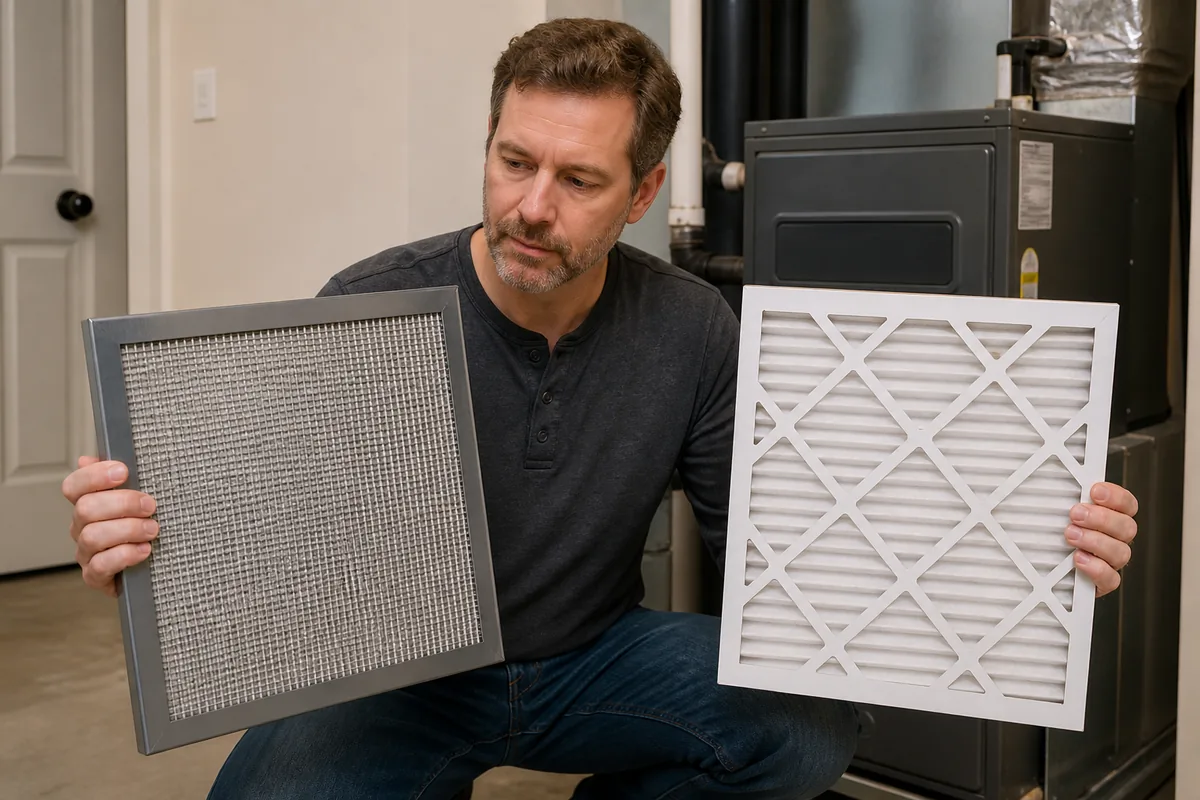
A washable HVAC filter is designed specifically for repeated cleaning. Depending on the product, it may use electrostatic synthetic media, woven metal mesh, layered plastic material, or another durable medium inside a rigid reusable frame. “Washable,” “reusable,” and “permanent” describe intended maintenance, not one standard level of performance.
These filters must be cleaned by the manufacturer’s method, dried completely, inspected, and reinstalled correctly. They are not maintenance-free, and “permanent” does not mean they last forever. Filtration efficiency and resistance can vary substantially between products that look similar.
If a filter is not explicitly labeled washable or reusable, treat it as disposable. The guide on vacuuming and reusing an air filter explains why cleaning a single-use filter does not restore it.
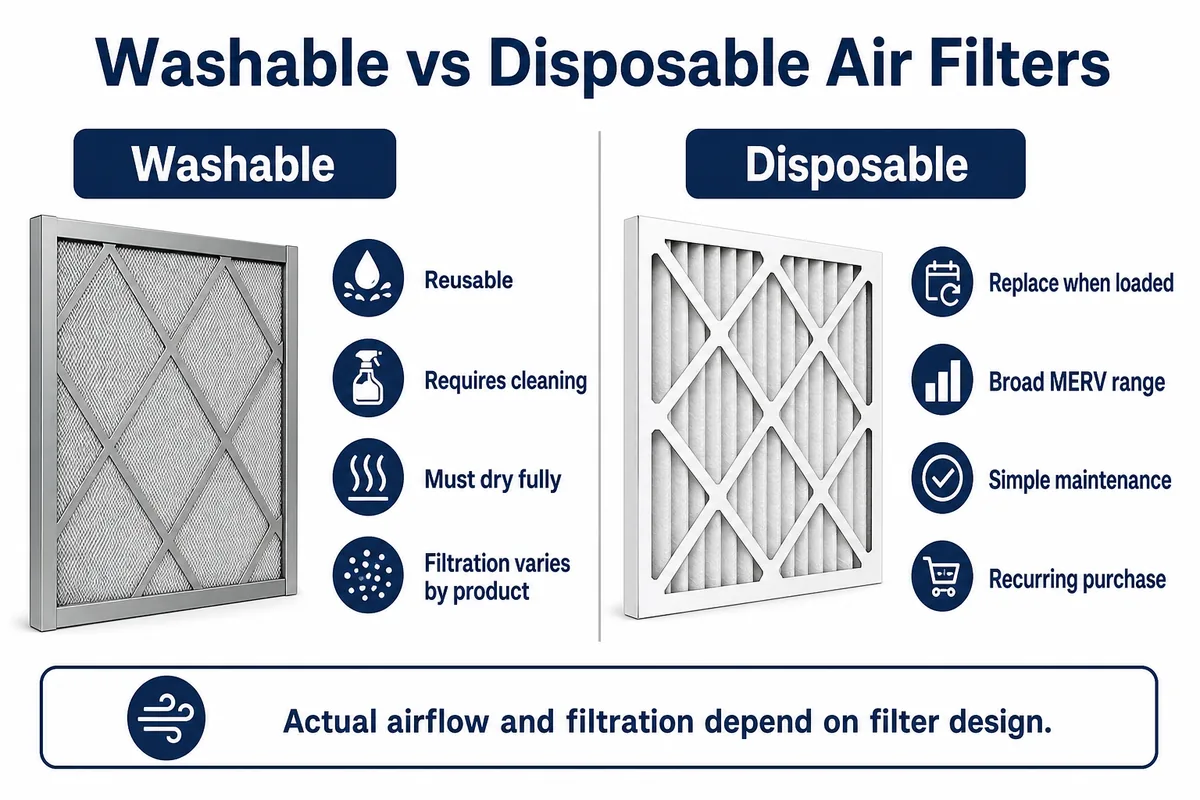
Washable filter advantages
- Repeated use may reduce replacement purchases.
- A durable frame can remain in service through many cleaning cycles.
- Some products offer relatively open media and manageable initial resistance.
- Reuse may reduce the number of filters discarded.
Washable filter tradeoffs
- Cleaning and full drying require time and planning.
- Available tested filtration levels vary.
- Incomplete cleaning can leave debris and resistance behind.
- Damage, corrosion, or deterioration can eventually require replacement.
What Is a Disposable HVAC Filter?
A disposable HVAC filter is designed to be replaced when loaded rather than washed. It may use flat fiberglass media, folded synthetic media, cotton-blend material, or other pleated construction. Disposable is a use model, not a quality rating.
Some disposable products provide basic equipment protection; others carry stronger tested MERV ratings and contain substantial pleated media. Depth, media area, MERV, fit, and construction determine performance. Compare fiberglass and pleated air filters before treating all disposable options as interchangeable.
Disposable filter advantages
- Simple inspection-and-replacement routine.
- Broad selection of sizes, depths, and MERV ratings.
- No cleaning or drying period.
- Consistent new media at each replacement.
Disposable filter tradeoffs
- Recurring purchase cost.
- Used filters and packaging enter the waste stream.
- Replacement intervals vary with household conditions.
- Higher efficiency or deeper products may cost more.
Washable vs. Disposable Filters at a Glance
| Feature | Washable / Reusable | Disposable |
|---|---|---|
| Upfront cost | Often higher | Often lower |
| Recurring purchase cost | Usually lower while serviceable | Ongoing |
| Maintenance effort | Higher | Lower |
| Cleaning requirement | Manufacturer-directed | Do not clean |
| Drying requirement | Must dry fully | None |
| MERV availability | Product-dependent | Broad range |
| Filtration range | Varies substantially | Basic through higher efficiency |
| Airflow resistance | Varies by product and condition | Varies by product and loading |
| Lifespan | Potentially years; maintenance-dependent | One service cycle |
| Convenience | Requires a routine | Simple replacement |
| Waste generation | Potentially fewer discarded filters | Recurring filters and packaging |
| Best reason to choose | Reuse with committed maintenance | Convenience and broader selection |
These are general tendencies, not guarantees. Actual airflow, filtration, cost, and service life depend on the specific product, system, household, and maintenance.
Which Filters More Particles?
Reusable or disposable status does not directly measure particle capture. The specific MERV rating or other documented test result matters more. Disposable pleated filters are available across a broader range of residential MERV ratings, so shoppers can generally find more higher-efficiency choices in that category.
Some washable products prioritize reuse and relatively open airflow over capture of finer particles. Others carry tested efficiency ratings. A high purchase price, metal frame, electrostatic label, or visible mesh does not prove a particular MERV.
No residential HVAC filter captures everything. Use the MERV 8, MERV 11, and MERV 13 comparison to weigh particle capture against system compatibility without turning filter selection into a medical promise.
Which Provides Better Airflow?
Neither category automatically wins. Some washable filters use open mesh with relatively low initial resistance. Some use denser layers that resist more airflow. Some disposable pleated filters create more resistance than basic fiberglass filters, while well-designed pleated products use generous media area to manage airflow at a useful efficiency.
Media area, depth, pleat spacing, face size, airflow rate, rating, and loading all matter. A dirty disposable filter becomes restrictive. A washable filter can also become restrictive when debris remains in the media after incomplete cleaning.
The full guide to filters that may be too restrictive explains why product data and system behavior matter more than a category label. The comparison of 1-inch, 2-inch, and 4-inch filters also shows how depth can change available media area.
Are Washable Filters More Restrictive?
Sometimes, and sometimes not. Reusable construction ranges from open metal mesh to layered synthetic media. “Washable” alone does not tell you whether a filter is restrictive.
Review a product’s MERV and pressure-drop or resistance information when available. Confirm that its exact dimensions and depth fit the intended rack. After installation, pay attention to meaningful changes such as weak airflow, new whistling, or filter movement, while remembering that these signs can have causes beyond the filter.
Cleaning quality affects performance. Residue, embedded debris, bent mesh, or damaged media can change how air moves through a reusable filter. If normal cleaning no longer restores condition, replacement or professional guidance may be appropriate.
Which Costs Less Over Time?
Washable filters often cost more upfront. Repeated use may reduce replacement purchases, but cleaning consumes time and may use water or manufacturer-approved cleaners. The filter can still require eventual replacement because of corrosion, damaged media, a distorted frame, or degraded performance.
Disposable filters often cost less per unit but create recurring purchases. Higher-MERV products, uncommon sizes, and deep media filters may cost more. Multipacks can reduce unit cost, but confirm one filter fits and performs normally before buying several.
Long-term cost depends on purchase price, service life, cleaning habits, replacement frequency, and how much the homeowner values maintenance time. Neither type is universally cheaper, and a filter that does not meet system or filtration needs is poor value at any price.
How Much Maintenance Does Each Require?
Washable filter routine
A washable filter must be removed, cleaned according to its instructions, allowed to dry fully, inspected for damage, and reinstalled in the correct orientation. You may need a second compatible filter if the HVAC system must operate while the first dries. Never reinstall a damp filter merely to avoid downtime.
Disposable filter routine
A disposable filter needs regular inspection and replacement when loaded, damaged, wet, or at the applicable manufacturer interval. Installation still requires the correct size, thickness, and arrow direction, but there is no washing or drying step.
Convenience is a genuine tradeoff. A reusable filter saves no effort if cleaning is postponed, rushed, or done incorrectly. A disposable filter is not maintenance-free either; forgetting replacement can allow heavy loading and airflow problems.
How Long Do Washable Filters Last?
A reusable HVAC filter may remain serviceable for years, depending on the product, but no single lifespan applies to the category. Frame construction, media durability, cleaning method, frequency, corrosion, damage, and manufacturer guidance all affect useful life.
“Permanent” should not be read literally. Replace a reusable filter when the frame no longer seals, media is torn or separated, mesh is bent, corrosion develops, or approved cleaning no longer restores usable condition. Follow product-specific limits rather than extending service solely to justify the upfront cost.
Disposable service life also varies. The guide to how often to change an air filter explains how runtime, pets, dust, smoke, renovations, thickness, and season affect inspection and replacement.
Are Washable Filters More Environmentally Friendly?
Reuse can reduce the number of filters and packages discarded. That is a meaningful potential advantage, but it is not a complete lifecycle comparison.
Cleaning uses water and sometimes approved cleaning products. Materials, manufacturing, transportation, real service life, local disposal, and how often a homeowner replaces either product also contribute. A reusable filter discarded early because it was damaged or neglected will not deliver the same reuse benefit as one maintained for a long service life.
The cautious conclusion is that reuse can reduce filter waste, while the total environmental comparison depends on the product and how it is maintained. Without verified lifecycle data for the exact alternatives, broad “greener” claims are not justified.
Which Is Better for Homes With Pets?
Disposable pleated filters generally offer a broader range of higher-efficiency filtration options. That can be useful in homes where pet-related particles, hair, and household dust increase filter loading. A washable filter may also work when its tested rating meets the household need and the owner cleans it consistently.
Multiple pets or heavy shedding may shorten the useful interval for either type. Inspect condition rather than relying only on the calendar. Keep up with routine floor, textile, and return-grille cleaning because the HVAC filter is only one part of household dust control.
Which Is Better for Dust?
Higher-efficiency disposable pleated filters often capture smaller dust particles more effectively than basic washable mesh products. That is a common tendency, not a rule for every product. Compare actual tested efficiency.
Correct fit matters. Air that slips through gaps around either filter bypasses the media. No HVAC filter eliminates all dust because particles also settle on surfaces and enter through normal household activity, open doors, outdoor air, and leaks.
If loading seems unusually fast, read why a filter gets dirty quickly. If the pattern is concentrated, the guide to one-sided filter dirt can help separate normal airflow patterns from issues that deserve investigation.
Can Washable Filters Be MERV 11 or MERV 13?
Some reusable products may carry tested efficiency ratings at MERV 11, MERV 13, or another level. Not every washable filter reaches those ratings, and some products use marketing language that should not be treated as equivalent to a verified MERV result.
MERV and washable status are separate properties. A disposable filter can be low-MERV or high-MERV; a reusable filter can also vary. Higher MERV is not automatically better for every system. Confirm equipment support, fit, depth, and product-specific airflow information before increasing filtration.
How to Clean a Washable Filter Safely
This checklist applies only to a filter explicitly designed for cleaning. If the label or instructions do not say washable or reusable, replace it.
- Turn the HVAC system off at the thermostat.
- Remove the filter from its normal accessible location.
- Note the airflow direction and orientation.
- Follow the manufacturer’s cleaning instructions.
- Remove loose debris only if permitted.
- Rinse only if the product is designed for rinsing.
- Use only manufacturer-approved cleaners.
- Avoid high-pressure spray unless specifically allowed.
- Allow the filter to dry completely.
- Inspect the frame and media for damage.
- Reinstall it in the correct direction.
- Monitor airflow after cleaning.
Do not use bleach, solvents, oils, coatings, compressed air, or pressure washing unless the manufacturer expressly directs it. Never reinstall a damp filter.
Which Should You Choose?
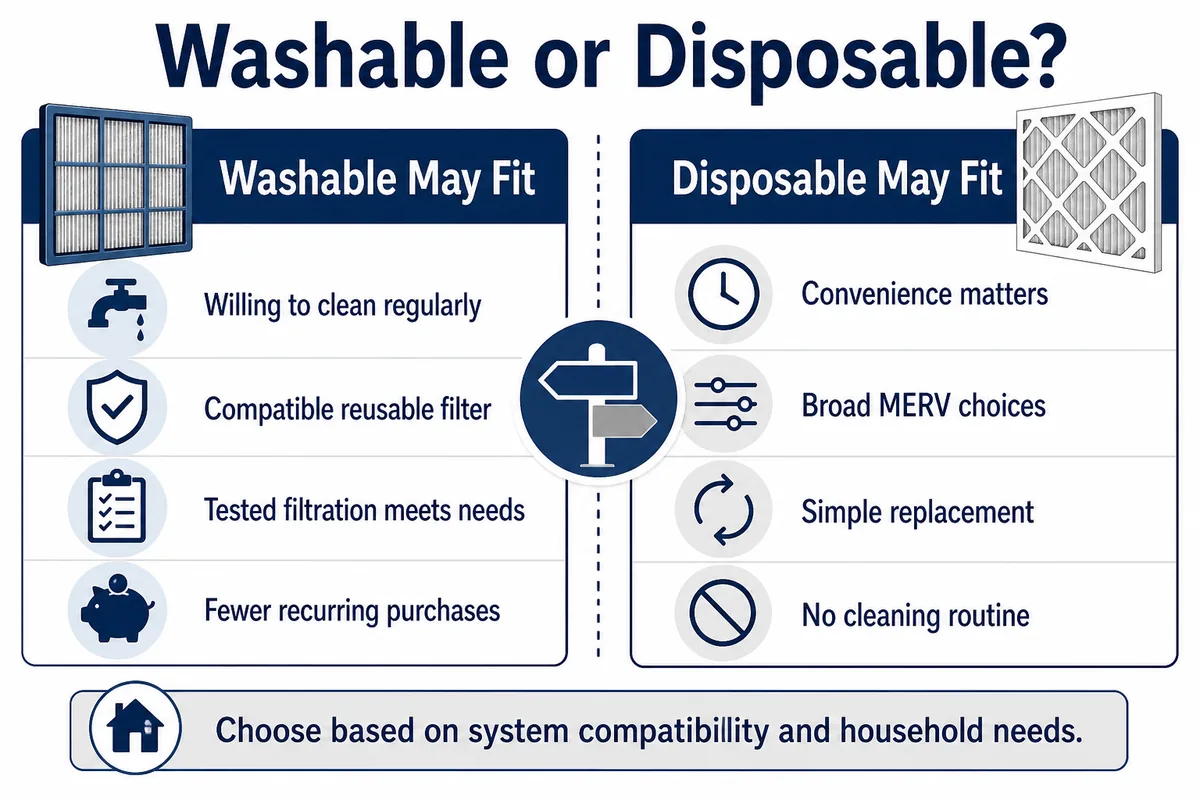
Washable may make sense if:
- The system supports the exact reusable product.
- You are willing to clean it consistently.
- Its tested filtration meets household needs.
- Reuse and fewer replacement purchases are priorities.
- You can accommodate complete drying time.
Disposable may make sense if:
- Convenience is the priority.
- Broader MERV choices are useful.
- Stronger particle-capture options are desired.
- Simple replacement is preferable.
- You do not want a cleaning and drying routine.
Before buying, confirm all three filter dimensions. Exact-size guides for 16 × 25 × 1, 20 × 20 × 1, and 20 × 25 × 1 can help after the physical size is known.
Free homeowner tool
Not sure which filter type fits your home?
Confirm the exact size first, then use Filter Wizard for cautious MERV guidance, replacement timing, and retailer options based on household conditions.
Open the Filter FinderWashable or Disposable: Quick Decision Guide
Washable may fit
- You will clean it regularly.
- The reusable product is compatible.
- Tested filtration meets your needs.
- Fewer recurring purchases matter.
Disposable may fit
- Convenience matters.
- Broad MERV selection is useful.
- Simple replacement is preferred.
- You do not want a cleaning routine.
Filter Wizard Recommendation
Filter Wizard generally recommends choosing based on filtration needs, HVAC compatibility, and maintenance habits rather than focusing only on whether a filter is reusable. Washable filters can work well for homeowners willing to maintain them properly, while disposable pleated filters often provide broader filtration choices and simpler upkeep.
Confirm the exact size, MERV rating, airflow compatibility, and manufacturer guidance before choosing. If product resistance is available, compare it at the relevant airflow rather than relying on appearance. Filter Wizard cannot inspect your system or guarantee compatibility.
A washable filter that is cleaned and dried correctly can be a practical option. A disposable filter that fits, meets the household need, and is replaced consistently can also be practical. The best option is the compatible one you will maintain.
Filter Wizard recommendation
Choose after confirming size and system support
Enter a confirmed three-dimensional size for cautious MERV guidance, replacement timing, household-condition guidance, and current retailer options.
Open the Filter FinderFree Filter Reminders
Remember Your Next Filter Check
Get occasional filter reminders, homeowner maintenance tips, and buying guidance.
Occasional emails only. Unsubscribe anytime.
You're on the list. We'll send practical filter reminders and updates occasionally.
Frequently Asked Questions
Are washable air filters worth it?
They can be when a compatible product meets your filtration needs and you will clean, dry, and inspect it consistently. Purchase price alone does not determine long-term value.
Are washable air filters better than disposable filters?
Not automatically. Washable filters emphasize reuse, while disposable filters offer simpler upkeep and broader MERV choices. The better option depends on the product, system, and household.
Do washable air filters work well?
Some do. Review the product's tested efficiency, resistance information, fit, and cleaning instructions rather than judging performance from washable construction alone.
Are washable filters more restrictive?
Sometimes, but not as a category. Resistance depends on media, frame, rating, airflow, condition, and debris loading. Poor cleaning can also leave a reusable filter restrictive.
Which type filters more particles?
Disposable pleated filters are available across a broader range of MERV ratings, including many stronger options. Compare tested ratings for the specific products.
Which type costs less over time?
It varies with upfront price, service life, cleaning supplies, replacement frequency, and the value of maintenance time. Neither type is universally cheaper.
How long do washable HVAC filters last?
A reusable filter may remain serviceable for years, but there is no universal lifespan. Material, cleaning, corrosion, damage, use, and manufacturer guidance determine replacement.
How often should washable filters be cleaned?
Follow the product instructions and inspect condition regularly. Runtime, pets, dust, smoke, season, and filter design can shorten the interval.
Can washable filters be MERV 11 or MERV 13?
Some reusable products may carry tested ratings at those levels, but many do not. Verify the specific rating and HVAC compatibility rather than assuming.
Are washable filters good for pets?
They may be if their tested filtration meets the household need and they are maintained often enough. Disposable pleated filters generally offer more high-efficiency choices.
Are washable filters good for dust?
Performance varies. A properly fitted washable filter with a suitable tested rating can capture dust, while higher-efficiency disposable pleated options may capture smaller particles.
Can I wash a disposable pleated filter?
No. Unless the manufacturer explicitly labels it washable or reusable, replace it. Washing disposable media can damage its structure and does not restore tested performance.
Can I reinstall a washable filter while damp?
No. Let it dry completely according to the manufacturer instructions before reinstalling it. A damp filter can create avoidable maintenance problems.
Which filter should I choose for my home?
Confirm the exact size, system support, desired MERV, product resistance, and your willingness to maintain it. Choose a compatible filter you can care for consistently.