Quick Answer
An air filter that is dirty on only one side or in one area usually reflects uneven airflow, air bypass around the filter frame, a loose or incorrect fit, the filter's position in the rack, or localized dust entering through the return. Uneven dirt does not automatically mean the HVAC system is failing or that the ducts need cleaning.
Some uneven loading is normal because return-air flow is rarely perfectly uniform. Obvious clean gaps around the edges may suggest bypass. A bent or loose filter can also create uneven patterns, while moisture, black residue, or rapid loading may point to separate issues. Filter appearance alone cannot identify duct leakage or equipment failure.
Free homeowner tool
Need help confirming the correct size and MERV rating?
Confirm the physical dimensions first, then use Filter Wizard for cautious MERV guidance, replacement timing, and retailer options.
Open the Filter Finder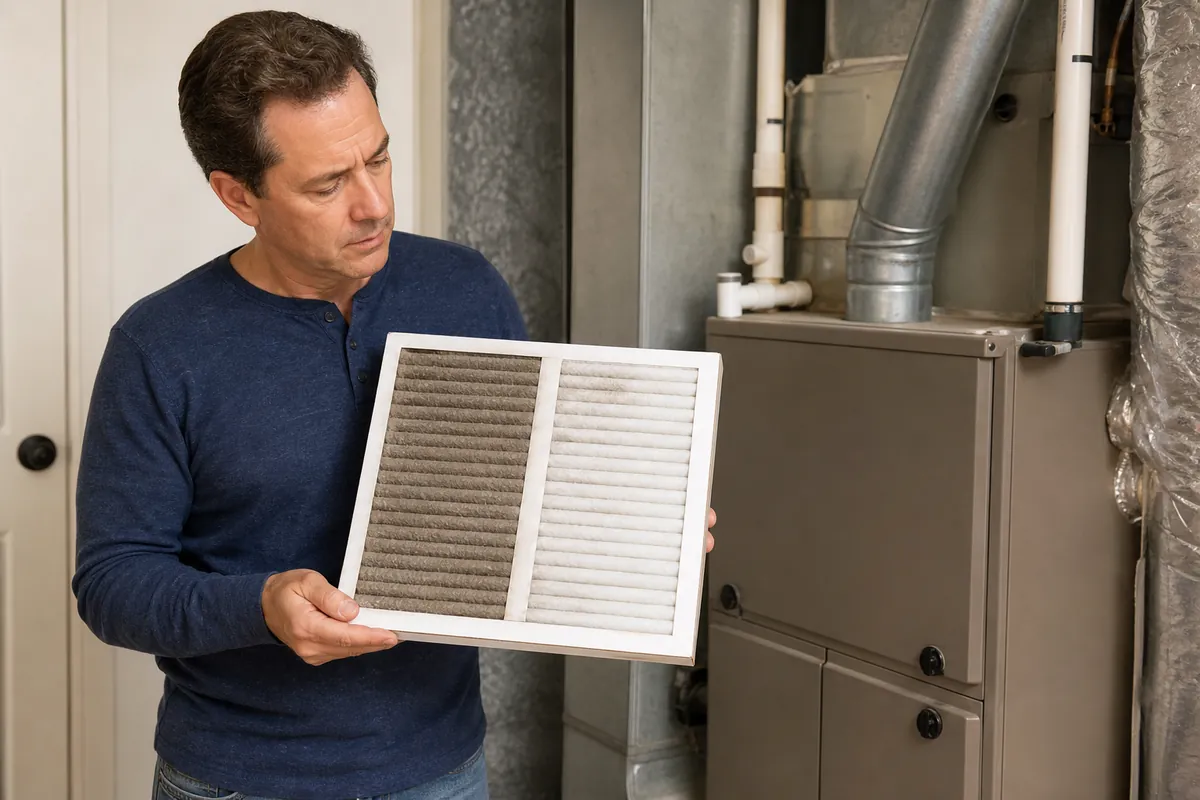
Is Uneven Dirt on an Air Filter Normal?
Perfectly uniform dirt across every pleat is uncommon. Air approaches a return grille from different parts of a room, passes through louvers, turns through duct transitions, and reaches the filter at different speeds. Pleat shape and support grids can also make some areas look darker than others.
Mild differences that develop gradually may be normal. The timeline matters: one half becoming slightly grayer over a normal replacement interval is different from one corner turning dark within days. Compare the pattern with airflow, noise, fit, and filter condition instead of judging color alone.
Very clean strips beside visible gaps, a large clean half next to a heavily loaded half, or recurring one-corner buildup deserves a fit check. Photographing the filter before removal preserves its position and makes the replacement easier to compare.
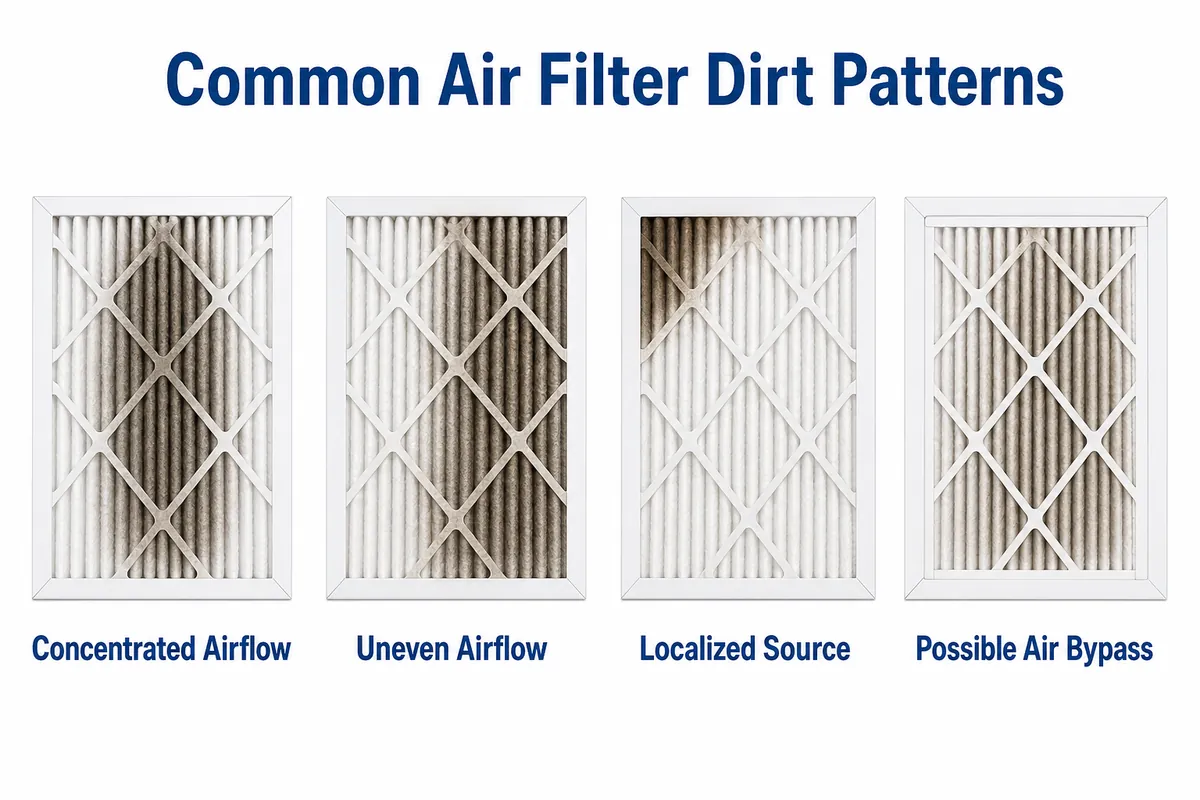
Air Filter Dirt Patterns at a Glance
| Filter pattern | Possible explanation | What to check | Likely next step |
|---|---|---|---|
| One half dirtier than the other | Uneven return airflow or a local dust source | Fit, orientation, nearby particles | Replace if due and monitor |
| Center dirtier than edges | Flow concentrated through the middle | Edge gaps and seating | Monitor mild loading |
| Edges dirtier than center | Perimeter flow or sticky residue | Frame, moisture, grille pattern | Inspect before replacing |
| One corner very dark | Localized flow, gap, water, or particles | Dryness and accessible fit | Address the separate clue |
| Clean strip around frame | Possible bypass or low edge flow | Visible gaps and actual fit | Reseat the correct size |
| Clean area near a gap | Air may travel around the media | Track and frame contact | Correct accessible seating |
| One side black or greasy | Soot, cooking residue, or a local source | Texture, odor, household source | Replace and investigate source |
| One side damp | Condensation or nearby water | Moisture and drainage clues | Replace wet filter; correct source |
| Dirt near return opening | Localized room particles | Pets, textiles, renovation dust | Reduce source and monitor |
| Uneven dirt plus a bent frame | Poor fit, support, or restriction | Frame and rack seating | Replace damaged filter |
| Uneven dirt plus whistling | Gap or restricted pathway | Accessible edges and grille | Correct fit; call if persistent |
| Same pattern returns quickly | Persistent airflow, bypass, or source | Timing, fit, noise, airflow | Consider evaluation |
Normal Return-Air Patterns
Air does not always enter a filter face evenly. A return duct may connect closer to one side, or an elbow and transition may direct more air through one area. A ceiling or wall grille can also favor certain sections. Those conditions can make a furnace filter dirty on one side while the opposite side remains lighter.
The physical arrangement matters. A filter installed directly behind a return grille sees the grille's louver pattern and room airflow. A furnace-slot filter may see air immediately after a duct turn. A media cabinet may distribute air differently across a deeper filter. None of those arrangements is universal.
Mild, gradual unevenness is not automatically a repair problem. If the filter is correctly sized, flat, dry, fully seated, and loading slowly without weak airflow or noise, the pattern may simply reflect system geometry. Monitor the replacement rather than treating the filter as a pressure gauge.
Air Bypass Around the Filter Frame
Air follows an easier path when a gap exists. Instead of moving through the media, some air can pass around an undersized frame, a tilted corner, a loose track, or a damaged gasket. That reduces effective filtration and may leave an obvious clean strip near the bypass path.
A clean gap does not prove that all nearby air bypassed the filter, because edge airflow can naturally be lower. Pair the appearance with visible evidence: does the frame sit against its track, can it slide sideways, or is one corner pulled away? With the system off, inspect only accessible edges.
Do not tape inside equipment, fabricate supports, or alter ductwork. If damaged hardware or a hidden opening prevents a correctly sized filter from seating, a qualified HVAC professional can evaluate the rack without relying on the dirt pattern alone.
Incorrect Filter Size or Loose Fit
Nominal dimensions are shopping labels; actual dimensions are often slightly smaller and vary by manufacturer. An undersized filter may slide toward one side and leave a gap. An oversized filter forced into place can tilt, wrinkle, or bend. Either condition changes how air reaches the media.
Use the size printed on a properly fitting old filter when it remains readable, and confirm length, width, and thickness. The guide to finding your air filter size explains nominal versus actual dimensions and safe measurement.
Filter Wizard also maintains guides for 20x25x1 filters, 16x25x1 filters, and 20x20x1 filters. Those pages help after you identify the nominal size; they cannot confirm that a dimension fits your physical rack.
A filter should sit squarely and snugly without being crushed or forced. A small amount of manufacturer clearance is normal. A large visible opening, repeated movement, or a frame that cannot rest on its intended rails is not something to solve by buying a multipack and hoping for a better fit. See how tightly an air filter should fit; if a gap produces noise, review why an air filter may whistle.
Bent Filters and Filter-Rack Support
A bent frame can pull away from one edge and create a bypass gap. Air may then favor the remaining supported area, leaving uneven dust. Heavy loading can contribute to deformation, but a damaged frame may also reflect wrong sizing, weak construction, missing rails, a large unsupported span, or poor seating.
The guide to why an air filter bends or bows inward explains how fit, loading, support, and airflow interact. Replace a damaged disposable filter rather than flattening it and putting it back.
Support problems can be subtle. A filter may lean because one rail is loose, or a broad return-grille filter may shift when the grille closes. Check only visible, accessible contact points. If intact rails do not support a correctly sized replacement or the filter repeatedly moves, request evaluation rather than improvising cabinet modifications.
Localized Household Dust Sources
A return near a pet bed, litter box, rug, laundry area, workshop, open window, fireplace, or active renovation can collect a concentrated stream of particles. Cooking aerosols and candle soot may darken one area, especially when a return is nearby. A room-level source can affect one part of the return path more than another.
Ask what changed. Was furniture moved near the return? Did sanding, drywall work, wildfire smoke, or open-window weather begin recently? Did a pet start sleeping beside the grille? These observations are more useful than assuming the ductwork needs cleaning.
Reduce obvious particle sources where practical and inspect the next filter sooner. The broader guide to why filters get dirty unusually fast covers pets, smoke, construction dust, outdoor particles, runtime, and poor fit.
What Specific Dirt Patterns May Mean
Why is the center dirty but the edges are clean?
The middle may receive the strongest airflow because of duct position, grille geometry, pleat support, or usable filter-face area. Mild center loading can be normal. Very clean edges combined with visible gaps may instead suggest air bypass, so check seating before drawing a conclusion.
The support grid can also change how the media looks. Dust may be more visible in exposed pleat valleys than behind cardboard or wire supports. Compare texture and loading rather than expecting every square inch to match.
Why are the edges dirtier than the center?
Perimeter airflow, the return grille pattern, distorted media, or dust collecting against frame surfaces may darken edges. Moisture or sticky residue can also trap particles along one edge. Texture, odor, timing, and dryness provide more useful context than color alone.
If an edge is greasy, do not assume it is ordinary dust. Nearby cooking, a fireplace, a garage source, or another airborne residue may be involved. Replace the filter when appropriate and investigate the source without claiming a system failure.
Why is only one corner dark?
A corner can align with concentrated airflow, a nearby gap, a localized dust source, cabinet contact, or a water path. If the area is damp, use the guide to why an HVAC filter gets wet. If it is dry but unusually dark or greasy, review the cautions for a black air filter.
Neither appearance proves mold, duct leakage, or combustion trouble. Treat unusual odor, moisture, soot, or recurring residue as separate evidence that may deserve evaluation.
Could Return-Duct Leakage Cause Uneven Dirt?
Return-side leakage can draw particles from an attic, crawlspace, garage, or wall cavity, and a nearby leak could contribute to localized loading. Uneven dirt alone does not prove leakage. Normal airflow geometry, filter fit, and household particles can create similar patterns.
Recurring debris, visible openings at accessible return joints, unusual odors, or contamination that appears rapidly may justify professional inspection. Do not enter unsafe spaces, remove sealed panels, or dismantle ducts based on a filter photograph.
Does Uneven Dirt Mean the Ducts Need Cleaning?
No. Uneven filter dirt alone does not prove that the duct system needs cleaning. Filters are designed to collect particles, and airflow patterns naturally influence where those particles land.
Verify size, fit, direction, dryness, and condition first. Visible contamination, confirmed pest activity, or another documented condition may warrant evaluation, but routine duct cleaning should not be recommended solely from a filter pattern.
Should the Filter Be Replaced?
Replace a disposable filter when it is heavily loaded, due under your normal schedule, torn, wet, bent, collapsed, greasy, odorous, or unable to stay seated. A filter with large bypass gaps also needs the fit corrected before continued use.
Mild one-sided dirt does not automatically require an early replacement if the filter is otherwise dry, intact, properly fitted, and within its normal service interval. Use actual condition and household circumstances alongside the guidance in how often to change an air filter.
Do not vacuum or wash a disposable filter. Vacuuming can damage media without restoring its intended performance. Only products explicitly labeled washable or reusable should be cleaned according to their manufacturer. See whether an air filter can be vacuumed or reused.
Safe Inspection Checklist
- Turn the HVAC system off. Wait for the blower to stop before removing the accessible filter.
- Photograph the filter in place. Preserve which area was dirty and how the frame sat.
- Note airflow orientation. Record which side faced the return and which faced the blower.
- Confirm the printed size. Check length, width, and thickness.
- Check the fit. The frame should sit snugly without being forced.
- Look for visible gaps. Inspect accessible edges and corners only.
- Inspect condition. Note frame deformation, moisture, tearing, grease, odor, or crushed pleats.
- Check the airflow arrow. It should point toward the furnace, blower, or air handler; see the air-filter arrow guide.
- Note nearby particle sources. Include pets, textiles, projects, smoke, windows, and cooking.
- Install a dry, correctly sized replacement. Do not force it or modify the rack.
- Record the date. Photograph the clean replacement while seated.
- Compare after normal operation. Check the pattern after an appropriate interval, not after one brief cycle.
- Escalate persistent clues. Call for evaluation if severe unevenness, bypass, noise, moisture, weak airflow, or repeated deformation continues.
Do not open sealed equipment panels, reach around electrical components, or alter ductwork. Weak airflow and rapid loading can overlap with the signs of a clogged HVAC filter, but filter appearance cannot diagnose the system.
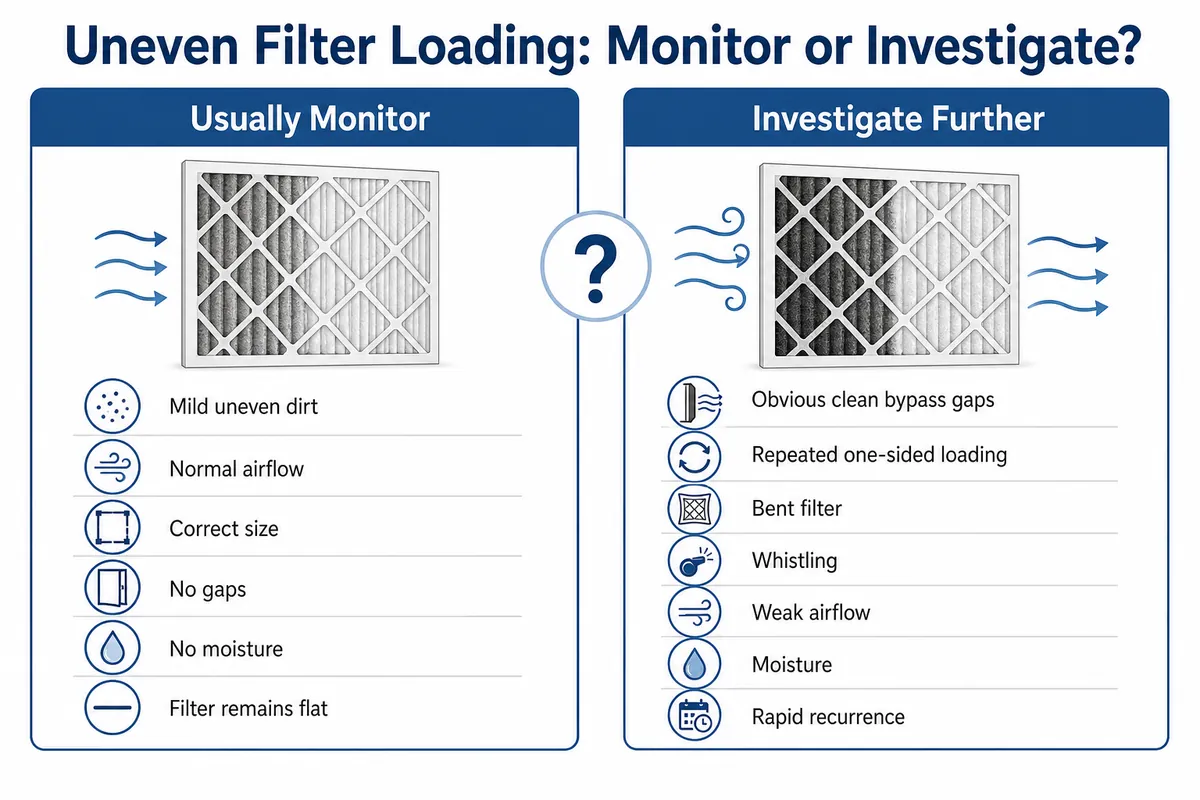
Replace and Monitor or Investigate Further?
Replace and monitor
- Mild uneven dirt developed near the expected replacement interval.
- An obvious incorrect size was corrected.
- A damaged filter was replaced and the new frame stays flat.
- Airflow seems normal, with no whistling or moisture.
- The replacement remains seated without visible gaps.
Consider HVAC evaluation
- The same severe pattern returns quickly.
- The filter repeatedly shifts, bends, or collapses.
- Major gaps remain with the confirmed size.
- Whistling, weak airflow, or a frozen-coil history continues.
- Visible return leakage, unexplained moisture or grease, or debris from inaccessible areas is present.
Filter Wizard Recommendation
Filter Wizard recommends first confirming the filter size, fit, airflow direction, and condition. Mild uneven loading may reflect normal airflow, but obvious clean gaps, repeated one-sided loading, deformation, whistling, moisture, or rapid recurrence deserve closer inspection. Replace damaged disposable filters and monitor how the correctly fitted replacement loads.
Choosing a higher MERV rating is not an automatic fix. Compare MERV 8, MERV 11, and MERV 13 only after confirming equipment guidance and physical fit. Filter Wizard cannot inspect the rack, measure duct leakage, or guarantee compatibility.
Filter Wizard recommendation
Confirm the correct replacement before ordering
Enter a valid three-dimensional size for cautious MERV guidance, replacement timing, household-condition guidance, and current retailer options.
Open the Filter FinderFree Filter Reminders
Remember Your Next Filter Check
Get occasional filter reminders, homeowner maintenance tips, and buying guidance.
Occasional emails only. Unsubscribe anytime.
You're on the list. We'll send practical filter reminders and updates occasionally.
Frequently Asked Questions
Why is my air filter dirty on only one side?
Uneven airflow, a loose or incorrect fit, air bypass, filter position, or a nearby particle source can make one area load faster. The pattern is a clue, not proof of HVAC failure.
Is uneven dirt on an HVAC filter normal?
Mild unevenness can be normal because return airflow is rarely perfectly uniform. Large clean gaps, quick recurrence, noise, moisture, or deformation deserve closer inspection.
Why is the center of my filter dirty?
Air may move most strongly through the center because of duct, grille, or rack geometry. Check for visible edge gaps before assuming the pattern is abnormal.
Why are the filter edges still clean?
Edges may receive less airflow, but a clean strip beside a visible gap can suggest air bypass around the frame. Confirm the filter is correctly sized and seated.
Why is one corner of my furnace filter black?
A corner may receive localized airflow, soot, cooking residue, moisture, or dust from a nearby source. Color alone cannot diagnose mold, leakage, or equipment failure.
Can an incorrect filter size cause uneven dirt?
Yes. An undersized filter can shift and leave gaps; an oversized filter may tilt or bend when forced. Confirm all three dimensions and actual fit.
Can air bypass around the filter?
Yes. Air can move around a loose frame, gap, damaged gasket, or tilted filter instead of through the media, reducing effective filtration.
Can a bent filter cause uneven loading?
Yes. A bent frame can open gaps and change which parts receive airflow. Replace a damaged disposable filter and investigate repeated deformation.
Does uneven dirt mean the ductwork is leaking?
No. Return leakage is one possibility, but normal airflow geometry, filter fit, and household particles can create similar patterns.
Does uneven dirt mean I need duct cleaning?
No. Uneven loading alone does not prove ducts need cleaning. Verify filter fit and condition and seek evaluation only when additional evidence supports it.
Should I replace a filter that is dirty on one side?
Replace it if heavily loaded, due, wet, damaged, greasy, odorous, bent, or bypassing. Mild unevenness alone does not necessarily require an early change.
Can I vacuum the dirty side?
Do not vacuum disposable filters. Replace them. Clean only filters explicitly labeled washable or reusable and follow their instructions.
Does the airflow arrow affect the dirt pattern?
Incorrect direction may affect support and seating on some filters. Point the arrow toward the furnace, blower, or air handler.
Can moisture make one side of the filter darker?
Yes. Moisture can trap particles and darken media. Replace a wet disposable filter and correct the moisture source.
Why does the replacement show the same pattern?
The underlying airflow path, gap, rack position, or local dust source may still be present. Confirm fit and monitor timing, noise, and airflow.
When should I call an HVAC professional?
Call when severe one-sided loading returns quickly, gaps remain, filters deform, whistling or weak airflow continues, moisture is unexplained, or debris appears from inaccessible areas.