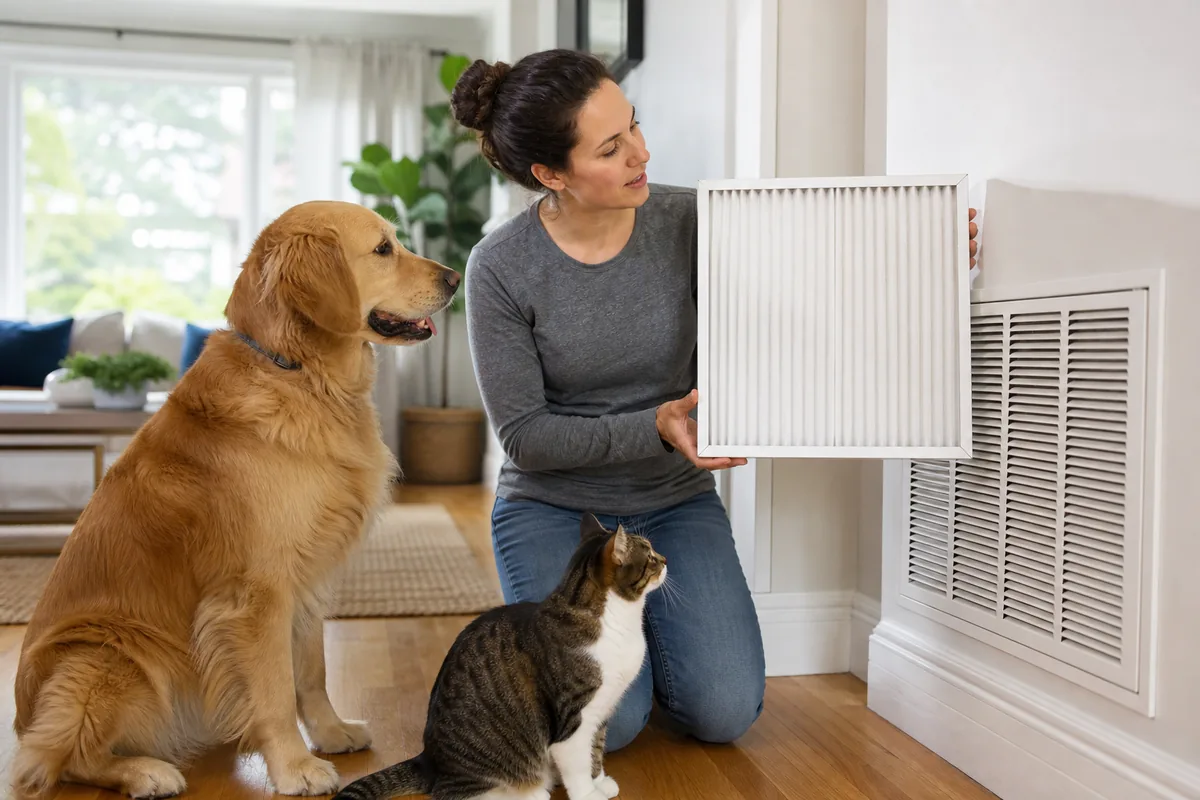
Quick Answer
Start with the filter size your system actually uses. For many pet homes, a pleated MERV 11 filter offers a reasonable balance between capturing smaller airborne particles and avoiding an automatic jump to the highest rating. Choose MERV 8 when system guidance, airflow, or basic filtration needs make it the better fit. Consider MERV 13 only when the equipment or an HVAC professional confirms compatibility.
No central HVAC filter captures every bit of pet hair or every airborne particle. Hair often settles before reaching a return, and filtration only works on air that passes through the filter. Regular floor cleaning, pet grooming, correct filter fit, and routine inspection still matter.
What Pet Owners Actually Need a Filter to Capture
A pet-friendly home can contain several kinds of material: visible hair, household dust, tracked-in soil, pollen carried on fur, and much smaller pet-related particles. These do not behave the same way. Large hairs commonly settle on upholstery or flooring. Smaller particles can remain airborne longer and may reach the return-air path. For a broader dust-source and MERV comparison, see the guide to the best air filter for dust.
The HVAC filter is primarily there to protect the system and filter recirculated air. It is not a whole-home vacuum and should not be expected to collect everything a pet sheds. A filter that seals correctly around its frame is more useful than a higher-rated filter that is the wrong size or leaves bypass gaps.
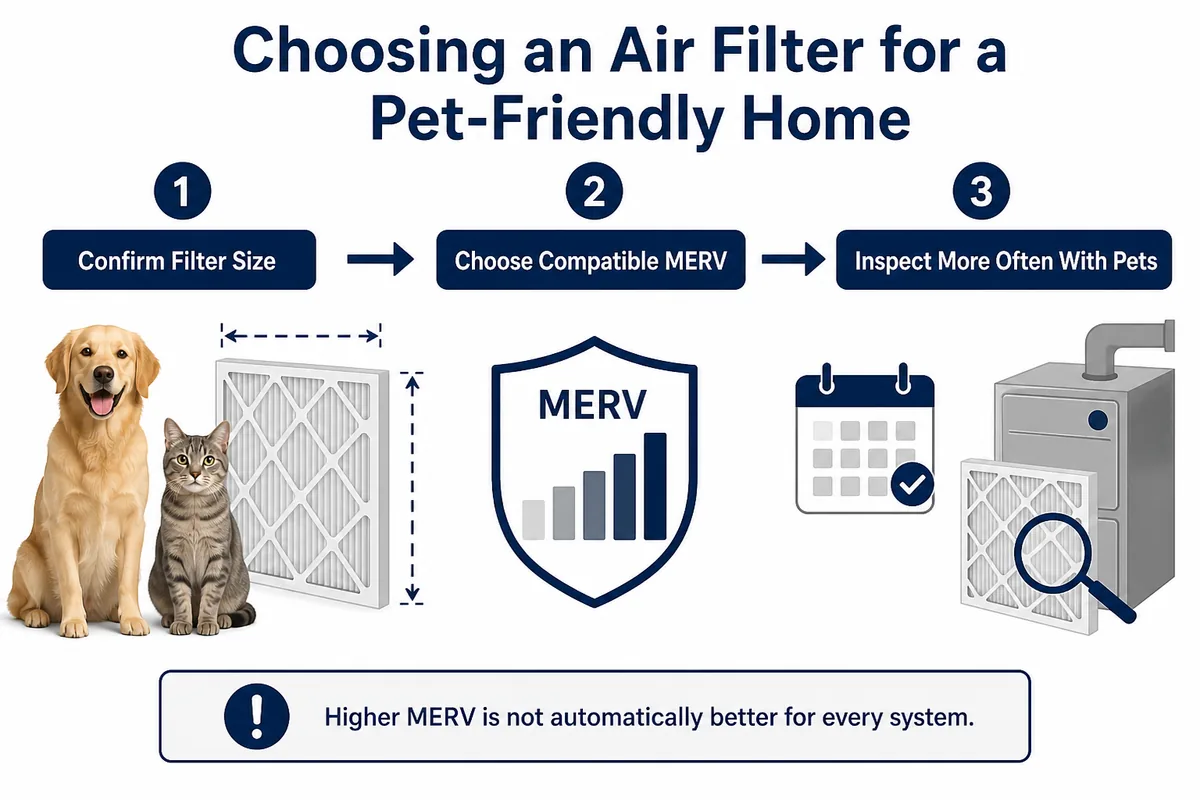
Before comparing ratings, confirm the physical air filter size and install it with the airflow arrow pointing the correct way. Those basic details affect performance regardless of the label on the package.
Pet Hair and Pet Dander Are Not the Same
Pet hair is visible and relatively large. It may gather on the return grille or the face of a filter, but much of it never enters the duct system. Vacuuming floors, washing pet bedding, and brushing animals where appropriate can reduce the amount that reaches the HVAC return.
“Dander” is often used broadly for smaller pet-related particles. Those particles can travel with ordinary household dust and are harder to judge by sight. A clean-looking filter may still contain fine material, while a hairy filter may mainly show that large debris reached the return. Appearance alone does not reveal capture efficiency.
Filtration can reduce some airborne material as air passes through the media, but it does not diagnose or treat allergies. Anyone with significant health concerns should follow medical guidance and consider the home as a complete environment rather than relying on one filter.
Best MERV Rating for Homes With Pets
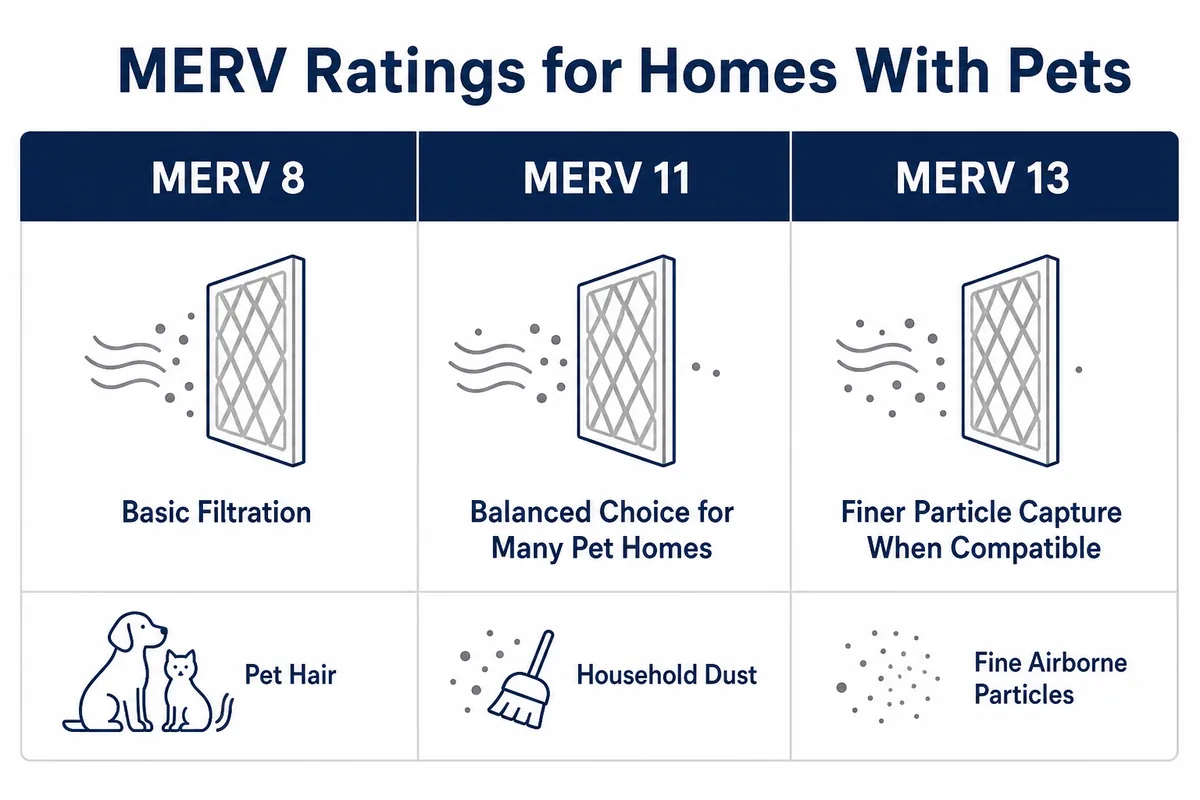
MERV describes a filter's performance across standardized particle-size ranges; it is not a direct measure of airflow resistance. Construction, media area, pleat design, depth, face velocity, and loading all affect how a filter behaves in a real system. The comparison below is a decision aid, not a compatibility guarantee.
| Rating | Practical role | Pet-home use | Compatibility caution |
|---|---|---|---|
| MERV 8 | Basic household filtration | May suit lighter shedding, frequent cleaning, or systems specified for a lower rating | Still confirm size, product resistance, and system guidance |
| MERV 11 | Balanced finer-particle capture | A practical starting point for many homes with cats or dogs | Do not assume every system supports every MERV 11 product |
| MERV 13 | Finer particle capture | Useful when greater capture is wanted and the system can support it | Confirm compatibility; higher is not automatically better |
Is MERV 8 Enough for Pets?
It can be. MERV 8 is not a “no-pet” filter. It provides basic filtration and can be appropriate when a system calls for it, when the household keeps surfaces clean, or when the main objective is capturing larger dust and debris. It generally offers less capture of smaller particles than MERV 11 or 13.
MERV 8 vs. MERV 11 for Pets
MERV 11 is often the more balanced choice when a homeowner wants improved capture of smaller airborne material without automatically moving to MERV 13. The actual filters must still be compared for size and resistance. Read the full MERV 8 vs. 11 vs. 13 comparison before changing ratings.
MERV 11 vs. MERV 13 for Pets
MERV 13 provides better standardized capture in finer particle ranges, but a higher rating is only useful when airflow remains appropriate. If the equipment documentation does not clearly support it, ask an HVAC professional rather than treating MERV 13 as an automatic pet upgrade. The guide on whether an air filter can be too restrictive explains why the full product and system matter.
Best Filter Type for Pet Homes
Pleated Disposable Filters
A pleated disposable filter is a practical default for many pet households. Pleats create more media area than a basic flat fiberglass panel, and pleated products are available in several MERV ratings and depths. They are easy to inspect and replace without washing or drying.
That does not make every pleated filter interchangeable. Frame dimensions, pleat count, media, rating, and resistance vary. Compare the fiberglass and pleated filter tradeoffs if you are moving from a low-cost flat panel.
Washable vs. Disposable
Some washable filters capture larger debris and can be reused when maintained exactly as directed. Their ratings and performance vary, and a washable product must be fully dry before it returns to service. Disposable filters offer predictable replacement and broader MERV selection but create recurring waste and cost.
The best choice depends on verified specifications and the homeowner's willingness to maintain it—not a blanket claim that reusable or disposable is always superior. See the complete washable vs. disposable comparison.
Odor and Specialty Media
Carbon or odor-control layers may help with some smells, but they do not replace cleaning litter areas, washing fabrics, removing accident sources, or ventilating appropriately. Added layers may change resistance. Avoid buying an odor label as a substitute for confirming the filter's rating, dimensions, and system fit.
Does Filter Thickness Matter for Homes With Pets?
A deeper filter can offer more media area, which may support lower resistance for a given performance level and a longer useful life. But a 4-inch filter cannot replace a 1-inch filter unless the cabinet is designed for it. Nominal depth and actual depth can also differ.
Never force a thicker filter into a narrow rack, stack filters, or leave a cabinet door open. Use the depth specified for the installed cabinet. The 1-inch vs. 2-inch vs. 4-inch guide explains the practical differences without assuming thicker is universally better.
How Often Should Pet Owners Replace the Filter?
There is no single replacement interval for every pet home. Start by inspecting the filter monthly, especially after changing rating or adding a pet. Replace a disposable filter when loading is substantial, the media is damaged or wet, airflow symptoms appear, or the manufacturer or system guidance calls for it.
One clean short-haired cat in a large, frequently cleaned home may affect loading differently from several heavy-shedding animals in a smaller space. HVAC runtime, outdoor dust, renovations, return location, filter area, depth, and household cleaning all matter. A calendar reminder is useful, but inspection should refine the schedule.
Review how often to change an air filter and the reasons a filter may be getting dirty faster than expected. Do not vacuum and reuse a disposable filter merely because pet hair is visible on its surface.
Choosing for One Pet, Multiple Pets, Cats, or Dogs
One Pet
With one pet, begin with the system-supported filter you would otherwise choose and observe loading. Do not buy the highest MERV solely because an animal lives in the home. Grooming, cleaning, and the individual animal's shedding may have more influence on visible hair.
Multiple Pets
More pets can mean faster loading, but the relationship is not perfectly linear. Inspect more often rather than automatically shortening the replacement interval or raising MERV. Multiple pets also make correct filter fit important because bypass air reduces the value of any media rating.
Cats
Cat hair, litter dust, tracked debris, and household dust can all reach returns. Keep litter sources reasonably clean and avoid placing loose dusty material directly beside a return. Choose the MERV level based on the system and filtration goal, not a cat-specific marketing label.
Dogs
Dog size does not alone determine filtration needs. Coat, shedding season, time outdoors, grooming, and the return layout matter. Vacuuming high-traffic areas and pet bedding handles material that settles before the HVAC system can filter it.
When Higher Filtration May Be Unnecessary
A higher MERV filter may add little practical value when the system does not support it, most visible hair is controlled at surfaces, or the household is satisfied with a compatible lower rating. The goal is a well-fitting, maintainable filter—not winning a number contest.
13-Step Pet-Home Filter Selection Checklist
- Find every intended filter location in the home.
- Read the nominal size on a properly fitting existing filter.
- Confirm length, width, and thickness before ordering.
- Check equipment or cabinet guidance for supported filter specifications.
- Identify the current MERV rating and whether airflow has been satisfactory.
- Choose MERV 8 for basic filtration when it best fits the system and goal.
- Consider MERV 11 as a balanced starting point for many pet homes.
- Use MERV 13 only when compatibility is reasonably confirmed.
- Prefer a pleated disposable filter when simple replacement and broader rating choices matter.
- Choose washable media only when its verified performance and maintenance fit your needs.
- Install the airflow arrow toward the blower or air handler.
- Inspect monthly at first and record how quickly loading develops.
- Buy a multipack only after the first replacement fits and performs correctly.
Match the Filter to Your Household
Confirm the physical size first, then use the free Filter Finder for cautious MERV guidance, replacement timing, household-condition questions, and current retailer options.
Open the Filter FinderA Simple Decision Guide
Choose MERV 8 when basic filtration matches the household goal or the system guidance points to a lower rating. Choose MERV 11 when you want a balanced improvement in smaller-particle capture and the product is compatible. Choose MERV 13 when finer capture is important and the system is confirmed to support it.
Then inspect more often with pets. A loaded filter can create more resistance regardless of its original rating. If airflow weakens, filters bend, the system becomes unusually noisy, or a clean compatible filter causes a persistent change, stop guessing and seek qualified HVAC evaluation.
Filter Wizard Recommendation
For many homes with pets, start with a correctly sized pleated MERV 11 filter when the HVAC system supports it. Move down to MERV 8 when basic filtration or system guidance makes it the more appropriate choice. Move up to MERV 13 only when finer capture is desired and compatibility is confirmed. No rating fixes a poor fit, incorrect airflow direction, overdue replacement, or bypass gap.
Still Deciding Between MERV 8, 11, and 13?
Use your confirmed size and household details to get a cautious recommendation and replacement schedule. Filter Wizard cannot physically identify your size or guarantee compatibility.
Open the Filter FinderGet Practical Filter Reminders
Save helpful filter guidance and receive occasional replacement reminders.
Your email is saved.
We will send helpful filter reminders and updates when available.
For pollen and smaller airborne particles beyond pet-specific conditions, see the air filter guide for allergy-focused filtration.
Frequently Asked Questions
What is the best air filter for homes with pets?
A correctly sized pleated MERV 11 filter is a practical starting point for many pet homes, provided the HVAC system supports it. MERV 8 may be adequate for basic filtration, while MERV 13 offers finer particle capture when compatible.
Is MERV 8 good enough for pets?
MERV 8 can provide basic household filtration and may be appropriate when the system calls for it or airflow margin is limited. It is less capable than MERV 11 or 13 at capturing smaller airborne particles.
Is MERV 11 good for pet dander?
MERV 11 generally captures smaller particles more effectively than MERV 8 and is a balanced choice for many pet homes, but compatibility and filter fit still matter.
Should pet owners use MERV 13?
MERV 13 can offer finer particle capture, but only use it when the HVAC system and filter cabinet support that filter's size and resistance.
Does an HVAC filter catch pet hair?
It can catch hair that reaches the return, but much pet hair settles on floors and furnishings first. Routine cleaning remains important.
Does an air filter remove pet dander?
A suitable filter can capture some airborne pet-related particles as air passes through the HVAC system. It does not remove every particle or replace source control and cleaning.
How often should I change an air filter with pets?
Inspect it monthly at first and replace it based on visible loading, manufacturer guidance, filter depth, household conditions, and system use rather than pets alone.
Do two pets require more frequent filter changes?
Often, but not always. More animals can increase hair and tracked-in material, while shedding, grooming, home size, cleaning, and HVAC runtime also affect loading.
Are pleated filters better for pet homes?
Pleated disposable filters commonly offer more media area and a wider range of MERV choices than basic fiberglass filters, making them a practical option when compatible.
Are washable filters good for pet hair and dander?
Some washable filters catch larger debris, but performance varies. Check the stated rating, cleaning instructions, fit, and system compatibility instead of assuming reusable means better.
Is a thicker filter better for pets?
A deeper filter can provide more media area and longer service life when the cabinet is designed for it, but thickness is not interchangeable and cannot be upgraded by forcing a filter into the slot.
Can a pet filter be too restrictive?
Yes. Any filter can be a poor match if its resistance, size, loading, or installation does not suit the system. MERV alone does not determine restriction.
Should I buy an odor-control filter for pets?
Odor media may help with some odors, but results vary and added media can affect resistance. Cleaning sources and ventilation remain important.
Can Filter Wizard tell me my physical filter size?
No. Confirm the physical size from a properly fitting existing filter, cabinet label, or careful measurement first. Filter Wizard can then help with MERV guidance, timing, and retailer options.