Quick Answer
Do not vacuum and reuse a disposable HVAC filter. A vacuum may remove visible lint from the surface, but it cannot reliably remove the fine particles embedded throughout the media or restore the filter's original structure and performance. Vacuuming can also loosen fibers, damage pleats, or create holes that are hard to see.
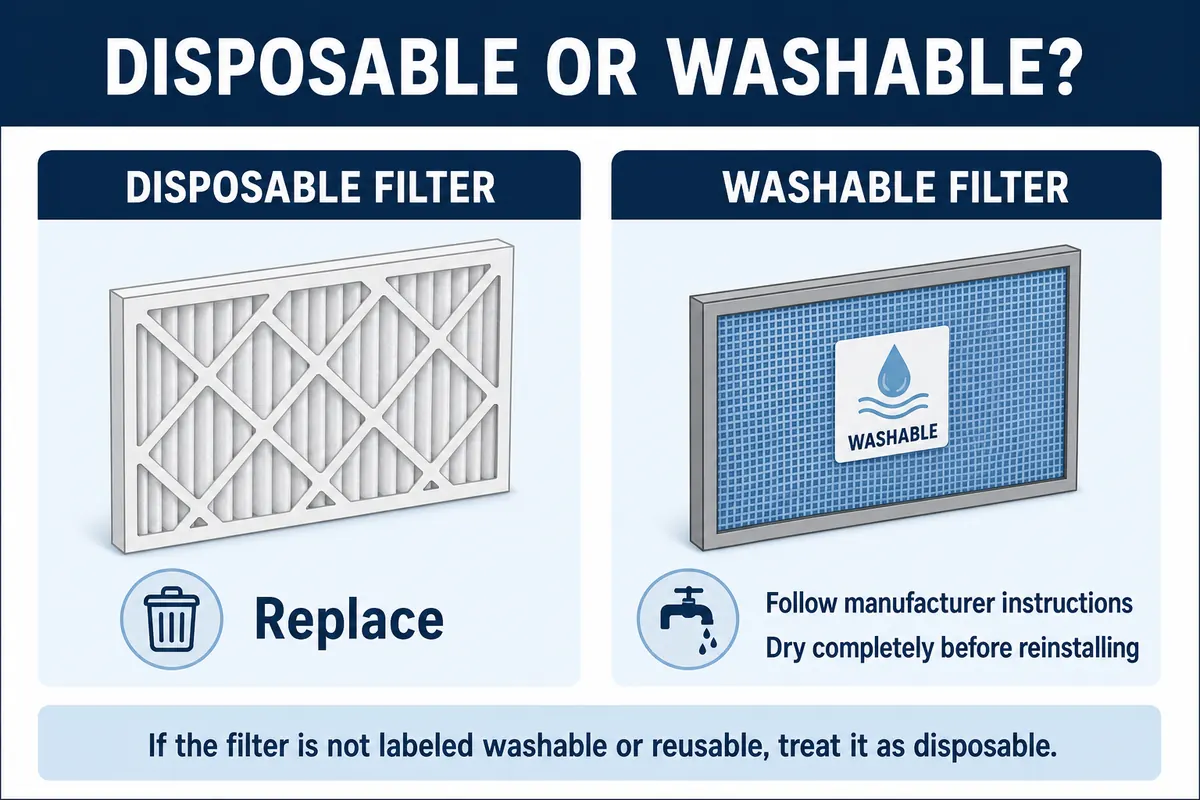
If the filter is clearly labeled washable, reusable, or permanent, clean it only by the method in its manufacturer instructions and let it dry completely before reinstalling it. When no label or instructions are available, treating the filter as disposable is the safer choice. Compare the broader washable vs. disposable filter tradeoffs before changing types.
Free homeowner tool
Need the right replacement?
Confirm the physical size, then use Filter Wizard for cautious MERV guidance, replacement timing, and current retailer options.
Open the Filter Finder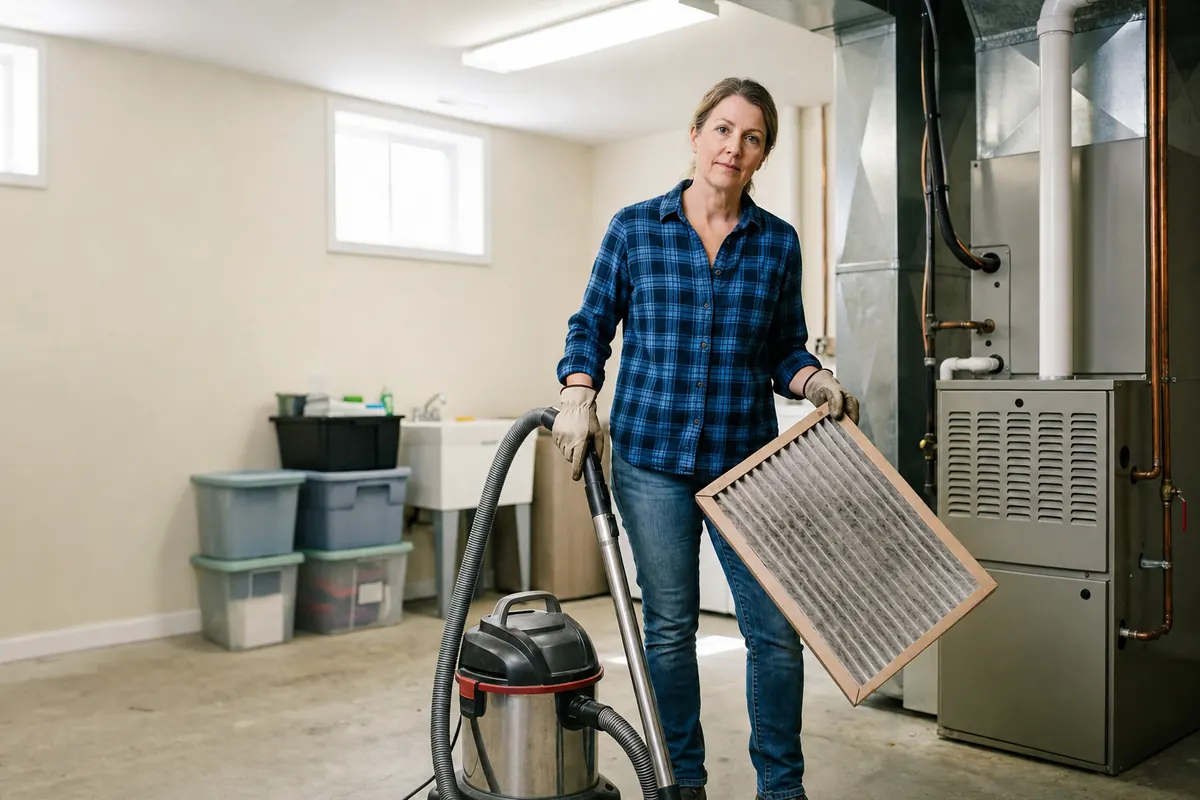
Disposable or Washable? Check Before You Clean
The cleaning decision depends on the filter type, not on how sturdy it looks. Cardboard-framed pleated filters and thin fiberglass panels are ordinarily single-use products. A reusable filter should say so on its frame, packaging, or manufacturer instructions. Color, frame material, pleat count, and price are not reliable proof.
| Filter type | Normal action | What to verify |
|---|---|---|
| Disposable pleated | Replace | Correct size, MERV, and airflow arrow |
| Fiberglass panel | Replace | Correct size and installation direction |
| Washable or reusable | Clean as directed | Label, approved method, and complete drying |
| Unknown or damaged | Identify or replace | Manufacturer information and physical condition |
If the size is unreadable, use the steps in our guide to find your air filter size. Confirm all three dimensions before ordering; a popular size is not necessarily your size.
Why Vacuuming Does Not Restore a Disposable Filter
An HVAC filter works across the depth and surface of its media. The dust you can see is only part of what it has captured. Smaller particles settle between fibers and within pleats, where a household vacuum cannot remove them evenly. A filter that looks lighter after vacuuming may still be substantially loaded.
Cleaning also changes the filter in ways that are difficult to evaluate at home. A nozzle can pull on media, flatten pleats, loosen bonds, or create small bypass paths. Holding the nozzle farther away reduces that risk but also removes less embedded material. There is no homeowner test that proves the cleaned filter has returned to its rated efficiency or original pressure drop.
Filtration is not simply a screen that becomes new when visible debris disappears. Filter media is arranged to intercept particles as air follows a complex path through it. Captured particles change those paths. Pulling at the surface from one direction does not undo that loading consistently, and a household vacuum is not a standardized restoration process used to certify filter performance.
The frame matters too. Even when the media appears intact, repeated handling can weaken cardboard corners or separate the media from the frame. A small edge gap lets some return air travel around the filter instead of through it. That bypass may be less obvious than a dark surface, but it works against the reason the filter is installed.
That is why appearance alone is a poor service-life measurement. Inspect for loading, bowing, damage, and worsening airflow, and follow the product or equipment guidance. Our guide to how often to change an air filter explains why pets, dust, smoke, filter depth, and HVAC runtime change the schedule.
Disposable Pleated and Fiberglass Filters
Pleated filters
Disposable pleated filters commonly use synthetic or blended media held in a cardboard or lightweight frame. Their folds provide more surface area, but they are not designed to withstand cleaning. Vacuuming may distort the folds, while water can soften the frame, affect adhesives, and alter the media.
Do not confuse a sturdy-looking frame with a reusable design. Replace the filter when it is loaded or reaches its recommended interval. Match the printed nominal size, use a MERV rating the system supports, and point the airflow arrow toward the furnace, blower, or air handler.
Fiberglass panel filters
Typical flat fiberglass panels are also disposable. Their loose media can be damaged easily by a nozzle, brushing, compressed air, or washing. Attempting to clean one can release captured dust and fibers without restoring dependable filtration. Bag it carefully if it is dusty and install a correct dry replacement.
Why washing is not a better shortcut
Water can make disposable media swell, sag, separate, or lose its shape. A damp cardboard frame can buckle and leave gaps around the rack. Detergent residue can remain in media that was never designed to be rinsed. Never place a wet disposable filter back into the system.
A poorly fitting or damaged filter can let air bypass the media and carry more dust downstream. It may also create unnecessary airflow problems. Those outcomes waste the price of the filter and can complicate issues described in our guides to signs of a clogged HVAC filter, dirty filters and energy use, and restricted airflow and frozen AC coils.
When an Air Filter Can Be Cleaned and Reused
A genuine washable filter is built for repeated cleaning and should include care instructions. It may use durable synthetic media, mesh, or another construction, but no single appearance defines the category. Look for explicit wording and a model-specific cleaning method.
Reusable does not mean permanent in every condition. Replace the filter if its frame is bent, its media is torn or separating, its seal no longer fits, corrosion is present, or residue remains after approved cleaning. A reusable filter must still be the exact size and an appropriate efficiency and resistance for the equipment.
Before changing filter type, compare verified specifications. The MERV 8, MERV 11, and MERV 13 comparison explains why a higher rating is not automatically the better system match. If documentation is unclear, ask the equipment or filter manufacturer, installer, or an HVAC professional.
How to Clean a Washable Filter Safely
- Turn the HVAC system off. This prevents the blower from pulling unfiltered air while the filter is out.
- Note the position and airflow direction. Take a photo before removal if that will help.
- Inspect the label and condition. Stop if the product is not clearly washable or if the frame or media is damaged.
- Follow the approved cleaning method. Use only the water pressure, direction, cleaning products, and tools named by the manufacturer.
- Rinse away loosened material as directed. Avoid aggressive scrubbing, high-pressure spray, compressed air, or heat unless explicitly permitted.
- Dry it completely. Set it in a clean location with airflow. Do not use a damp filter and do not rush drying with an unapproved heat source.
- Reinspect and reinstall. Confirm that it is dry, undamaged, seated without large gaps, and oriented correctly before restarting the system.
Keep the manufacturer's interval rather than waiting for severe buildup. Reusable filters still need inspection during periods of heavy runtime, wildfire smoke, remodeling dust, or other unusual loading.
What If You Do Not Have a Replacement Right Now?
Do not turn a dirty disposable filter into a “reusable” one simply because a replacement is unavailable. First record the size, MERV rating, model information, and airflow arrow. Check both sides of the frame and photograph the filter slot. You can use a filter-size page such as the 16 × 25 × 1 guide or 20 × 25 × 1 guide only after confirming that exact nominal size.
Avoid forcing a different thickness into the rack, stacking filters, trimming a filter, or using one that leaves large gaps. Do not run the system without a filter unless the equipment manufacturer or an HVAC professional specifically directs you. If indoor conditions make shutting the system down unsafe, contact a local HVAC professional for situation-specific guidance.
Make the next change easier
Once the correct replacement is installed, write the installation date on the frame or record it in a reminder. Keep the size, MERV rating, brand or model, and a clear photo somewhere accessible. That information makes it easier to purchase one confirmed replacement without carrying a dirty filter into a store.
Storing one spare can prevent an avoidable improvisation, but keep it clean, dry, flat, and protected from crushing. Do not buy a large quantity until you know the first replacement seats properly. Product labels that share the same nominal dimensions can have slightly different actual dimensions, so check that the frame fits without being forced and without leaving an obvious bypass gap.
If the old filter is extremely loaded, oily, damp, mold-like, pest-damaged, or contaminated by renovation material, do not shake or vacuum it indoors. Minimize handling, place it in a bag, wash your hands afterward, and address the source of unusual contamination. Water intrusion, recurring dampness, or debris inside an accessible filter compartment may warrant professional evaluation rather than another cleaning attempt.
Buy one replacement before committing to a large multipack, especially when the old frame is unreadable or the fit was questionable. Filter Wizard can help with MERV guidance and retailer options after you confirm the physical size, but it cannot inspect the rack or guarantee compatibility.
Clean or Replace? A Simple Decision
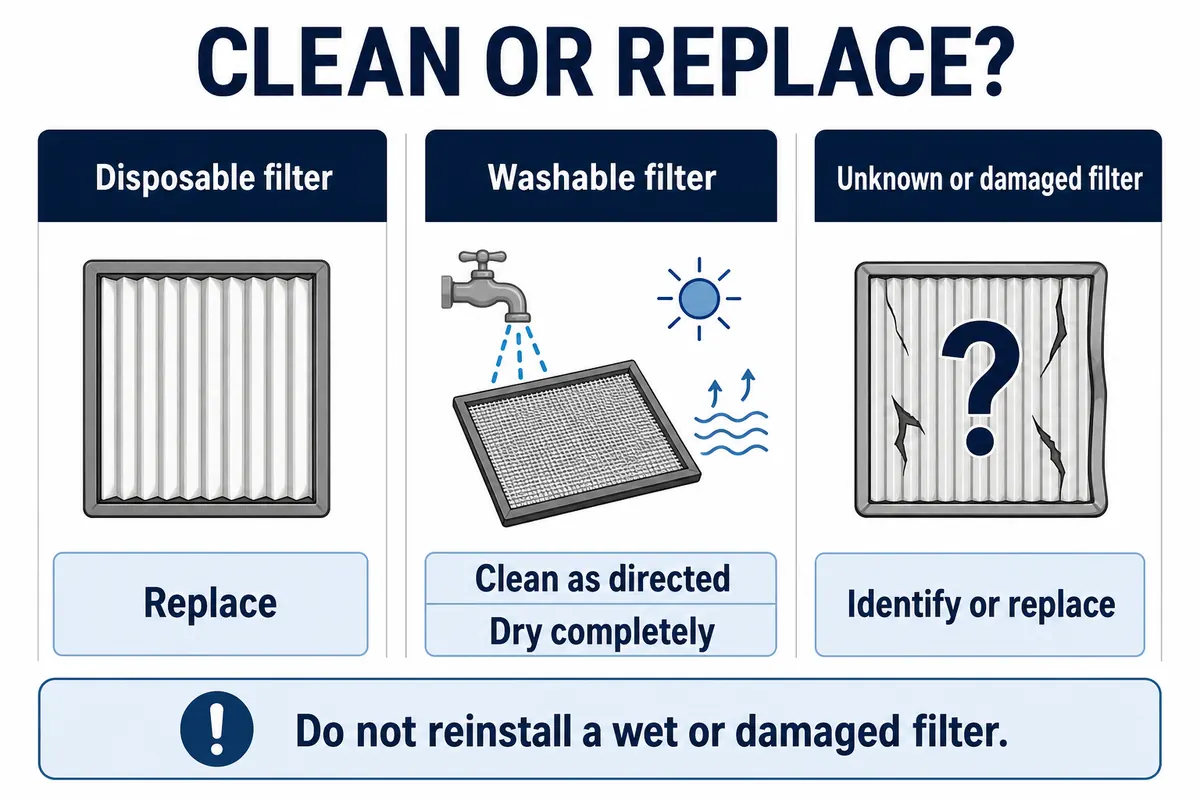
- Replace: disposable pleated filter, fiberglass panel, torn media, bent frame, failed seal, unknown type that cannot be verified.
- Clean as directed: filter explicitly labeled washable or reusable, with available manufacturer instructions and no damage.
- Pause and identify: unlabeled filter, unfamiliar cabinet, unclear service panel, or conflicting documentation.
Never use compressed air to blast dust from a disposable filter. Do not strike the filter against a hard surface, brush fragile media, add fragrance or household cleaner, or reinstall anything wet. These shortcuts can damage media or release collected material.
Are Washable Air Filters Worth It?
A washable filter can reduce recurring disposal and purchasing, but it adds cleaning, drying, and inspection work. Performance and pressure drop vary by product. Some homeowners value reuse; others prefer the predictable replacement routine and broader efficiency choices available with disposable pleated filters.
Start with the HVAC system rather than the promise on the package. The filter must fit the rack, remain secure during blower operation, and fall within the equipment maker's guidance. A product that fits physically can still differ in airflow resistance or filtration performance from the filter it replaces. When a reusable product lists test data, compare the actual model rather than assuming all washable filters share the same characteristics.
Reasons a washable filter may suit a household
- You are comfortable following a regular cleaning and inspection routine.
- You have a clean place to rinse and fully air-dry the filter.
- The product has clear care instructions and credible performance information.
- The exact size and operating characteristics match the HVAC equipment guidance.
- You are willing to replace it when the media, frame, or seal deteriorates.
Reasons a disposable filter may be simpler
- You want a predictable remove-and-replace routine without drying time.
- You need a specific MERV rating or filter construction that is readily documented.
- Your system uses a common size with suitable replacement options.
- You may forget to clean a reusable filter or cannot let it dry fully before the system is needed.
- You prefer to keep a sealed spare on hand for quick changes.
Cost comparisons need the same care. A reusable filter may last through many cleaning cycles, but purchase price does not include your time, cleaning effort, or eventual replacement. A disposable multipack may cost more over time but make maintenance easier to complete on schedule. Neither calculation proves which option will filter better in a specific system.
Household conditions also change the experience. Heavy dust, renovation work, smoke, multiple pets, and long seasonal runtime can load any filter faster. A washable filter may need more frequent attention, while a disposable filter may need an earlier replacement. Check actual condition instead of relying only on a calendar.
Compare total ownership effort, verified MERV or other performance information, equipment compatibility, fit, and cleaning instructions. Do not choose a washable filter solely because it is marketed as permanent, and do not assume it will match the particle capture of the disposable filter it replaces. A correct, maintained filter is more important than the category label.
Filter Wizard recommendation
Replace disposable filters; clean only verified washable filters
Confirm your size first. Then use the free Filter Finder for cautious MERV guidance, replacement timing based on household conditions, and current retailer options.
Open the Filter FinderHelpful reminders
Make the next filter change easier
Get occasional practical filter guidance and replacement reminders from Filter Wizard.
Occasional emails only. Unsubscribe anytime.
You're on the list. We'll send practical filter reminders and updates occasionally.
Frequently Asked Questions
Can you vacuum a disposable air filter?
You can remove some loose surface dust, but vacuuming does not restore disposable filter media. Replace a dirty disposable filter instead of treating vacuuming as maintenance.
Can you wash a pleated air filter?
Do not wash a disposable pleated filter. Water can damage its media, frame, adhesives, and shape. Wash only a filter explicitly labeled washable or reusable.
Can you reuse a furnace filter after vacuuming it?
A disposable furnace filter should not be reused as though vacuuming made it new. Fine particles remain in the media, and cleaning can damage the filter.
How do I know if my air filter is washable?
Look for washable or reusable wording and cleaning instructions on the frame, packaging, or manufacturer documentation. If the type is uncertain, do not assume it is washable.
Can a washable filter be vacuumed?
Only if the manufacturer permits it. Follow the product instructions because approved cleaning methods differ.
How long should a washable filter dry?
Drying time varies. Reinstall it only when it is completely dry according to the manufacturer instructions; never put a damp filter into the HVAC system.
What happens if I reinstall a wet air filter?
A wet filter can restrict airflow, deform, shed moisture, and create an unsuitable damp area. Keep the system off or use a correct dry replacement.
Can I run my HVAC system without a filter temporarily?
Avoid running it without a filter unless the equipment manufacturer or an HVAC professional specifically directs you. Unfiltered air can carry dust into the system.
Can vacuuming extend an air filter's life?
Vacuuming may change the surface appearance but does not reliably restore disposable media or its original performance. Use condition and replacement guidance instead.
Are fiberglass filters reusable?
Typical fiberglass panel filters are disposable. Replace them unless the product is explicitly labeled washable or reusable.
Is compressed air safe for cleaning a disposable filter?
No. Compressed air can damage media and send captured dust into the air. Replace the disposable filter.
Should I replace a damaged washable filter?
Yes. Replace a filter with tears, holes, a bent frame, failing seals, or media that no longer sits securely.
Are washable filters better than disposable filters?
Neither type is universally better. Compare verified efficiency, pressure drop, equipment compatibility, cleaning effort, and manufacturer guidance.
How often should I inspect my HVAC filter?
Inspect it regularly and more often during heavy HVAC use, dusty work, smoke events, or when pets and household activity load it faster.