Quick Answer
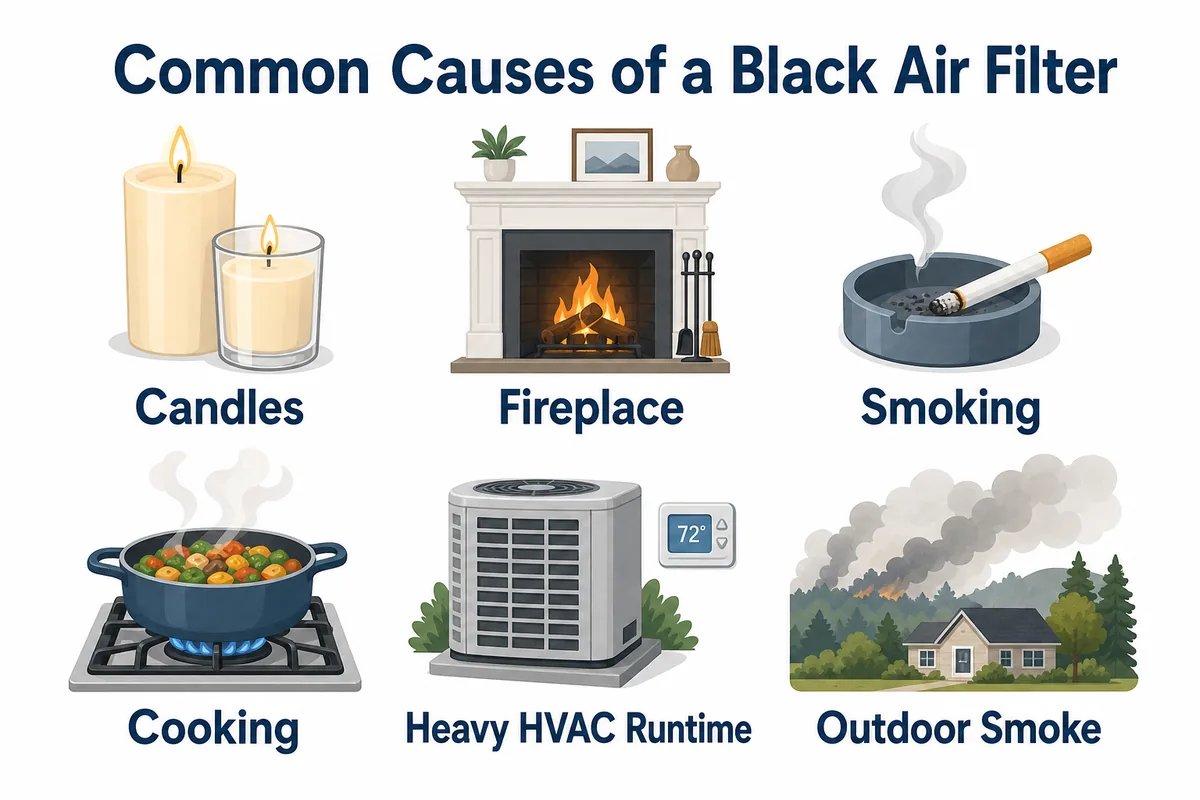
A black HVAC filter is usually caused by accumulated dust, fine airborne particles, candle soot, fireplace use, cooking particles, smoking, outdoor smoke, or heavy HVAC runtime. A black filter alone does not confirm mold, furnace failure, carbon monoxide, or the need for duct cleaning.
Black does not automatically mean danger. First note how long the filter was installed, whether it is dry or damp, whether the buildup is powdery or greasy, whether airflow has changed, and what particle sources were active in the home. Replace a heavily loaded or damaged disposable filter and monitor the next one.
Free homeowner tool
Need help choosing the next filter?
Confirm the physical size first, then use Filter Wizard for cautious MERV guidance, replacement timing, and retailer options after size confirmation.
Open the Filter Finder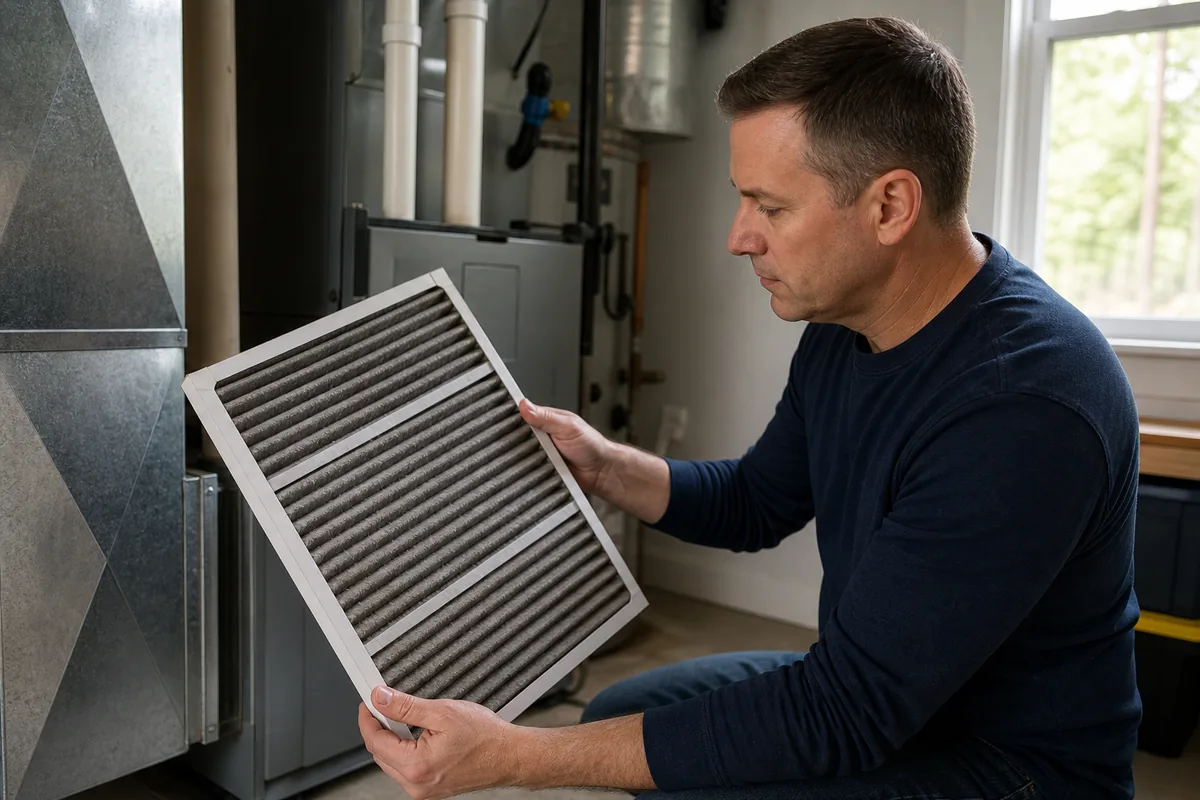
What Makes an HVAC Filter Turn Black?
An HVAC filter darkens because air moves through its media while airborne material stays behind. Ordinary household dust is a mixture of many fine particles. When those particles accumulate across white or light-colored media, the filter may progress from light gray to dark gray and eventually appear black under some lighting.
Color is not a laboratory test. A black return air filter can contain several materials at once, and two sources may produce a similar appearance. Candle soot can mix with ordinary dust. Outdoor smoke can arrive during a period of heavy cooling. Cooking aerosols can combine with pet dander and lint. Even the original color, pleat depth, and surface treatment of the media affect how dark the filter appears.
The most useful first questions are practical: When was it installed? How many hours has the blower been running? Is the loading even? Does it feel dry and dusty, damp, sticky, or greasy? Is there an unusual odor? Were candles, a fireplace, frying, smoking, renovation work, or outdoor smoke present? Is airflow weaker than usual?
| Possible source | Helpful context | Practical response |
|---|---|---|
| Ordinary fine dust | Gradual, even gray-to-dark loading | Track the date and inspect regularly |
| Candles | Frequent or long burn periods | Reduce use and monitor the next filter |
| Fireplace or wood stove | Seasonal change during heating use | Review operation and visible indoor soot |
| Smoking indoors | Persistent discoloration and residue | Remove the indoor particle source |
| Cooking | Frying, searing, or greasy texture | Use appropriate kitchen exhaust |
| Outdoor smoke | Wildfire or local burning event | Inspect more often during the event |
| Heavy HVAC runtime | Even loading during hot or cold weather | Compare runtime and filter condition |
| Moisture | Dampness, staining, or recurring odor | Replace and investigate the moisture source |
Can Candle Soot Turn an Air Filter Black?
Yes. Candles are a common explanation for black soot on an air filter. A flame can release very small carbon particles, especially when it flickers, the wick is too long, the candle burns in a draft, or the fuel does not burn completely. Those particles can remain suspended, move with household air, and collect on the HVAC filter.
Scented and paraffin candles are often discussed because many households use them frequently, but filter color alone cannot identify candle type or composition. Burn time, wick condition, ventilation, number of candles, flame stability, and room airflow all influence particle production. One candle used occasionally may have little visible effect; several candles burned for hours can create a different indoor particle load.
Look for a timeline rather than assuming. Did the filter begin turning black during a period of frequent candle use? Is there dark residue on candle jars, nearby walls, or surfaces? If so, reduce or pause burning, trim wicks according to product directions, avoid drafts, and compare the next filter. This is a simple source-control test, not a diagnosis.
Fireplaces, Wood Stoves, and Seasonal Soot
Wood-burning fireplaces and stoves produce smoke, ash, and combustion particles. Some material can enter indoor air when a fire is started, tended, or allowed to smolder, when doors are opened, or when draft conditions are imperfect. Once indoors, fine particles may circulate to the furnace filter and create a darker seasonal pattern.
A furnace filter turning black only during fireplace season is useful context, but it does not prove that the fireplace is unsafe or that the furnace is failing. Compare the timing with actual use. Note whether smoke enters the room, soot appears around the fireplace or vents, or an unusual odor persists after the fire is out.
Operate the appliance according to its manufacturer instructions and use appropriate fuel. Recurring indoor smoke, visible soot beyond the immediate firebox, draft problems, or uncertainty about a combustion appliance deserves evaluation by a qualified professional. Do not rely on the HVAC filter as the only safety indicator.
Smoking Indoors and Filter Discoloration
Tobacco smoke contains fine particles and residue that can travel through indoor air. With repeated exposure, an AC filter may look black, brownish, or gray and may develop an odor. The pattern can be more persistent than a single short-lived dust event because smoking adds particles whenever it occurs.
Replacing the HVAC filter removes the material captured in that filter. It does not remove residue already deposited on walls, furnishings, coils, grilles, or other surfaces, and it should not be presented as a complete cleanup method. The most effective way to reduce this source is to avoid smoking indoors.
Filter color cannot measure exposure or establish a health diagnosis. If odor and discoloration continue after the indoor source stops and normal cleaning occurs, document the timeline and consider an appropriate evaluation rather than repeatedly installing more restrictive filters without checking equipment compatibility.
How Cooking Particles Reach the HVAC Filter
Cooking releases moisture, odors, fine particles, and sometimes grease aerosols. Frying, searing, broiling, and other high-heat methods can produce more airborne material than low-temperature cooking. If a return grille is near the kitchen or the blower runs while cooking, some material may travel to the filter.
Grease-related loading may feel tacky rather than dry and powdery. Sticky media can hold additional dust and darken more quickly. A greasy filter should not be washed unless it is explicitly designed to be washable, and a disposable filter should not be sprayed with cleaners.
Use an effective range hood or kitchen exhaust system as directed, capture splatter and residue at the source, and clean nearby surfaces. A recirculating hood and an externally vented hood do not perform the same function, so check the actual installation rather than assuming. Persistent heavy grease beyond the kitchen may justify further assessment.
Wildfire Smoke, Agricultural Burning, and Outdoor Pollution
Outdoor smoke can enter through doors, windows, leakage paths, and normal ventilation. Wildfires, prescribed burns, agricultural burning, neighborhood fires, and other pollution events can sharply increase fine airborne particles. The filter may darken faster because it is capturing some of the material that entered the home.
During a significant smoke event, follow current local public-health and emergency guidance. Inspect the filter more frequently, but do not automatically install the highest MERV rating available. A more restrictive filter must be compatible with the equipment and filter cabinet. The comparison of MERV 8, MERV 11, and MERV 13 explains why filtration and airflow should be considered together.
After outdoor conditions improve, record the replacement date and watch whether the next filter returns to its usual loading pattern. That comparison can help separate a temporary outdoor event from a recurring indoor source.
Heavy HVAC Runtime Can Make a Filter Look Dark Faster
The filter collects particles only while air moves through it. During very hot or cold weather, the blower may run much longer than it did during mild conditions. More air passing through the same filter means more opportunities to capture particles, even if the home itself did not suddenly become dirtier.
This is why “black after one month” is not a complete diagnosis. One month of nearly continuous cooling can represent far more airflow than one month of occasional operation. Fan settings, equipment staging, thermostat use, occupancy, and weather all affect runtime.
Even dark loading across the whole filter during peak season may be explainable. Heavy loading in only a few days, repeated inward bowing, damaged pleats, or substantial airflow loss deserves a closer look. The guide to why an air filter gets dirty so fast covers pets, renovation dust, fit, bypass, return leakage, and other causes beyond color.
Could a Black Air Filter Be Mold?
A black filter does not automatically mean mold. Mold cannot be confirmed from a photograph or surface color alone. Fine dust, soot, cooking residue, smoke, and ordinary filter loading can all appear dark. Calling every black spot mold may create unnecessary fear and can distract from more likely sources.
Moisture history matters. A filter that is damp, repeatedly wet, stained by water, or accompanied by persistent musty odor deserves attention. Replace a damp disposable filter rather than continuing to operate it. Then look for safe, accessible evidence of condensation, drainage trouble, plumbing leakage, or excessive humidity without opening sealed service panels or touching electrical components.
Suspected growth or recurring moisture should be evaluated appropriately. A qualified professional can inspect the actual system and moisture conditions; appearance alone cannot determine species, cause, extent, or risk. Filter Wizard cannot inspect or diagnose biological growth. If the media is tan rather than black, the guide to brown or tan filter discoloration uses pattern, timing, and dryness to interpret it without identifying contaminants by color.
Color Is a Clue, Not a Diagnosis
- Black does not prove mold.
- Black does not prove carbon monoxide.
- Black does not prove a cracked heat exchanger.
- Black does not prove the ducts need cleaning.
- Dampness, odor, rapid recurrence, visible soot, and airflow symptoms add useful context.
Does a Black Filter Mean You Need Duct Cleaning?
No. Filter color alone is not a reason to recommend duct cleaning. The filter is located in the airflow path specifically to collect particles. A dark surface may show that it is doing that job during a dusty or smoky period.
Start with the filter’s age, the home’s particle sources, HVAC runtime, fit, and airflow. Confirm that the filter is the correct length, width, and thickness using the steps in How to Find Your Air Filter Size. Check that the filter arrow points toward the furnace, blower, or air handler. A poor fit can create bypass gaps and uneven patterns, although it does not by itself explain every dark filter.
Further evaluation may be appropriate when substantial debris is visibly entering accessible returns, pest activity is confirmed, contamination is documented, moisture persists, or system performance problems continue. Those conditions call for evidence-based assessment, not an automatic whole-house cleaning sale.
Should You Replace a Black Air Filter Immediately?
Replace a disposable filter when it is heavily loaded, damp, damaged, deformed, greasy, unusually odorous, contributing to weak airflow, or due under the product or equipment guidance. If the filter is only lightly darkened and airflow remains normal, color alone may not mean it has reached the end of its useful service life.
Do not hold a dusty filter up and hit it, shake it indoors, or use compressed air. Bag a heavily soiled disposable filter if that makes removal cleaner. Install one correctly sized replacement and write the date on its frame. Confirm the exact size before ordering a multipack; a nominal guide such as the 20 × 25 × 1 filter guide or 16 × 25 × 1 filter guide applies only after that physical size is confirmed.
Disposable pleated and fiberglass filters should be replaced, not vacuumed or washed. If the filter is explicitly labeled washable or reusable, follow its manufacturer instructions and reinstall it only after it is completely dry. See Can You Vacuum and Reuse an Air Filter? for the distinction.
A fresh filter may help restore airflow when the old filter was heavily restricted, but it does not guarantee lower energy use or resolve every HVAC problem. Review the relationship between dirty filters and energy use and the airflow conditions that can contribute to AC icing without treating either outcome as automatic.
Replacement guidance and retailer options
Confirm the size before shopping
Use the Filter Finder for a cautious MERV starting point and replacement timing. Retailer options appear only after you enter a valid three-dimensional size.
Find My Recommended FilterBlack Filter: Often Explainable or Worth Investigating?
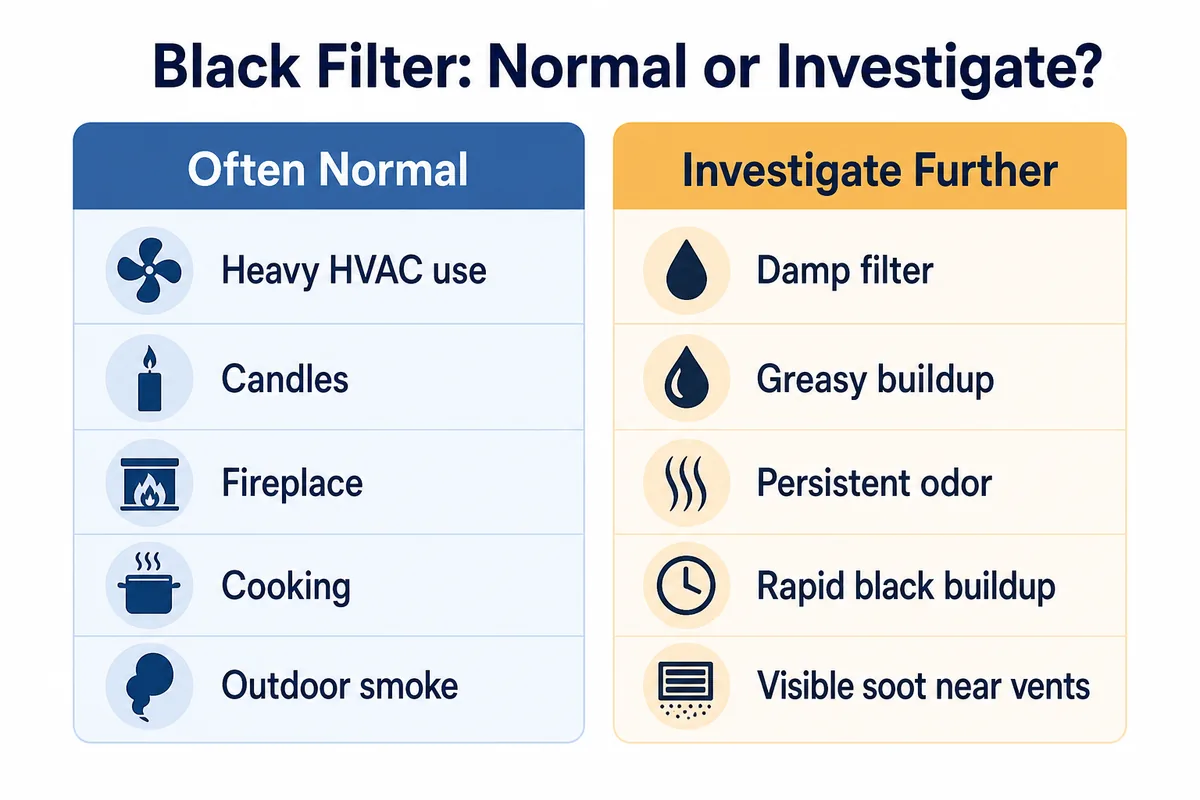
The goal is not to label every dark filter “normal.” It is to use the pattern and surrounding evidence. A gradual change during heavy runtime, candle use, fireplace season, cooking, or an outdoor smoke event often has a practical explanation. Conditions that repeat without explanation or involve moisture, grease, odor, visible soot, or airflow changes deserve more attention.
| Often explainable | Worth investigating |
|---|---|
| Even loading during heavy HVAC use | Damp filter or recurring moisture |
| Darkening during frequent candle use | Greasy or sticky buildup |
| Seasonal fireplace use | Persistent unusual odor |
| Frying or high-heat cooking | Heavy black buildup within days |
| Known outdoor smoke event | Visible soot around vents or living areas |
| Gradual dark-gray dust accumulation | Major airflow loss or repeated filter deformation |
When to Call an HVAC Professional
Professional evaluation is reasonable when unusual black contamination returns quickly after replacement, airflow stays weak with a clean correctly fitted filter, filters repeatedly bow or collapse, or soot-like material appears around multiple vents. Also seek help for recurring damp filters, persistent unusual odor, suspected drainage or humidity problems, or debris apparently entering from inaccessible return ductwork.
If you are uncertain about a fuel-burning furnace, fireplace, wood stove, or another combustion appliance, contact an appropriately qualified professional. The filter cannot diagnose combustion failure, carbon monoxide, or a cracked heat exchanger. Maintain carbon-monoxide alarms according to applicable manufacturer and local guidance; do not use filter color as a substitute for an alarm or inspection.
Describe what you actually observed: filter installation date, how quickly the color changed, whether the material is dry or greasy, whether the filter was damp, recent candle/fireplace/cooking/smoke exposure, airflow symptoms, odors, and where visible soot appeared. Dated photographs can make a recurring pattern easier to assess.
Filter Wizard Recommendation
- Turn the HVAC system off before removing an accessible filter.
- Record the installation and removal dates.
- Confirm length, width, thickness, and airflow direction.
- Note whether loading is even, dry, damp, powdery, greasy, or odorous.
- Consider candles, fireplace use, smoking, cooking, outdoor smoke, renovations, and recent HVAC runtime.
- Replace a heavily loaded, damp, damaged, or due disposable filter.
- Monitor the next filter under similar conditions.
- Seek professional evaluation if unusual contamination, moisture, soot, odor, or airflow problems recur.
Use actual condition alongside the schedule in How Often Should You Change Your Air Filter?. If airflow is weak, dust is increasing, runtime is longer, or odor develops, review the signs of a clogged HVAC filter.
Filter Wizard recommendation
Choose cautiously after confirming the physical size
The Filter Finder can suggest a practical MERV starting point, replacement interval, household-condition guidance, and current retailer options. It cannot identify contamination or guarantee equipment compatibility.
Open the Filter FinderFree Filter Reminders
Remember Your Next Filter Check
Get occasional filter reminders, homeowner maintenance tips, and buying guidance.
Occasional emails only. Unsubscribe anytime.
You're on the list. We'll send practical filter reminders and updates occasionally.
Frequently Asked Questions
Why is my air filter black?
A black or very dark HVAC filter commonly contains accumulated fine dust, candle or fireplace soot, cooking aerosols, tobacco smoke, outdoor smoke, or particles captured during heavy system runtime. Color alone cannot identify the exact source.
Is a black air filter dangerous?
Not necessarily. A dark filter often shows that it collected airborne particles. Replace a heavily loaded, damp, damaged, or odorous disposable filter and investigate recurring unusual buildup, visible soot, moisture, or combustion concerns rather than judging danger from color alone.
Does a black air filter mean mold?
No. Filter appearance alone cannot confirm mold. Moisture history, odor, repeated dampness, and conditions elsewhere in the system matter. Replace a damp filter and have persistent moisture or suspected growth evaluated appropriately.
Can candles turn an air filter black?
Yes. Burning candles can release small soot particles that circulate indoors and collect on HVAC filters. The amount varies with the candle, wick, flame stability, ventilation, burn time, and number of candles used.
Can fireplaces darken HVAC filters?
Yes. Fine particles from wood smoke and ash can enter indoor air during fireplace or wood-stove use and darken a filter, especially during the heating season. Recurring visible soot in living areas deserves further evaluation.
Does cooking affect HVAC filters?
Cooking can release fine particles and grease aerosols, particularly during frying, searing, or high-heat cooking. Effective kitchen exhaust used as directed and source cleanup can reduce how much material circulates to the HVAC filter.
Can smoking turn a filter black?
Indoor tobacco smoke contributes fine particles and residue that can discolor and load an HVAC filter. Replacing the filter addresses captured material but does not remove residue already deposited on indoor surfaces.
Does a black filter mean I need duct cleaning?
No. A black filter alone does not establish that duct cleaning is needed. Filters are intended to collect particles. Consider household sources, runtime, filter fit, moisture, visible debris, and system symptoms before seeking an evaluation.
Should I replace a black air filter?
Replace a disposable filter when it is heavily loaded, damp, damaged, greasy, odorous, deformed, restricting airflow, or due under product or equipment guidance. A lightly darkened filter may still be collecting particles normally.
Can wildfire smoke darken air filters?
Yes. Fine particles from wildfire smoke or other outdoor burning can enter a home and collect on the filter. Inspect the filter more often during and after a significant smoke event and follow local public-health guidance.
Can I vacuum a black air filter?
Do not vacuum and reuse a disposable pleated or fiberglass filter. Vacuuming does not reliably restore embedded media. Clean only a filter explicitly labeled washable or reusable and follow its instructions, including complete drying.
How fast should an air filter turn black?
There is no universal timeline because HVAC runtime, filter design, particle sources, season, and household conditions differ. A filter that becomes heavily blackened within days or repeatedly loads much faster than expected deserves investigation.
Does a black filter mean my furnace is failing?
No. Filter color alone cannot diagnose furnace failure, a cracked heat exchanger, or another combustion problem. If you have combustion-appliance concerns, recurring soot, unusual odors, or alarms, use appropriate safety procedures and contact a qualified professional.
Why is my furnace filter dark gray instead of black?
Dark gray is a common appearance when fine household dust and airborne particles accumulate across filter media. Compare the timeline, loading depth, airflow, odor, moisture, and recent household activities rather than relying on color alone.
When dark material is concentrated in only one area, compare the one-sided air filter buildup with fit, airflow, moisture, and nearby particle sources.