Quick Answer
For a 20x20x1 air filter, both 20-inch numbers are rounded face-size labels and the final 1 is a rounded depth class. Read all three numbers from the current frame. If that frame fits correctly, use its printed label as the primary shopping reference and verify the candidate product’s actual dimensions before purchasing several.
- Filtration choices: MERV 8 for basic guidance, MERV 11 for pets or heavier dust, and MERV 13 only as a compatibility-checked consideration.
- Replacement planning: approximately 45 to 90 days, depending on conditions and system use.
- Fit warning: do not substitute a nearby face size or thicker frame merely because it looks close.
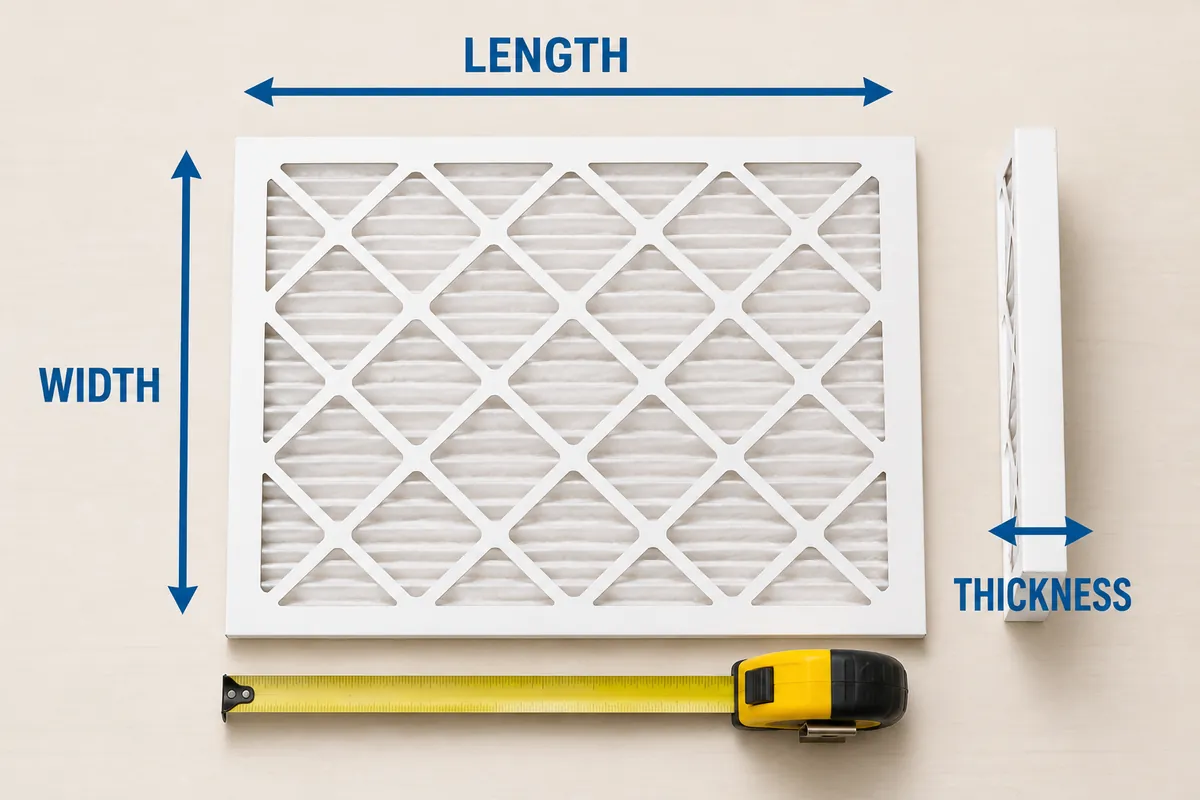
What 20x20x1 Means
The first 20 and second 20 identify the nominal face dimensions in inches. The 1 identifies nominal thickness. Nominal dimensions are category labels used for shopping; they are not a guarantee that a tape measure will read exactly 20 by 20 by 1 inches.
The horizontal or vertical face measurement, depending on how the rack is installed. Check the listed manufactured dimension.
The other nominal face dimension. A square label still does not guarantee identical actual dimensions across brands.
The thin-filter category, not a guaranteed one-inch tape measurement. Verify rack depth, door clearance and removal space.
Because both face labels are 20 inches, rotating the frame does not change its nominal face size. Rotation also does not solve an actual-dimension mismatch, an incorrect thickness or a reversed airflow arrow. Check the specific product dimensions and install it with the arrow following the system’s airflow.
Do Not Confuse 20x20x1 With Nearby Sizes
The square shape can make nearby products look deceptively close, but the rack still depends on both face dimensions and depth. A shorter side can expose part of the opening; a longer side can miss the rails; extra depth can interfere with the door or removal path.
| Nearby label | What is different | Why it matters |
|---|---|---|
| 16x20x1 | One face dimension is four inches shorter nominally | Can leave a large uncovered area instead of seating in a 20x20 track |
| 18x20x1 | One face dimension is two inches shorter nominally | May leave a bypass gap or fail to engage the intended side rails |
| 20x24x1 | One face dimension is four inches longer nominally | May not enter the rack or allow its grille or door to close |
| 20x25x1 | One face dimension is five inches longer nominally | Is not interchangeable with a square 20x20 face size |
| 20x20x2 | Twice the nominal depth | Needs a rack designed for a two-inch filter |
| 20x20x4 | Much deeper media-cabinet format | Requires compatible cabinet depth, clearance and equipment guidance |
Do not solve a mismatch by trimming or bending the frame, stacking filters, removing media, or squeezing a deeper product into the slot. A loose or improvised old filter is not reliable evidence—use the rack label, equipment documentation, installer, manufacturer, or a qualified HVAC professional to resolve the intended size.
How to Confirm a 20x20x1 Filter
- Turn the HVAC system off when appropriate. Work only with an accessible return grille or filter compartment.
- Remove the existing filter carefully. Support a ceiling grille and avoid sealed panels or electrical components.
- Read the nominal-size label. Look for 20x20x1 or 20 × 20 × 1 on every edge of the frame.
- Photograph the airflow arrow. Capture its relationship to the furnace, air handler or return duct before moving the filter.
- Measure the old filter if the label is missing. Record both face dimensions and depth without rounding prematurely.
- Compare listed actual dimensions. Use the specific replacement’s packaging, retailer listing or manufacturer specification.
- Confirm one-inch clearance. Check that tracks, doors and removal space are intended for the replacement depth.
- Resolve disagreement before ordering. Check the cabinet label, equipment manual, manufacturer or a qualified HVAC professional.
An empty opening is only supporting evidence. Its visible edges may sit outside hidden tracks, stops or seals, and the frame may need room to tilt during removal. Whenever possible, compare the old filter itself with the candidate product rather than rounding the opening to 20 inches.
Nominal and Actual Dimensions
| Measurement term | What it describes | What to verify |
|---|---|---|
| Nominal size | Rounded shopping label, such as 20x20x1 | Matches the label on the properly fitting old filter |
| Actual size | The manufactured physical dimensions | Matches the old filter and available rack clearance |
| Filter slot | The rack, track or grille opening | Accounts for stops, rails, seals, door and removal space |
| Face dimensions | The two broad sides of the frame | Neither side is confused with a nearby nominal size |
| Thickness | The depth of frame and media | The cabinet is designed for the stated depth |
| Airflow direction | How the media is oriented in moving air | The arrow follows airflow toward the equipment |
There is no repository-approved universal actual measurement for this nominal label. Record the old frame precisely, including fractions, and compare those numbers with the manufacturer’s listing instead of rounding from memory.
Which Way Should the Airflow Arrow Point?
Use the frame arrow to follow moving air toward the blower or other HVAC equipment. Because a 20x20 face is square, the frame may appear to fit after a quarter-turn, but that visual symmetry does not make the arrow reversible.
Take a context photo before removal so the arrow and equipment are visible together. If the prior installation seems questionable, consult the cabinet or equipment instructions. Treat fit and airflow as two separate decisions: matching dimensions does not establish direction.
Choose a MERV Level the System Supports
The same 20x20x1 nominal label appears across multiple MERV levels. Filter Wizard uses household selections to suggest a starting category; it cannot measure airflow resistance at the equipment or authorize a higher-efficiency filter.
Basic household-filtration guidance when no demanding condition is selected.
Commonly considered by the Finder when pets or heavier dust are selected.
Allergy-focused guidance that always requires an equipment-support check.
Compatibility caution: More filtration can also mean more resistance. Check the equipment or filter-cabinet guidance—or ask a qualified HVAC professional—before moving to a higher MERV level.
The MERV guidance is not medical advice and does not promise symptom improvement or removal of a particular contaminant. Use the residential MERV comparison as a household-oriented starting point after the physical size is confirmed.
Get My MERV GuidanceReplacement Timing for a 20x20x1 Filter
A square frame does not load faster or slower simply because it is 20x20x1. The current planning rules suggest about 45 days when several demanding conditions overlap, 60 days for pets, allergies or heavy dust, 75 days for some moderate-use households, and 90 days for lighter-use conditions.
Adjust the plan for actual HVAC runtime, visible loading, pets, dust, smoke, renovation, occupancy and seasonal use, and follow the manufacturer’s instructions. A heavily used system may need inspection sooner than the calendar estimate; an occasional-use system may behave differently.
Estimated Annual Filter Use
These yearly quantities use the site’s rounded-up planning method. They estimate how many individual filters cover 365 days; they do not prescribe a multipack size or purchase schedule.
| Replacement interval | Approximate filters per year | Planning note |
|---|---|---|
| 45 days | 9 | Multiple demanding conditions |
| 60 days | 7 | One demanding condition |
| 75 days | 5 | Some family or moderate-use conditions |
| 90 days | 5 | Lighter-use planning |
Annual cost in the Filter Finder is a planning range based on MERV category and replacement count, not a live quote. Tax, delivery, brand, promotions, pack pricing and later price changes are outside that estimate.
20x20x1 Buying Checklist
- Confirm 20x20x1 is printed on the properly fitting current filter.
- Compare the new product’s actual dimensions with the old frame.
- Confirm nominal one-inch thickness and available removal clearance.
- Record the old airflow-arrow direction before installation.
- Select a MERV level supported by the HVAC equipment.
- Check package quantity and calculate price per filter.
- Review return terms when dimensions or brand fit are uncertain.
- Purchase a small quantity first when changing brands or frame styles.
- Reject nearby-size substitutions that require forcing, bending or gaps.
Compare 20x20x1 Retailer Searches
Verify fit before shopping. Each card opens a search for the nominal phrase 20x20x1 air filter; it does not narrow results to one actual dimension or equipment specification. Review the individual listing’s measurements, MERV, quantity and return terms.
Search broadly for nominal 20x20x1 filters.
Search Amazon Home DepotCompare listed dimensions and pickup choices.
Search Home Depot Lowe’sReview delivery, pickup and package options.
Search Lowe’s FilterbuyCompare direct size-search options.
Search FilterbuyAs an Amazon Associate, Filter Wizard earns from qualifying purchases. Amazon is the active affiliate relationship identified by this site. Other retailer links are provided for comparison; availability and terms can change.
Free homeowner tool
Not Completely Sure 20x20x1 Is Your Size?
First establish that the system really takes 20x20x1. After that, the Filter Finder can organize household-based MERV guidance, timing and estimated annual cost. It cannot see the rack, identify its physical dimensions or guarantee compatibility.
- Measurement guidance
- MERV guidance
- Replacement timing
- Estimated annual cost
Frequently Asked Questions
What are the actual dimensions of a 20x20x1 air filter?
There is no universal actual measurement for every 20x20x1 filter. The label is a nominal size, while manufactured dimensions vary by brand and product line. Compare the replacement’s listed actual dimensions with a properly fitting old filter.
Are 20x20x1 filters from different brands the same size?
Not necessarily. Products can share the 20x20x1 nominal label while differing slightly in actual dimensions, frame construction and resistance. Compare the listed actual dimensions with a properly fitting old filter, especially when changing brands.
Are 20x20x1 and 20x25x1 filters interchangeable?
No. A 20x25x1 filter has a nominal face dimension that is five inches longer. It should not be forced into a 20x20x1 rack or used where it leaves the intended track or seal.
Can I use a 20x20x2 filter instead?
Only when the filter rack and HVAC equipment are designed for a nominal two-inch filter. Do not force, compress or modify a thicker filter to fit a one-inch slot.
Can I use a 20x20x4 filter instead?
Not in a rack intended for a one-inch filter. A nominal four-inch media filter needs a compatible cabinet, appropriate clearance and equipment support; it is not a drop-in substitute based on matching face dimensions.
How often should a 20x20x1 filter be changed?
Filter Wizard uses approximate planning intervals of 45, 60, 75 or 90 days based on household conditions. HVAC runtime, dust, pets, smoke, renovation, occupancy, season, visible loading and manufacturer instructions can change the actual interval.
Which MERV rating should I choose?
Filter Wizard uses MERV 8 for basic household guidance, MERV 11 when pets or heavier dust are selected, and Consider MERV 13 for allergy-focused guidance. Confirm that the HVAC system supports the chosen filter resistance before increasing MERV.
Which way should the airflow arrow point?
The arrow points with the airflow, generally toward the blower or HVAC equipment. Record the old filter’s direction before removal because the correct physical direction varies with the installation.
Can I measure the empty filter slot instead of the old filter?
The opening can provide a clue, but tracks, doors, seals and removal clearance can make that measurement misleading. Prefer the printed size and exact measurements of a properly fitting old filter, supported by cabinet or equipment documentation.