Quick Answer
A wet air filter is not normal. Cooling equipment creates condensation, but that water should drain through a pan and condensate line—not soak the filter. Turn the system off when water is actively dripping or standing, ice is visible, airflow is weak, or moisture is near electrical components.
Do not reinstall a wet disposable filter. Correct the moisture source, install a dry replacement of the same confirmed size, and check it again soon. If water returns or the source is unclear, an HVAC professional should inspect the system.
Free homeowner tool
Replacing the wet filter?
Confirm the physical size first. Then use Filter Wizard for cautious MERV guidance, replacement timing, and retailer options after size confirmation.
Open the Filter Finder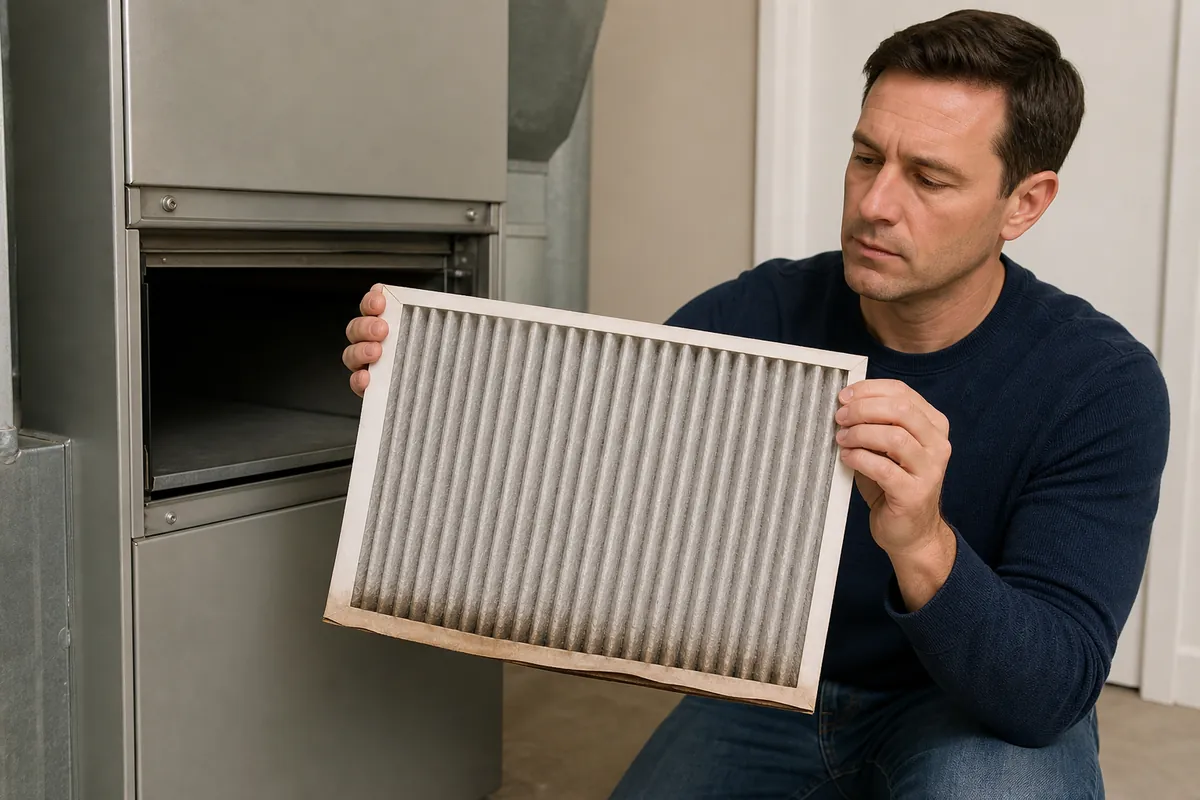
Is It Normal for an HVAC Filter to Be Wet?
No. A furnace or air-conditioner filter is designed for moving air and capturing particles, not managing liquid water. The filter may be installed close to components that create or carry condensate, especially in a furnace or air-handler cabinet, but normal drainage should keep that water away from the media.
During cooling, warm humid air crosses the cold evaporator coil. Moisture condenses on the coil, falls into a drain pan, and exits through a condensate line. That process is normal. Water backing up, overflowing, dripping into a filter slot, condensing on the cabinet, or entering from the building is not.
A little humidity in the air is different from a filter that feels wet. Visible drops, a soggy cardboard frame, a dark saturated edge, buckled pleats, or water below the filter all justify attention. Even subtle dampness should not be ignored if it returns after replacement.
First distinguish an active leak from evidence of an earlier event. If water is still moving, shut the system off and avoid wet electrical areas. If the filter is only slightly damp and there is no active water, replace it and inspect the accessible area for clues. Do not remove sealed service panels or reach around wiring, blower parts, refrigerant lines, or other internal components.
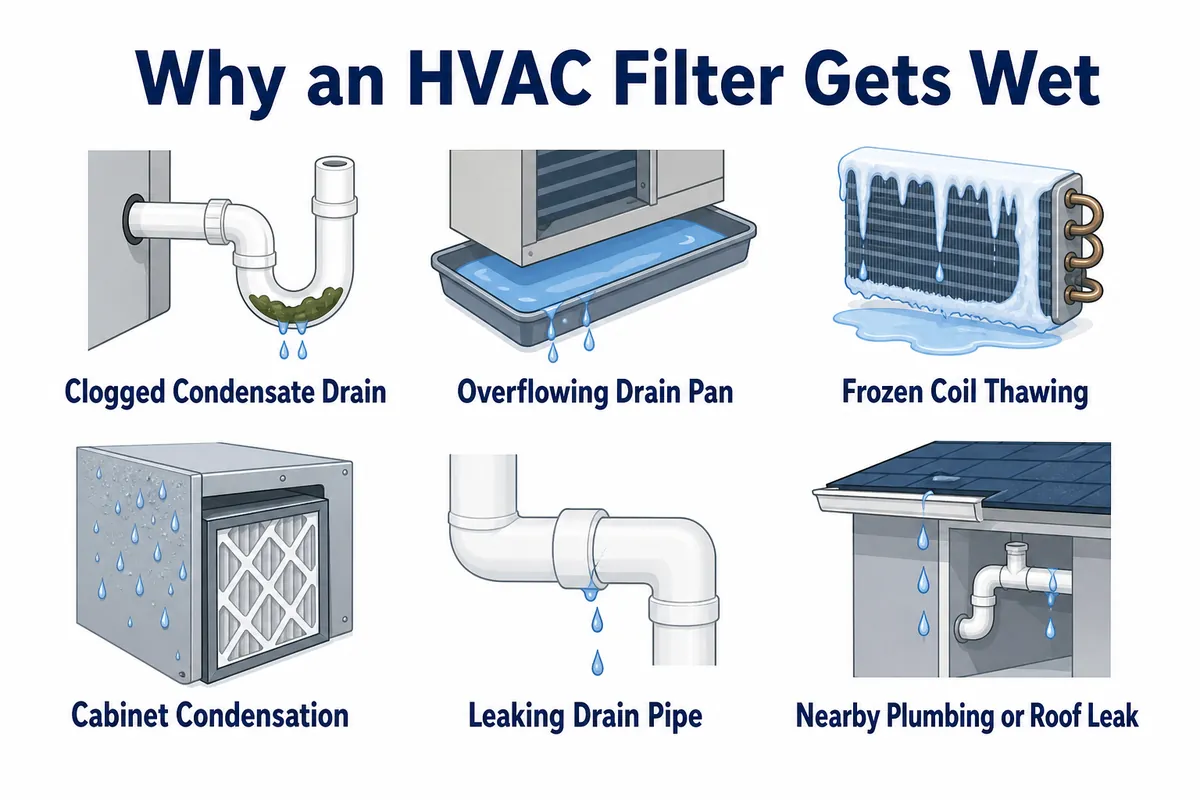
Six Common Reasons an Air Filter Gets Wet
The filter location determines which causes are plausible. A filter beside a furnace may be close to the coil drain pan and condensate line. A wall or ceiling return filter may be farther from cooling equipment and more exposed to a building leak. Some homes have more than one filter, so check each accessible location before assuming the whole system has one source.
| Possible cause | What you may notice | Practical next step |
|---|---|---|
| Clogged condensate drain | Water backing up near the coil cabinet or filter slot | Turn off if water is active; arrange drain evaluation |
| Overflowing drain pan | Standing water, pan overflow, or a wet lower filter edge | Stop operation and have the cause corrected |
| Frozen coil thawing | Ice, weak airflow, then more water as ice melts | Turn off cooling and request HVAC service |
| Cabinet condensation | Beads or sweating on cold metal surfaces | Have insulation, air leakage, and humidity assessed |
| Leaking drain pipe | Localized drip near a fitting, joint, or line | Do not disturb the connection; arrange repair |
| Nearby plumbing or roof leak | Water staining away from the drain or after rain | Use the appropriate HVAC, plumbing, or roofing professional |
| Wet bottom edge | Moisture collected below the filter | Look for safe, accessible evidence of pooling |
| Wet one side | One cabinet seam or nearby source is damp | Photograph the pattern and trace only accessible clues |
| Wet return-grille filter | Wall or ceiling staining around the grille | Consider condensation and building-water sources |
| Repeated dampness | Replacement becomes wet again | Arrange professional evaluation |
| Water near electrical parts | Moisture inside equipment or near wiring | Keep the system off and call for service |
| Unknown source | No safe, visible explanation | Do not guess or open sealed panels; call for help |
1. The Condensate Drain Is Clogged
A clogged condensate drain is one of the most practical places to investigate when a furnace filter gets wet during cooling season. The drain carries water away from the evaporator-coil pan. Algae-like buildup, sludge, debris, an improperly sloped line, or a blocked outlet can slow that flow. As the pan fills, water may back up into the cabinet or escape near a filter slot.
Installations vary. Some systems have a safety switch designed to stop cooling when water rises, but homeowners should not assume every system has one or that it will address every leak path. A filter can be wet even when the thermostat still calls for cooling.
Look only at accessible evidence: water around the cabinet base, a full visible secondary pan, a wet lower filter edge, or no discharge from a normally active drain outlet. Do not pour chemicals into an unknown line, disconnect fittings, bypass a float switch, or open sealed equipment panels. Drain design and service access differ, and an incorrect intervention can create another leak.
If water is active, turn the system off and arrange service. A technician can verify the blockage, clear the correct line, confirm slope and fittings, and check whether the pan or safety controls were affected.
2. The Drain Pan Is Overflowing or Damaged
The primary drain pan sits beneath the evaporator coil to collect condensate. If the drain is blocked, the pan is tilted, or the pan has deteriorated, water may escape rather than reaching the drain line. In attic installations, a separate secondary pan may sit below the equipment as added protection, but it is not intended to hold ongoing overflow.
A wet filter near the bottom of an air handler can be caused by water traveling along the cabinet before it reaches the filter compartment. The exact trail may be hidden, so a wet edge does not prove the pan itself is cracked. Drain backup, a loose connection, or coil icing can create a similar result.
Standing water in either pan is a reason to stop and investigate. Continuing to run the system can add condensate and obscure the original source. Do not reach into a wet cabinet or attempt to patch an internal pan from outside. Photograph what you can see safely and note whether the water appeared during cooling, after shutdown, or after rain.
3. A Frozen Evaporator Coil Is Thawing
An evaporator coil can accumulate ice when its surface becomes too cold. Restricted airflow from a heavily clogged filter is one possible contributor because less warm air crosses the coil, but an incorrect filter fit, blocked returns, blower trouble, low refrigerant, control problems, and other mechanical conditions may also be involved. A wet filter does not identify which one occurred.
When the ice melts, it may release water faster or in a different pattern than normal condensation. The drain pan and line may be unable to handle that sudden volume, especially if drainage is already limited. Water can then reach the filter or surrounding cabinet.
Possible clues include weak airflow, reduced cooling, visible ice on an accessible refrigerant line or coil area, and water appearing after the system stops. If ice is visible, turn cooling off and avoid chipping or heating it. Forcing removal can damage delicate components. The article Can a Dirty Air Filter Cause Your AC to Freeze? explains the airflow connection without treating the filter as the only cause.
Replace a wet or heavily loaded disposable filter only after it is safe to access, then request service if icing occurred or the cause is uncertain. A new filter alone cannot correct refrigerant, blower, control, or drainage problems.
4. Condensation Is Forming on the Cabinet or Return
Condensation forms when humid air contacts a surface below its dew point. Cold air-handler metal, an uninsulated filter cabinet, a return boot in a hot attic, or air leakage around a grille can create localized sweating. Drops may run toward the filter even though the condensate drain itself works normally.
Humidity may contribute, but “it is just humidity” is not a complete explanation for a visibly wet filter. The useful questions are where the surface becomes cold, whether insulation is missing or damaged, whether humid air is leaking into the return, and whether the moisture appears only under certain weather or runtime conditions.
At a wall or ceiling return, look for staining, softened drywall, damp insulation, or condensation around the grille. Turn the system off before opening an accessible grille, and support a ceiling grille carefully. Do not assume a ceiling stain is HVAC condensation; a roof, plumbing, or building-envelope leak can appear in the same area.
5. A Drain Pipe or Connection Is Leaking
A condensate line can leak at a fitting, trap, cleanout, pump, or connection. The water path may be short and obvious, or it may follow the cabinet and emerge at the filter slot. A pump used to lift condensate can also stop moving water, allowing its reservoir to overflow.
Do not twist, tighten, or separate an unfamiliar fitting while the equipment is running. Plastic drain parts can crack, and a connection that looks loose may be part of a larger slope or support problem. A technician can identify the correct line and test it without creating a second leak.
6. Water Is Coming from Nearby Plumbing or the Roof
Not every wet air filter is caused by the HVAC system. An attic air handler may sit below roofing, plumbing, a water heater, or another appliance. A utility-closet filter may be near a drain, supply line, or wall cavity. A return grille can collect water from a roof or plumbing leak before it reaches the filter.
Timing is helpful. Moisture after rain suggests a different path than moisture appearing only during long cooling cycles. Water after using a nearby fixture may implicate plumbing. These are clues rather than diagnoses. If the source is outside the HVAC system, contact the appropriate roofing, plumbing, or building professional.
What the Wet Pattern Can Tell You
Why is only the bottom of the filter wet?
A wet bottom edge often means water collected in the lowest part of the filter track, return box, or cabinet. Drain-pan overflow, a leaking condensate connection, condensation running down metal, or water entering from a nearby source can all create that pattern. Check for accessible pooling without reaching inside equipment.
Why is only one side wet?
One-sided dampness suggests a localized path: a nearby pipe joint, cabinet seam, cold surface, tilted drain pan, or drip from above. Photograph which edge was installed where before discarding the filter. That orientation can help a professional trace the source.
Why is a return-grille filter wet?
A filter behind a wall, floor, or ceiling return is often remote from the evaporator coil. In that location, condensation around the return boot, humid air leakage, a spill, plumbing, or roof water may be more plausible than a pan directly overflowing onto the filter. Filter arrangements vary, so confirm the physical layout rather than assuming.
If you are unsure where the filter belongs, review How to Find Your Air Filter Size, which also shows common filter locations. When reinstalling a dry replacement, the airflow arrow should point toward the furnace, blower, or air handler.
Can You Dry and Reuse a Wet Air Filter?
Do not dry and reuse a wet disposable filter. Pleated paper-like media, fiberglass media, cardboard frames, adhesives, and support grids can deform after soaking. A filter that looks dry later may no longer hold its intended shape or sit evenly in the track. Drying also does not tell you what the water carried into the media.
Replace the disposable filter after the source is corrected and the accessible filter compartment is dry. Confirm all three dimensions before buying; the printed nominal size on a properly fitting old filter is usually the best shopping reference. Exact pages such as the 20 × 25 × 1 filter guide and 16 × 25 × 1 filter guide apply only after that size has been physically confirmed.
Washable filters are different only when the product is explicitly designed and labeled for cleaning. Follow the manufacturer’s directions and reinstall it only after it is completely dry. A washable filter that became wet because of an HVAC leak still does not solve the leak. See Can You Vacuum and Reuse an Air Filter? for a fuller disposable-versus-reusable guide.
A higher MERV rating will not prevent water intrusion. MERV describes particle filtration, not drainage or moisture control. Choose a rating the system can support; MERV 8 vs. MERV 11 vs. MERV 13 explains the tradeoffs.
Replacement guidance and retailer options
Confirm the size before shopping
After the moisture source is corrected, use the Filter Finder for a cautious MERV starting point and replacement timing. Retailer options appear only after you enter a valid three-dimensional size.
Find My Recommended FilterWhat to Do When You Find a Wet Filter
- Look before touching. If water is near wiring, controls, a motor, or other electrical parts, keep away and arrange service.
- Turn the system off when the condition is active. Standing or dripping water, visible ice, weak airflow, or ongoing overflow are reasons not to keep cooling.
- Photograph the filter in place. Record which edge was wet, the airflow-arrow direction, and any accessible water trail.
- Remove the filter only if access is safe. Turn the system off first. Support ceiling grilles and avoid sealed panels.
- Do not reinstall a wet disposable filter. Bag it if needed to prevent drips and debris.
- Inspect safe, visible areas. Note a full pan, cabinet sweating, a dripping fitting, ceiling stain, or ice without probing equipment.
- Confirm the replacement size. Use the printed nominal size if the old filter fit correctly, or measure length, width, and thickness carefully.
- Correct the source before normal operation. Unknown, recurring, or inaccessible water deserves professional evaluation.
- Install a dry replacement in the correct direction. Do not force it or leave large bypass gaps.
- Check the replacement soon. Inspect after the next cooling cycles and again within a day or two when a minor known source was corrected.
Do not rely on a routine calendar interval after a moisture event. The article How Often Should You Change Your Air Filter? explains why actual condition, runtime, filter thickness, and household conditions matter. If the replacement begins loading unusually quickly, use Why Is My Air Filter Getting Dirty So Fast? to evaluate particle sources separately from moisture.
Does a Wet Filter Mean Mold?
No. Wetness indicates moisture; it does not prove mold. Dark specks, discoloration, or odor also cannot identify a substance by appearance alone. A black or dark HVAC filter may contain ordinary dust, soot, cooking particles, or smoke, while a wet filter can simply show where water traveled.
Moisture does create conditions that deserve prompt correction. Remove and replace a wet disposable filter, dry the accessible area after the source is stopped, and avoid running the system with ongoing water. Persistent musty odor, visible suspected growth, repeated dampness, or contamination beyond the accessible filter compartment calls for appropriate professional evaluation.
Do not spray cleaners, bleach, fragrance, or disinfectant into the filter slot or ductwork. Products and materials vary, and introducing liquids or chemicals into an airflow path can create new exposure or equipment concerns. A qualified professional can evaluate the actual moisture source and affected materials rather than guessing from a filter photograph.
Can a Wet Filter Damage the HVAC System?
A wet filter can become misshapen, sag into the filter track, or create more airflow resistance. Water can also travel beyond the filter and affect cabinet materials or nearby components. However, it is not accurate to say every wet filter causes equipment damage. Duration, water volume, location, filter construction, and the underlying problem all matter.
The source deserves priority. A blocked drain can continue producing overflow. A frozen coil can signal an airflow, refrigerant, blower, or control issue. A roof leak may affect building materials even when the HVAC equipment is fine. Replacing the filter without addressing that source only resets the visible symptom.
Weak airflow, longer runtime, unusual odor, noise, or a filter pulling inward are useful observations. Compare them with the seven signs an HVAC filter is clogged. A restricted dirty filter can contribute to poor airflow and potentially to coil icing, but moisture can also damage an otherwise clean filter.
Energy use is similarly conditional. A wet or collapsed filter may add resistance, yet a single filter cannot prove why a bill changed. See Can a Dirty Air Filter Raise Your Energy Bill? for a cautious explanation of that relationship.
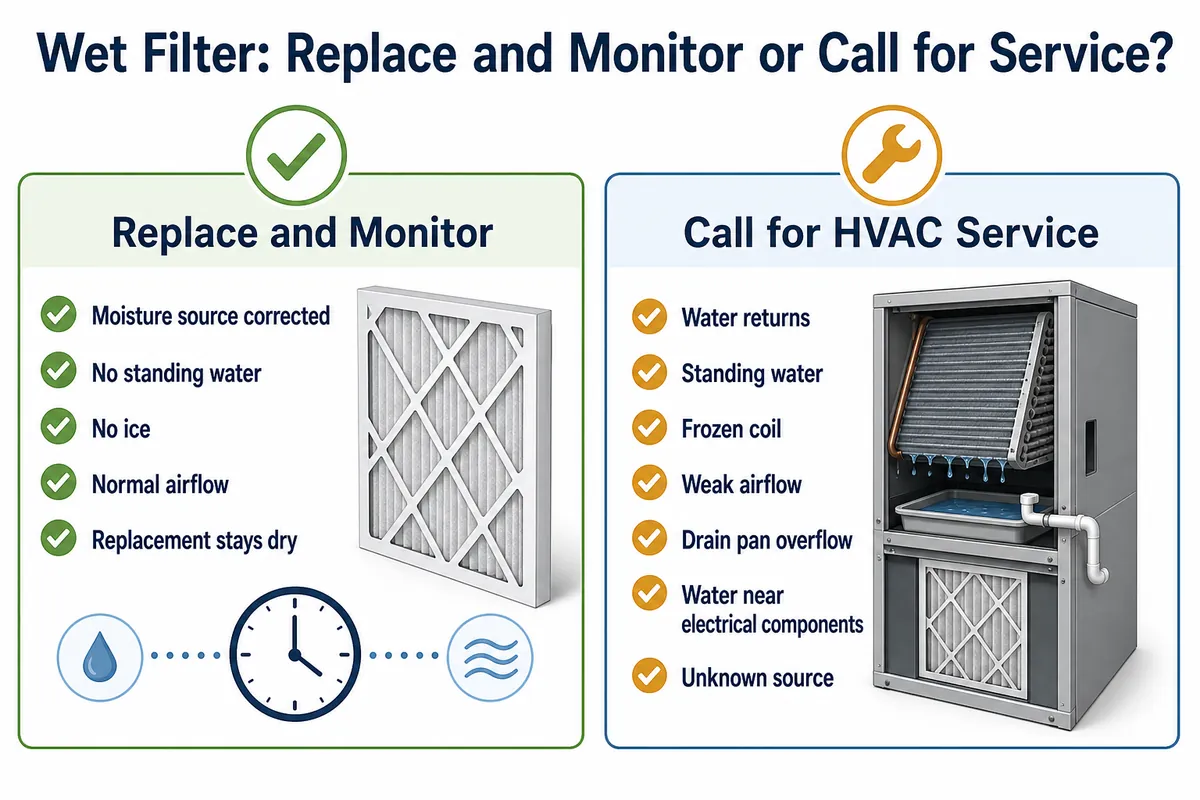
Replace and Monitor—or Call for Service?
Replacing the wet filter is only one step. Monitoring may be reasonable when a minor, clearly identified moisture source has been corrected, no water remains, no ice was present, airflow is normal, and a dry replacement stays dry. Do not call the problem solved until the new filter has been checked after operation.
Call an HVAC professional when water returns, standing water is present, a drain pan overflows, a coil freezes, airflow is weak, the source is unknown, or moisture is inside inaccessible equipment. Keep the system off and avoid the area if water is near electrical components. A plumbing or roof leak may require the appropriate trade rather than HVAC service.
Filter Wizard Recommendation
- Treat a wet filter as evidence of unwanted moisture, not as a diagnosis.
- Turn the system off for active water, standing water, ice, weak airflow, or moisture near electrical components.
- Photograph the pattern and record when it appeared.
- Replace a wet disposable filter; do not dry, vacuum, or reuse it.
- Confirm the exact length, width, thickness, and airflow direction before installing the replacement.
- Do not increase MERV merely to address moisture.
- Check the replacement after the next cooling cycles and within a day or two.
- Arrange professional evaluation if water returns, the source is unknown, or system symptoms continue.
A wet filter is often the first visible clue to a drainage, icing, condensation, or building-water problem. Acting calmly and early protects the evidence needed to find the source. Filter Wizard can help with replacement guidance after the physical size is confirmed, but it cannot inspect the system, identify a leak, or guarantee compatibility.
Filter Wizard recommendation
Choose the replacement after confirming the source and size
The Filter Finder can suggest a practical MERV starting point, replacement interval, household-condition guidance, and current retailer options. It cannot diagnose the moisture source or determine physical dimensions without your confirmation.
Open the Filter FinderFree Filter Reminders
Remember Your Next Filter Check
Get occasional filter reminders, homeowner maintenance tips, and buying guidance.
Occasional emails only. Unsubscribe anytime.
You're on the list. We'll send practical filter reminders and updates occasionally.
Frequently Asked Questions
Why is my air filter wet?
A wet HVAC filter usually means water reached the filter from a clogged condensate drain, overflowing drain pan, thawing frozen coil, cabinet condensation, leaking drain connection, or nearby plumbing or roof leak. The location and recurrence help narrow the source.
Is it normal for an HVAC filter to be wet?
No. An HVAC filter is meant to stay dry. Air conditioners and heat pumps produce condensate, but that water should collect in a pan and leave through the drain rather than soak the filter.
Should I turn off my HVAC system if the filter is wet?
Turn the system off if the filter is wet, water is standing or dripping, ice is visible, airflow is weak, or water is near electrical components. A slightly damp filter with no active water still needs replacement and the moisture source should be checked.
Can I put a wet air filter back in?
Do not reinstall a wet disposable filter. Moisture can deform the media and frame, increase resistance, and make condition difficult to monitor. Correct the water source and install a dry, correctly sized replacement.
Can I dry and reuse a wet disposable filter?
No. Disposable pleated and fiberglass filters should be replaced after becoming wet. Drying does not reliably restore their shape, media, adhesive, or performance.
Can a clogged condensate drain wet the filter?
Yes. If condensate cannot leave through the drain, water can back up into the drain pan or cabinet and reach a nearby filter. The exact path depends on the installation.
Can a frozen evaporator coil cause a wet filter?
Yes. Ice on an evaporator coil can release more water than the drainage system handles when it thaws. Restricted airflow is one possible contributor to coil icing, but refrigerant and mechanical problems are also possible.
Why is only the bottom of my filter wet?
A wet lower edge often suggests water collected at the bottom of the slot, cabinet, or return opening. Possible sources include drain-pan overflow, a leaking connection, condensation, or water entering from nearby.
Why is only one side of my filter wet?
One-sided dampness may point to a nearby drip, cabinet seam, drain fitting, condensation area, or tilted water path. It is a clue, not proof of a specific failure.
Can high humidity make an air filter wet?
High humidity can contribute to condensation on cold surfaces, but a visibly wet filter should not be dismissed as ordinary humidity. Look for where moisture forms and whether drainage, insulation, or air leakage needs evaluation.
Does a wet filter mean mold?
No. Wetness alone does not confirm mold, and appearance cannot identify biological growth. Replace the wet filter, correct recurring moisture, and seek appropriate evaluation for persistent musty odor or suspected growth.
Can a wet air filter damage the HVAC system?
A wet filter can deform, restrict airflow, or allow water to reach places it should not. The underlying drainage, icing, condensation, or leak problem matters more than making a blanket damage prediction.
Can I run the furnace with a wet filter?
Do not continue operating with a wet disposable filter. Turn the system off when active water, ice, weak airflow, or water near electrical components is present, and replace the filter only after the source is addressed.
What should I do after replacing a wet filter?
Confirm the new filter is the correct size and direction, record the date, and inspect it again soon. If moisture returns, water accumulates, airflow weakens, or the source remains unknown, arrange professional evaluation.
How soon should I check the replacement filter?
Check it after the next cooling cycles and again within a day or two when a minor, known source was corrected. Do not wait if water, ice, odor, or weak airflow returns.
Can a roof or plumbing leak wet an HVAC filter?
Yes. Filters in attics, closets, wall returns, or near plumbing can be affected by building leaks unrelated to HVAC condensate. Trace only safe, accessible evidence and avoid assuming every wet filter is an air-conditioner problem.
When should I call an HVAC professional for a wet filter?
Call when water returns, a pan overflows, a coil freezes, airflow is weak, the source is unknown, moisture reaches inaccessible areas, or water is near electrical components. Building or plumbing leaks may require the appropriate trade instead.
Will a higher MERV filter stop the filter from getting wet?
No. MERV describes particle filtration, not water control. A different MERV rating will not repair a blocked drain, overflowing pan, leaking pipe, frozen coil, or condensation problem, and system compatibility still matters.
A dry filter with one darker area is a different clue; review why one side of a filter gets dirtier before treating uneven loading as a moisture problem. If a recently installed filter develops an odor, use the new-filter odor checklist to separate storage contamination from a moisture source in the system.