Quick Answer
A 20x25x1 air filter is usually labeled by its nominal width, length and thickness. Actual manufactured dimensions are commonly a little smaller, but the difference varies by brand and product line. Confirm 20x25x1 on the properly fitting filter you are replacing, or measure all three dimensions and compare the exact product specifications before buying.
- Common filtration choices: MERV 8, MERV 11 and—only when supported—MERV 13.
- Planning range: roughly 45 to 90 days depending on household conditions and system use.
- Most important warning: the same nominal label does not guarantee identical actual dimensions or HVAC compatibility.
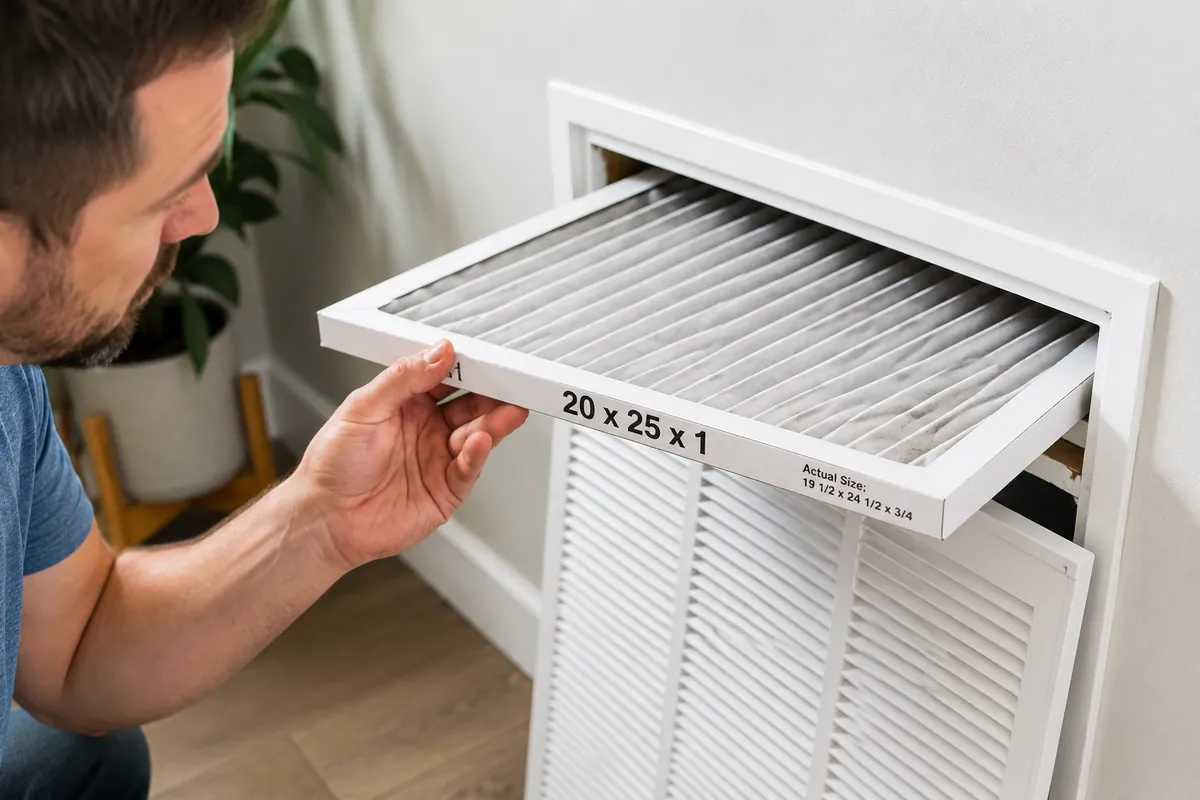
What 20x25x1 Means
The three numbers describe the filter’s nominal face dimensions and depth in inches. Depending on the manufacturer, the first two numbers may be described as width by length, length by width, or height by width. That naming difference is why the old filter, its airflow direction and the product’s exact specifications matter more than assuming every 20x25x1 and 25x20x1 label means the same thing.
One nominal face dimension. A manufacturer may call it width, length or height.
The other nominal face dimension. Confirm orientation and actual measurements.
Nominal thickness. This is especially important for slot depth and removal clearance.
A filter labeled one inch thick is often physically thinner than a full inch. That does not make a two-inch filter a substitute. Use a thicker filter only when the cabinet and equipment are designed for it; never force a deeper frame into a one-inch track.
How to Confirm a 20x25x1 Filter
- Turn the HVAC system off when appropriate. This reduces airflow while you open an accessible return grille or filter compartment.
- Remove the current filter carefully. Support ceiling grilles and do not open sealed service panels or handle electrical components.
- Read every edge of the frame. Look for 20x25x1 or 20 × 25 × 1, not the MERV rating, model number or airflow arrow.
- Record the arrow direction. A quick photo preserves the label, orientation and installation date.
- Measure the old filter if needed. Measure both face dimensions and thickness in inches; do not round too early.
- Compare nominal and actual dimensions. Match your measurements to the specific replacement listing or packaging.
- Confirm thickness and clearance. The frame should enter its intended track without crushing, forcing or leaving a large bypass gap.
- Check documentation when uncertain. Use the filter-cabinet label, equipment manual, manufacturer or a qualified HVAC professional.
Do not rely on the opening measurement alone. A return grille or furnace slot can include tracks, doors, seals and removal clearance that are not obvious from the open width and height.
Nominal Size vs. Actual Size
Nominal size helps shoppers group filters. Actual size determines whether a particular manufactured filter can enter and sit correctly in the rack. Filter-slot size describes the equipment opening, which may include additional clearance and hardware.
| Term | What it means | How to use it |
|---|---|---|
| Nominal size | Rounded label used for shopping, such as 20x25x1 | Match the label on a properly fitting old filter |
| Actual size | Physical manufactured dimensions | Compare the specific brand and product listing |
| Filter slot size | Opening or track in the HVAC system | Account for rails, seals, doors and removal clearance |
| Thickness | Depth of the frame and media | Confirm the rack is designed for that depth |
There is no single exact actual measurement that applies to every 20x25x1 product. Check the package or retailer/manufacturer specification for the exact filter you plan to buy. When changing brands or trying an unfamiliar product, test one before purchasing a large multipack.
Choosing a MERV Rating Cautiously
MERV describes how a filter performs across defined particle-size ranges; it does not describe physical size. A 20x25x1 label can appear on several MERV levels, and a higher number is not automatically the right choice for every system.
Filter Wizard’s basic household-filtration starting point when no demanding condition is selected.
Often considered in the Finder for pets or heavier household dust.
Used for allergy-focused guidance only with a prominent equipment-compatibility caution.
Compatibility caution: A higher MERV rating is not automatically better for every HVAC system. Confirm the maximum recommended filter resistance or MERV rating with the equipment manufacturer or a qualified HVAC professional.
For the tradeoffs behind each option, compare MERV 8, MERV 11 and MERV 13. The Filter Finder can apply the current household-condition rules consistently, but it cannot inspect your blower, ductwork or filter cabinet.
Get My MERV GuidanceHow Often to Replace a 20x25x1 Filter
Filter size alone does not determine service life. Filter Wizard uses approximate planning intervals based on household conditions: about 45 days for multiple demanding conditions; 60 days for one of pets, allergies or heavy dust; 75 days for some family conditions without those demanding factors; and 90 days for lighter-use conditions.
Actual timing can be shorter or longer depending on HVAC runtime, pets, dust, smoke, nearby construction, occupancy, season, filter loading and the equipment or filter manufacturer’s instructions. Inspect the filter periodically and pay attention to airflow or visible loading rather than assuming every 20x25x1 product lasts the same number of days.
Estimated Filters Per Year
This planning table uses the same replacement-frequency assumptions as the Filter Finder. It rounds up so a household has enough filters for the year; purchase dates and multipack quantities may differ.
| Replacement interval | Approximate filters per year | Typical planning context |
|---|---|---|
| 45 days | 9 | Multiple demanding conditions |
| 60 days | 7 | One demanding condition |
| 75 days | 5 | Some family conditions |
| 90 days | 5 | Lighter-use planning |
The Finder can also show an estimated annual cost using its documented MERV price assumptions. Those estimates exclude tax, shipping, brand differences, multipack pricing and future price changes.
20x25x1 Buying Checklist
- Confirm 20x25x1 appears on the properly fitting existing filter.
- Compare the replacement’s actual dimensions with the old filter.
- Confirm the rack is intended for a nominal one-inch filter.
- Record and follow the correct airflow-arrow direction.
- Select a MERV rating the equipment supports.
- Review pack quantity and calculate price per filter, not only package price.
- Check the return policy when changing brands or when fit is uncertain.
- Buy one first rather than a large multipack if measurements or labels disagree.
Compare 20x25x1 Retailer Searches
Confirm fit before leaving this page. These links search for the nominal size 20x25x1; they do not guarantee that every result has the same actual dimensions, MERV compatibility, pack quantity or return terms. Recheck the exact product listing before ordering.
Broad search for 20x25x1 air filters.
Search Amazon Home DepotCompare delivery and local-pickup options.
Search Home Depot Lowe’sCompare available sizes and fulfillment choices.
Search Lowe’s FilterbuyReview direct filter-size search options.
Search FilterbuyAs an Amazon Associate, Filter Wizard earns from qualifying purchases. Amazon is the active affiliate relationship identified by this site. Other retailer links are provided for comparison; availability and terms can change.
Free homeowner tool
Not Completely Sure This Is Your Size?
Confirm the physical dimensions at your system first. Then use the Filter Finder for measurement guidance, cautious MERV guidance, replacement timing and an estimated yearly filter cost.
- Size-format guidance
- MERV guidance
- Replacement timing
- Estimated annual cost
Frequently Asked Questions
What are the actual dimensions of a 20x25x1 filter?
There is no single actual measurement for every 20x25x1 filter. The label is a nominal shopping size, while exact physical dimensions vary by manufacturer and product line. Check the product packaging or listing against the dimensions of the properly fitting filter you are replacing.
Are 20x25x1 and 25x20x1 filters the same?
Do not assume they are universally interchangeable. Some manufacturers reverse width and length conventions, but labels, airflow direction, frame construction and actual dimensions can differ. Match the existing filter and the product specifications.
Can I use a 20x25x2 filter instead?
Only if the filter cabinet and HVAC equipment are designed for a two-inch filter. A thicker filter should not be forced into a one-inch slot, and nominal thickness does not guarantee the same actual depth across brands.
How often should I replace a 20x25x1 filter?
Filter Wizard uses planning intervals of about 45, 60, 75 or 90 days based on household conditions. Actual timing depends on HVAC runtime, pets, dust, smoke, construction, occupancy, season, filter loading and equipment instructions.
What MERV rating should I choose for a 20x25x1 filter?
MERV 8 is a basic household option, MERV 11 is often considered for pets or heavier dust, and MERV 13 may be considered for allergy-focused filtration only when the system supports it. Confirm the equipment manufacturer’s maximum recommendation or ask a qualified HVAC professional.
Does every 20x25x1 brand fit the same?
No. Products with the same nominal label can have slightly different actual dimensions, frame construction or resistance. Compare the specific product dimensions and test one filter before buying a large pack when fit is uncertain.
Which direction should the airflow arrow point?
The arrow should point in the direction air travels toward the furnace or air handler. Record the old filter’s arrow before removal and follow the equipment or filter-cabinet instructions when the direction is unclear.
Can I measure the filter slot instead of the old filter?
A slot measurement can help, but it may not account for tracks, doors, seals or removal clearance. Prefer the printed label and actual dimensions of a properly fitting old filter, then confirm against equipment documentation when uncertain.