Quick Answer
An HVAC filter should fit snugly enough to stay seated and avoid an obvious bypass path, but it should not need to be forced into the rack or grille. Small installation clearance can be normal because nominal filter sizes and actual physical dimensions are different concepts.
If the filter rattles, shifts, leaves a large visible gap, bends during insertion, sticks, or makes the access door difficult to close, check the specified size, actual dimensions, frame construction, and rack condition before ordering more.
What Should a Correctly Fitted Air Filter Feel Like?
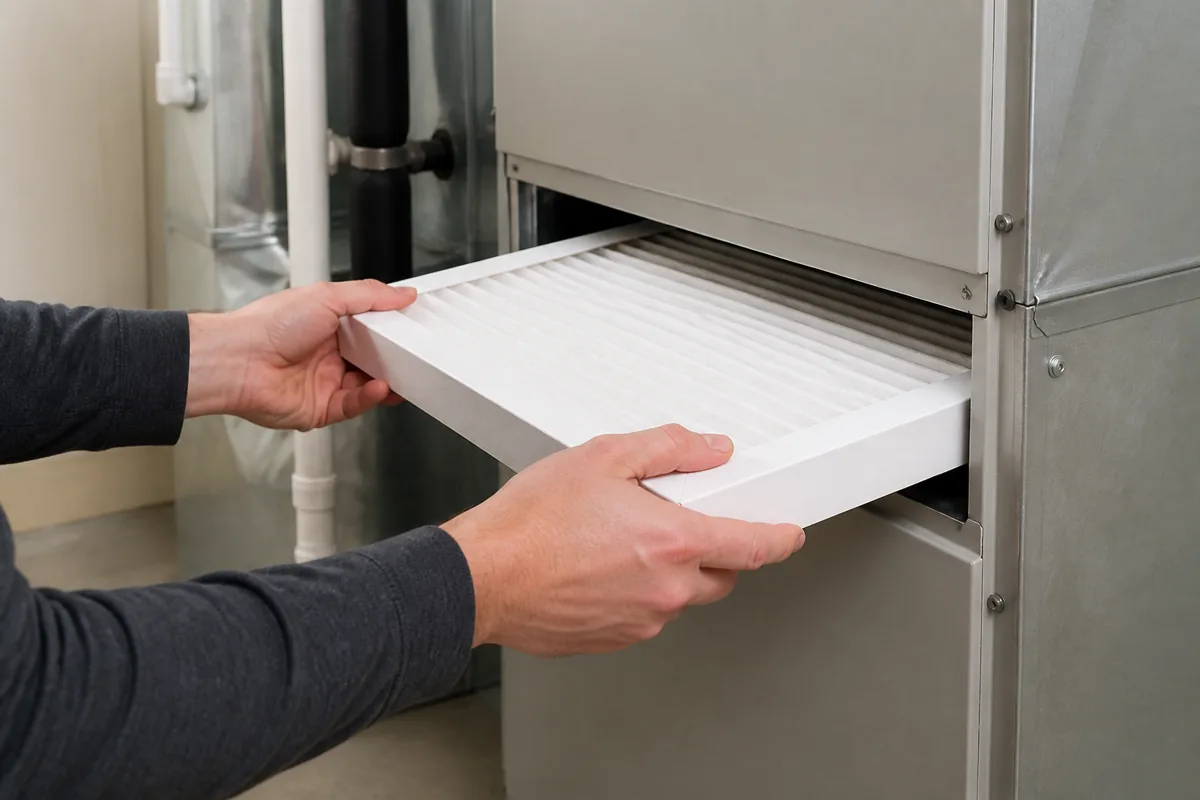
A correct filter starts square to its rails and slides into position with light hand pressure. The frame stays flat, the media is not pinched, and the grille or access cover closes normally.
Secure does not mean wedged. The filter should not require a flexed corner, compressed media, or the cover to push it home. It also should not wobble dramatically, fall out of a vertical track, or sit diagonally.
How Much Clearance Is Normal?
There is no universal fractional-inch tolerance for every furnace slot, media cabinet, or return grille. Rack geometry and actual filter dimensions vary. Clearance that lets the filter enter and leave normally can be intentional.
Investigate clearance that lets the frame rattle, tip off its support, lift, drop, or leave an obvious side channel. The question is whether the filter stays in its intended support position while air moves. Never fill a gap with cardboard, foam, tape, stacked filters, or homemade spacers.
Nominal Size vs Actual Size
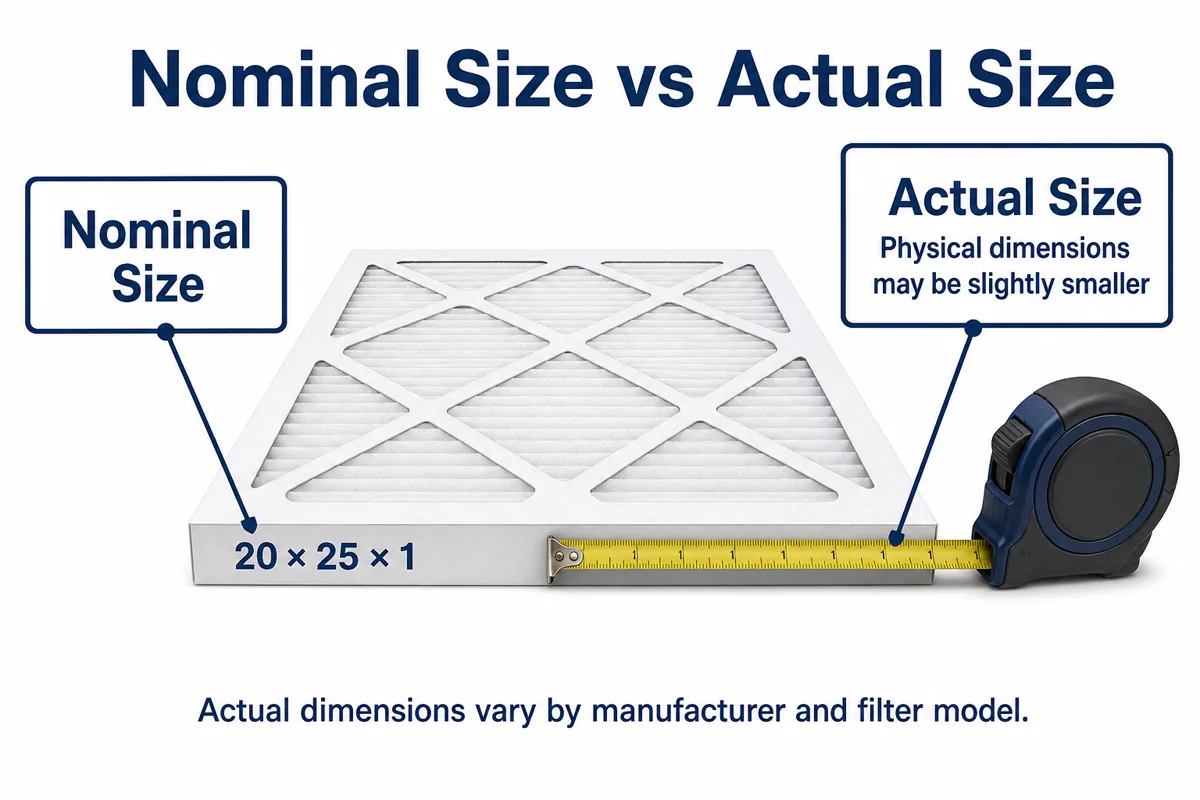
The size printed on a disposable filter is usually its nominal size: the standard label used for shopping and matching it to a nominal rack. The actual size is what the frame physically measures. A filter labeled 20 × 25 × 1 should not be assumed to measure exactly 20.00 × 25.00 × 1.00 inches.
Actual dimensions are commonly somewhat smaller to provide installation clearance, but the difference is not identical across every product. Two manufacturers can sell the same nominal size with slightly different physical dimensions or frame construction. Deep media cabinets may use product-specific or proprietary dimensions that make nominal labels especially important.
When a readable existing filter has always fit correctly, its printed nominal size is usually the best replacement reference. Record its actual dimensions when comparing another brand or diagnosing a close fit. The broader filter-size guide explains all five ways to confirm dimensions, while the filter-thickness guide explains why depth is not interchangeable.
Air Filter Fit Diagnosis at a Glance
| What you notice | Possible explanation | What to check | Next step |
|---|---|---|---|
| Slides in and stays put | Likely correct fit | Square seating and closed cover | Install and monitor |
| Slight clearance, no movement | Normal rack allowance | Support and bypass path | No change if secure |
| Filter rattles | Excess clearance or support issue | Nominal size, rails, clips | Confirm intended filter |
| Lifts when blower starts | Loose fit under pressure change | Seating and retainers | Inspect size and support |
| Drops when blower stops | Not held securely | Track engagement | Correct fit or support issue |
| Visible gap on one edge | Undersize, tilt, or rack geometry | Actual dimensions and seating | Remove bypass route |
| Bows while running | Fit, support, loading, or restriction | Frame, dirt, airflow symptoms | Diagnose more than size |
| Must be forced in | Oversize, obstruction, or wrong orientation | All three dimensions | Stop and recheck |
| Frame crushes | Binding or wrong product | Actual size and rack damage | Do not install damaged filter |
| Sticks during removal | Swelling, deformation, debris, or tight fit | Frame and accessible track | Remove carefully; correct cause |
| New brand fits differently | Different actual dimensions | Published/measured actual size | Compare before multipack |
| No standard size fits | Wrong location, proprietary media, or altered rack | Label, manual, slot | Confirm specification |
Signs the Filter Is Too Loose
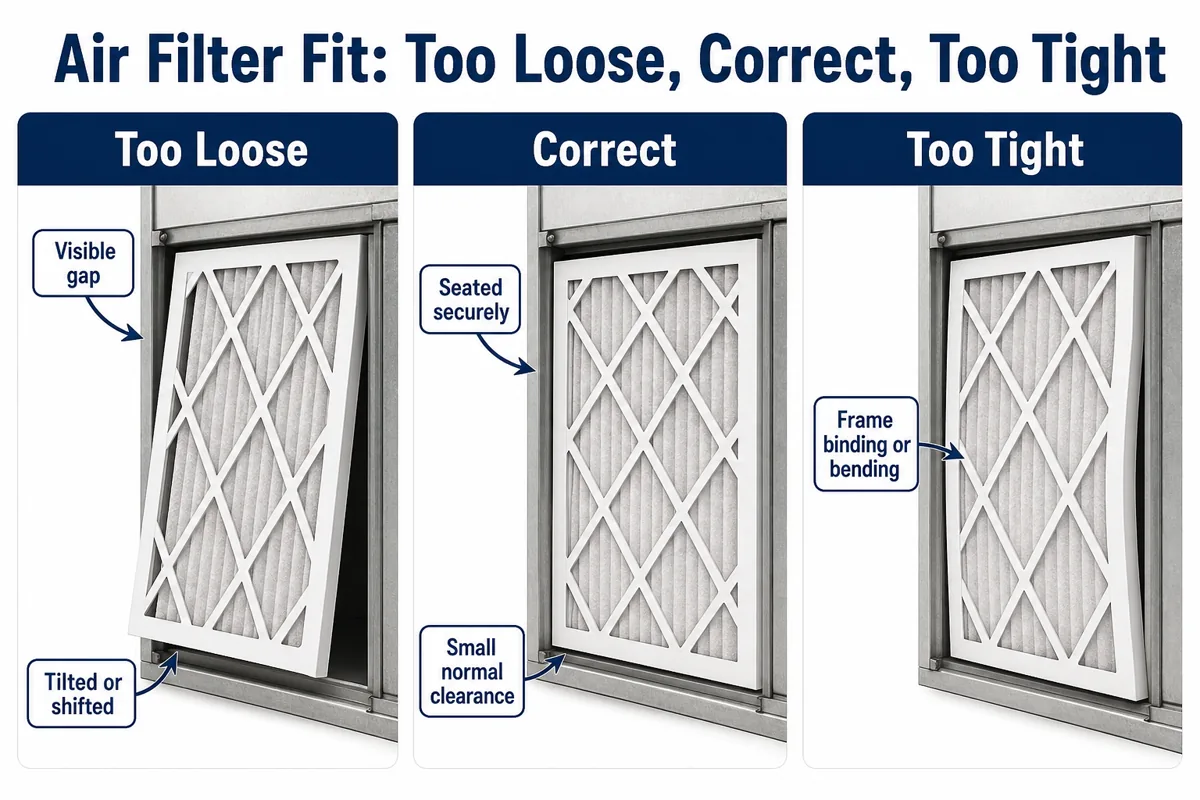
A loose filter may rattle against its rails, shift sideways, tilt, lift at startup, or drop when the blower stops. You may see a large gap along one edge or find the frame no longer resting on the intended supports. Repeated motion matters more than a small wiggle while you are handling an open rack.
Loose fit can also create indirect clues. Air moving around an edge can produce noise, and bypass can leave a relatively clean strip beside heavier dirt. Those patterns are clues rather than proof: airflow geometry, a warped frame, and nearby particle sources can look similar.
Use the focused guides when the main symptom is filter movement at blower startup, whistling near the filter, or dirt loading on only one side. A loose filter does not automatically cause every one of those symptoms.
Signs the Filter Is Too Tight
A too-tight filter binds before it reaches its stop, requires unusual force, bends at the corners, crushes its frame, or sticks when you try to remove it. The access door or return grille may not close normally because the filter is protruding or sitting crooked.
Stop rather than forcing it. Confirm length, width, and thickness; then check orientation and whether debris, bent rails, paint, or a damaged edge is narrowing the accessible track. A product with the same nominal label may still fit differently because its actual frame dimensions or rigidity differ.
Do not trim, fold, shave, crush, or cut a disposable filter to make it fit. Those changes can damage the media and prevent square seating. Do not leave the filter partly installed or use the cover as a clamp.
Can a Loose Filter Cause Air Bypass?
Yes—when a gap gives return air a path around the frame instead of through the media. That air avoids the particle-capture performance printed on the filter. A higher MERV label cannot compensate for bypass. The guide to visible dust around registers explains when poor fit may be contributing.
Can a Physically Tight Filter Restrict Airflow?
Physical binding and media resistance are different. A frame that is hard to insert has a dimensional or rack-fit problem. Filter restriction depends on media design, face area, depth, airflow, and loading.
Forcing an oversized filter can distort its frame, but insertion effort does not measure pressure drop. For weak airflow, heavy loading, icing, or whistling, review air-filter restriction.
Why Does a New Filter Brand Fit Differently?
Nominal sizing does not mean identical exact dimensions. Frame thickness, stiffness, folded corners, adhesives, support grids, and manufacturing tolerances change fit. Compare listed actual dimensions with the known-good filter before buying a new-brand multipack, especially when the old fit was close.
What If the Filter Moves When the HVAC Starts?
Blower startup changes pressure across the filter. Excess clearance or inadequate support may let a frame lift, slide, or tap the rack. Repeated movement suggests fit or support—not automatically blower failure. The moving-filter guide separates slight motion from displacement, rattling, loading, and restriction.
What If the Filter Bends or Bows?
Bowing can involve wrong size, weak support, loading, resistance, moisture, or airflow conditions. Fit is only one possibility. Replace a damaged disposable filter; never brace it with improvised material. Review why filters bend or bow inward for the full checklist.
How to Measure the Filter Correctly
Start by deciding whether the existing filter is a trustworthy reference. If it has fit securely, stayed flat, and allowed the cover to close, read its printed nominal length, width, and thickness. That label is normally the primary shopping reference. Record its physical dimensions when changing brands or investigating a close fit.
If the existing filter is missing, visibly undersized, forced, or clearly not intended for the rack, measure the accessible filter slot or cabinet where the frame actually sits. Record all three dimensions, the orientation, accessible rail spacing, and any cabinet label or service sticker. Do not measure the decorative face of a return grille and assume those outside dimensions equal the filter size.
Keep work limited to the accessible filter compartment. Do not open sealed service panels or reach around wiring. Equipment and filter-cabinet manuals may identify a specified media family even when the HVAC model alone cannot determine the installed rack.
Should You Measure the Slot or the Old Filter?
Use a correctly fitting old filter first; use the intended rack or slot when the old filter is missing or wrong. This decision prevents two common errors: treating a bad old filter as proof of the correct size, and measuring an entire grille opening that was never meant to equal the filter frame.
Can You Use a Slightly Different Filter Size?
Do not assume nearby nominal sizes are interchangeable. A smaller filter can move or leave a gap; a larger one can bind. Small actual-dimension differences within one nominal size can be normal, but they do not make a different nominal size interchangeable. Confirm one replacement before ordering a multipack. The focused guide to substituting a different air-filter size explains same-size brand changes, unavailable sizes, and documented alternatives.
What If No Standard Filter Size Fits?
First verify that you measured the intended filter rack rather than the grille face, duct opening, or equipment panel. Compare nominal and actual dimensions, inspect both sides of any old frame, and look for a cabinet label. Some media cabinets use proprietary or uncommon replacements, and custom-size filters also exist.
A previous owner may have used the wrong filter, or the rack may be bent, damaged, or altered. Do not rebuild sheet metal, bend rails, or improvise fillers. When the intended specification remains unclear, an installer or qualified HVAC professional can identify the rack and determine whether repair is needed.
Fit Symptoms vs Restriction Symptoms
More consistent with a fit problem
- Rattling or repeated movement
- Visible edge gap
- Tilted seating
- Filter will not seat fully
- Frame binds during installation
More consistent with restriction
- Weak supply airflow
- Whistling through a loaded filter
- Frame bowing under operation
- Heavily loaded media
- Repeated coil icing
The categories can overlap. A bowed filter can expose a gap, while a wrong-size frame can also deform. Use several observations—fit, condition, noise, airflow, and timing—rather than diagnosing from one symptom.
Safe Air Filter Fit Inspection Checklist
- Turn the HVAC system off at the thermostat.
- Photograph the current filter in place.
- Read the printed nominal size.
- Record actual dimensions if brand fit is questionable.
- Confirm the filter slides without force.
- Check whether it remains seated.
- Look for large edge gaps.
- Check accessible retaining clips or rails.
- Inspect for bending, crushing, tears, or moisture.
- Confirm the airflow-arrow direction.
- Compare another correctly sized filter if necessary.
- Check equipment or cabinet documentation.
- Do not trim, fold, crush, stack, tape, or improvise spacers.
- Escalate when the intended size remains unclear.
Free homeowner tool
Know the Size but Need the Right Replacement?
Confirm the nominal size and thickness, then use Filter Wizard for cautious MERV guidance and replacement options.
Open the Filter FinderLoose, Tight, or Correct: A Decision Guide
Fit looks correct
- Slides normally
- Stays seated
- No large gap
- Door closes normally
- No repeated rattling
Likely too loose
- Rattles or lifts
- Drops or tilts
- Shifts off support
- Visible bypass gap
Likely too tight
- Requires force
- Frame bends or crushes
- Filter sticks
- Slot or door will not close
Filter Wizard Recommendation
Use the nominal filter size specified for the HVAC rack or return grille while remembering that actual physical dimensions may be slightly smaller and can vary by product. The filter should slide in without force, remain securely seated, and avoid an obvious bypass route.
If it rattles, shifts, binds, bends during installation, or no standard size seems to fit, verify actual dimensions and the intended rack specification before ordering another replacement. Confirm one filter before purchasing multiples.
Filter Wizard recommendation
Continue After You Confirm the Fit
Enter a valid three-dimensional size for household MERV guidance, replacement timing, and current retailer options. Filter Wizard cannot physically inspect the rack or guarantee compatibility.
Start the Filter FinderFree Filter Reminders
Remember Your Next Filter Check
Get occasional filter reminders, homeowner maintenance tips, and buying guidance.
Occasional emails only. Unsubscribe anytime.
You're on the list. We'll send practical filter reminders and updates occasionally.
Frequently Asked Questions
How tight should an air filter fit?
It should slide into the intended rack without force, remain supported and seated, and avoid obvious bypass gaps. Small installation clearance can be normal because racks and actual filter dimensions vary.
Should an HVAC filter fit snugly?
Yes, if snug means secure rather than compressed. The filter should not rattle freely, tilt, or fall out, but its frame should not need to be crushed or bent to fit.
Is a small gap around an air filter normal?
Some clearance may be intentional and normal. There is no universal acceptable gap; investigate a large opening that lets the filter shift or gives air an obvious path around the media.
Can an air filter be too loose?
Yes. A filter that rattles, lifts, drops, tilts, or leaves a large edge gap may be undersized, unsupported, or incorrectly seated and can allow air bypass.
Can an air filter be too tight?
Yes. If installation requires force, crushes the frame, prevents full seating, or keeps the access door from closing, confirm the nominal size, actual dimensions, brand, and rack condition.
Why does my furnace filter rattle?
Rattling can come from excess clearance, missing or damaged support, a warped frame, or pressure changes when the blower runs. Verify the filter size, seating, and accessible retainers.
Why does my filter move when the blower starts?
The pressure change at startup can move a filter that has excess clearance or inadequate support. Repeated lifting, shifting, or dropping deserves a size and rack-support check.
Should I force a filter into the slot?
No. Do not force, trim, fold, or crush a disposable filter. Recheck all three dimensions, orientation, rack condition, and the product's actual size.
Why is the actual filter smaller than the printed size?
The printed dimensions are usually a nominal shopping size. Manufacturers commonly make the physical filter slightly smaller so it can fit the intended nominal rack, but exact actual dimensions vary by product.
Do different brands with the same size fit differently?
They can. Products sharing a nominal size may have slightly different actual dimensions, frame materials, and construction. Compare listed actual dimensions before changing brands if fit is close.
Can I use a slightly smaller air filter?
Do not assume a different nominal size is interchangeable. A smaller filter can leave bypass gaps or move in the rack. Match the intended specification and confirm physical fit.
Can I use a slightly larger air filter?
Do not force a larger nominal filter into the rack. Binding or crushed edges can prevent proper seating. Confirm the specified size and compare actual dimensions instead.
Should I measure the old filter or the filter slot?
If the old filter fit correctly, use its printed nominal size first and record actual dimensions if needed. If it is missing or clearly wrong, measure the intended accessible rack or slot and consult labels or documentation.
What should I do if no standard filter size fits?
Verify the measuring location, nominal-versus-actual dimensions, cabinet label, and equipment documentation. The cabinet may use proprietary or custom media, or the rack may be damaged or altered; seek professional confirmation when the specification remains unclear.