Quick Answer
Dust around supply vents can be filter-related, particularly when the filter is missing, damaged, undersized, or poorly seated, but dusty register edges do not automatically mean the filter is failing. Air movement can also deposit ordinary room dust on nearby walls and ceilings.
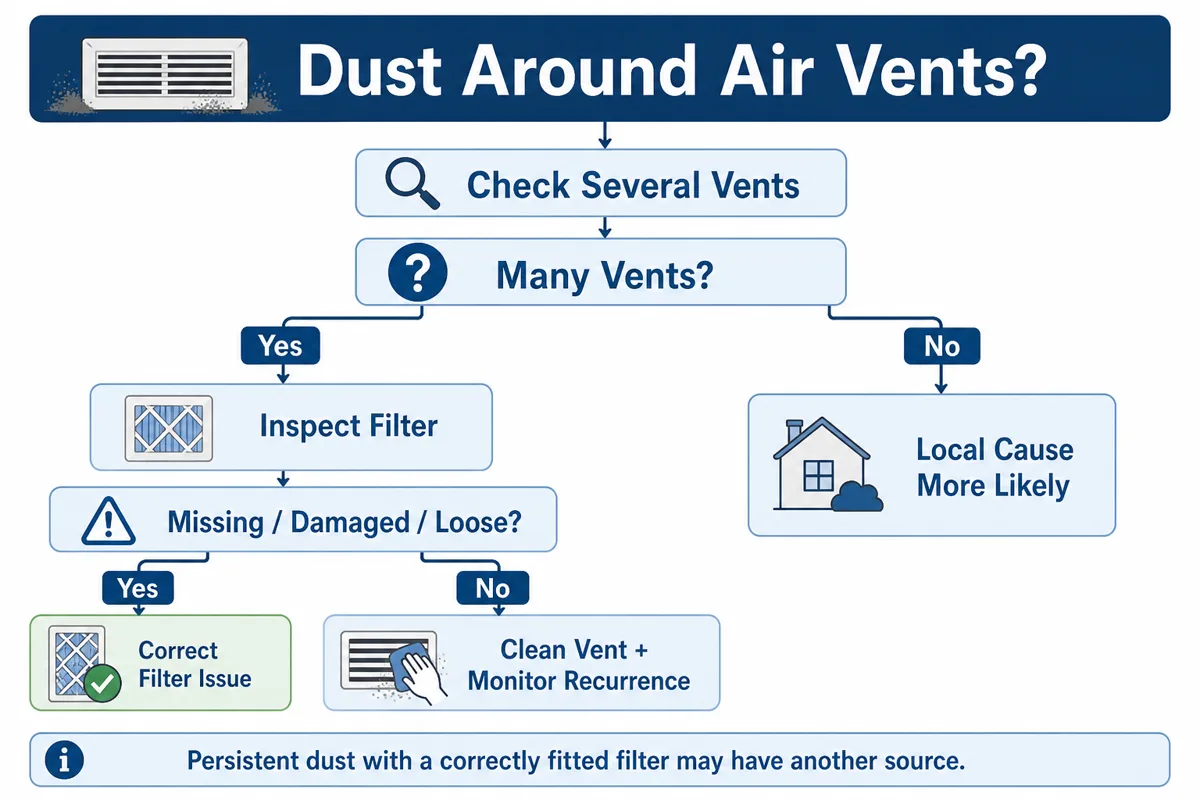
A pattern at many vents makes a central filtration or system factor more plausible; one dusty vent makes a local source more likely. Inspect filter condition, size, seating, and obvious bypass gaps before changing MERV. Do not treat surface dust alone as evidence that duct cleaning is needed.
Why Dust Collects Around Air Vents
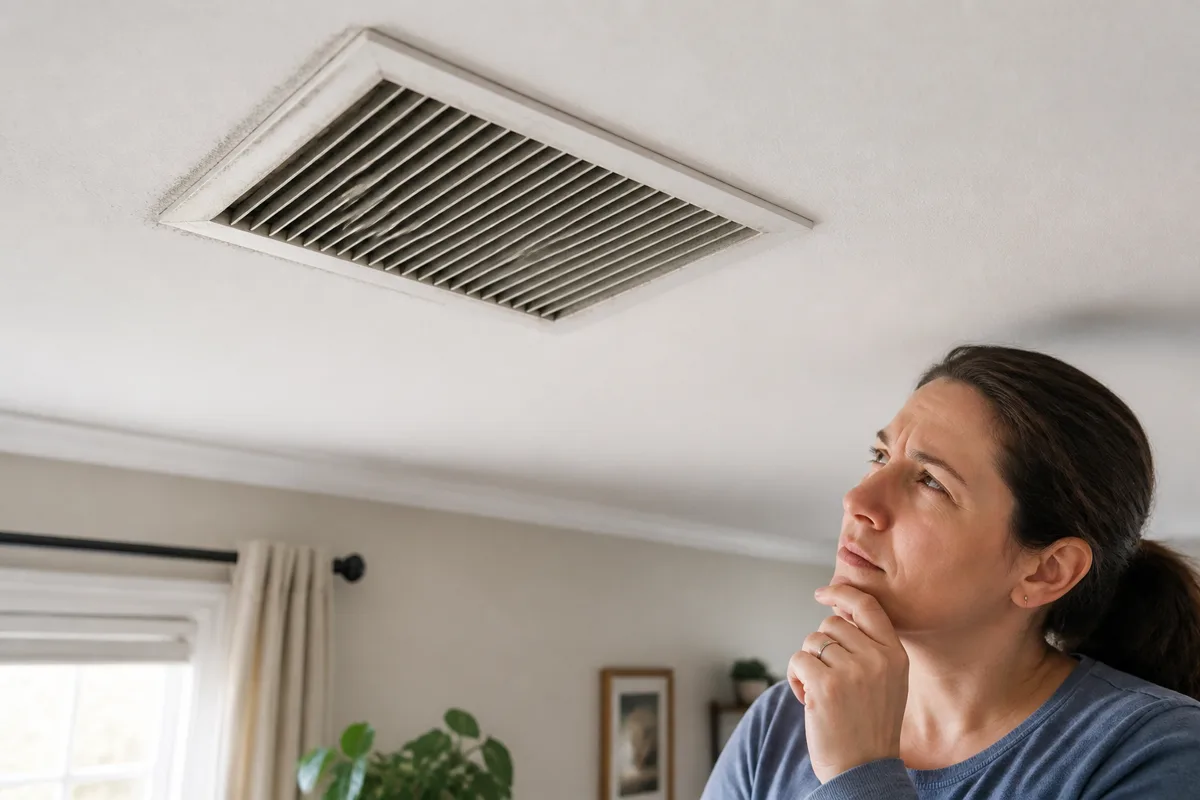
Supply air leaves a register and mixes with room air. That movement can disturb fibers and particles already in the room, create small local currents, and encourage some material to settle along the register frame or nearby surface. Edges, textured ceilings, and paint contrast can make a thin deposit unusually visible.
Some material can also arrive through the HVAC path when filtration is absent, damaged, or bypassed, or when loose debris is near a register. Appearance alone cannot separate these routes. The useful question is whether the dust pattern and filter evidence make HVAC delivery more or less plausible.
Is the Dust Actually Coming From the Vent?
Material inside register openings, visible particles when the blower starts, buildup at several supplies, and a missing or poorly seated filter make HVAC delivery more plausible. They still do not identify the source or quantify bypass.
Dust outlining the outside edge, slow accumulation like nearby surfaces, or one affected register is less suggestive. Photograph the pattern, clean the accessible face, and monitor recurrence.
Dust Around One Vent vs Many Vents
One dusty vent
One register is less consistent with a central filter failure because the same filtered air generally serves multiple supplies. Consider room-specific textiles, pets, open windows, nearby construction, register position, local airflow, or a local duct condition. This does not rule out HVAC involvement; it simply weakens the filter hypothesis.
Dust around many vents
A repeated pattern makes whole-system factors more relevant: a missing filter, torn media, poor seating, bypass around the frame, an unusually high indoor dust load, or broader contamination. Compare several registers and then inspect the intended filter location rather than assuming every dusty grille needs its own filter. The guide to filters at return vents explains why supply registers are not filter locations.
Can a Dirty Filter Cause Dust Around Vents?
A heavily loaded filter can add resistance, deform, or pull away from weak support, particularly when its fit was already poor. Those changes may make bypass or abnormal airflow more plausible. Yet a dirty filter normally contains captured material; it does not manufacture dust.
Use clogged-filter signs to assess loading, airflow, and deformation. Replacing a genuinely loaded filter is appropriate, but dust around a register does not prove that loading caused the deposit.
Can a Loose Filter Let Dust Bypass It?
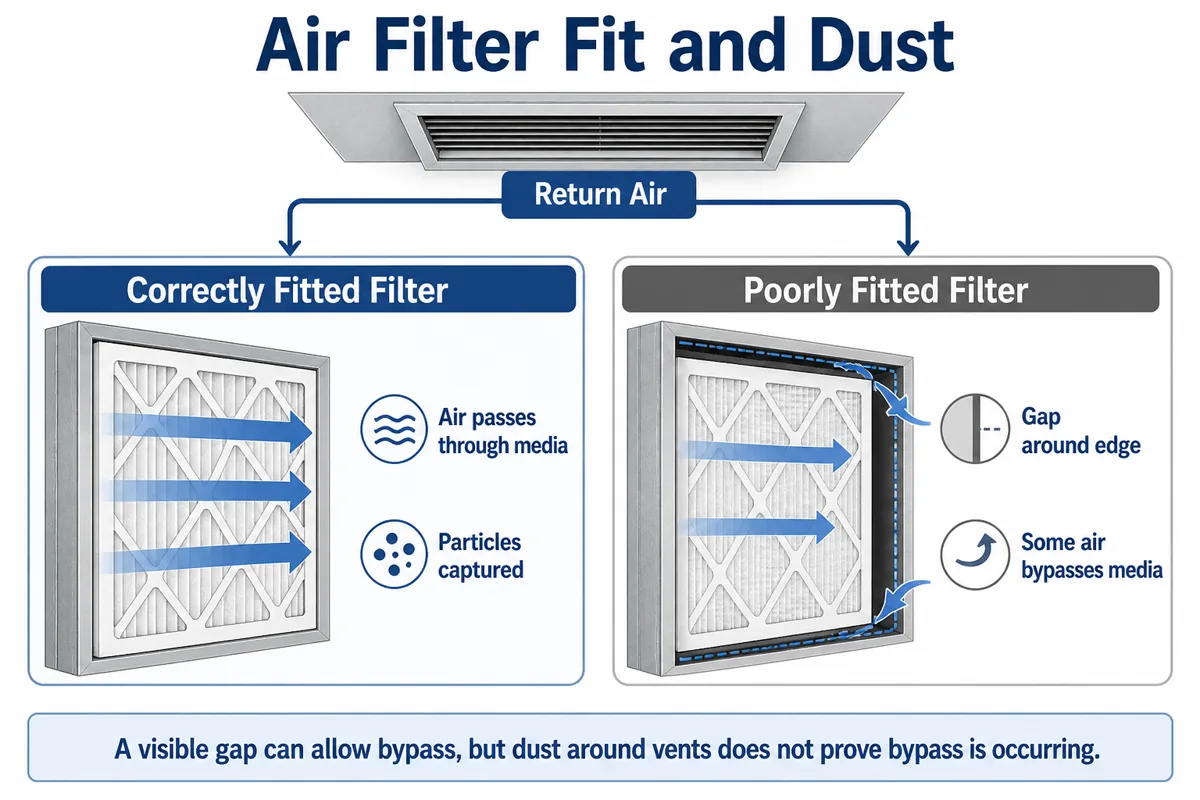
Yes. Return air follows available paths. When an obvious gap exists around the frame, some air may travel around the media, allowing those particles to avoid capture. The gap establishes a possible bypass path; it does not reveal the amount of air using it.
A correct filter should slide in without force, remain seated, and avoid large visible edge gaps. There is no universal clearance number for every rack. Review how tightly an air filter should fit rather than inventing a tolerance.
Can the Wrong Size Filter Cause Bypass?
An undersized filter may leave gaps or shift in the track. A warped, crushed, or poorly seated frame may also fail to cover the intended opening. An oversized filter can bind or deform when forced. Not every slight brand-to-brand actual-dimension difference creates meaningful leakage, so distinguish nominal substitution from ordinary manufacturing variation.
If the printed size differs, do not assume it is close enough. See whether nearby filter sizes are interchangeable and confirm the intended filter size.
What If the Filter Looks Clean but the House Is Dusty?
The filter may be new, or larger room particles may settle before reaching a return. A high dust load can come from textiles, pets, tracked soil, open doors, remodeling, and normal activity. A clean-looking filter can also result when air bypasses it, but appearance alone does not diagnose that path.
Confirm that the filter sits at the intended filtration point and that all designated locations are accounted for. Uneven airflow and gaps may produce one-sided filter loading, while rapid whole-filter loading belongs in the guide to a filter getting dirty unusually fast.
Does a Higher-MERV Filter Fix Dust Around Vents?
Higher particle-capture efficiency can reduce some airborne material that reaches and passes through compatible media. It cannot repair bypass, replace a missing filter, clean settled room dust, secure a damaged register, or correct every source of visible household debris.
MERV describes capture efficiency in defined particle ranges; it is not a complete pressure-drop specification. Product design, depth, media area, airflow, and loading matter. Use the dust filter buying guide, MERV comparison, and restriction guide only after confirming size and fit. There is no blanket reason to jump to MERV 13 because a ceiling looks dusty.
Could the Dust Be From the Room Instead of the Duct?
Yes. Fabrics, people, pets, tracked soil, open windows, renovation debris, and activity contribute particles, much of which settles before reaching a return. Supply airflow can redistribute room air and create an outline without delivering the original particles from the duct.
What If the Dust Is Black?
Dark residue may mix ordinary dust with soot, smoke particles, staining, moisture marks, or other material. Color does not diagnose mold, combustion failure, or duct contamination. Compare it with the black-filter guide without assuming the same source.
What If Dust Appears Only Around Ceiling Vents?
Ceiling airflow and surface texture can make edge deposits more visible. Compare vents with nearby ceiling surfaces. This pattern is context, not a measurement of filter performance.
What If Dust Comes Out When the HVAC Starts?
Repeated visible particles are more concerning than passive surface dust. Loose register debris, renovation material, contamination, or filtration bypass may be involved. Turn the system off before handling the filter; do not reach into ducts or open equipment.
Clean the accessible register face and observe recurrence. Continued discharge warrants evaluation rather than repeated filter purchases.
What If the Filter Is Missing?
A system intended for a filter should not run without the appropriate one. Identify the designated location and dimensions; do not insert media into any convenient grille.
What If the Filter Is Damaged or Collapsed?
Torn media, a collapsed frame, or a filter outside its track can reduce coverage and create bypass. Replace it correctly, then investigate repeated bowing or movement.
Should You Clean the Vent First?
- Photograph the existing pattern.
- Turn the HVAC system off if working near the filter.
- Gently clean the accessible register face and nearby surface.
- Inspect the intended filter location, condition, and fit.
- Correct an obvious missing, damaged, loaded, or wrong-size filter.
- Restart normally and compare several vents.
- Monitor whether the same pattern returns.
This separates old settled material from new accumulation without beginning with invasive duct work.
What Should You Check at the Filter?
- The correct filter is present at the intended location.
- The media is not torn, wet, or collapsed.
- The frame remains square and supported.
- The airflow arrow points correctly.
- The filter sits in its track without force.
- No obvious large gap exposes the opening.
- The filter is not severely overloaded.
- The nominal size and supported thickness are correct.
- No other designated filter location has been overlooked.
Dust Around Vents: Filter-Related or Not?
| Observation | Filter issue more plausible? | Why |
|---|---|---|
| Many dusty vents and loose filter | More plausible | Central pattern plus a bypass path. |
| One dusty vent only | Less suggestive | Local source or airflow is more relevant. |
| Filter visibly undersized | More plausible | Gaps can let air avoid media. |
| Filter missing | More plausible | Return air receives no intended media capture. |
| Filter clean and well seated | Less suggestive | Direct filter evidence is weak. |
| Dust outlines register edges | Less conclusive | Room-air deposition can create an outline. |
| Particles blow from several vents | Needs investigation | Stronger evidence of HVAC-delivered material. |
| Higher MERV but gaps remain | More plausible | Efficiency does not correct bypass. |
| Dust persists after fit correction | Needs investigation | Another source may be involved. |
Should You Have the Ducts Cleaned?
Dust around vents alone is not enough evidence. EPA notes that dusty registers do not by themselves indicate heavy duct contamination, and that the benefits of duct cleaning cannot be generalized across homes. Clean accessible register surfaces and correct obvious filter problems first.
Further evaluation becomes more reasonable when visible debris repeatedly blows from vents, substantial contamination is safely visible, major renovation material entered the system, or the filter was missing for a prolonged period. Do not promise health benefits or open ductwork yourself. See the EPA duct-cleaning guidance.
What If You Just Changed the Filter?
A new filter does not remove dust already deposited on registers, accessible vent surfaces, walls, ceilings, or furniture. Clean existing buildup and watch recurrence. There is no universal period after which a new filter should make surface dust disappear.
When Should You Upgrade Filtration?
Consider efficiency only after confirming size, supported thickness, secure fit, and lack of obvious bypass. Then compare compatible products and equipment guidance. A higher rating may capture more particles that reach the return, but it is not a repair for an unidentified register or duct condition.
Free homeowner tool
Need a Better-Fitting Replacement?
If the filter is damaged, undersized, missing, or genuinely due, confirm the correct size before changing filtration levels. Filter Wizard can narrow options by size and household needs.
Open the Filter FinderWhen Should You Stop Blaming the Filter?
The filter becomes a weaker suspect when the correct product is present, intact, seated well, and free of obvious bypass; dust appears at only one vent; buildup resembles other room-surface dust; or correcting a filter problem does not change recurrence. At that point another room, register, duct, or system source may need investigation.
When Should You Get HVAC Help?
Seek qualified evaluation when particles repeatedly blow from several vents, the filter repeatedly collapses or leaves its track, the rack appears damaged, substantial debris is visible from an accessible opening, airflow is abnormal, or moisture, odor, noise, or another symptom cannot be assessed safely.
Do Not Do This
- Do not assume dust color means mold.
- Do not assume dusty registers require duct cleaning.
- Do not tape a filter into an improvised position.
- Do not stack filters or force an oversized frame.
- Do not jump directly to very high MERV.
- Do not operate intentionally without the required filter.
- Do not open sealed HVAC or duct compartments.
- Do not spray cleaner or fragrance into ducts or onto media.
Filter Wizard Recommendation
Dust around vents can point to filtration when the filter is missing, damaged, undersized, or allowing air around its edges. It can also be room dust collecting where air moves. Inspect the filter, correct obvious fit or damage, clean the register, and monitor recurrence.
If dust continues despite a well-seated filter, the source may be elsewhere. Repeated particles, abnormal airflow, or inaccessible contamination deserve evaluation rather than a stronger filter by default.
Filter Wizard recommendation
Confirm Size Before Choosing a Replacement
Enter a valid three-dimensional size for cautious MERV guidance, replacement timing, and retailer options. Filter Wizard cannot identify the source of vent dust or guarantee compatibility.
Start the Filter FinderFree Filter Reminders
Remember Your Next Filter Check
Get occasional filter reminders, homeowner maintenance tips, and buying guidance.
Occasional emails only. Unsubscribe anytime.
You're on the list. We'll send practical filter reminders and updates occasionally.
Frequently Asked Questions
Why is there dust around my air vents?
Air currents can deposit ordinary room dust around register edges. Filter gaps, a missing or damaged filter, or another HVAC source can also contribute, so the pattern and filter condition matter.
Does dust around vents mean my air filter is bad?
No. Dust around a register does not prove filter failure. Inspect whether the correct filter is present, intact, properly seated, and reasonably clean before changing it.
Can a dirty air filter cause dust around vents?
A heavily loaded filter can deform or contribute to abnormal airflow, especially if fit is already poor. The filter captures dust rather than creating it, so loading alone does not prove the vent dust came through the system.
Can an undersized air filter let dust through?
It can. An undersized or poorly seated filter may leave gaps where some return air avoids the media. A visible gap establishes a bypass path, not how much bypass is occurring.
What is air filter bypass?
Filter bypass occurs when some return air travels around the filter frame instead of through the media, allowing those particles to avoid capture.
Why is there dust around only one vent?
One dusty vent is less suggestive of a central filter problem. Room dust, a local airflow pattern, nearby activity, the register itself, or a local duct condition may be more relevant.
Why is there dust around all my vents?
A repeated pattern makes whole-system factors more plausible, including filter absence, damage, poor seating, bypass, or an unusually high indoor dust load. It still does not identify the cause by itself.
Will a higher-MERV filter stop dust around vents?
Not necessarily. Higher-efficiency media can capture more particles that pass through it when compatible, but it cannot correct gaps, a missing filter, settled room dust, or every HVAC source.
Why is my house dusty even with a new air filter?
A new filter does not remove dust already on surfaces, and much household dust settles before reaching a return. Fit, bypass, runtime, room sources, and filter location also matter.
Does dust around vents mean my ducts are dirty?
No. Surface dust around a register is not proof of heavy duct contamination. Repeated visible debris blowing from several vents is a stronger reason for further investigation.
Should I have my air ducts cleaned if the vents are dusty?
Not based on vent dust alone. Clean accessible registers, correct obvious filter problems, and monitor recurrence before deciding whether system-specific evaluation is warranted.
What does black dust around an air vent mean?
Dark residue can combine ordinary dust with soot, smoke particles, staining, or other material. Color alone does not diagnose mold, combustion failure, or duct contamination.
What if dust actually blows out of the vent?
Repeated visible particles from one or more vents deserve further investigation. Clean the accessible register and inspect the filter, but do not assume a replacement alone will correct loose debris or another system condition.
When should I call an HVAC professional about dusty vents?
Seek evaluation when particles repeatedly blow from multiple vents, the filter will not stay seated, the rack appears damaged, airflow is abnormal, or debris, moisture, odor, or another symptom cannot be assessed safely.