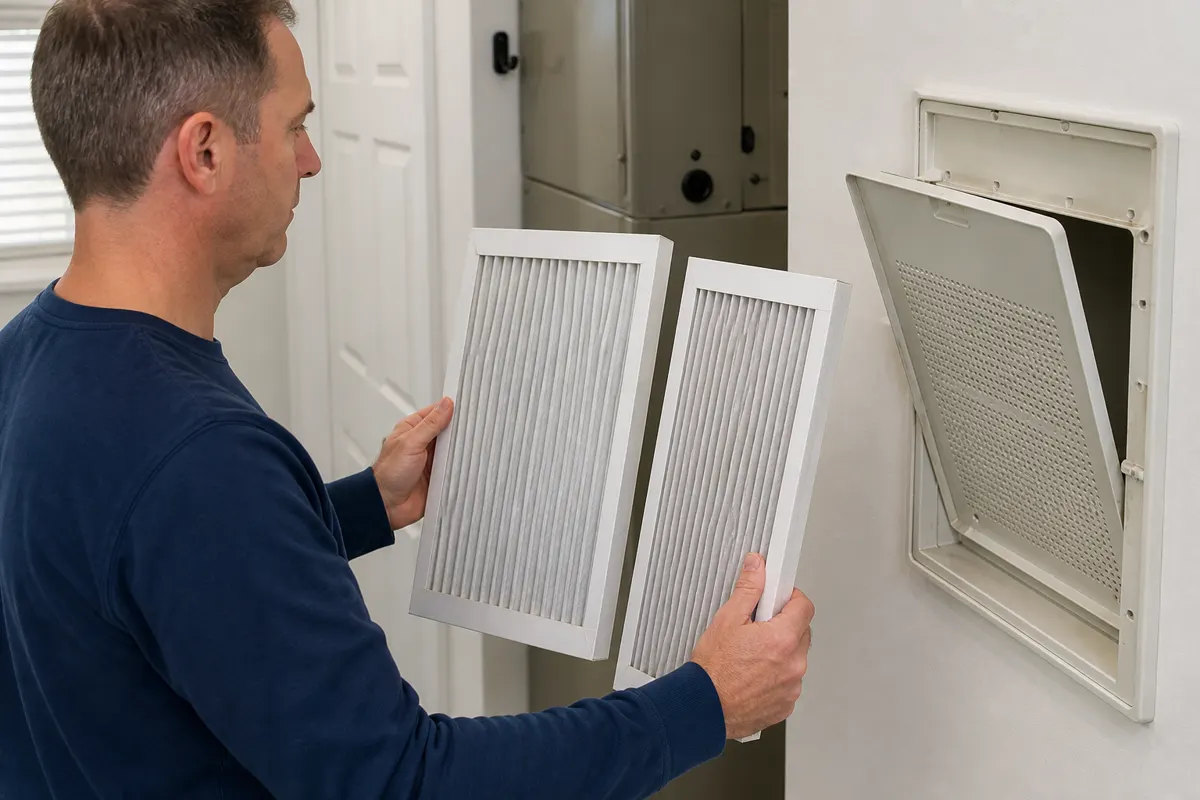
Quick Answer
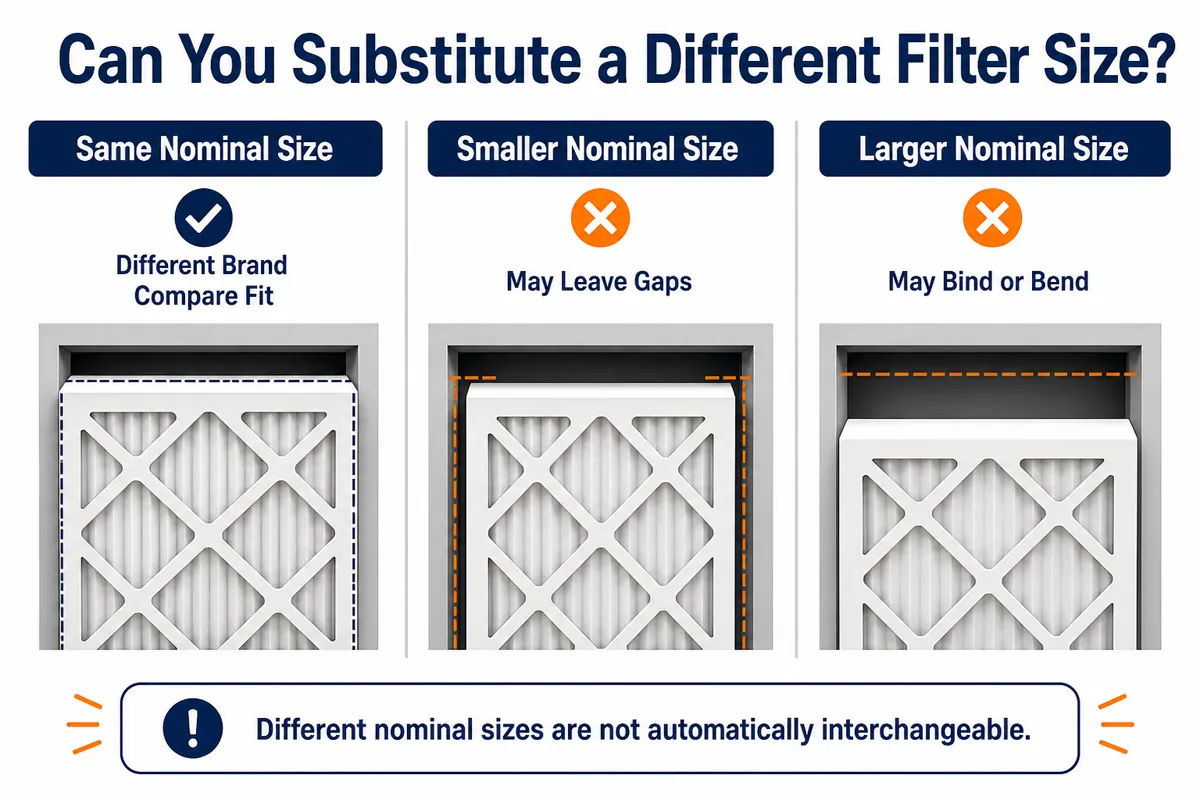
Usually, you should not substitute a different nominal air-filter size simply because it seems close. A slightly smaller nominal filter can leave bypass gaps or move in the rack, while a larger one can bind, bend, or fail to seat correctly.
Two filters with the same nominal size can have slightly different actual dimensions between brands, and that variation may be normal. Some equipment also documents approved alternative configurations. Match the intended nominal size whenever possible and verify any true substitution before relying on it.
Same Nominal Size vs Different Nominal Size
This distinction prevents most substitution mistakes. A 20 × 25 × 1 filter from Brand A and a 20 × 25 × 1 filter from Brand B share the same nominal shopping size. Their exact frames may differ slightly in length, width, corner construction, or thickness, so one can feel looser or tighter while still belonging to the intended category.
A 20 × 25 × 1 and a 20 × 24 × 1 have different nominal dimensions. They should not be treated as interchangeable merely because two dimensions match and the third looks close. The missing nominal inch can change how the frame rests on rails, meets a sealing edge, or stays retained when the blower starts.
If you have not confirmed the intended label, use How to Find Your Air Filter Size. If two same-label products fit differently, use the air-filter fit guide to evaluate seating, clearance, and binding.
Why “Close Enough” Can Still Be Wrong
Filter racks and return grilles support the frame at particular edges. The frame may ride in tracks, rest against a ledge, or be held by clips or a hinged grille. A nearby size can miss a support point even if it covers most of the opening.
An undersized frame may tilt or expose a route around the media. An oversized frame may stop before its intended position. Either condition can affect cover closure or let the filter move as pressure changes. These are fit and filtration problems; they do not mean every mismatch damages equipment.
Compare the known-good old filter, replacement label, and listed actual dimensions rather than deciding by appearance.
What Happens If the Filter Is Slightly Too Small?
A smaller nominal filter can leave a visible edge gap, sit diagonally, drop off a rail, or rattle when airflow changes. In a return grille, it may lift when the blower starts and settle when the blower stops. The exact behavior depends on rack geometry, retainers, airflow, and the size difference.
The important filtration concern is bypass. If return air has an open route around the frame, that portion of air does not pass through the filter media. A high MERV label cannot capture particles carried through a gap. Uneven dirt, a clean strip near one edge, or repeated movement can be clues, although none proves size is the only cause.
For focused troubleshooting, see why a filter may move when the HVAC starts, load dirt on only one side, or whistle near the rack. Do not solve a loose replacement with household filler material.
What Happens If the Filter Is Slightly Too Large?
A larger nominal filter may bind before it reaches its stop, protrude from the slot, bend at a corner, crush along an edge, or keep the grille or access door from closing. Removal may also become difficult after the frame loads with particles or absorbs moisture.
If normal hand pressure does not seat the filter, stop. Recheck length, width, thickness, orientation, and the actual dimensions of the product. Also inspect the accessible track for debris or a damaged rail without opening sealed service panels.
Do not trim, compress, or use the cover to push a disposable filter into position. A frame that begins distorted may not rest squarely and can bow when air moves. The bent-filter guide explains why size, loading, support, and resistance can overlap.
Can a Smaller Filter Be Used Temporarily?
Temporary use does not make an undersized filter acceptable; it can move or provide a bypass path during every cycle. Confirm the label, check same-nominal-size brands, review equipment or cabinet documentation, and investigate custom sizing for a nonstandard rack.
When you cannot obtain the specified filter or confirm a documented alternative, ask the installer, manufacturer, or a qualified HVAC professional rather than choosing an arbitrary smaller frame. Do not operate without filtration unless applicable guidance specifically directs it for the situation.
Can a Larger Filter Be Used Temporarily?
If the larger filter does not enter and seat naturally, do not use it. Temporary use does not justify forcing the frame, leaving a door open, or installing the filter partially.
Can You Use a Thinner Filter?
Thickness is a third nominal dimension, not spare space. A 1-inch filter may physically enter some 4-inch cabinets yet fail to meet the cabinet's intended sealing surface or retaining hardware. It can shift inside the cabinet or leave air paths around the media.
Do not assume a thinner filter is safer because it seems less restrictive. Media resistance and physical fit are separate issues. Follow the cabinet or equipment specification and never fabricate spacers to position a thin frame inside a deep-media cabinet.
Can You Use a Thicker Filter?
Only when the rack or media cabinet is designed for that depth. A 2-inch or 4-inch filter is not a drop-in substitute for a 1-inch slot even when length and width match. Do not force a deep frame into a shallow track or modify sheet metal for a routine filter change.
The 1-inch vs 2-inch vs 4-inch filter guide explains cabinet depth and media area. If airflow is the concern, review whether an air filter can be too restrictive; how hard a frame is to insert does not measure media pressure drop.
Can You Trim, Fold, or Crush a Filter to Make It Fit?
No. Trimming can cut media or support material and weaken the frame. Folding or crushing changes the filter geometry and may prevent a dependable seal. Do not shave cardboard edges, remove media, compress pleats, or wedge a distorted frame into the rack.
Can You Fill Gaps Around a Smaller Filter?
Do not pack the opening with cardboard, foam scraps, tape, folded paper, random gasket material, or homemade spacers. Improvised material can shift, become difficult to remove, interfere with a cover, or conceal that the wrong filter is installed.
An appropriate rack repair, approved adapter, or cabinet conversion is different from a household workaround and may require equipment-specific evaluation. Correct the replacement choice rather than teaching the rack to accept the wrong size.
When Can an Alternative Size Be Legitimate?
An alternative can be legitimate when the applicable equipment or media-cabinet documentation explicitly supports it. Examples may include a cabinet designed for multiple filter depths, a manufacturer-approved adapter or conversion arrangement, a service document listing compatible cartridge families, or a custom filter manufactured to the rack's actual specification.
The documentation must apply to the installed cabinet—not merely to a similar furnace model. Duct configurations and filter cabinets can differ between installations. Filter Wizard cannot infer approval from a model number or from the fact that another size physically enters the opening.
Approved alternative does not mean improvised substitution. Do not invent an adapter, assume that a retailer's “similar” suggestion is equipment approval, or copy an unknown previous installation without confirming it.
Why Do Two Brands With the Same Nominal Size Feel Different?
Nominal size is the shopping label; actual size is the physical measurement. Products sharing one label can differ slightly in frame length, width, thickness, corner folds, rigidity, adhesives, and support construction. Those differences can change how easily a filter slides or how much it moves.
A same-nominal brand change is usually the first place to look when the correct size is hard to find. Compare manufacturer-listed actual dimensions with the old filter, then install one replacement and confirm that it seats without force or a large bypass gap. Do not buy a large multipack until that fit is known.
What If Your Exact Filter Size Is Unavailable?
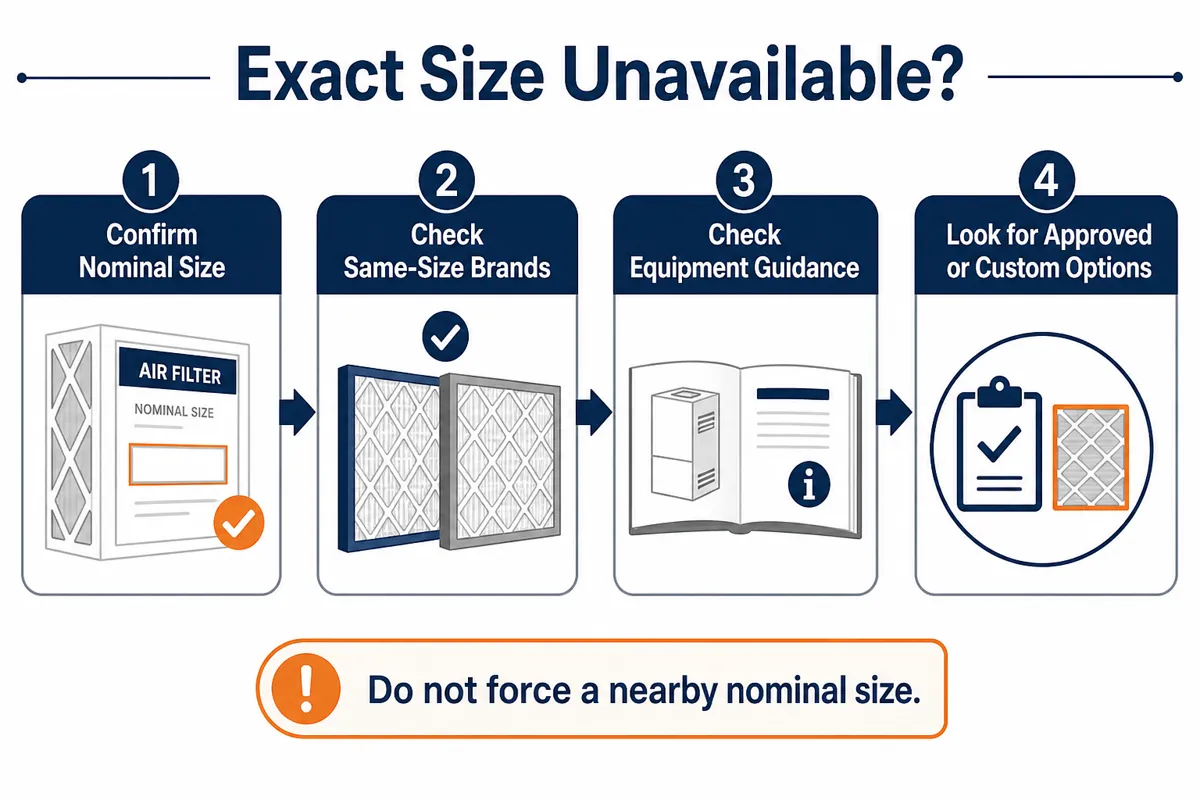
- Read the printed nominal size on the correctly fitting old filter.
- Check both sides of the frame for a model or product identifier.
- Look for other brands in the same nominal size.
- Compare actual dimensions when brand fit has been close.
- Review the filter-cabinet or equipment documentation.
- Check whether the manufacturer identifies an approved configuration.
- Investigate a custom-size filter when the rack is genuinely nonstandard.
- Confirm one replacement before purchasing a multipack.
Do not choose a nearby nominal size solely because it is in stock. Size-specific guides for 20 × 25 × 1, 16 × 25 × 1, and 20 × 20 × 1 filters apply only after that nominal size is confirmed.
Wrong-Size Symptoms vs Restrictive-Filter Symptoms
More consistent with wrong size or fit
- Rattling or repeated movement
- Visible edge gap
- Tilted seating
- Frame will not insert fully
- Access door will not close
More consistent with restriction
- Weak supply airflow
- Whistling through loaded media
- Filter bowing during operation
- Heavy dirt loading
- Repeated coil icing
The groups can overlap. A wrong-size frame can bow, while a restrictive or loaded filter can move against weak support. Evaluate fit, loading, airflow, timing, and noise together instead of diagnosing from one symptom.
Safe Air Filter Substitution Checklist
- Turn the HVAC system off at the thermostat.
- Confirm the existing filter's nominal size.
- Confirm that the current filter is a trustworthy fit reference.
- Record actual dimensions when changing brands.
- Verify rack or media-cabinet depth.
- Check equipment and cabinet documentation.
- Determine whether the proposed replacement has the same nominal size.
- If the nominal size differs, do not assume interchangeability.
- Look for manufacturer-approved alternatives.
- Do not trim, fold, crush, stack, tape, or improvise spacers.
- Install one confirmed replacement before ordering a multipack.
- Check for gaps, binding, and normal cover closure.
- Restart and monitor for movement, rattling, or airflow changes.
- Escalate when the intended size or approved alternative remains uncertain.
Free homeowner tool
Can’t Find Your Exact Filter Size?
Confirm the intended nominal size first, then use Filter Wizard for cautious MERV guidance and replacement options instead of guessing with a nearby size.
Open the Filter FinderQuick Decision Guide
Usually acceptable to compare
- Same nominal size
- Different brand
- Slight actual-dimension variation
- Correct fit confirmed
Do not assume interchangeable
- Different nominal length
- Different nominal width
- Different nominal thickness
- Requires force or leaves a gap
Verify before using
- Documented alternative
- Proprietary media cartridge
- Custom-size rack
- Converted filter cabinet
Filter Wizard Recommendation
Use the nominal filter size specified for the HVAC rack or cabinet rather than substituting a nearby size simply because it is available. Slight actual-dimension differences between brands with the same nominal size can be normal, but a different nominal size can create gaps, binding, movement, or poor support.
If the exact replacement is hard to find, verify same-size alternatives, applicable manufacturer documentation, or custom sizing before improvising. Confirm one replacement's fit before ordering multiples.
Filter Wizard recommendation
Continue After You Confirm the Intended Size
Enter a valid three-dimensional size for household MERV guidance, replacement timing, and current retailer options. Filter Wizard cannot inspect the rack or approve a substitution.
Start the Filter FinderFree Filter Reminders
Remember Your Next Filter Check
Get occasional filter reminders, homeowner maintenance tips, and buying guidance.
Occasional emails only. Unsubscribe anytime.
You're on the list. We'll send practical filter reminders and updates occasionally.
Frequently Asked Questions
Can I use a slightly different size air filter?
Usually, no. Do not assume a different nominal size is interchangeable. Use the size specified for the rack or cabinet unless equipment documentation identifies an approved alternative.
Can I use a smaller air filter?
A smaller nominal filter can shift, rattle, or leave a gap that lets return air bypass the media. Match the intended nominal size rather than treating a nearby smaller size as equivalent.
Can I use a larger air filter?
Do not force a larger nominal filter into the rack. If it binds, bends, protrudes, or prevents the cover from closing, it is not a suitable replacement.
Can I use a 20x24x1 instead of a 20x25x1?
Do not assume those nominal sizes are interchangeable. The one-inch nominal length difference can create a gap or prevent correct support. Use 20x25x1 when that is the specified size unless documented equipment guidance says otherwise.
Can I temporarily use the wrong size air filter?
Temporary use does not make a wrong size fit correctly. Check same-size brands, equipment documentation, approved alternatives, custom options, or system-specific guidance rather than relying on an undersized or forced filter.
Can I use a thinner filter?
Only when the rack or cabinet is designed to support and seal that thickness. A thin filter placed loosely in a deep-media cabinet may shift or allow bypass, so do not improvise spacers.
Can I use a thicker filter?
Only when the filter rack or media cabinet is designed for that depth. Do not force a 2-inch or 4-inch filter into a 1-inch slot or modify the cabinet as a routine replacement step.
Can I trim an air filter to fit?
No. Trimming can damage the frame and media, reduce support, and create a poor seal. Find the intended replacement instead.
Can I fold a filter to make it fit?
No. Folding or crushing changes the frame and media geometry and prevents dependable seating. A filter that does not enter naturally should not be forced.
Can I fill gaps around a smaller filter?
Do not use cardboard, foam scraps, tape, folded paper, or improvised spacers. Those materials can shift or interfere with access. Use the correct filter or obtain appropriate system-specific guidance.
Why do two brands with the same size fit differently?
Filters sharing a nominal size can have slightly different actual dimensions, frame stiffness, corners, and construction. Compare listed actual dimensions and confirm one filter before buying a multipack when fit is close.
What should I do if my exact filter size is unavailable?
Confirm the nominal size, check other brands in that same size, compare actual dimensions, review cabinet documentation, and look for approved or custom options. Do not choose a nearby nominal size only because it is in stock.
Can HVAC manufacturers approve alternative filter sizes?
Some equipment or media cabinets may document multiple supported configurations, approved adapters, or specific cartridge families. Verify the applicable manual or manufacturer information rather than assuming an alternative.
Should I buy a multipack before checking fit?
No. Install and confirm one replacement first when the brand, actual dimensions, rack condition, or previous fit is uncertain. That avoids buying several unusable filters.