Quick Answer
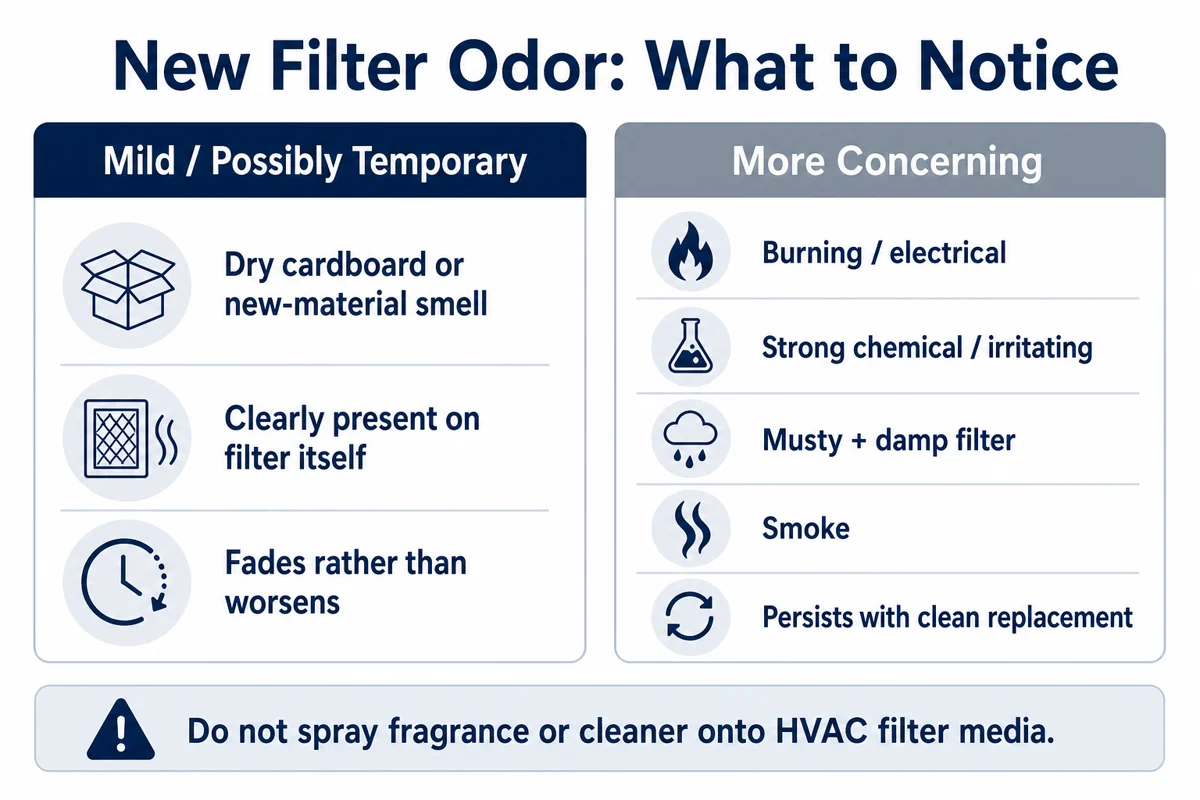
A new air filter can sometimes have a mild material or packaging odor, but strong or persistent odor should not automatically be blamed on the filter. Timing is useful evidence, not proof.
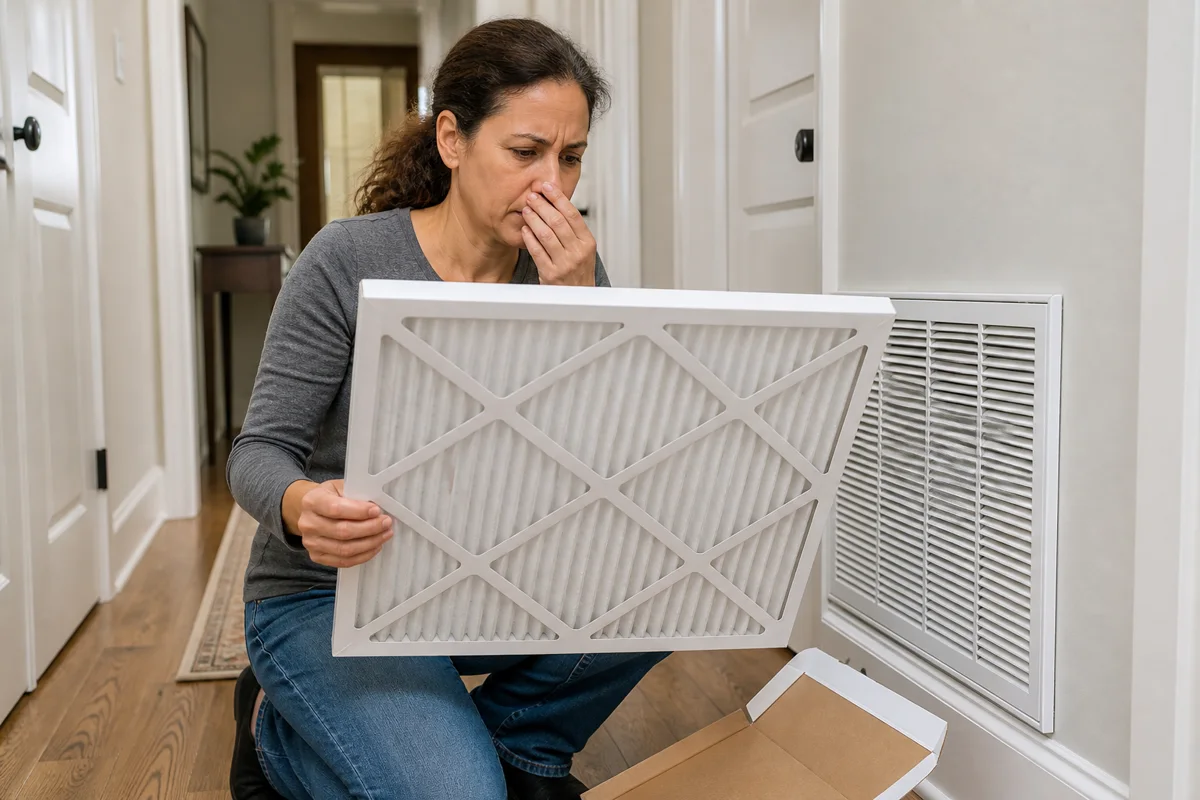
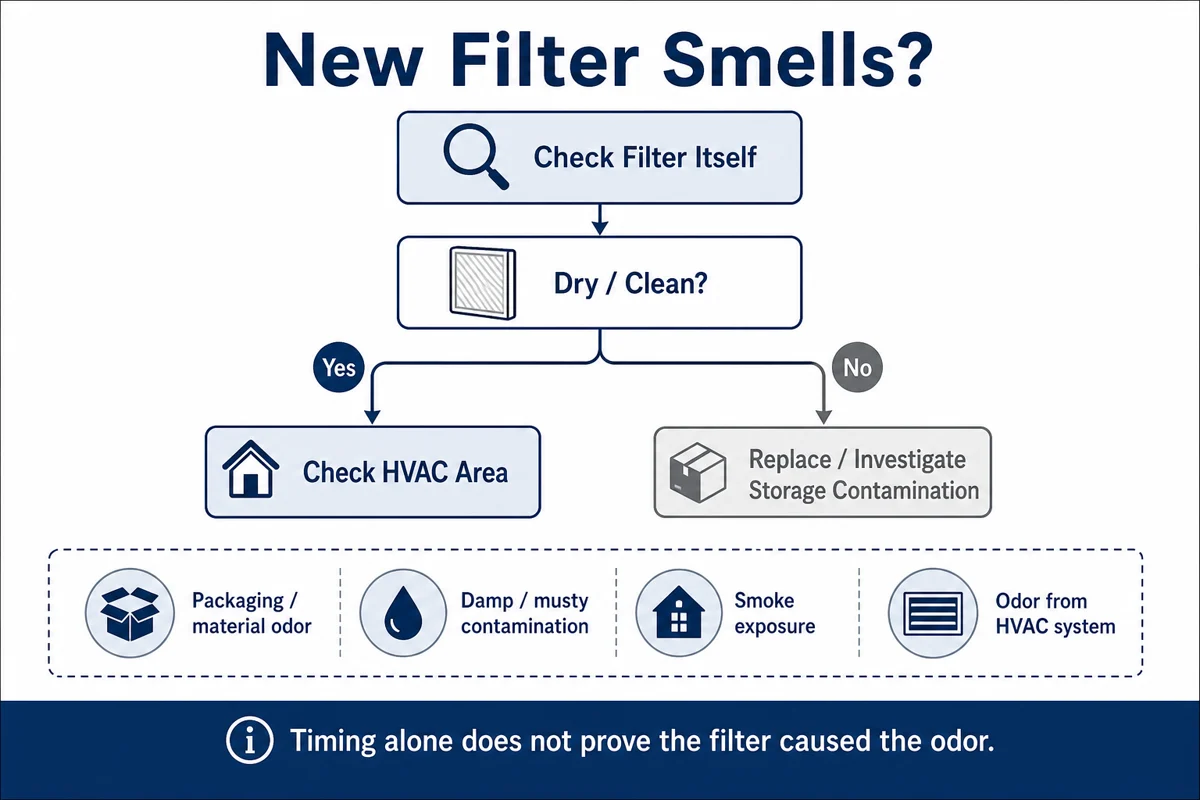
Turn the system off, remove the accessible filter, inspect whether it is dry and clean, and check whether the odor is actually present on the filter away from the return. Dampness, smoke exposure, damaged packaging, or dirty storage can matter. A recurring musty odor or a burning, electrical, smoky, worsening, or irritating smell deserves more caution and may originate elsewhere.
Can a Brand-New Air Filter Have a Smell?
It can. A filter includes media, frame material, adhesives or binders, and packaging, and any of those dry materials may have a noticeable odor when first opened. Storage conditions can add another influence. This possibility does not mean every filter releases a strong odor or that every odor after replacement is harmless.
The strongest evidence is direct: with the system off, does the removed filter itself carry the same odor? Is the filter dry, clean, intact, and intended for HVAC use? Does the nearby return smell different when the filter is away from it? Those observations separate “new filter smells” from “the HVAC started moving an existing odor.”
How Long Should a New-Filter Odor Last?
There is no universal waiting period. A mild dry-material smell may diminish, but filter construction, packaging, storage, airflow, and the true source differ. A strong, worsening, or persistent odor is a reason to reassess rather than wait for an invented 24- or 48-hour deadline.
What If It Smells Like Cardboard or New Materials?
A mild dry cardboard, package, or new-media odor can plausibly come from the frame or carton. Turn the system off, remove the filter safely, and compare the filter with its package. Look for moisture, staining, dust, damaged wrapping, or a storage odor. Do not spray the filter to cover the smell.
What If the New Filter Smells Musty?
A musty smell is less consistent with an ordinary dry new-material odor. The filter may have been stored in a humid or damp location, may have become wet after installation, or may simply be carrying odor from the return or cabinet. Smell alone does not diagnose mold.
Do not reinstall a damp disposable filter. Photograph moisture and inspect only accessible areas without opening service panels. The guide Why Is My Air Filter Wet? explains condensate, icing, leaks, and safe escalation without turning odor into a moisture diagnosis.
What If It Smells Chemical or Plastic-Like?
Some materials or packaging may have a noticeable odor. A nose cannot identify a compound, concentration, or safety level, so do not label a chemical-like smell toxic—or harmless—from odor alone. Remove and inspect the filter, confirm it is an HVAC product, and review whether packaging was opened or exposed during storage.
Do not dismiss an odor that is strong, irritating, worsening, or persistent. Stop normal testing when remaining in the space is uncomfortable and seek product or qualified HVAC guidance rather than repeatedly circulating it.
What If It Smells Smoky?
A stored filter can absorb surrounding smoke odor, while the return system can move existing indoor or outdoor smoke through the home. The filter is more plausible when it carried the same odor before installation or was stored near smoke. It is less convincing when the filter smells neutral after removal but the return or room does not.
A particulate filter does not reliably remove smoke gases or odor. The smoke-filter guide separates particle capture from gas and odor control. Visible smoke or an active burning odor is a different safety situation.
What If It Smells Burning or Electrical?
Do not assume a burning or electrical odor is normal filter break-in. Stop normal operation, do not keep cycling the equipment to reproduce it, and do not open electrical or mechanical compartments. Visible smoke, a tripped breaker, abnormal noise, or a persistent burning odor warrants qualified HVAC or electrical evaluation.
This guidance does not diagnose a motor, wire, heater, or other component. A brief dusty heating-season odor and an active electrical smell are not interchangeable, and neither should be identified from a web description alone.
What If the Smell Happens Only When the Blower Starts?
Blower timing shows that moving air is carrying the odor; it does not identify where it began. The source may be the filter, nearby return material, moisture elsewhere, or an odor already present in the home.
Turn the system off before removing the filter. Compare the filter away from the return, inspect the accessible area, and check packaging. Reinstall only when the filter is clean, dry, correct, and undamaged. Do not operate the HVAC system without a filter as an experiment.
Could the Filter Have Been Stored Somewhere Damp or Dirty?
Yes. An opened or damaged package in a humid garage, damp basement, smoky room, dusty project area, or location exposed to fumes may affect the filter before installation. Pet contact, spills, and crushed packaging are also useful observations. A storage location alone does not prove contamination; evidence on the filter or package matters.
Replace a disposable filter that is clearly damp, stained, smoky, dirty, or contaminated. Do not wash, perfume, or deodorize it. Store spares flat, dry, protected, and away from smoke, cleaners, paint, fuel, and other strong odors.
Should You Use a Filter That Got Wet?
No damp disposable filter should simply be installed and ignored. Moisture can weaken the frame or media and may signal a storage or HVAC water problem. Follow the wet-filter inspection guidance; do not dry and reuse disposable media.
Can a Dirty HVAC System Make a New Filter Seem Like the Problem?
Yes. Opening a grille may disturb dust, while the blower may move an existing return-area odor, moisture-related smell, smoke, or another household odor just after the change. Compare the filter and packaging, look for visible moisture or debris near the accessible opening, and note where the odor is strongest. Do not dismantle ducts, coils, blowers, or sealed cabinets.
What If the Old Filter Didn’t Smell?
The replacement may use different materials, have different storage history, or coincide with seasonal heating, humidity, outdoor smoke, or another source. The old filter is useful context, not proof the new one is defective.
Can Higher-MERV Filters Smell Different?
Products can use different media, frames, and construction. MERV is a particle-filtration efficiency classification, not an odor rating; a higher number does not inherently mean “more chemical smell.” See the MERV comparison guide for rating guidance, but investigate odor separately.
Should You Spray Air Freshener, Cleaner, or Essential Oils on the Filter?
No. Fragrance, disinfectant, perfume, bleach, cleaner, or essential oil can contaminate the media, introduce substances into the airstream, alter filter behavior, or mask an unresolved source. Do not use a disposable HVAC filter as a scent diffuser.
Should You Vacuum or Wash the New Filter?
Do not vacuum or wash disposable pleated or fiberglass media. If a filter is explicitly labeled reusable, follow its manufacturer directions and reinstall it only when completely dry. Can You Vacuum and Reuse an Air Filter? explains the disposable-versus-washable distinction.
What Should You Check First?
- Describe the odor without treating the description as a diagnosis.
- Record whether it began immediately after installation or later.
- Turn the HVAC system off before accessing the filter.
- Photograph the filter in place and note the airflow-arrow direction.
- Inspect for dampness, staining, debris, damage, or contamination.
- Compare the filter's odor away from the return when practical.
- Inspect the packaging and recall its storage conditions.
- Look at the accessible filter slot and return area without opening equipment panels.
- Confirm size, seating, and that the filter is intended for HVAC use.
- Reinstall only if the filter is clean, dry, correct, and undamaged.
- Stop treating the filter as the only suspect when a clean replacement changes nothing.
- Escalate burning, electrical, smoky, strongly irritating, wet, or abnormal-system conditions.
Filter Odor vs HVAC-System Odor
| Observation | Filter itself more plausible? | Why |
|---|---|---|
| Odor on removed filter | More plausible | Direct evidence connects odor to media or frame. |
| Mild dry cardboard smell | More plausible | Frame or packaging may carry it. |
| Filter visibly damp | Needs investigation | Storage or HVAC moisture may be involved. |
| Musty only while blower runs | Less conclusive | Air may carry odor from elsewhere. |
| Burning or electrical smell | Less suggestive | Do not treat it as normal filter odor. |
| Persists with clean replacement | Less suggestive | The source likely extends beyond one filter. |
| Stored in smoky or damp location | More plausible | Packaging and media may absorb odor. |
| Strongest near cabinet, not filter | Needs further diagnosis | Filter evidence is weak. |
What If a Second New Filter Smells the Same?
Compare brand, model, packaging, storage, and pre-installation odor. Similar odor supports material or packaging. If smell appears only after airflow begins or remains with another clean product, look beyond the filter. Do not keep buying filters as a test.
When Should You Replace the New Filter?
Replacement is reasonable when the filter is damp, visibly contaminated, smoke-exposed in storage, damaged, incorrect, or clearly carries a strong persistent odor. Damaged or dirty packaging adds context. A faint uncertain odor on an otherwise clean dry filter does not, by itself, prove replacement is required.
Confirm the correct three-dimensional size before ordering. Check one replacement before buying multiples, especially when brand or construction changes.
Free homeowner tool
Need a Clean Replacement?
If the new filter appears contaminated, damaged, or wrong for the system, confirm the size first and use Filter Wizard to narrow down an appropriate replacement.
Open the Filter FinderWhen Should You Stop Blaming the Filter?
The filter becomes a weaker suspect when it has little or no odor after removal, another clean replacement makes no difference, the smell is strongest near equipment or ducts, a musty odor returns despite a dry filter, visible moisture exists elsewhere, or the odor follows seasons or household activity rather than filter changes. Timing is evidence, not proof.
When Should You Get HVAC Help?
Seek qualified help for burning or electrical odor, visible smoke, a strong irritating odor that persists, water near equipment, recurring mustiness, abnormal mechanical noise, a tripped breaker, abnormal system behavior, or a source that cannot be isolated safely. Do not open sealed electrical or mechanical compartments.
Do Not Do This
- Do not spray fragrance, cleaner, disinfectant, or deodorizer on filter media.
- Do not apply essential oils, perfume, or bleach.
- Do not wash a disposable pleated or fiberglass filter.
- Do not reinstall a damp or contaminated disposable filter.
- Do not run the system with an obvious burning odor.
- Do not open HVAC or electrical compartments to chase a smell.
- Do not assume odor proves mold, toxicity, or electrical failure.
Filter Wizard Recommendation
A mild new-material or packaging smell can sometimes come from a newly installed filter, but strong, persistent, musty, smoky, burning, or irritating odors deserve a closer look. Remove and inspect the filter safely, check whether it was stored clean and dry, and determine whether the odor is actually present on the filter itself.
If another clean, correctly stored replacement does not change the smell, the source probably is not the filter alone. Escalate conditions that cannot be evaluated safely rather than masking the odor.
Filter Wizard recommendation
Replace Only After You Confirm the Need and Size
Enter a valid three-dimensional size for cautious MERV guidance, replacement timing, and current retailer options. Filter Wizard cannot identify an odor source or guarantee compatibility.
Start the Filter FinderFree Filter Reminders
Remember Your Next Filter Check
Get occasional filter reminders, homeowner maintenance tips, and buying guidance.
Occasional emails only. Unsubscribe anytime.
You're on the list. We'll send practical filter reminders and updates occasionally.
Frequently Asked Questions
Why does my new air filter smell?
A new filter may carry a mild odor from dry frame materials, media, packaging, or storage. Timing alone does not prove causation, so inspect the filter and nearby return area before deciding.
Is it normal for a new furnace filter to smell?
A mild dry material or packaging odor can occur. A strong, worsening, persistent, musty, smoky, burning, or irritating odor should be reassessed rather than dismissed as normal.
Why does my new air filter smell like chemicals?
Some materials or packaging may have a noticeable odor, but smell cannot identify a chemical or its safety. Remove and inspect the filter; stop treating it as normal if the odor is strong, irritating, persistent, or worsening.
Why does my new air filter smell musty?
A musty odor is less consistent with a dry new-filter smell. Check whether the filter or packaging was damp and whether moisture or odor is present in the accessible return or cabinet area. Odor alone does not diagnose mold.
Can a new air filter smell like cardboard?
Yes. A dry cardboard frame or packaging carton can have a mild material odor. Confirm the filter is dry, clean, undamaged, and actually carries the smell when removed.
How long should a new air filter smell last?
There is no universal time. A mild odor may fade, but materials, storage, airflow, and the true source vary. Strong, worsening, or persistent odor deserves inspection rather than a fixed waiting period.
Why does the smell only happen when the blower runs?
Moving air may carry odor from the filter area, return, cabinet, ducts, or elsewhere in the home. Blower timing makes the HVAC path relevant but does not prove the filter itself is the source.
Can a filter absorb odors while it is stored?
Yes. Open or damaged packaging in a damp, smoky, dusty, or fume-exposed location can affect a filter. Replace clearly contaminated disposable media rather than washing or deodorizing it.
Should I replace a new filter if it smells bad?
Replacement is reasonable when the filter is damp, contaminated, damaged, smoke-exposed, incorrectly stored, or clearly carries a strong persistent odor. A faint uncertain odor alone is not conclusive.
Can I spray air freshener on my HVAC filter?
No. Fragrance or cleaner can contaminate the media, add substances to the airstream, alter filter behavior, and hide rather than correct the odor source.
Can I put essential oils on an air filter?
No. Do not apply essential oils, perfume, disinfectant, bleach, or household cleaners to disposable HVAC filter media.
Why does my AC smell after I changed the filter?
The filter may carry an odor, but replacement can also disturb dust or coincide with moisture, smoke, or an existing HVAC-area odor. Compare the removed filter with the return area before assigning the cause.
What if a second new filter smells the same?
Compare the brand, model, packaging, and pre-installation odor. If the smell appears only after the blower runs or persists with another clean properly stored filter, look beyond the filter rather than buying replacements repeatedly.
When is an HVAC odor a reason to stop using the system?
Stop normal operation and seek qualified help for burning or electrical odor, visible smoke, a tripped breaker, abnormal mechanical noise, water near equipment, or a strong irritating odor that cannot be isolated safely.