Quick Answer
A tan or brown air filter is often showing the dust, soil, fibers, and other particles it captured; brown color alone does not prove mold, rust, smoke, or another specific contaminant.
Gradual, uniform, dry browning is generally less unusual than a rapid change, patchy staining, tacky residue, or damp areas. Consider recent remodeling, smoke, cooking, open windows, outdoor dust, pets, and HVAC runtime. Replace the filter when it is loaded, wet, damaged, contaminated, or due—not simply because it is lightly tan.
What Does a Brown Air Filter Usually Mean?
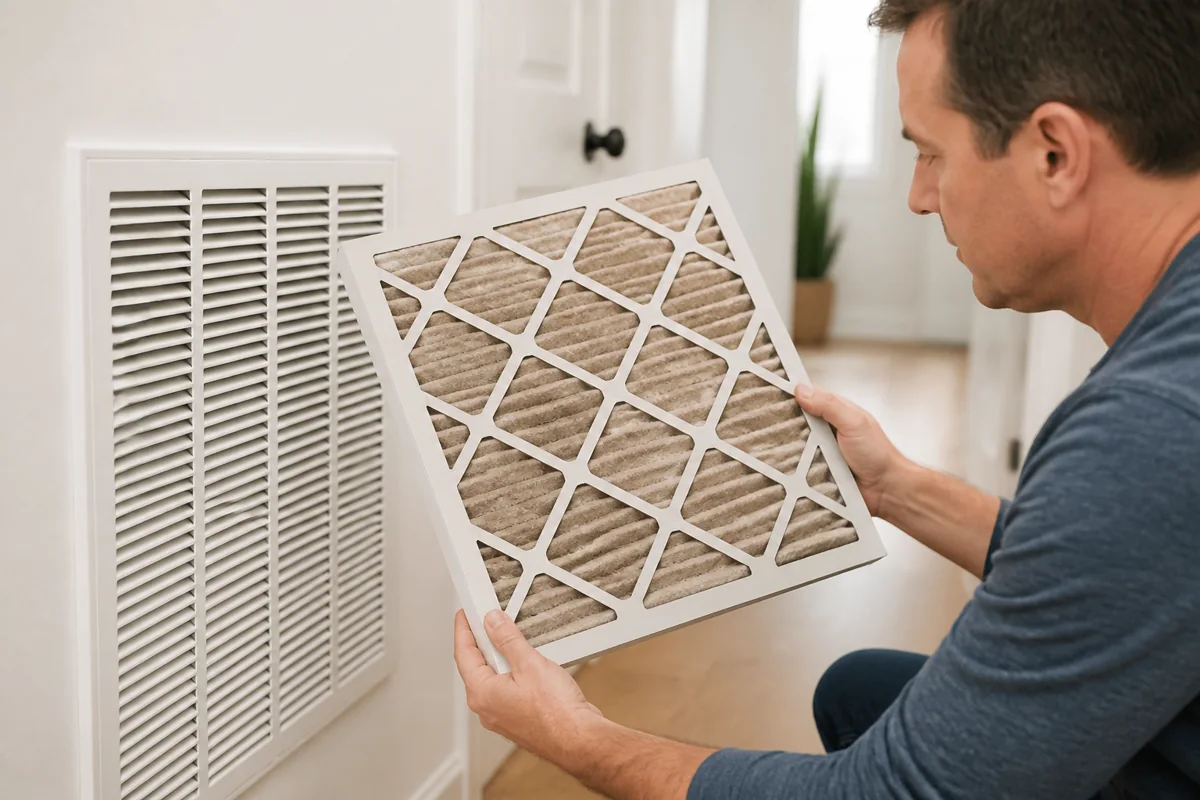
An HVAC filter collects a changing mixture of household dust, textile fibers, hair and pet debris, outdoor soil, pollen, and other airborne particles that reach the return. Together, that mixture may appear beige, tan, gray-brown, or brown against previously white media. A color change therefore often means the filter has been doing its basic job: collecting particles from moving return air.
That explanation is a starting point, not a verdict. Color does not reveal particle identity, concentration, or risk. Check the filter's surface coverage, texture, moisture, installation time, and pattern. Ask what changed in the home. Those observations can make an ordinary loading explanation more or less plausible without pretending the filter is a laboratory test.
The guide to the best air filter for dust explains what HVAC filtration can capture and why it cannot eliminate every household dust source.
Gradual Brown Color vs Rapid Brown Color
Gradual discoloration
A slow, even shift from white toward tan or brown is more consistent with normal accumulation than a sudden dramatic change. The actual pace depends on HVAC runtime, filter area and depth, household activity, pets, outdoor conditions, and particle sources. There is no universal number of days or weeks that defines normal browning.
Track the installation date and compare the filter under similar lighting at each inspection. A photo can be more useful than memory. If airflow remains normal, the frame is intact, the media is dry, and loading develops gradually, follow the equipment and filter guidance rather than replacing solely because the media is no longer white.
Rapid discoloration
A new filter turning brown quickly deserves context. Renovation dust, open windows, dry outdoor soil, smoke, frequent cooking, high occupancy, pets, or unusually long HVAC runtime can increase collection. A dusty return location or fit problem can also change the pattern. The dedicated guide to a filter getting dirty unusually fast covers those loading causes without relying on color.
"Quickly" is relative to that home and season. Do not infer a failure from a calendar alone. Instead, note the last replacement, recent events, filter condition, and whether the same behavior repeats with a correctly installed replacement.
Uniform Brown vs Patchy Brown
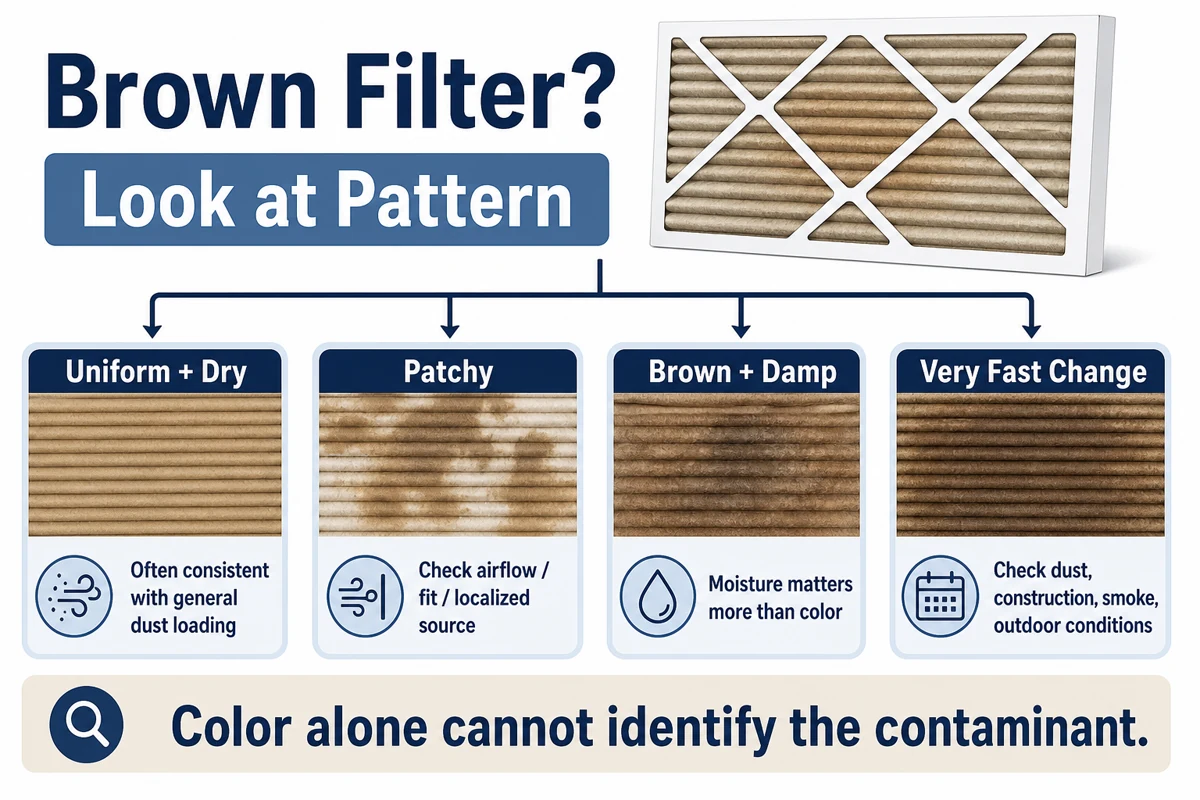
Uniform dry coloration across the incoming-air face is more consistent with general particle loading. It still does not tell you which particles are present or whether replacement is due. Look across the pleats for matting, heavy coverage, damage, or reduced airflow rather than judging hue alone.
Patchy areas justify a closer look at airflow distribution, localized debris, filter seating, and moisture. A darker corner may align with a nearby source or the way air enters the rack. Clean edges beside a dirty center can reflect geometry; an edge stain can involve frame contact or slot dust. None of those patterns proves duct leakage or bypass.
Compare unusual patterns with Why Is My Air Filter Dirty on Only One Side?. That guide separates normal upstream loading from uneven areas on the same face, fit gaps, and localized sources.
What If the Filter Is Brown and Dry?
Dry, dusty tan or brown loading is commonly consistent with captured dust and soil-type debris. Turn the system off before removing the filter, hold the frame rather than the media, and inspect it visually in good light. Note how long it has been installed and whether similar dust is present near the return.
Do not rub, shake, beat, or blow the filter to inspect it. Those actions release captured material and can damage the media. Do not vacuum a disposable filter for reuse. If it is visibly loaded or due, replace it with the correct size.
What If the Filter Is Brown and Damp?
Moisture becomes the more important clue. Most disposable HVAC filters are not intended to stay damp. Water can darken ordinary debris, create tide-like staining, deform cardboard and media, and make a color pattern look more alarming without identifying what caused the water.
Do not diagnose mold from a brown damp area. Replace a wet disposable filter after the moisture source is addressed, and do not reinstall it after drying. The wet-filter troubleshooting guide covers accessible drain, condensation, icing, and building-water clues while keeping readers away from sealed or energized equipment.
Can Outdoor Dirt or Soil Turn a Filter Brown?
Yes, plausibly. Dust from dry soil, yard work, nearby roads, open doors and windows, foot traffic, and normal outdoor-air infiltration can add tan or brown particles indoors. The filter may collect some of what reaches the return. Brown media does not establish whether particles entered through doors, the building envelope, or any specific HVAC path.
Can Construction or Remodeling Turn a Filter Brown?
Renovation can increase airborne debris substantially. Drywall sanding, sawing, demolition, flooring work, and painting preparation can change a filter quickly and may create uneven loading when work is concentrated near one return. Keep work dust controlled at its source and inspect the filter more often during the project.
Do not identify asbestos, lead, silica, or any hazardous material from filter color. If a project may involve regulated or hazardous material, use qualified project-specific guidance rather than a household filter photograph.
Can Smoke Turn an Air Filter Brown?
Smoke-related particles can contribute gray, brown, dark-brown, or black loading. Cooking smoke, candles, fireplaces, tobacco, and wildfire events are possible sources, but the same color can come from non-smoke debris. Recent exposure and odor may support a smoke hypothesis; neither color nor odor proves it.
For dark discoloration, see Why Is My Air Filter Black?. For product selection during smoke conditions, use Best Air Filter for Smoke, which distinguishes particle capture from gases and odor.
Can Cooking Make an Air Filter Brown?
Cooking releases particles and, during frying or searing, airborne oil droplets and smoke. In an open-plan home, some may reach the HVAC return. A tacky or greasy-feeling filter is different from ordinary dry dust and merits checking cooking ventilation and other nearby sources, but texture still cannot identify a substance with certainty.
Does Brown Mean Rust?
Not necessarily—and brown filter media is not evidence of rust. Captured debris commonly makes pleated or fiberglass media look brown. Actual orange-brown corrosion on an accessible metal surface is a separate observation. Do not open panels or reach into equipment to search for it; report safely visible corrosion or water staining during qualified service.
Does Brown Mean Mold?
No. Color alone cannot identify mold. Dampness, unusual spotting, persistent musty odor, or visible growth-like material deserves caution, but appearance and smell are not definitive identification. Correct recurring moisture and seek appropriate evaluation when suspected contamination extends beyond the replaceable filter.
What If the Filter Is Brown Only on One Side?
The upstream face receives dirty return air before the downstream face, so it normally loads first. That front-versus-back difference is not the same as one corner or one half of the incoming face becoming much darker. Record orientation before disposal and use the one-sided-loading guide for a focused comparison.
What If It Is Brown Around the Edges?
Edge discoloration can reflect frame contact, airflow geometry, dust in the accessible track, fit, or a localized source. A gap may permit bypass, but a brown edge does not prove bypass occurred. Check whether the filter sits squarely without being forced or leaving obvious gaps, then review how tightly an air filter should fit.
What If the Filter Turns Brown Very Quickly?
Use this sequence rather than choosing a contaminant from the color:
- Confirm the installation date and whether the previous filter was already overdue.
- Ask whether renovation, sanding, sawing, or cleaning disturbed dust.
- Note open-window weather, dry soil, nearby road work, and yard activity.
- Consider pets, occupancy, smoke, candles, fireplaces, and heavy cooking.
- Compare recent heating or cooling runtime with normal operation.
- Inspect the filter for dampness, damage, bowing, and obvious fit gaps.
- Confirm the correct filter location in systems with multiple returns.
- Replace a loaded filter and see whether the pattern repeats under similar conditions.
These checks identify context, not certainty. Repeated rapid loading with a clean, correctly fitted replacement is stronger evidence for further investigation than one unexpectedly brown filter.
Brown vs Black vs Gray Filters
| Appearance | Possible explanation | What it proves |
|---|---|---|
| Light tan or brown | General dust, fibers, soil, or mixed debris | Very little by color alone |
| Gray-brown | Mixed loading accumulated over time | Needs condition and timing context |
| Dark brown | Heavier loading, smoke-related residue, soil, or another source | Does not identify the source or danger |
| Black | Soot, smoke, very dark dust, or other material | Does not confirm mold or equipment failure |
| Brown with damp spots | Moisture darkening captured debris | Confirms dampness, not mold or cause |
| Brown with tacky feel | Airborne oil, cooking residue, or another sticky contaminant | Needs context; color does not identify it |
This is a comparison guide, not a diagnostic color chart. Lighting, original media color, particle mixture, and moisture all change appearance.
Should You Change a Brown Air Filter?
Color alone is not the deciding factor. Replace the filter when debris visibly loads the pleats, the media is matted, airflow symptoms appear, the frame or media is damaged, the filter is wet or contaminated, or the equipment and product guidance indicate it is due. A lightly tan dry filter is not automatically bad.
Calendar schedules are starting points because runtime, filter depth, household sources, and equipment vary. See How Often Should You Change Your Air Filter? and Signs Your HVAC Filter Is Clogged for condition-based clues.
Can You Clean the Brown Dust Off?
Do not clean and reuse a disposable filter. Vacuuming, washing, compressed air, or aggressive shaking can damage media and does not restore verified performance. Replace it. If a filter is explicitly labeled reusable, follow its manufacturer instructions. The disposable-versus-washable distinction is covered in Can You Vacuum and Reuse an Air Filter?.
What Should You Check Before Replacing It?
- Turn the HVAC system off before accessing the filter.
- Record the installation date if known.
- Check whether the filter is fully dry.
- Inspect whether color is uniform or patchy.
- Look for tears, collapse, warped edges, or other damage.
- Confirm the filter sits correctly without obvious gaps.
- Consider recent smoke, renovation, outdoor dust, cooking, or unusual activity.
- Confirm the printed size or measure carefully if the label is unavailable.
- Replace the filter if it is loaded, damaged, damp, contaminated, or due.
Free homeowner tool
Time for a Clean Replacement?
If the filter is loaded, damp, damaged, or due, confirm the correct size before buying another one. Filter Wizard can narrow replacement options by size and filtration needs.
Open the Filter Finder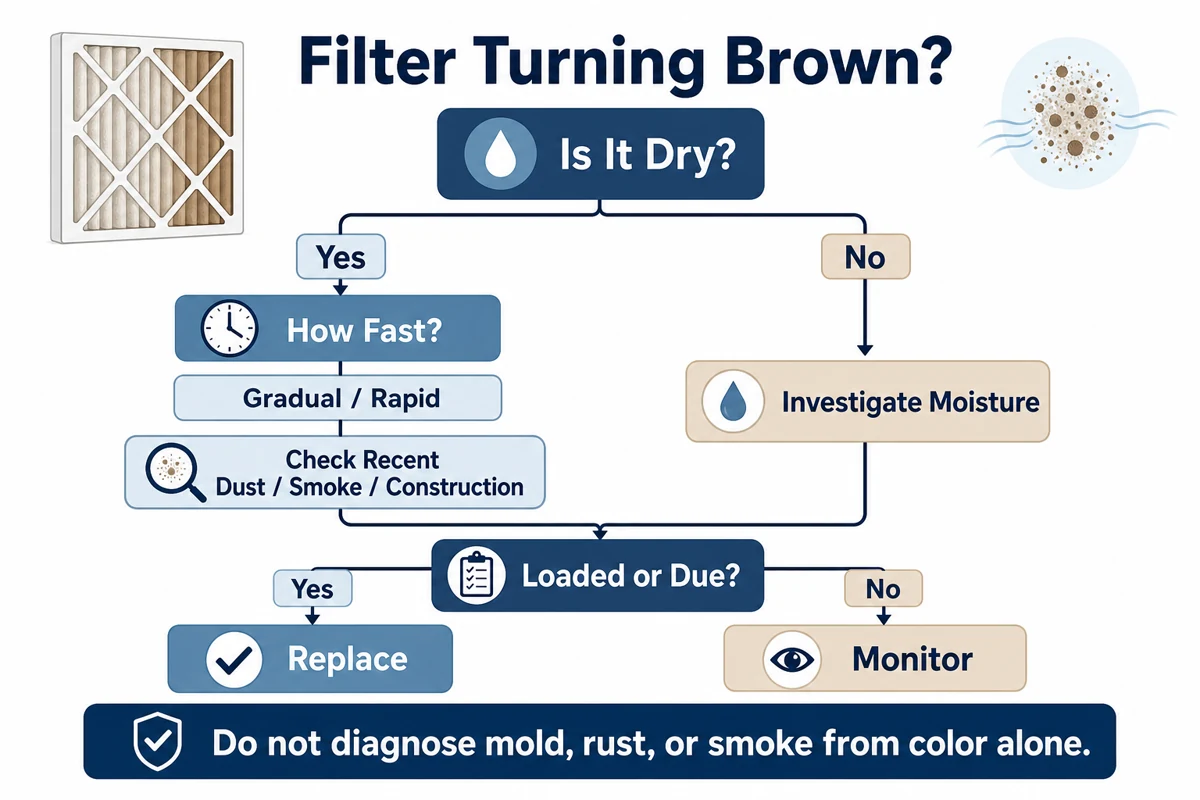
When Should You Investigate Further?
Look beyond routine replacement when the filter turns dark brown unusually quickly, dampness recurs, staining is sharply localized, the media feels tacky, smoke or strong odor is present, or abnormal loading repeats. Weak airflow, whistling, bowing, or a filter that will not remain seated adds separate evidence that fit or system conditions need attention.
A new filter can help establish whether the pattern repeats, but do not keep buying filters as a diagnostic experiment. Record dates and conditions. If repeated behavior cannot be explained from safe, accessible observations, arrange qualified evaluation.
When Should You Get HVAC Help?
Seek help when a moisture source cannot be identified safely, the filter repeatedly becomes wet, significant debris is visible in accessible equipment areas, airflow changes substantially, the filter rack is damaged, or unusual burning, electrical, smoke, or mechanical symptoms occur. Do not remove sealed panels or reach around wiring, blowers, coils, or controls.
Filter Wizard Recommendation
A brown or tan filter often shows the dust and debris it captured. The more useful clues are how quickly the color appeared, whether the filter is dry or damp, whether discoloration is even or patchy, and whether remodeling, smoke, cooking, or unusually dusty conditions recently changed.
Replace a filter that is loaded, wet, damaged, contaminated, or due, but do not use color alone to diagnose the source. If unusual staining, moisture, odor, rapid loading, or airflow symptoms continue with a correctly fitted replacement, investigate beyond the filter.
Filter Wizard recommendation
Confirm the Size Before Choosing
Enter a valid three-dimensional size for cautious MERV guidance, replacement timing, and retailer options. Filter Wizard cannot identify captured material or guarantee compatibility.
Start the Filter FinderFree Filter Reminders
Remember Your Next Filter Check
Get occasional filter reminders, homeowner maintenance tips, and buying guidance.
Occasional emails only. Unsubscribe anytime.
You're on the list. We'll send practical filter reminders and updates occasionally.
Frequently Asked Questions
Why is my air filter brown?
A filter often turns tan or brown as it captures a mixture of ordinary household dust, fibers, outdoor soil, and other particles. Timing, pattern, dryness, and recent conditions provide more useful context than color alone.
Is it normal for an air filter to turn brown?
Gradual, uniform, dry browning can be consistent with normal particle loading. It is not automatically harmless or due for replacement; assess loading, condition, and the recommended inspection schedule.
What causes brown dust on an air filter?
Possible contributors include ordinary household dust, textile and pet debris, outdoor soil, renovation dust, cooking particles, and smoke. The color cannot identify which source is present.
Why did my new air filter turn brown so quickly?
Recent remodeling, open windows, dusty outdoor conditions, smoke, cooking, pets, heavy HVAC runtime, or a dusty return area can accelerate loading. There is no universal timeline that proves a problem.
Can outdoor dirt turn an air filter brown?
Yes. Soil and outdoor particles entering through normal activity or air infiltration can contribute tan or brown material, but filter color does not prove where the particles entered.
Can construction dust make an air filter brown?
Yes. Sanding, sawing, demolition, flooring work, and painting preparation can increase airborne debris and change filter color quickly. Avoid identifying hazardous materials from appearance alone.
Can smoke make an air filter brown?
Smoke particles can contribute gray, brown, dark-brown, or black loading. Brown color alone does not confirm smoke exposure, so use recent events and other evidence.
Can cooking make an air filter brown?
Cooking smoke and airborne oil droplets can contribute to filter loading, particularly with frequent frying or searing. A tacky surface is a different clue from ordinary dry dust but still does not identify the source by itself.
Does a brown air filter mean mold?
No. Brown color cannot identify mold. Dampness, recurring moisture, unusual spotting, or persistent odor deserves investigation, but appearance or smell alone is not a mold diagnosis.
Does a brown air filter mean rust?
No. Brown pleated media is not evidence of rust. Actual orange-brown corrosion on an accessible metal component is a separate observation that should not be investigated by opening sealed equipment.
Why is my filter brown only on one side?
The upstream face normally receives dirty return air first, so it often looks browner than the downstream face. Uneven areas on the same face can also reflect airflow, fit, or a nearby source.
Should I replace a brown air filter?
Replace it when it is loaded, damaged, damp, contaminated, or due under the product and equipment guidance. A lightly tan, dry filter is not automatically bad because of color alone.
Can I clean brown dust off a disposable air filter?
No. Do not vacuum, wash, blow out, or beat a disposable filter for reuse. Replace it; clean only a filter explicitly designed as reusable and follow its manufacturer instructions.
When is a brown air filter something to worry about?
Investigate when discoloration is unusually rapid, damp, patchy, tacky, strongly odorous, repeatedly abnormal, or accompanied by airflow, deformation, water, smoke, burning, or electrical symptoms.