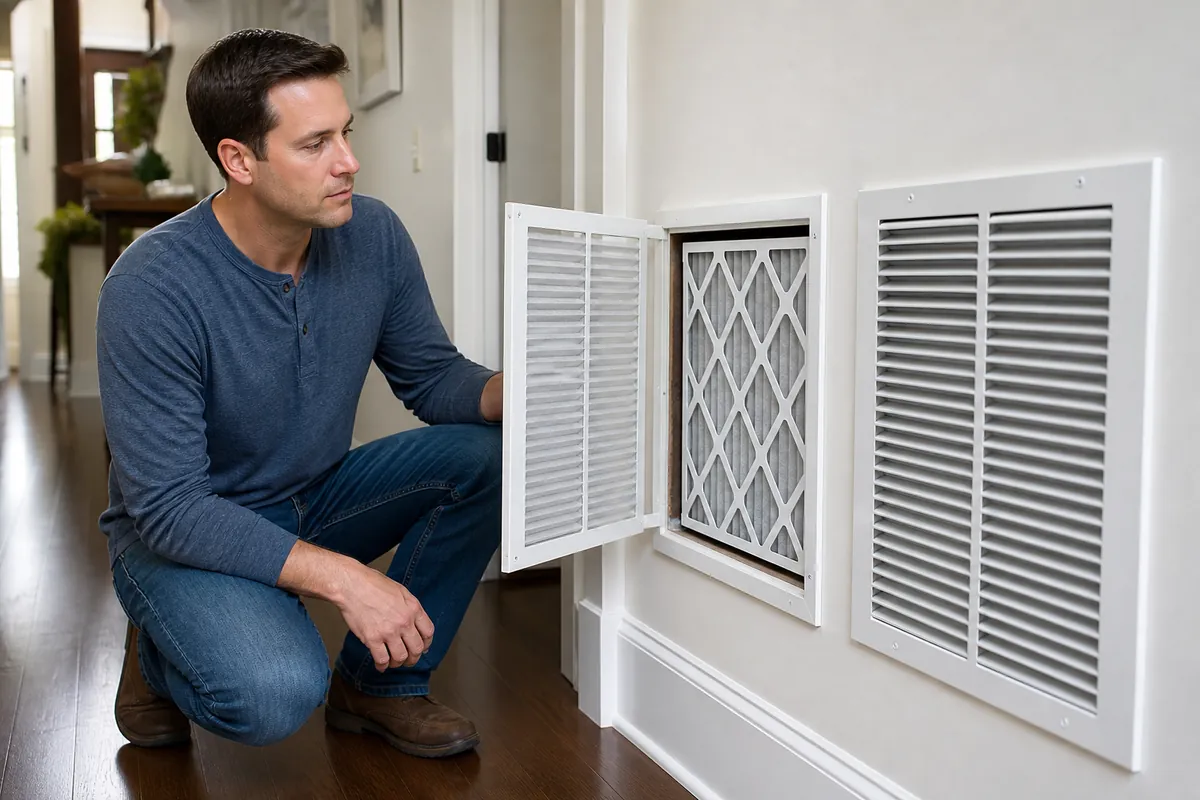
Quick Answer
Furnace filters and AC filters are usually the same type of return-air filter in a central forced-air system. Many homes use one indoor blower and one filtration path for both heating and cooling, so the filter beside the furnace or air handler works in winter and summer.
The words are not a guarantee of interchangeability. A correct replacement still must match the intended location, nominal and actual dimensions, depth, and system-supported filtration specification. Window air conditioners, portable units, ductless mini-splits, room air purifiers, and purpose-built media cabinets can use entirely different filters.
Why Do the Names “Furnace Filter” and “AC Filter” Overlap?
Central heating and cooling equipment often shares more than the thermostat. In a common split-system arrangement, the outdoor air conditioner works with an indoor evaporator coil, while the furnace cabinet or air handler contains the blower that moves air through the home. Return air passes through the system's filter before the blower sends conditioned air through the supply ducts.
During a heating call, the filter protects the return side of the furnace and captures particles from recirculated air. During a cooling call, the same return air, blower, and filter may serve the indoor cooling coil. That is why homeowners, stores, and manufacturers use “furnace filter,” “AC filter,” “air conditioner filter,” and “HVAC filter” for products that can be physically identical.
Trane's filter guidance states directly that AC, furnace, heat-pump, and dual-fuel systems use the same type of return-air filter. Carrier's AC filter guidance likewise points homeowners to the return side of the indoor furnace or air handler. These sources support the general answer, but the installed configuration still controls the details.
When Are They Truly the Same Filter?
The terms usually describe the same filter when the home has one ducted forced-air system with a shared indoor blower and return path. Common signs include:
- The thermostat controls both central heat and central cooling.
- The indoor cooling coil is connected to the furnace or air handler.
- One filter slot or media cabinet sits on the return side of that indoor equipment.
- The same return grilles draw air during heating and cooling.
- The existing filter remains installed year-round rather than being swapped for a seasonal product.
In that setup, you do not buy an “AC filter” for summer and a separate “furnace filter” for winter. You replace the one HVAC filter when its condition and the manufacturer's guidance call for it. The name on a retailer category is less important than the dimensions and specifications on the product.
Does Central Air Use the Furnace Filter in Summer?
Often, yes. A central air conditioner may rely on the furnace blower to move return air across the indoor cooling coil. The filter installed upstream of that blower continues filtering the recirculated air while cooling runs. Calling it a furnace filter does not make it heating-only.
This also explains why a heavily loaded filter can affect both seasons. Reduced return airflow may contribute to cooling problems as well as heating problems, though the symptom and mechanism vary. If cooling performance changes, use the focused guide on whether a dirty filter can contribute to an AC not cooling rather than assuming the product needs a different seasonal label.
When Are Furnace and AC Filters Not Interchangeable?
The shared-filter answer applies to many central forced-air systems, not every device that heats or cools a room. Important exceptions include:
- Window and portable air conditioners: these commonly use appliance-specific screens or washable filters, not a framed furnace filter.
- Ductless mini-splits: an indoor wall cassette usually has manufacturer-specific filters designed for that unit.
- Boilers and radiant heat: hydronic heat does not use a central forced-air furnace filter unless a separate ducted cooling system is also present.
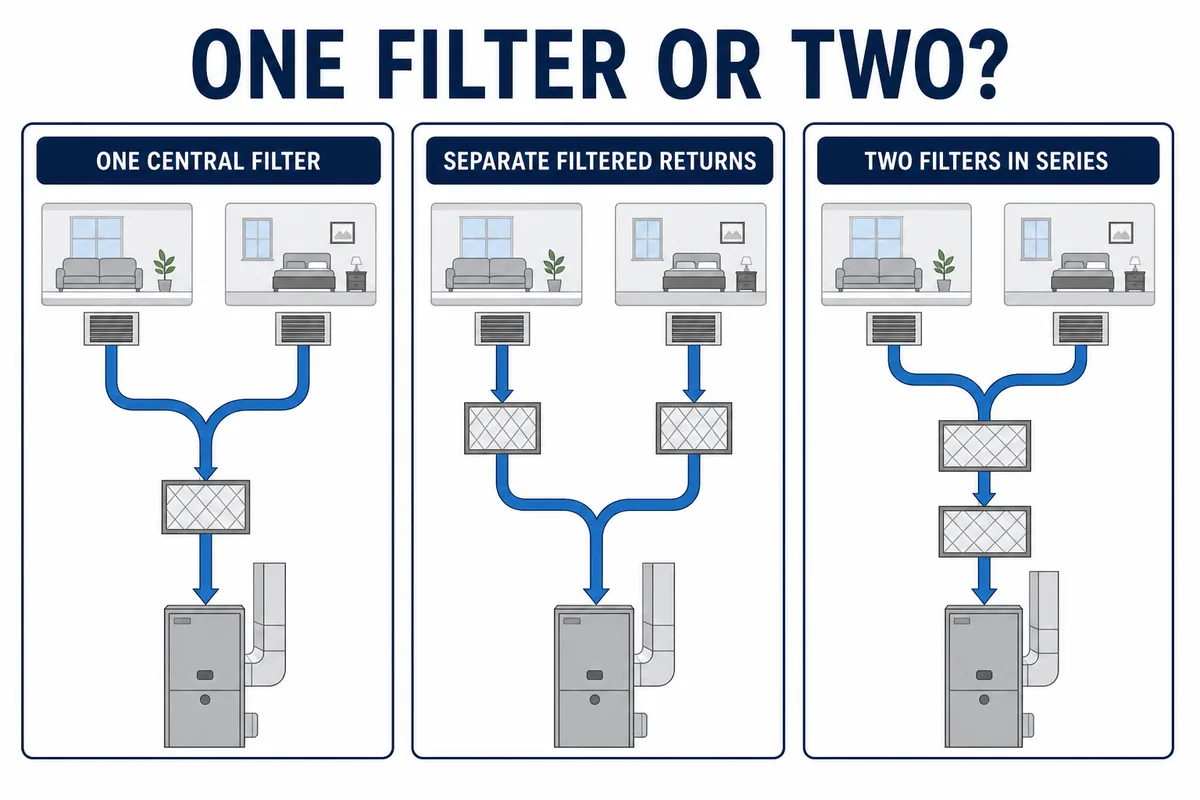
- Separate HVAC systems: an upstairs air handler and downstairs furnace may each have their own return path and filter.
- Dedicated media cabinets or electronic air cleaners: these may require a particular cartridge, cabinet size, prefilter, or service procedure.
- Multiple filtered returns: one system can use several designated return-grille filters instead of one central filter.
A heat pump is not automatically an exception. A ducted heat pump usually uses a return-air filter at its air handler, serving both heating and cooling modes. Again, confirm the installed design instead of treating the equipment name as the shopping specification.
A whole-house humidifier is a separate accessory again. Its replaceable water panel, evaporative pad, or steam canister is not the shared furnace/AC particle filter; see the guide to furnace air filters versus humidifier media.
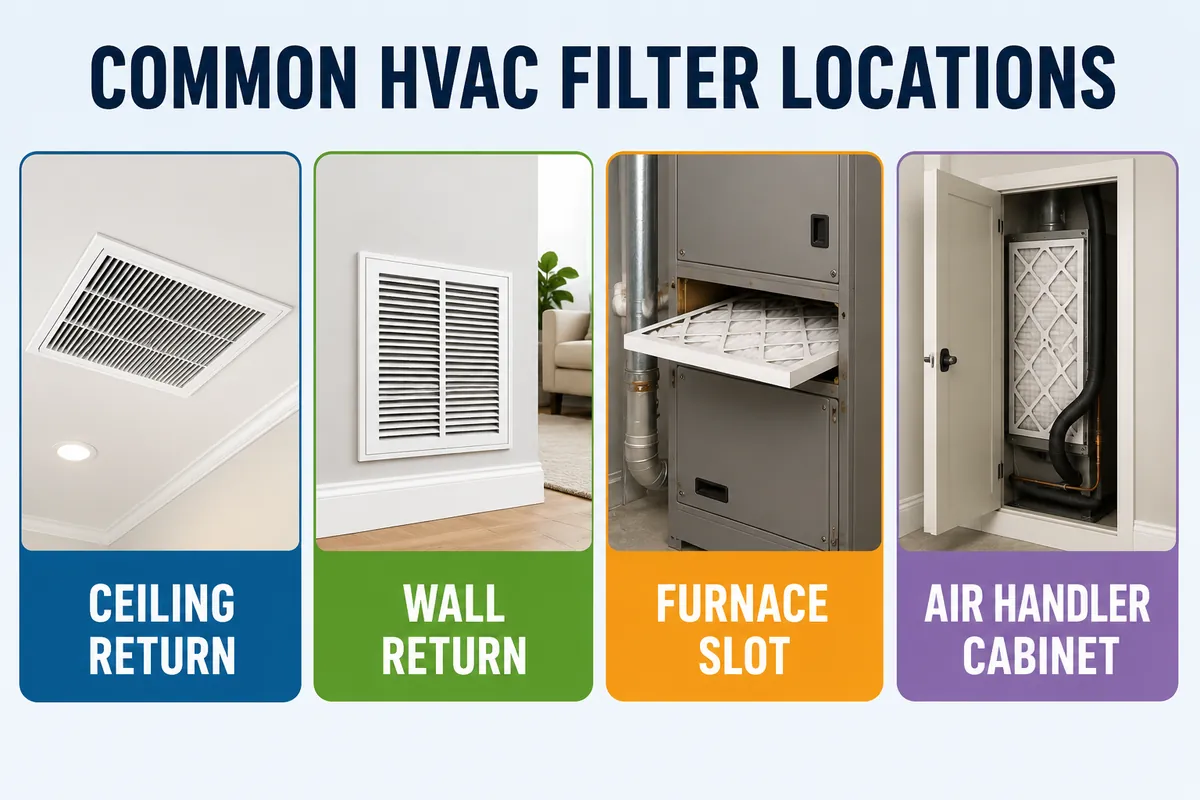
Where Should You Look for the Filter?
Look along the return-air path, where room air travels back toward the indoor equipment. Common homeowner-accessible locations include a hinged wall or ceiling return grille, a narrow slot beside the furnace or air handler, or a dedicated filter cabinet attached to the return duct.
Do not assume every grille needs a filter. Some homes use one central filter near the equipment; others use filters at designated return grilles. The guide to whether every return vent needs a filter explains that distinction. If you find filters both at a return and at the furnace, review whether the filters serve separate paths or filter the same air in series before adding or removing anything.
Turn the system off at the thermostat and wait for the blower to stop before removing an accessible filter. Do not open sealed service compartments or reach around wiring, moving parts, burners, or other equipment. If the filter location is unclear, use cabinet labels, homeowner manuals, installer records, and a qualified HVAC professional rather than experimenting.
How Do You Choose the Correct Replacement?
Start with a correctly fitting existing filter. Record the nominal size, any printed actual dimensions, depth, MERV rating, brand or model information, and airflow arrow before disposal. Then check the rack or cabinet label and the equipment or filter-cabinet documentation.
The nominal size is the rounded shopping label. Actual dimensions describe the physical product and can vary slightly between brands. Two packages can both say 16 × 25 × 1 yet fit differently in a tight rack. Use the complete filter-size guide when the label is missing or uncertain, and review how a correctly fitted filter should sit before ordering a multipack.
| Package wording | What it tells you | What still needs confirmation |
|---|---|---|
| Furnace filter | Marketed for forced-air heating/HVAC use | Size, depth, actual dimensions, rating, compatibility |
| AC or air conditioner filter | May describe the same central return-air product | Whether it is for central HVAC or a specific appliance |
| HVAC filter | General central-system terminology | The installed rack and equipment requirements |
| Heat-pump filter | Return-air filtration for a ducted heat-pump system | Air-handler location, size, and cabinet design |
| Reusable appliance filter | May belong to a window, portable, or ductless unit | Manufacturer-specific cleaning and replacement instructions |
Should the MERV Rating Change With the Season?
Not merely because heating changed to cooling. If one system uses the same filter location year-round, the filter must remain compatible with that system in both modes. Household needs may change—wildfire smoke, pollen, renovations, or heavy occupancy can affect loading—but “summer” and “winter” do not create universal MERV rules.
MERV is also not a complete resistance specification. Media area, pleat design, face size, depth, construction, airflow, and loading matter. Use the MERV 8, 11, and 13 comparison as a cautious starting point, then follow equipment and filter-cabinet guidance.
Free homeowner tool
Confirmed the Filter and Size?
Once you know the intended filter location and all three dimensions, Filter Wizard can provide a cautious MERV starting point, replacement timing guidance, and retailer options.
Open the Filter FinderHomeowner Checklist
- Confirm whether heating and central cooling share the same indoor blower and duct system.
- Turn the system off and wait for the blower to stop.
- Locate accessible return grilles, furnace or air-handler slots, and media cabinets.
- Photograph the existing filter in place and note the airflow arrow.
- Record all three dimensions, MERV, depth, and any product identifier.
- Check the cabinet label and equipment documentation.
- Determine whether multiple filters serve separate returns or sit in series.
- Replace only with a product that matches the intended location and specifications.
- Do not trim, fold, stack, force, or tape a wrong-size filter into place.
- Ask a qualified professional when the return path or intended location remains unclear.
Filter Wizard Recommendation
For most homes with one central forced-air heating and cooling system, furnace filter and AC filter are two names for the same return-air filter. Keep the installed airflow path—not the marketing label—at the center of the decision.
Confirm the designated location, exact dimensions, depth, and supported filtration guidance. If the home has separate equipment, multiple returns, ductless units, or a specialized cabinet, treat each filtration point according to its own documentation. When the configuration is uncertain, verify it before ordering or changing the number of filters.
Filter Wizard recommendation
Match the Replacement to the Installed System
Enter a confirmed three-dimensional size for cautious MERV and replacement guidance. Filter Wizard cannot identify a filter location or guarantee equipment compatibility from the words on a package.
Start the Filter FinderFree Filter Reminders
Remember the Right Filter
Get occasional filter reminders, homeowner maintenance tips, and buying guidance.
Occasional emails only. Unsubscribe anytime.
You're on the list. We'll send practical filter reminders and updates occasionally.
Frequently Asked Questions
Are furnace filters and AC filters the same?
Usually, yes. In a central forced-air system that uses the same indoor blower and return-air path for heating and cooling, furnace filter and AC filter are commonly two names for the same HVAC filter. The installed size, location, and system design still determine the correct replacement.
Can I use a furnace filter for my air conditioner?
You can when both labels describe the same central HVAC filter and the replacement matches the required nominal size, actual dimensions, depth, and supported filtration specification. Do not assume a filter for a window, portable, mini-split, or other appliance is interchangeable.
Does central air use the furnace filter in summer?
Often, yes. Many split systems use the furnace blower and the same return-air filter while the air conditioner runs. Equipment configurations vary, so confirm the actual return path and designated filter location in your home.
Does a heat pump use the same kind of HVAC filter?
A ducted heat pump generally uses a return-air filter serving its indoor air handler, much like a central furnace-and-AC system. The exact filter size and location depend on the installed air handler, return grilles, and filter cabinet.
Why do stores label some products furnace filters and others AC filters?
The labels reflect familiar seasonal terminology and marketing. For central forced-air systems, the physical product may serve both heating and cooling. Match the installed specifications rather than choosing by the season named on the package.
Do I need one filter for heating and another for cooling?
Not usually when one central forced-air system shares an indoor blower and return path. Homes with multiple HVAC systems, separate air handlers, or designated filtered returns may have more than one filter, but not simply because the season changed.
Where is the furnace or AC filter located?
Common locations include a return grille, a slot beside the furnace or air handler, or a dedicated media cabinet in the return duct. The correct location is the one designed for the installed system.
Can furnace and AC filters with the same nominal size fit differently?
Yes. Products carrying the same nominal label can have slightly different actual dimensions. Compare the printed actual size and cabinet requirements, especially when the existing fit is tight.
Should I use the same MERV rating in heating and cooling seasons?
Often the same compatible filter can remain in use across both seasons, but MERV alone does not determine airflow resistance. Follow equipment and filter-cabinet guidance and consider the specific product, dimensions, depth, construction, and condition.
How do I know which replacement filter to buy?
Start with the size and specifications printed on a correctly fitting existing filter, then verify the filter rack or cabinet label and equipment documentation. Confirm all three dimensions and do not rely on the words furnace or AC alone.