Quick Answer
Electrostatic and pleated are not necessarily opposite HVAC-filter categories. “Pleated” describes media folded into ridges to place more media area inside a frame. “Electrostatic” can describe charge on filter fibers that helps attract particles, but manufacturers also use the word for several product types.
A filter can be disposable, pleated, and electrostatically charged at the same time. Other products marketed as electrostatic are washable panels with passive media. Powered electronic air cleaners and electrostatic precipitators are different equipment again. Choose from the exact product’s size, tested rating, HVAC compatibility, construction, and maintenance instructions—not the word “electrostatic” alone.
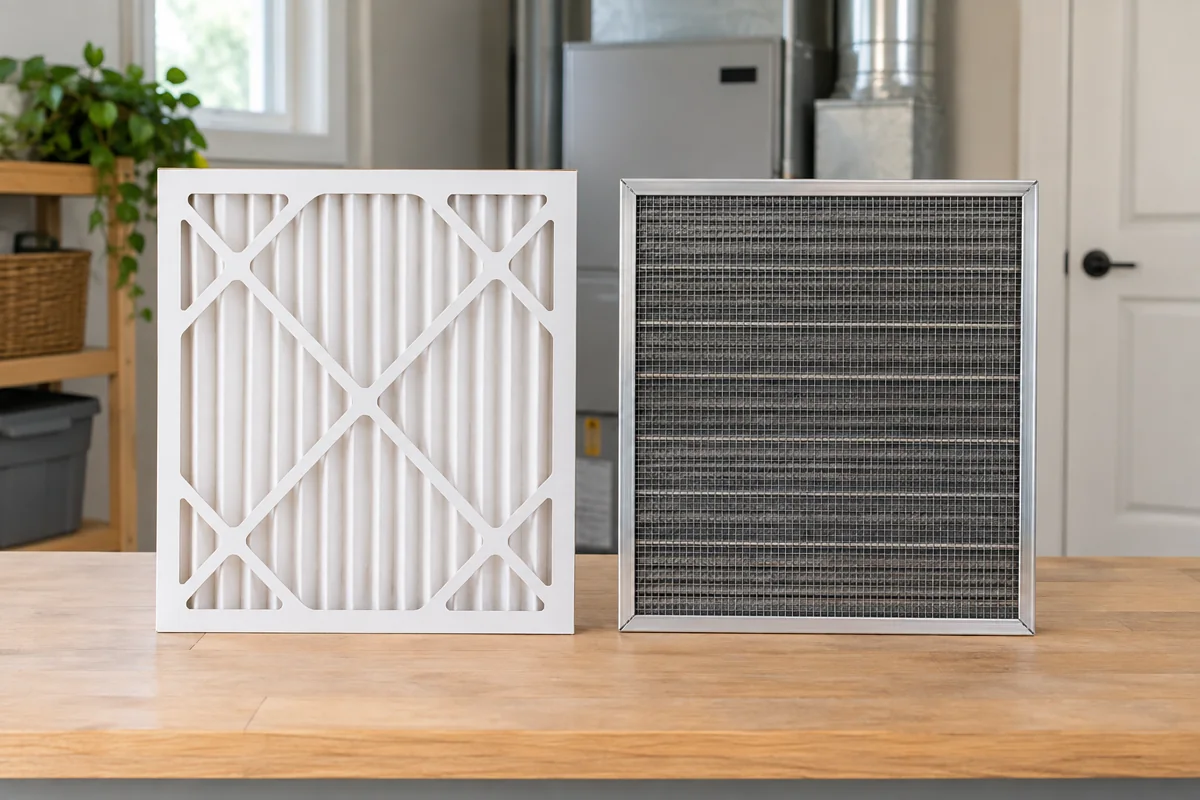
The Most Important Point: Electrostatic and Pleated Can Overlap
The comparison sounds binary because stores and articles often put “electrostatic” in one column and “pleated” in another. ASHRAE and current manufacturer documentation show why that shortcut fails. ASHRAE describes charged-fiber, or electret, media whose fibers hold electrostatic charge without needing an operating power source. Manufacturers sell disposable pleated filters made with that charged media.
The terms answer different questions. Pleated describes how media is arranged. Electrostatically charged describes one contribution to particle capture. Washable or disposable describes lifecycle. Passive or powered distinguishes ordinary media from equipment that energizes an electric field. MERV reports tested particle-removal performance for the particular filter.
One product can fit several descriptions. That makes “electrostatic versus pleated” a real homeowner question, but not a complete technical classification.
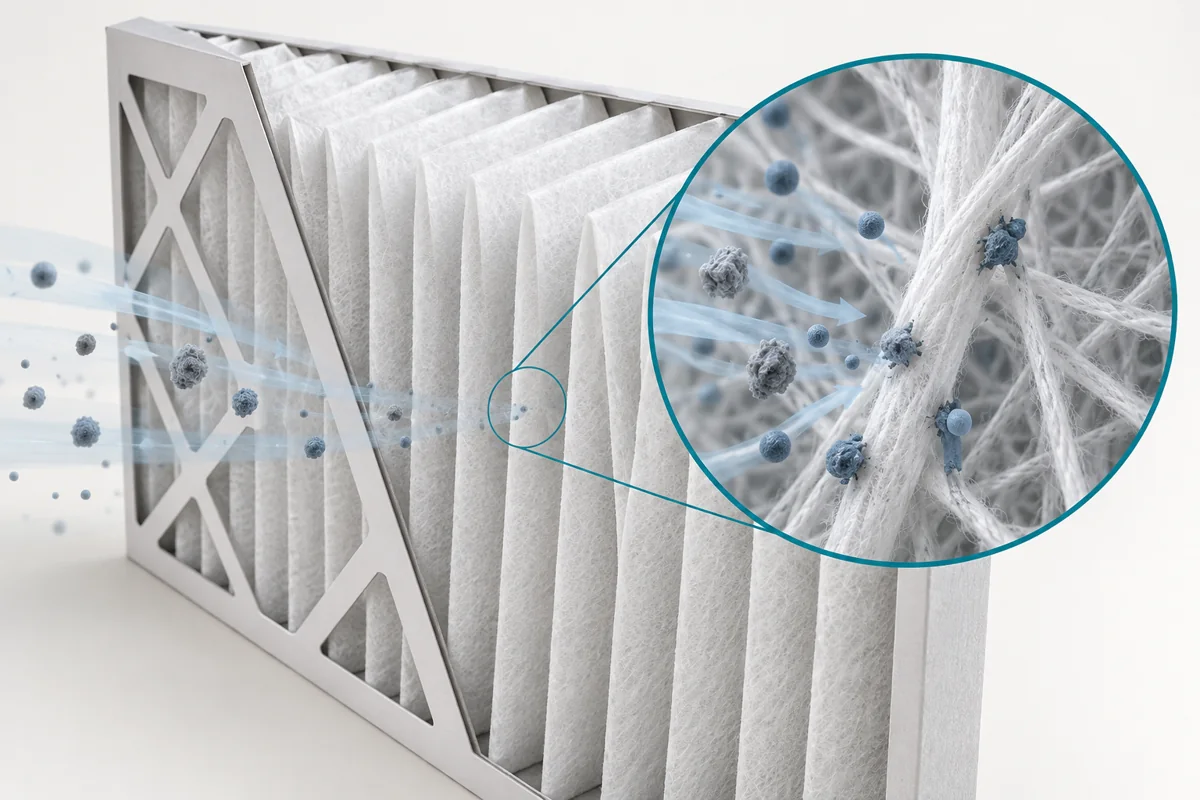
What Is a Pleated Air Filter?
A pleated filter folds fibrous media into repeated ridges. The folds put more media surface inside the same face width and height than a flat sheet would provide. ASHRAE describes extended-media filters as having media area greater than their face area, lowering velocity through the media relative to air approaching the filter face.
More area can help a product balance particle capture, dust holding, and resistance, but pleats do not guarantee a specific result. Media, fiber structure, pleat spacing, depth, support, face dimensions, airflow, and loading all affect the complete filter.
“Pleated” therefore does not mean high MERV, disposable in every case, uncharged, or automatically restrictive. The fiberglass versus pleated guide owns the broader comparison between basic flat fiberglass products and pleated media.
What Is an Electrostatic Air Filter?
There is no single product design behind the retail phrase. It may refer to:
- Disposable charged-media filters. Synthetic fibers receive an electrostatic charge during manufacturing. Many are pleated and are discarded after use.
- Washable passive electrostatic filters. A reusable frame holds layered synthetic or mesh media designed to develop or retain charge without a powered connection. Some are pleated; others use flatter layers.
- Powered electronic air cleaners. Equipment uses a power supply and electric field to charge particles and collect them on plates or other media. An electrostatic precipitator belongs here, not in the lifecycle category of an ordinary framed filter.
The label alone does not tell you whether a product is pleated, washable, disposable, powered, or compatible with a particular system.
Passive Electrostatic Media vs. Electronic Air Cleaners
Passive charged media needs no electrical connection. ASHRAE calls these electret or charged-fiber filters and explains that electrostatic effects supplement normal fibrous-media collection through impaction, interception, and diffusion. A charged pleated filter is not “purely electrostatic” while another is “purely mechanical”; multiple mechanisms can act within media.
A powered electrostatic precipitator intentionally charges particles and uses collector plates. It has a power supply, service procedures, and system-specific installation requirements. Other electronic cleaners may use ionization followed by collection media. These are equipment categories, not interchangeable labels for a drop-in filter.
Washable Electrostatic vs. Disposable Charged Filters
Current product documentation confirms both categories. Washable electrostatic HVAC filters may use aluminum frames and layered synthetic media, carry product-specific MERV ratings, and require prescribed cleaning and drying. “Permanent” describes intended reuse, not maintenance-free or unlimited service. The washable versus disposable guide owns lifecycle, cleaning burden, waste, and replacement tradeoffs.
Disposable pleated charged-media filters are also common. They are not washable because charge contributes to capture. Once loaded or due for replacement, they are replaced. If a filter is not explicitly approved as washable, do not rinse, hose, or vacuum it for reuse. The guide to vacuuming and reusing filters explains why visible surface cleaning does not restore disposable media to a verified original condition.
What Should You Actually Compare?
| Attribute | Pleated charged-media filter | Washable passive electrostatic filter | Powered electronic air cleaner |
|---|---|---|---|
| What it describes | Folded media that also uses charge | Reusable media using passive electrostatic effects | Powered equipment using an electric field |
| Can be pleated? | Yes | Yes or no; product-specific | Not defined by ordinary filter pleating |
| Requires power? | No | No | Yes |
| Disposable? | Commonly yes | No, when approved as washable | Not an ordinary disposable filter |
| Washable? | No, unless specifically approved | Yes, by product instructions | Collector service is equipment-specific |
| Performance information | Check MERV and product data | Check MERV or documented test data | Check complete-cleaner test and emissions data |
| Compatibility focus | Size, depth, resistance, system support | Size, fit, resistance, maintenance | Approved equipment, power, installation, service |
This is not a ranking. A specific washable product and a disposable pleated product may have different performance, but those results cannot be assigned to every member of either category.
Use Tested Performance, Not the Label Alone
MERV is the ASHRAE Standard 52.2 framework used to report particle-removal performance for many HVAC filters. Electrostatic is not a MERV level, and pleated is not a MERV level. Both disposable charged filters and washable electrostatic filters can carry ratings depending on the exact tested product.
ASHRAE also provides an optional conditioning method reported as MERV-A to examine performance after reducing charge effects. That distinction confirms charged media exists; it is not a reason to guess how an unlabeled residential product performs. Use the data supplied for the exact filter.
Some filters display MPR or FPR instead. Use the MERV, MPR, and FPR guide to interpret those labels without applying a universal conversion.
What About Airflow and Pressure Drop?
No category-wide airflow ranking is reliable. Charged media may improve initial particle capture without the same increase in media density as otherwise similar uncharged media, but that does not prove every “electrostatic” product has low resistance. Pleating adds area, but does not prove every pleated product has low—or high—resistance.
Pressure drop depends on the complete product: media, pleat geometry, face dimensions, depth, airflow rate, loading, frame, and installation. The HVAC system matters too. Compare product-specific resistance information when available and follow equipment guidance.
If a change is followed by weak airflow, unusual noise, bending, or equipment symptoms, do not diagnose from the label. Review whether the filter may be too restrictive and seek qualified help when symptoms persist.
Maintenance: Replace or Wash?
- Disposable charged pleated filter: inspect and replace as directed; do not wash or vacuum for reuse.
- Approved washable electrostatic filter: follow its cleaning, inspection, and drying instructions; reinstall only as directed.
- Powered electronic air cleaner: follow its manual and service boundary; do not work around energized components.
There is no universal schedule. Runtime, household conditions, media area, loading, and product guidance matter. The replacement-timing guide owns ordinary disposable-filter intervals; washable and powered products require their own instructions.
How to Choose Without Getting Trapped by the Label
- Confirm all three physical dimensions. Electrostatic says nothing about fit.
- Identify the product category. Is it disposable charged media, approved washable media, or powered equipment?
- Read the tested rating. Compare MERV or applicable product data rather than assuming charge or pleats establish efficiency.
- Check HVAC compatibility. Confirm intended depth, rating, and available resistance information.
- Choose maintenance you will follow. Replace disposable media; clean only approved washable products; use qualified service for powered equipment where required.
- Avoid a universal winner. Select an actual compatible product, not a technology slogan.
Ordinary HVAC filter guidance
Need Help With Size and MERV?
After you confirm the physical dimensions and that an ordinary disposable residential HVAC filter is appropriate, Filter Wizard can provide a cautious MERV starting point and replacement guidance. It cannot determine whether washable electrostatic media or powered electronic equipment suits your system.
Open the Filter FinderFilter Wizard Recommendation
Read “pleated” as a construction clue and “electrostatic” as an incomplete technology clue. Then find the missing facts: size, disposable or washable lifecycle, passive or powered operation, tested efficiency, resistance information, and HVAC compatibility.
A pleated charged-media filter may be right for one system. An approved washable electrostatic filter may suit another maintenance preference. Powered equipment is a separate decision. None wins from the category name alone.
Frequently Asked Questions
What is an electrostatic HVAC filter?
The label is used for more than one product type. It may describe passive charged media, a washable product built with passive electrostatic media, or—less precisely—a powered electronic air cleaner. Read the construction, power, maintenance, and tested-rating details rather than relying on the word alone.
Are electrostatic and pleated filters opposites?
No. Pleated describes folded media construction. Electrostatic describes the use of electrical charge as part of particle capture or, in some marketing, a product family. A filter can be both pleated and electrostatically charged.
Can a disposable pleated filter be electrostatic?
Yes. Manufacturers sell disposable pleated HVAC filters made with electrostatically charged synthetic media. The product remains disposable even though its media uses charge.
Are all electrostatic filters washable?
No. Some products marketed as electrostatic are washable and reusable, while others are disposable charged-media filters. Wash a filter only when its manufacturer explicitly identifies it as washable and provides instructions.
Do electrostatic HVAC filters need electricity?
Passive charged-media filters do not require a power connection. Powered electronic air cleaners and electrostatic precipitators are different equipment categories that use electrical components during operation.
Do passive electrostatic filters produce ozone?
Ordinary passive charged filter media does not use the powered ionization process associated with ozone concerns for some electronic air cleaners. Do not transfer a warning about powered technologies to passive media merely because both descriptions use electrostatic.
Are electrostatic filters better than pleated filters?
There is no universal winner because the categories overlap and products vary. Compare actual size, tested efficiency, product-specific resistance information when available, HVAC compatibility, and maintenance instructions.
Do electrostatic filters have MERV ratings?
Some disposable and washable electrostatic products carry MERV ratings. Electrostatic does not establish a particular MERV level, so check the rating for the exact product.
Are electrostatic filters less restrictive?
Not as a category-wide rule. Actual pressure drop depends on the complete product, size, depth, airflow, loading, and HVAC system.
Can I wash an electrostatic filter?
Only if the exact product is manufacturer-approved as washable or reusable. Do not wash or vacuum a disposable charged pleated filter. Follow the washable product’s cleaning and drying instructions.
What should I compare when choosing an HVAC filter?
Confirm all three physical dimensions, tested efficiency, HVAC compatibility, construction and depth, whether it is disposable or approved washable, and required maintenance. Do not choose from the word electrostatic alone.
Questions or feedback?
Help Improve Filter Wizard
Tell us what was clear, what was missing, or which air-filter question you want answered next.