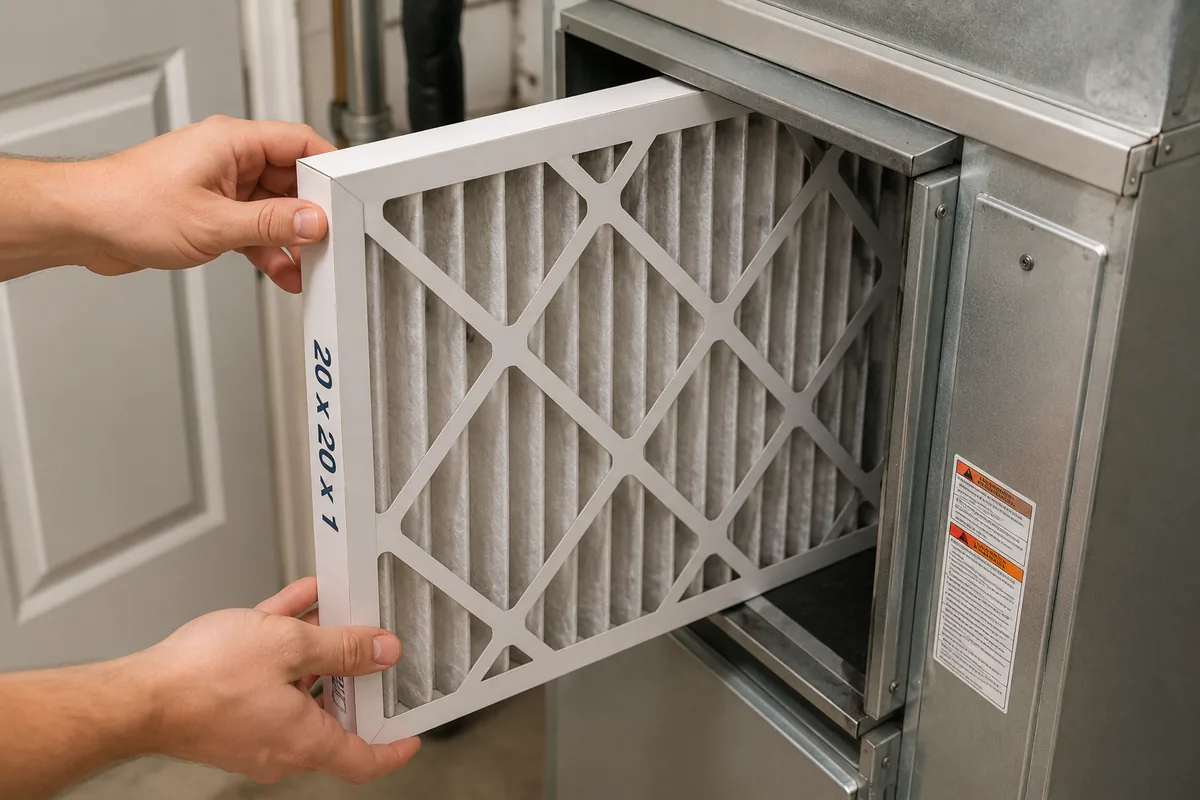
Quick Answer
Do not knowingly run a central forced-air HVAC system without a filter it is designed to require. The filter is part of the return-air path and helps keep airborne debris from reaching downstream equipment. Removing a dirty filter and continuing to operate is not the recommended solution.
There is no universal “safe” filterless runtime. If the filter is missing, damaged, or unavailable, turn the system off while you verify the intended filter location, exact size, and compatible specification. Install the correct filter according to the equipment guidance. If indoor conditions make shutdown a safety concern, contact a qualified HVAC professional for situation-specific direction.
Can You Run Central HVAC Without a Filter?
A central forced-air furnace, air conditioner, heat pump, or air handler commonly pulls room air through return ducts, passes it through a designated filter, and then moves the conditioned air back through supply ducts. When that installed design calls for a filter, the answer is straightforward: do not intentionally operate it with the required filter removed.
Trane's gas-furnace maintenance instructions state that applicable equipment should never operate for heating or cooling with filters removed. That is equipment guidance, not a prediction that one unfiltered cycle automatically destroys a system. The practical issue is that removing the filter eliminates the debris barrier the return path was designed to have.
This answer does not apply identically to every device that heats or cools a space. Ductless mini-splits, window and portable air conditioners, boiler-only hydronic systems, room air purifiers, electronic cleaners, and deep-media cabinets use different arrangements. Read when furnace and AC filter terminology describes the same central-HVAC filter, then follow the documentation for your installed equipment.
What Does the HVAC Filter Actually Protect?
An HVAC filter does more than make visible household dust disappear. The U.S. Department of Energy's Building Science Education guidance explains that filters installed on the return side help protect HVAC equipment and improve indoor air quality. The filter captures part of the particle load before return air reaches components in the air handler or furnace.
Without that intended barrier, dust, lint, hair, and other airborne debris can travel farther into the return side and settle on downstream surfaces. Trane also notes that debris can accumulate on fans and coils over time and restrict performance. The exact consequence depends on equipment design, runtime, contaminant load, and how long the condition existed; appearance alone cannot establish damage.
A standard central filter is not a complete indoor-air-quality solution. It does not remove every particle, gas, odor, or allergen, and installing one does not repair an HVAC fault. Its immediate job here is simpler: restore the filtration point the system was designed to use.
What Can Happen When a Required Filter Is Missing?
The most defensible concern is loss of intended debris protection. Return air continues carrying particles, but there is no filter in the designated position to capture them. Over time, contamination can reach surfaces that are more difficult to inspect or clean than a disposable filter.
That does not justify fear-based claims that a furnace, air conditioner, or blower will fail instantly. Nor can a homeowner infer coil condition, energy cost, or repair needs from an empty slot alone. If the system has operated without a required filter, install the correct one and arrange qualified inspection when performance has changed, significant debris is visible in accessible areas, or the history is long or unknown.
What If I Only Need to Run It for a Few Hours?
No credible universal clock makes filterless operation acceptable for 30 minutes, overnight, or one day. A large clean home with brief runtime and a dusty renovation site with continuous runtime present very different particle loads. Equipment and filter arrangements also vary.
For that reason, Filter Wizard does not publish an invented temporary allowance. If the system requires a filter, pause operation while resolving the missing filter. If extreme temperatures, a medically vulnerable occupant, frozen-pipe risk, or another immediate safety concern makes shutdown unsafe, call a qualified local HVAC professional for advice based on the actual equipment and conditions.
What If My Current Filter Is Extremely Dirty?
An excessively loaded filter can restrict airflow. The solution is not to pull it out and keep the system running; replace it with the correct compatible product. Use the guide to recognize a genuinely clogged HVAC filter and the separate explanation of filter and system restriction when airflow symptoms are involved.
After replacement, observe whether airflow, heating, or cooling returns to normal. A clean filter is a sensible first check, not a guaranteed repair. Persistent weak airflow, shutdowns, unusual cycling, ice, noise, or poor comfort may have another cause that requires service.
What If the Filter Is Damaged or Wet?
A torn, collapsed, badly bent, saturated, or otherwise damaged disposable filter should not be treated as serviceable. Replace it with the correct product; do not vacuum it, wash it, tape it, or remove it and continue operating. Repeated bending may involve fit or airflow, while recurring moisture needs its own investigation.
Existing guides explain why a filter may bend or bow and what a wet filter can indicate. Keep homeowner checks to accessible filter areas. Do not open sealed service panels or reach around electrical, combustion, refrigerant, or moving components.
What If I Don't Have the Correct Replacement Size?
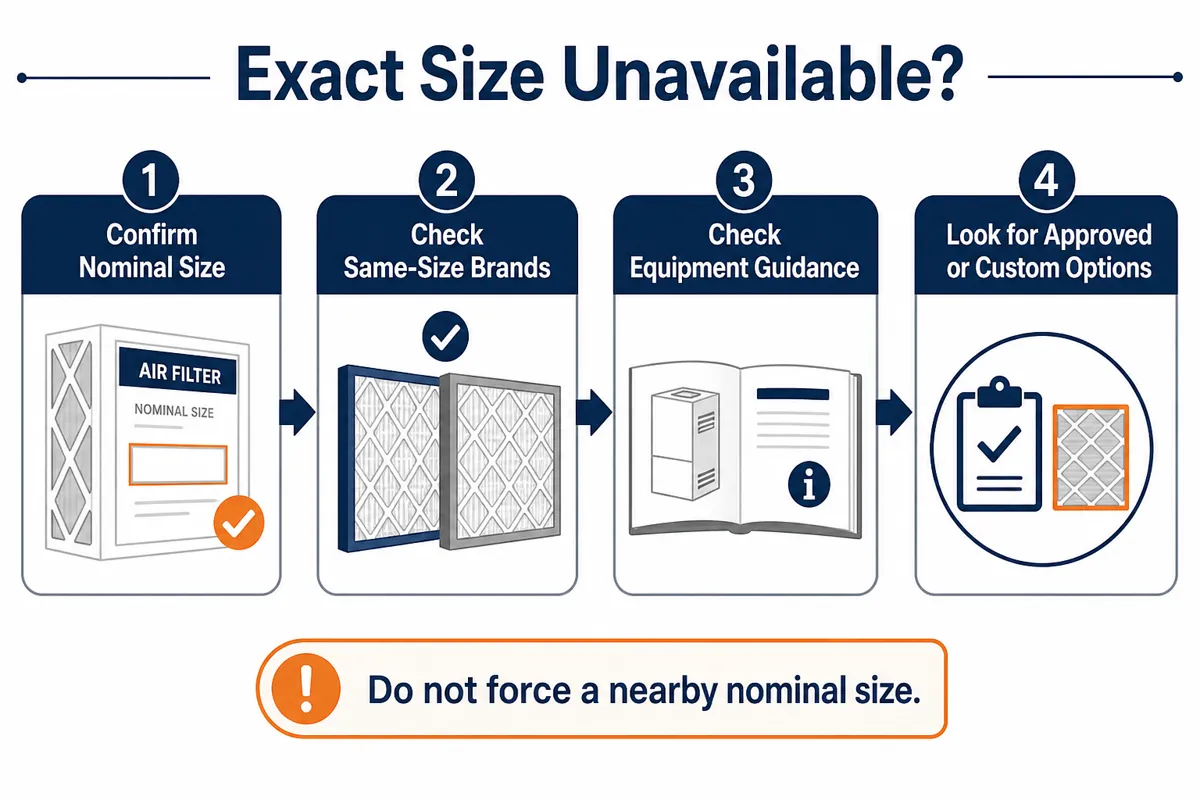
Start with evidence from the old filter and its designated location. Photograph the old frame before disposal and record the nominal size, any printed actual dimensions, depth, MERV rating, airflow arrow, brand or model, and cabinet label. Check the equipment manual or installer records when available.
If the old label is unreadable or the filter is missing, follow the full guide to find and verify the HVAC filter size. Confirm length, width, and thickness. Filter Wizard cannot discover physical dimensions automatically; it provides guidance only after you enter a user-confirmed three-dimensional size.
Do not substitute a nearby size because the correct filter is inconvenient to obtain. Never trim, fold, crush, or stack filters; tape filters together; add cardboard or foam fillers; force an oversized product; or leave an undersized bypass gap. The guide on using a slightly different filter size explains why “close” is not a safe assumption.
Free homeowner tool
Confirmed the Location and All Three Dimensions?
Once the physical size is known, Filter Wizard can provide a cautious MERV starting point, replacement timing guidance, and retailer options. It cannot inspect the rack or confirm equipment compatibility.
Open the Filter FinderWhat If I Can't Find Where the Filter Goes?
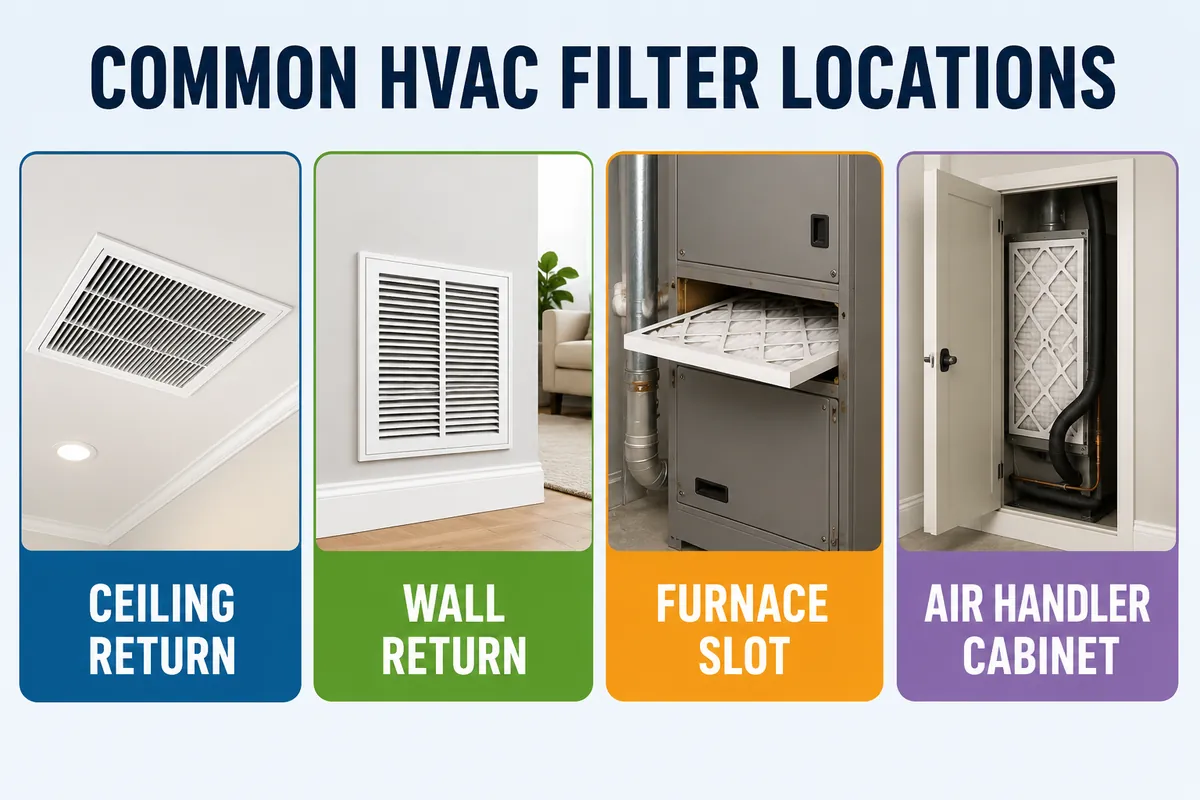
Look only in accessible locations along the return-air path: behind a hinged wall or ceiling return grille, in a slot beside the furnace or air handler, or in a dedicated media cabinet. A filter can be remote from the equipment, and some homes have several designated filtered returns.
Do not assume every return needs a filter or insert products into arbitrary grilles. The guide on whether filters belong in every return vent explains central versus return-grille arrangements. If filters appear at both a return and the equipment, verify the design before removing or adding anything.
Use homeowner manuals, cabinet labels, installer records, and accessible visual inspection. If the location still is not clear, the system may use a specialized arrangement or need an HVAC professional to identify the intended filtration point. Do not defeat a door switch, remove sealed panels, or operate equipment with required covers removed to search for it.
How to Get the HVAC System Back to Normal Safely
- Turn the system off at the thermostat and wait for the blower to stop before handling an accessible filter.
- Identify the designated filter location from the old filter, cabinet labels, manuals, or qualified guidance.
- Confirm the nominal size, actual dimensions when relevant, and thickness.
- Confirm the filter specification supported by the equipment or filter cabinet.
- Inspect the accessible slot for obvious damage without opening sealed service compartments.
- Install the correct compatible filter with the airflow arrow pointing in the documented direction.
- Make sure the frame seats normally without crushing, forcing, or an obvious gap.
- Restore operation according to the equipment instructions.
- Observe whether any prior airflow, heating, cooling, noise, or cycling symptom persists.
MERV is secondary to restoring the correct required filter. A higher rating is not automatically better, and MERV alone does not determine pressure drop. If you need a starting point after confirming the size, compare MERV 8, MERV 11, and MERV 13 while following system guidance.
When the Problem Is More Than the Filter
Professional HVAC evaluation is appropriate when you cannot identify the intended filter location; the system uses an electronic cleaner or specialized media cabinet; the correct filter will not seat properly; filters repeatedly collapse, tear, or become wet; or significant debris appears to bypass a properly installed filter.
Get help when weak airflow, inadequate heating or cooling, repeated shutdowns, short cycling, unusual noise, odors, or other performance problems continue after a correct clean filter is installed. For burning smells, electrical problems, gas or combustion concerns, smoke, or carbon-monoxide alarms, stop and follow the relevant emergency and equipment guidance rather than attempting filter-based diagnosis.
A filter replacement cannot prove that internal equipment is clean or that another fault is absent. A technician can evaluate the actual airflow path and equipment without relying on a universal assumption.
Filter Wizard Recommendation
If a central forced-air system is designed around a required filter, do not knowingly operate it with that filter missing. Pause, identify the intended location, verify all three dimensions and the supported specification, and install the correct compatible replacement. There is no responsible universal filterless grace period.
Keep sizing, fit, and configuration questions in their proper order: first determine where the filter belongs, then confirm its physical size, then choose an appropriate product. If the setup is unclear or HVAC symptoms persist after replacement, use qualified help instead of improvising around the filter.
Filter Wizard recommendation
Choose Only After the Size Is Confirmed
Enter a verified three-dimensional size for cautious MERV and replacement guidance. Filter Wizard does not measure the opening, inspect the equipment, or guarantee compatibility.
Start the Filter FinderFree Filter Reminders
Remember the Next Filter Change
Get occasional filter reminders, homeowner maintenance tips, and buying guidance.
Occasional emails only. Unsubscribe anytime.
You're on the list. We'll send practical filter reminders and updates occasionally.
Frequently Asked Questions
Can I run my AC without an air filter?
If the central air-conditioning system is designed to use a required return-air filter, do not knowingly operate it with that filter missing. Turn the system off while you confirm the intended location, size, and specification, then install the correct filter according to equipment guidance.
Can I run my furnace without a filter?
Do not run a forced-air furnace that requires a filter with the filter removed. Manufacturer instructions for applicable furnaces warn against operating for heating or cooling without the required filter in place.
Can I run HVAC without a filter for one night?
There is no universal safe number of minutes or hours. System design, filter location, runtime, and airborne debris vary, so do not treat one night as an automatically safe allowance. Resolve the missing-filter issue or obtain system-specific professional guidance.
Is no filter better than a dirty filter?
Do not choose between two improper operating conditions. A heavily loaded filter can restrict airflow, but removing a required filter is not the recommended fix. Install the correct clean replacement and investigate any symptoms that remain.
What should I do if I do not know my air filter size?
Check the old filter frame, filter cabinet label, equipment documentation, and accessible filter opening. Confirm length, width, and thickness before buying. Filter Wizard can help after you provide a verified three-dimensional size; it cannot discover the physical size automatically.
Can I use a different filter size temporarily?
Do not knowingly use an undersized, oversized, folded, trimmed, crushed, stacked, or improvised filter. A wrong-size product can fit poorly or leave a bypass gap. Confirm the intended nominal and actual dimensions and use a compatible replacement.
Why can’t I find my HVAC filter?
Common locations include a return grille, a slot beside the furnace or air handler, or a dedicated media cabinet. Some systems use specialized arrangements. Check accessible labels and manuals, and ask a qualified HVAC professional if the intended location remains unclear.
What if the old air filter is damaged or wet?
A torn, collapsed, badly bent, or wet disposable filter should not be treated as serviceable. Replace it with the correct compatible filter and address recurring moisture, deformation, or fit problems instead of operating without the required filter.
Does every HVAC system use the same kind of filter?
No. Central forced-air systems, ductless mini-splits, window units, portable units, boilers, and specialized media cleaners use different filtration arrangements. Follow the documentation for the actual installed equipment.
When should I call an HVAC professional about a missing filter?
Get qualified help when you cannot identify the intended filter location, the system has specialized filtration, the correct filter will not seat properly, filters repeatedly collapse, or heating, cooling, airflow, shutdown, odor, electrical, gas, or combustion concerns persist.