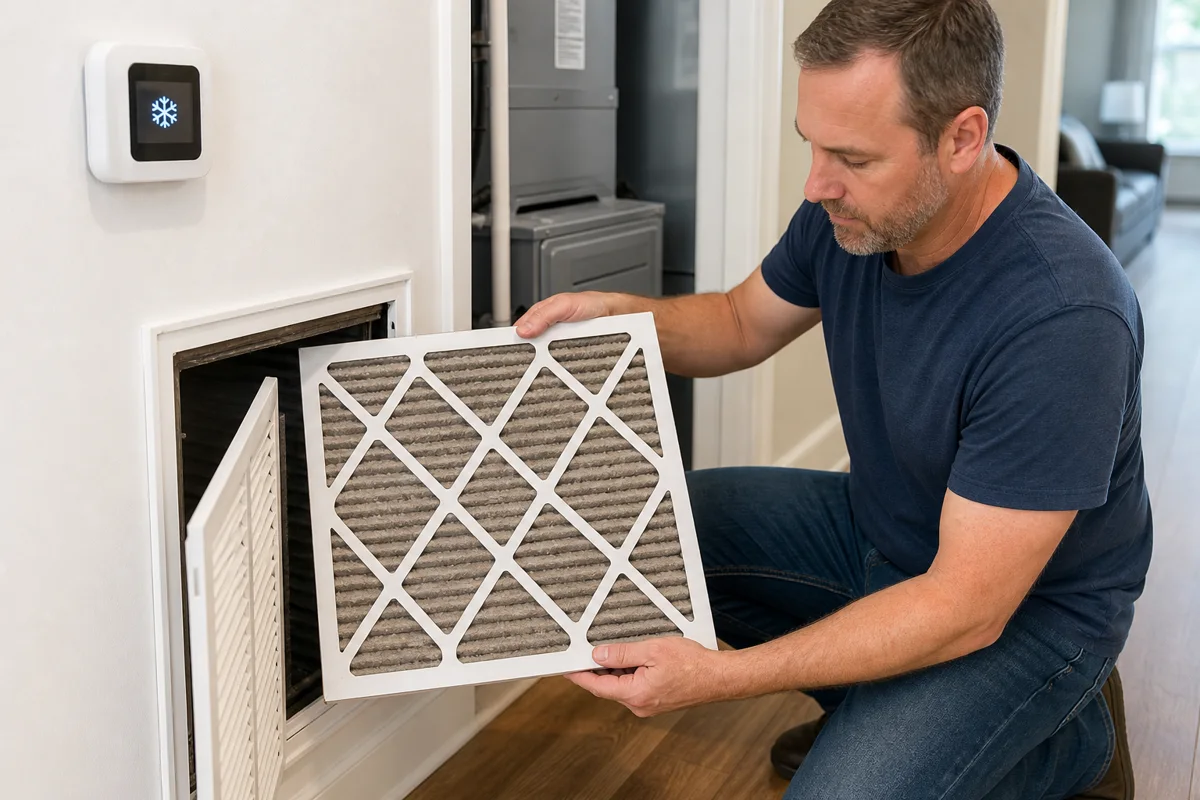
Quick Answer
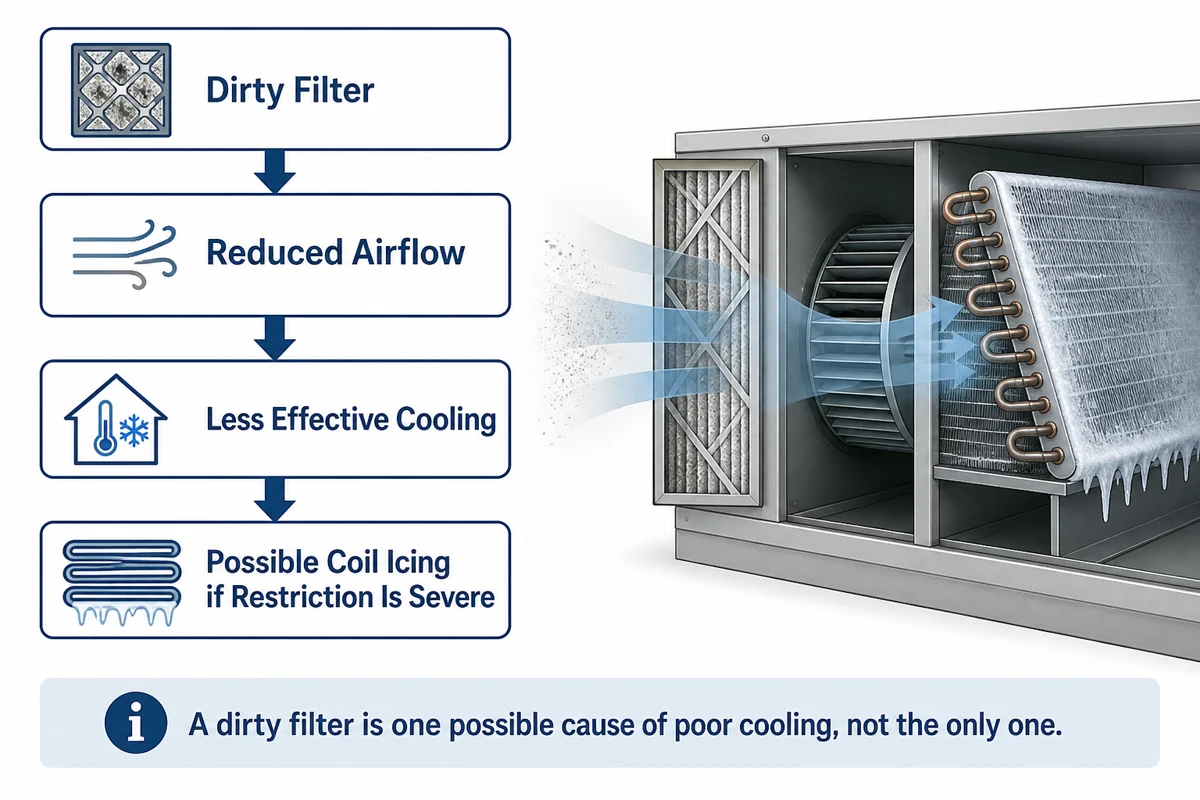
Yes. A heavily clogged air filter can reduce airflow enough to hurt cooling performance. If too little warm return air crosses the evaporator coil, the coil can also become excessively cold and may ice over, which reduces airflow and cooling further.
A mildly dusty filter does not automatically explain poor cooling. Replace a genuinely clogged filter with the correct replacement, then observe airflow and operation. If the clean filter makes no meaningful difference, another HVAC problem may be responsible.
How a Dirty Filter Can Reduce AC Cooling
In a typical central system, room air enters a return, passes through the filter, reaches the blower, crosses the evaporator coil, and returns to the rooms through supply ducts. The filter does not set refrigerant temperature. Its role is to collect particles from air traveling toward the equipment.
As debris accumulates, the media generally creates more resistance. When loading becomes severe enough for the particular blower, filter face area, duct system, and operating condition, airflow may decline. Less room air then crosses the coil and less conditioned air reaches the rooms. The equipment can run while comfort changes slowly or not enough.
This mechanism is conditional. A gray surface is not the same as a measured airflow restriction, and a clean-looking filter does not rule out restriction elsewhere. Compare filter condition with whole-house airflow, timing, noise, and system behavior.
Why Low Airflow Can Contribute to a Frozen Evaporator Coil
The evaporator coil absorbs heat from return air. If airflow becomes too low, less warm air crosses the coil. Under some conditions the coil surface can become excessively cold, moisture can freeze, and the growing ice can block still more airflow. Cooling delivery then deteriorates even though the system may continue running.
A dirty filter is one possible starting point, not a diagnosis of every frozen coil. Refrigerant, blower, coil, duct, and control problems can also be involved. The dedicated guide Can a Dirty Air Filter Cause Your AC to Freeze? covers that mechanism and safe response in depth.
Signs the Filter May Actually Be Contributing
- The media is heavily matted or packed with debris rather than lightly gray.
- Airflow has weakened at several supply vents, not only one register.
- The filter is collapsed, wet, torn, or visibly deformed.
- Whistling is concentrated near the return or filter slot.
- The frame bows inward while the blower operates.
- Long cooling cycles appeared as airflow declined.
- Frost or ice is visible in a safely observable area.
These observations increase plausibility; none proves the filter is the sole cause. A whistle can come from a gap, a bowed filter can lack support, and long cycles can reflect weather or an unrelated fault. Use the focused guides on clogged-filter signs, filter whistling, and filter bowing for the overlapping clues.
Dirty Filter vs Normal-Looking Filter
Filter is a more plausible contributor
- Media is heavily loaded or matted
- Frame has collapsed or deformed
- Whole-house airflow has declined
- Filter was neglected under heavy runtime
- Symptoms developed with obvious loading
Filter is a less convincing cause
- Media is relatively clean and dry
- Airflow at multiple vents seems normal
- Cooling loss was sudden without airflow clues
- A correct clean replacement changes nothing
- Only one room remains uncomfortable
Visual inspection cannot measure pressure drop. Its value is identifying obvious loading, damage, moisture, fit problems, and whether the filter deserves to be ruled out first.
What Should You Check First?
- Confirm the thermostat is set to cooling and the requested temperature is below room temperature.
- Listen for whether the indoor blower appears to run.
- Turn the system off at the thermostat before accessing the filter.
- Photograph the filter in place so orientation and seating are recorded.
- Inspect for heavy loading, collapse, moisture, tears, or frame damage.
- Confirm the airflow arrow points toward the blower.
- Confirm the filter is the intended size and sits normally.
- Replace it when genuinely loaded or due, using the correct size and supported type.
- Restore normal operation and compare airflow at several vents.
- Observe whether cooling begins recovering without unusual noise, water, or recurring frost.
Do not open sealed equipment compartments, reach near energized parts, probe refrigerant lines, or bypass a safety control. This sequence rules out an accessible filter problem; it does not diagnose the entire air conditioner.
What If the Filter Is Completely Clogged?
A severely loaded filter can substantially increase system resistance. Possible results include weak delivered airflow, longer cooling cycles, poor comfort, filter deformation, and—in suitable conditions—a greater chance of coil icing. The outcome depends on the system and does not occur identically in every home.
Replace a disposable filter rather than vacuuming or washing it. Match the documented size, depth, and a reasonable filtration level. Do not stack filters or remove filtration as a routine workaround. If a fresh filter immediately bows, whistles, or produces weak airflow, the cause may extend beyond dirt accumulation.
What If You Change the Filter and the AC Still Isn’t Cooling?
Replacing a clogged filter removes that restriction source, but it does not guarantee instant recovery. An already iced coil remains obstructed until the underlying condition is addressed and the ice is gone. Another restriction can exist at a return, coil, duct, or register. Blower, thermostat, control, outdoor-unit, refrigerant, and capacity problems are also outside what a filter change can solve.
A clean filter therefore rules out one common, accessible possibility. It does not prove which other component failed. Persistent weak airflow, icing, or poor cooling deserves qualified evaluation rather than repeated filter purchases.
What If the Evaporator Coil Is Already Frozen?
Replacing the filter does not instantly remove existing ice. Do not chip or scrape the coil, apply a heat gun, pour hot water, or bypass controls. Turn cooling off and follow the safe high-level guidance in the frozen-AC guide. Recurring or unexplained icing needs professional diagnosis.
Can the Wrong Filter Cause Poor Cooling?
A clean filter can still impose more resistance than a particular system comfortably supports, but the MERV number alone does not determine pressure drop. Media design, pleat area, face size, thickness, airflow rate, loading, rack geometry, and product construction all matter. Two filters with the same MERV can behave differently.
If airflow declined immediately after a filter change, compare the old and new products, size, depth, orientation, and manufacturer resistance information when available. See Can an Air Filter Be Too Restrictive? and the MERV 8 vs 11 vs 13 guide.
Can the Wrong Filter Size Affect Cooling?
An undersized filter may leave bypass gaps, while an oversized or wrong-depth filter may bind, deform, or fail to seat. Those conditions can contribute to abnormal airflow behavior, though not every mismatch causes poor cooling. Confirm size with the sizing guide, check proper filter fit, and do not substitute a nearby nominal size casually.
What If Airflow Is Weak at Every Vent?
Weak airflow across much of the house makes a central airflow issue more plausible than a problem isolated to one register. A heavily loaded or collapsed filter is worth checking, as are visible icing and an obvious blocked return. If correcting an obvious filter problem does not restore airflow, stop treating the filter as the complete explanation.
What If Only One Room Isn’t Cooling?
A single warm room is less suggestive of a whole-system filter restriction when the rest of the house has normal airflow and cooling. Register position, duct distribution, balancing, solar load, insulation, and a local duct issue are different categories. The filter can still need routine replacement, but it becomes a weaker suspect for the room-specific symptom.
Dirty Filter vs Other AC Problems
| Observation | Filter-related problem more plausible? | Why |
|---|---|---|
| Filter packed with debris | More plausible | Obvious loading can add resistance. |
| Weak airflow throughout house | More plausible, not proven | A central restriction could affect many vents. |
| Filter whistling or bowing | More plausible | Loading, fit, or support may be involved. |
| Ice plus weak airflow | Needs diagnosis | Filter restriction is one of several causes. |
| Clean filter; outdoor unit abnormal | Less suggestive | The observation points beyond filter loading. |
| One room warm | Less suggestive | A local distribution issue is more plausible. |
| Sudden loss with normal airflow | Less suggestive | There is little evidence of filter restriction. |
| New filter made no difference | Needs further diagnosis | The accessible restriction was ruled out. |
How Quickly Should Cooling Improve After Replacing a Dirty Filter?
There is no universal time. Airflow may feel better relatively quickly when filter restriction was the primary problem, but room-temperature recovery depends on indoor temperature, outdoor weather, humidity, thermostat setting, system capacity, and how much heat the building gained.
If icing occurred, changing the filter alone does not create an immediate normal cooling cycle. Lack of improvement is evidence to investigate further, not proof of a compressor, refrigerant, or other specific failure.
When Should You Stop Troubleshooting the Filter?
Seek qualified service when the filter is clean but cooling remains poor, little or no airflow persists, icing returns, a breaker trips, electrical or burning odor appears, unusual mechanical noise develops, water appears where it should not, the outdoor equipment does not appear to operate normally, or the system repeatedly fails to reach temperature. Do not keep restarting a system that shows recurring ice, electrical symptoms, or water near electrical components.
Filter-Related Cooling Checklist
- Confirm the thermostat is in cooling mode.
- Observe whether the indoor blower operates.
- Turn the system off before accessing the filter.
- Inspect filter condition.
- Verify the airflow direction.
- Verify size and seating.
- Look for heavy loading, collapse, moisture, or deformation.
- Replace the filter when genuinely dirty or due.
- Do not stack filters.
- Do not force an incorrect size.
- Restart the system normally.
- Compare airflow at several vents.
- Watch for recurring icing or abnormal behavior.
- Escalate if cooling does not recover.
Free homeowner tool
Need the Right Replacement Filter?
If the current filter is dirty and due for replacement, confirm the size first, then use Filter Wizard to narrow down an appropriate replacement and filtration level.
Open the Filter Finder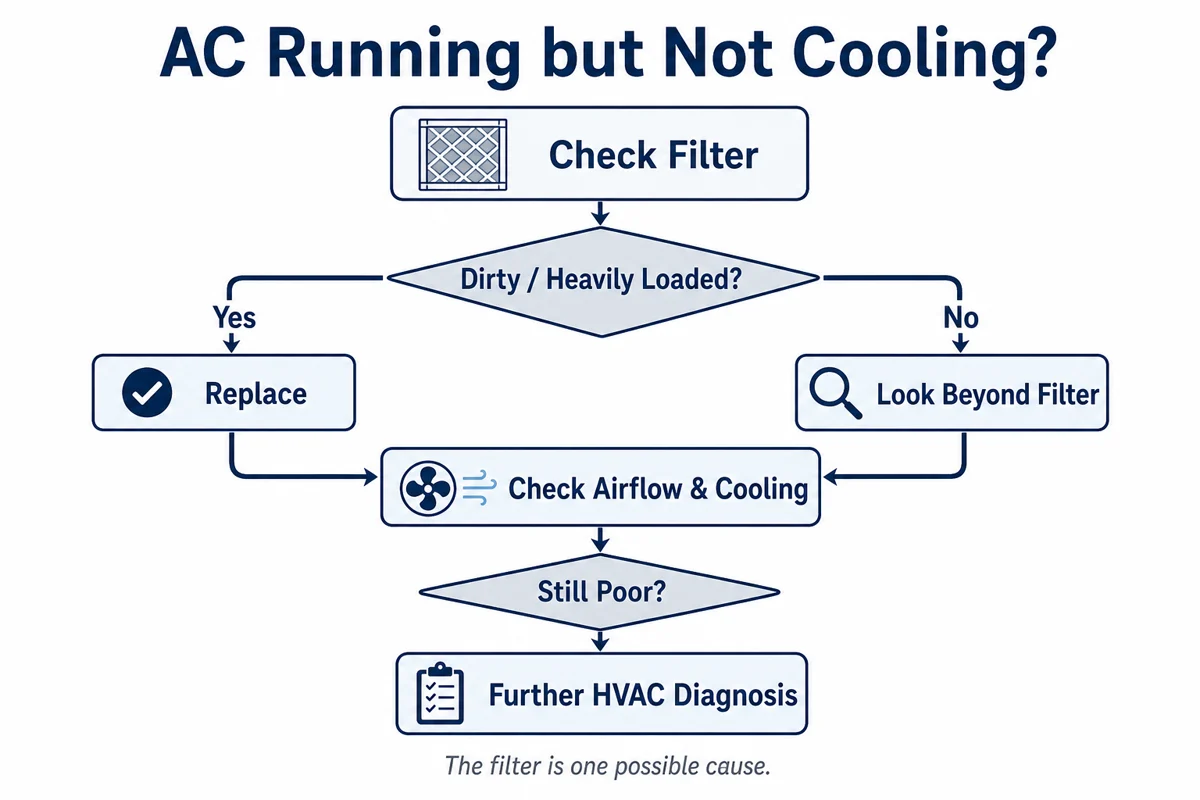
Filter Wizard Recommendation
A dirty air filter can contribute to an AC that runs without cooling well, but the filter should show evidence that restriction is plausible. Check it first because it is accessible and easy to rule out—not because every cooling problem begins there.
Replace a genuinely clogged filter with the correct replacement, then pay attention to whole-house airflow and cooling. If the system remains weak, iced, or unable to cool, the problem needs diagnosis beyond the filter.
Filter Wizard recommendation
Replace Only After You Confirm the Size
Enter a valid three-dimensional size for cautious MERV guidance, replacement timing, and current retailer options. Filter Wizard cannot diagnose the cooling system or guarantee compatibility.
Start the Filter FinderFree Filter Reminders
Remember Your Next Filter Check
Get occasional filter reminders, homeowner maintenance tips, and buying guidance.
Occasional emails only. Unsubscribe anytime.
You're on the list. We'll send practical filter reminders and updates occasionally.
Frequently Asked Questions
Can a dirty air filter cause the AC not to cool?
Yes. A heavily clogged filter can reduce airflow enough to hurt cooling, but it is only one possible cause. If a clean replacement does not restore normal operation, further diagnosis is needed.
Can a clogged air filter stop an AC from blowing cold air?
A severe restriction can reduce delivered cooling and may contribute to coil icing. It does not directly control refrigerant temperature, and other faults can also stop effective cooling.
Why does a dirty filter reduce cooling?
Collected debris raises resistance, so less return air may cross the evaporator coil and reach the supply ducts. Reduced airflow can lower the amount of cooling delivered to rooms.
Can a dirty air filter cause weak airflow?
Yes, when loading is heavy enough to add substantial resistance. Weak airflow can also come from icing, blower, duct, coil, return, or register problems.
Can a dirty air filter freeze the AC coil?
Low airflow from a heavily clogged filter can contribute to icing, but it is not the only cause. Refrigerant, blower, coil, duct, and control conditions can also be involved.
Will changing the air filter make the AC colder?
It may restore airflow when a clogged filter was the primary restriction. It will not correct an iced coil immediately or repair unrelated mechanical, control, refrigerant, or duct problems.
How do I know if my AC filter is too dirty?
Heavy matted debris, deformation, collapse, whistling, bowing, and declining whole-house airflow make restriction more plausible. Appearance alone cannot measure pressure drop.
What if I changed the filter and the AC still isn’t cooling?
The filter has ruled out one accessible cause. Existing ice or another airflow, control, outdoor-unit, refrigerant, duct, or equipment problem may require qualified diagnosis.
How long does cooling take to recover after changing a dirty filter?
There is no universal recovery time. It depends on indoor and outdoor conditions, system capacity, humidity, temperature difference, and whether the evaporator coil is iced.
Can a high-MERV filter make an AC cool poorly?
A clean filter can add too much resistance for a particular system, but MERV alone does not determine pressure drop. Media design, face area, depth, airflow, fit, and loading matter.
Can the wrong filter size affect AC cooling?
It can contribute to abnormal fit or airflow behavior. An undersized filter may bypass, while an oversized or wrong-depth filter may bind or deform, but not every mismatch causes poor cooling.
Why is my AC running but the house is still warm?
A clogged filter is one possibility, especially with weak whole-house airflow. A clean filter, sudden severe loss, or no improvement after replacement points toward diagnosis beyond the filter.
Does weak airflow from every vent mean the filter is clogged?
It makes a central airflow issue more plausible, but does not prove the filter is responsible. Inspect the filter safely, then escalate if weak airflow persists.
When should I call for HVAC service if the AC isn’t cooling?
Seek service when cooling remains poor with a clean correct filter, little airflow persists, icing returns, a breaker trips, electrical or burning odor appears, unusual noise develops, or water is present.