Quick Answer
An HVAC filter and a portable air purifier are not interchangeable. The HVAC filter treats air only when the central system moves air through its return path. It also remains part of the filtration arrangement the equipment was designed to use.
A portable air cleaner—often called an air purifier—has its own fan and processes air in the room or area where it operates. It may supplement central filtration for a room-level particle goal, but it does not replace the required HVAC filter. MERV and CADR describe different performance concepts, so there is no valid universal conversion between them.
What an HVAC Air Filter Does
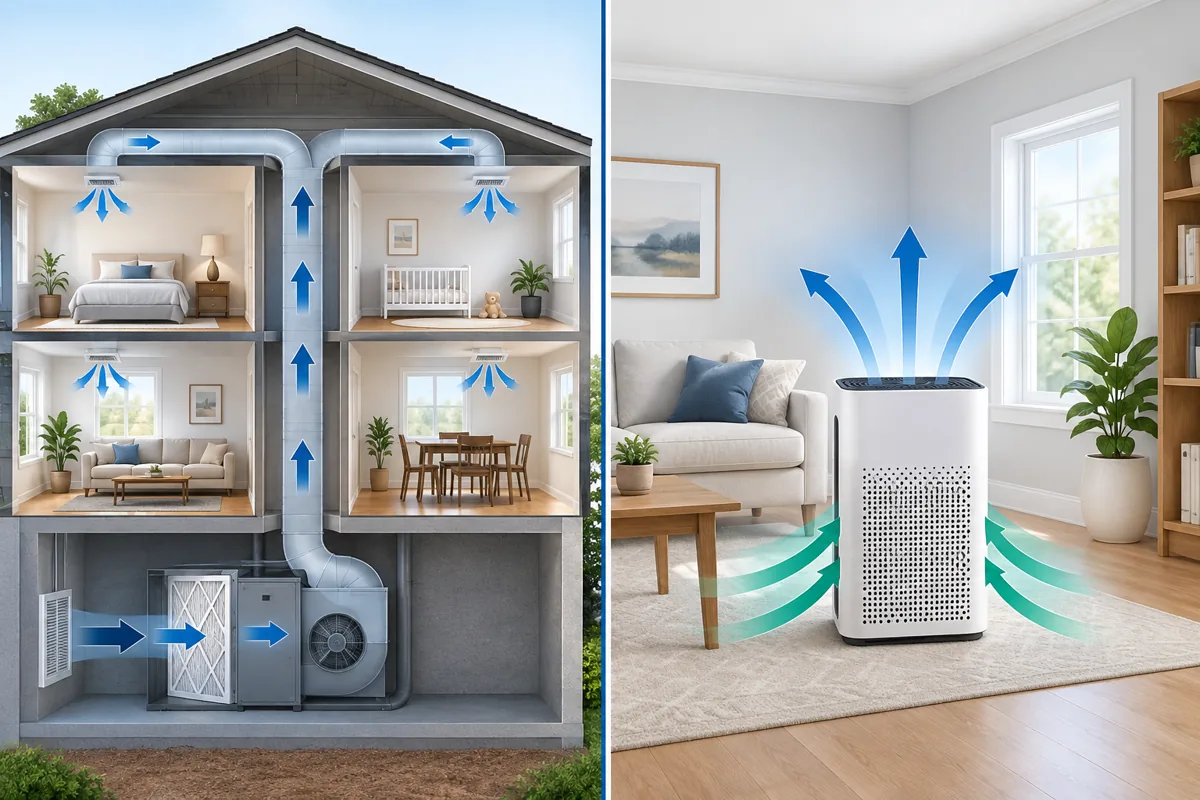
A normal residential central HVAC filter sits in an intended return-air location: for example, a return grille, filter rack, or media cabinet. When the blower moves air through that path, the filter captures some particles before the air continues through the equipment and back to the areas the system serves.
That makes the filter part of both the equipment’s debris protection and the home’s particle-filtration strategy. Its effect depends on the actual filter, fit, system airflow, filtration efficiency, loading, and how much air the system moves. A central filter does not continuously clean all air merely because it is installed.
HVAC filters commonly use MERV to report particle-removal performance under the ASHRAE Standard 52.2 test framework. MERV is useful for comparing compatible HVAC filters, but the rating does not state how much air a specific installed system will circulate or whether a higher-efficiency product fits that system. The guides to choosing among MERV 8, 11, and 13 and checking filter restriction and compatibility own those decisions.
What a Portable Air Purifier Does
EPA and ENERGY STAR more precisely call this product a portable air cleaner or room air cleaner. The familiar term “air purifier” does not guarantee a particular technology or performance level.
A portable cleaner contains its own fan. It draws air from the surrounding room or area, passes that air through its cleaning components, and returns treated air to the space. It can operate independently of central heating or cooling cycles. How much particle removal it provides depends on the complete device, fan setting, operating time, placement, space, and pollutant being evaluated.
Many portable units use particle media, and some use true HEPA filters. Others add activated carbon or electronic technologies. Do not assume every device is HEPA, removes gases, or has been tested under the same program. Product labels and independent certification data matter more than the word “purifier.”
HVAC Filter vs. Air Purifier: Key Differences
| Question | Central HVAC filter | Portable room air cleaner |
|---|---|---|
| Where does filtration happen? | In the system’s designed return-air path | Inside a stand-alone device in the room or area |
| What moves the air? | The central HVAC blower | The cleaner’s own fan |
| When does it filter? | When the HVAC blower moves air through the filter | When the portable unit is operating |
| What area can it affect? | Areas served by the central system, subject to actual circulation | The room or connected area where it runs, subject to device and space conditions |
| Common particle metric | MERV for the filter | CADR for the complete cleaner |
| Main selection constraint | Physical fit and HVAC compatibility | Clean-air delivery appropriate for the intended space and use |
| Does it remove gases? | Ordinary particle media does not establish gas removal | Only if the device has suitable gas-removal media and documented capability |
| Does it replace the required HVAC filter? | It is the required system filter when specified by the design | No |
The table describes function, not a contest. A strong result from either approach still depends on the installed product and how it is used. Neither column guarantees uniform filtration, complete pollutant removal, or a health outcome.
MERV vs. CADR: Why the Ratings Mean Different Things
What MERV represents
ASHRAE Standard 52.2 establishes a laboratory method for evaluating a ventilation air-cleaning device’s removal efficiency across defined particle-size ranges as the device loads. The resulting MERV category describes the filter’s particle-capture performance within that framework.
What CADR represents
Clean Air Delivery Rate evaluates a complete room air cleaner. ENERGY STAR defines CADR as the delivery of contaminant-free air within a defined particle-size range, expressed as a flow rate. Consumer labels may show separate particle CADRs, such as smoke, dust, or pollen, because performance can differ by particle category.
Why there is no conversion
MERV describes removal efficiency for a filter under its test. CADR describes clean-air delivery from a complete device, which reflects both particle removal and the air the unit processes. A MERV number does not supply the installed HVAC airflow and runtime needed to describe clean-air delivery. A CADR does not identify an HVAC filter’s MERV category or system compatibility.
For that reason, do not use an online equation, match a MERV number to a CADR number, or assume that a MERV 13 central filter is the “same” as a particular portable cleaner. They are measurements for different products and decisions.
Which One Filters More of Your Home?
Neither device has a universal coverage advantage. A central filter can act on air circulated through the ducted areas served by the HVAC system. That reach may be broad, but filtration occurs only while the blower moves air through the filter, and room-to-room circulation is not necessarily uniform.
A portable cleaner processes air around the space where it operates. Its effect depends on the unit’s CADR, fan speed, placement, run time, room layout, ceiling height, open doors, and other air movement. A room label is not proof that one unit evenly treats an entire house.
ENERGY STAR and EPA recommend choosing a portable unit with CADR appropriate for the intended room or area and keeping its airflow unobstructed. This article deliberately does not prescribe a universal square-foot formula: follow current authoritative sizing guidance and the tested device label for the actual space.
If your decision is whether to increase central blower runtime, read whether the HVAC fan should run continuously for filtration. Longer runtime creates more opportunity for central filtration, but energy, humidity, controls, motor type, and filter loading keep that from being a universal recommendation.
Does an Air Purifier Replace Your HVAC Filter?
No. A portable cleaner does not sit in the return-air path, protect downstream HVAC components, or satisfy the system’s filter requirement. Keep the correctly sized, compatible filter installed and maintain it according to the equipment and filter guidance.
Do not remove an HVAC filter because a portable unit is running. Do not delay replacement on the theory that the room cleaner has captured everything first. If the required system filter is missing, follow the safe recovery steps in Can You Run an HVAC System Without an Air Filter?
Can an HVAC filter replace a portable cleaner?
That also cannot be answered universally. A compatible central filter may address a homeowner’s particle-filtration goal without another device. In another home, someone may want additional particle removal in one frequently occupied room, or the central system may run too little to provide the desired room-level cleaning opportunity.
The correct conclusion is not “everyone needs both.” It is that the devices work differently. Define the pollutant and location goal, then evaluate each product in the framework that applies to it.
Can You Use an HVAC Filter and Portable Air Cleaner Together?
Yes. EPA describes central filtration and portable room air cleaning as approaches that can complement each other. A portable cleaner may add particle removal in a particular room while the HVAC filter continues serving its required central role.
Using both does not justify an incompatible HVAC upgrade. A higher MERV rating still has to suit the filter slot and system. The portable unit still needs appropriate clean-air delivery for its intended area, unobstructed placement, maintenance, and operating time. Two devices also do not replace source control or appropriate ventilation.
What About HEPA?
HEPA is a particle-filtration performance category, not another name for MERV 13 and not a room-coverage rating. True HEPA media is common in portable room air cleaners, but the complete unit’s CADR remains important because a highly efficient filter is useful only when the device moves enough air through it for the intended space.
A standard residential furnace should not automatically be assumed to accept a true HEPA filter as a drop-in replacement. Purpose-built central or bypass HEPA arrangements exist, but their cabinet, sealing, airflow, and pressure-drop requirements are system-specific. The guide to using true HEPA filtration with a furnace owns that compatibility question.
What About Smoke, Odors, and VOCs?
Start by separating particles from gases. MERV and HEPA describe particle filtration. CADR used for consumer room cleaners is also a particle-performance metric. None of those labels alone proves removal of gases, volatile organic compounds, or odors.
Smoke illustrates the problem: it can contain both particles and gases. A particle filter may reduce airborne smoke particles without removing every gaseous component or odor. Some portable cleaners include activated carbon or another sorbent designed for certain gases, but performance depends on the target pollutant and the amount and design of the media. A thin carbon sheet and a large sorbent bed should not be treated as equivalent merely because both mention carbon.
The HVAC filter guide for smoke particles keeps this boundary explicit. For any gas or odor goal, inspect documented product capability rather than assuming “HEPA,” “high MERV,” or “air purifier” means all pollutants are removed.
How to Decide Which Approach Fits Your Goal
- Keep required HVAC filtration in place. Confirm the system’s correct physical filter size and compatible filtration specification. A portable cleaner does not change this requirement.
- Name the pollutant type. Is the goal airborne particles, a gas or odor, or a source that should be removed or controlled? Do not use particle ratings to promise gas removal.
- Name the area. Decide whether the question concerns air circulated by the central system, one occupied room, or another defined space.
- Use the correct metric. Compare compatible HVAC filters using MERV and product-specific pressure-drop information where available. Evaluate a portable unit using CADR and guidance for the intended area.
- Consider operating time. Central filtration depends on blower operation; portable filtration depends on the room unit running at its selected setting.
- Maintain each device separately. Follow the correct replacement or cleaning instructions for the HVAC filter and the portable unit. Do not interchange their media or improvise fit.
- Keep expectations realistic. Filtration supplements source control and ventilation. It does not remove every pollutant, diagnose indoor air, or guarantee a health result.
HVAC filter guidance only
Need Help With the Central-Filter Side?
After you confirm all three physical dimensions and that an ordinary residential HVAC filter is appropriate, Filter Wizard can provide a cautious MERV starting point and replacement guidance. It does not select portable air cleaners or interpret CADR for a room.
Open the Filter FinderFilter Wizard Recommendation
Treat the HVAC filter as required system filtration and the portable cleaner as a separate room-level tool. Do not make either device carry a job its rating does not describe.
For the central system, verify size, fit, MERV, and compatibility. For a portable cleaner, evaluate the complete unit’s particle CADR for the intended space, its operating and maintenance requirements, and any separately documented gas-removal capability. Use both only when the two distinct roles match a real need.
Frequently Asked Questions
Is an HVAC filter the same as an air purifier?
No. An HVAC filter treats air moving through the central system’s return path. A portable air purifier, more precisely called a portable or room air cleaner, uses its own fan to process air in the room or area where it operates.
Does a portable air purifier replace a furnace filter?
No. Keep the filter required by the furnace or central HVAC design installed and maintained. A portable cleaner is a separate device and does not protect the HVAC airflow path or replace its required filter.
Do I need an air purifier if I already have an HVAC filter?
Not everyone needs both. A portable cleaner may add room-level particle filtration when that is the goal, but its usefulness depends on the space, device performance, operating time, pollutant type, and existing HVAC filtration. It is not a universal requirement.
Can I use a portable air cleaner and an HVAC filter together?
Yes. EPA describes central filtration and portable room air cleaning as approaches that can complement each other. The HVAC filter still must fit the system and remain compatible, while the portable cleaner should be selected and operated for the intended room or area.
Is MERV the same as CADR?
No. MERV reports particle-removal performance for a ventilation filter under an ASHRAE test method. CADR reports how quickly a complete room air cleaner delivers particle-cleaned air under its applicable test. They answer different questions.
Can you convert MERV to CADR?
No universal conversion is valid. MERV rates filter removal efficiency by particle-size range; CADR combines the complete room cleaner’s particle-removal performance and airflow into a clean-air delivery rate. Neither number supplies the missing conditions needed to calculate the other.
Does a MERV 13 filter replace a portable air purifier?
Not automatically. MERV 13 describes HVAC-filter performance under its test framework, while a portable cleaner has its own fan, CADR, placement, and room context. Either approach may contribute particle filtration, but one rating cannot prove that the devices are interchangeable.
Is HEPA the same as MERV 13?
No. HEPA is a separate particle-filtration performance category. HEPA media is common in portable room cleaners, but a standard residential HVAC system should not be assumed to accept true HEPA as a drop-in furnace-filter replacement.
Do air purifiers remove odors and VOCs?
A particle filter, including HEPA media, does not by itself establish gas, odor, or VOC removal. Some portable cleaners include activated carbon or another sorbent intended for certain gases, but performance depends on the device and amount of suitable media. CADR is a particle metric.
Does an HVAC filter clean the whole house?
A central filter can act on air circulated through the areas served by the HVAC system, but only while air moves through that filtered path. It does not prove uniform filtration in every room, continuous cleaning, or removal of every pollutant.
Does Filter Wizard choose portable air purifiers?
No. Filter Wizard helps with the ordinary residential HVAC-filter side of the decision after you confirm the physical size. It does not compare purifier models, determine room coverage, interpret CADR for a room, or verify HVAC compatibility.
Questions or feedback?
Help Improve Filter Wizard
Tell us what was clear, what was missing, or which air-filter question you want answered next.