Filtration & HVAC Operation
Should You Run Your HVAC Fan Continuously?
Continuous fan operation can send more return air through the HVAC filter, giving it more opportunities to capture particles. That does not make the ON setting best for every home: filter compatibility, energy use, filter loading, thermostat controls, and possible cooling-season humidity effects all matter.
Quick Answer
Running a compatible central forced-air system's fan for longer can provide more filtration time because more return air has opportunities to pass through the installed filter. EPA and ASHRAE guidance both recognize HVAC fan runtime as part of central filtration effectiveness.
But continuous operation is not a universal recommendation. It uses electricity, can load the filter sooner, and may reduce cooling-season dehumidification in some systems. AUTO remains a sensible default for many homes; ON can be useful when extra filtration or circulation is an intentional, supported goal; and CIRCULATE, where available, can provide an intermittent middle option.
How Fan Runtime Changes HVAC Filtration
A central HVAC filter can affect only air that enters the system's return path, crosses the filter media, and returns to the rooms through the supply system. When the blower is off, that central filter is not actively receiving return airflow. EPA's residential air-cleaner guidance says HVAC filters work only when the system operates and that longer fan operation increases the amount of air filtered.
That creates an opportunity—not a guarantee. The result depends on the filter's actual particle-removal performance, its fit and condition, the amount of airflow, the location of returns, particle sources, and how well room air mixes into the return path. Continuous fan operation does not make a low-efficiency or poorly fitted filter equivalent to a better one. It also cannot ensure that every particle in every room reaches the filter.
ASHRAE likewise identifies runtime as an important part of central filtration effectiveness. This supports the basic relationship: all else equal, more operating time gives the central filter more opportunities to act on particles carried through it. It does not support a universal percentage improvement or a promise of healthier air.
What AUTO, ON, and CIRCULATE Usually Mean
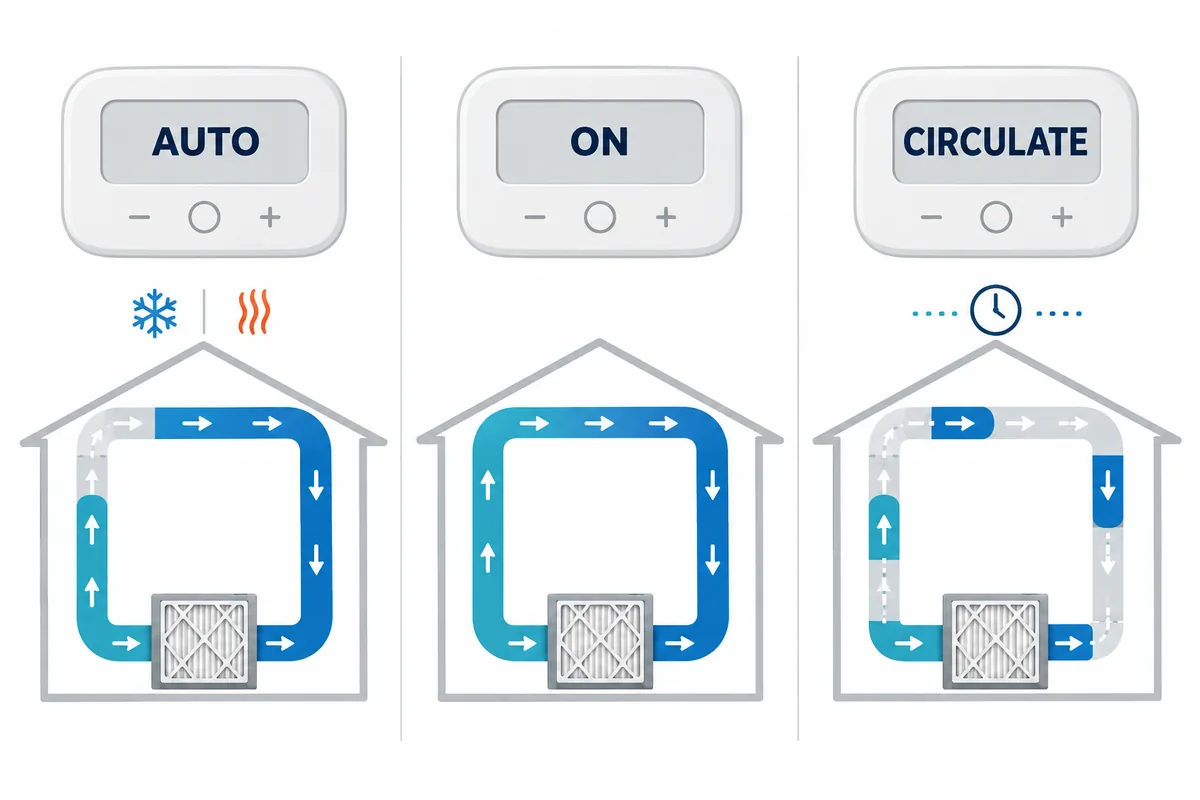
Thermostat labels are not perfectly universal, but current manufacturer documentation supports these practical distinctions:
- AUTO: the blower normally runs with a heating or cooling call, then stops when that call ends.
- ON: the blower runs independently of heating or cooling and is generally continuous.
- CIRCULATE: on thermostats that offer it, the blower runs periodically between heating or cooling calls. The schedule, minutes per hour, and fan speed vary by product.
Google Nest documents scheduled fan operation for selected systems, while Resideo documents AUTO, ON, and CIRCULATE modes and describes CIRCULATE as interval-based air movement. Lennox controls also offer all three choices on supported equipment. If your thermostat lacks CIRCULATE—or if its fan control is disabled—do not assume another product's instructions apply.
Continuous Fan Tradeoffs to Consider
Electricity use varies by the actual blower
Extra runtime uses electricity. Google Nest explicitly warns that longer fan use can increase the electric bill, and Carrier describes ON as continuous operation that consumes extra electricity. The size of that effect cannot be stated responsibly without the equipment and control details.
DOE distinguishes conventional permanent-split-capacitor (PSC) furnace-fan motors from more efficient electronically commutated motors (ECMs). Motor type, fan speed, control strategy, airflow resistance, and equipment design can all affect consumption. That supports a qualitative distinction—not a universal monthly cost, wattage, or promise that every ECM makes 24-hour operation inexpensive.
Cooling-season humidity can change in some systems
During cooling, moisture condenses on the indoor coil. DOE/PNNL building-science guidance explains that continuous blower operation after the compressor stops can re-evaporate some retained moisture into the air in certain systems and climates, diminishing dehumidification. Lennox documentation also warns that continuous operation may result in higher humidity and recommends AUTO during cooling when humidity becomes uncomfortable.
This does not mean ON always raises humidity, causes mold, or must never be used in a humid climate. Equipment controls differ, and some variable-speed systems have specific continuous-fan strategies. If the home already has moisture problems, follow the equipment and thermostat documentation rather than using a generic setting as a humidity remedy.
Air mixing may improve without solving a comfort problem
Manufacturer guidance says longer fan operation may help even out temperatures between rooms by mixing air. It cannot correct undersized ducts, closed or blocked registers, missing returns, insulation problems, or equipment faults. Better mixing is a possible secondary benefit, not evidence that the filter setting fixed the underlying comfort issue.
What Continuous Operation Means for the Filter
More air moving through the media creates more opportunities to collect airborne particles. It can therefore make a filter load sooner under the same particle conditions. Google Nest advises that extended fan use may require earlier replacement, but there is no defensible rule such as “replace twice as often.” Particle concentration, filter design, airflow, and system conditions vary too much.
Inspect the filter and follow the product and equipment guidance. The guide to how often to change an air filter owns the detailed replacement decision. A continuous-fan choice is a reason to revisit inspection timing, not permission to discard a filter on an invented calendar.
Continuous operation also does not make an incompatible filter safe. MERV is only one aspect of filter performance, and pressure drop varies by product design, dimensions, media area, loading, and airflow. Review the guides to MERV 8, 11, and 13 and whether an air filter can be too restrictive before changing filtration level.
A Practical Fan-Mode Decision Path
- Confirm that this is a central forced-air system. Boiler-only heat, ductless equipment, window units, and portable units use different controls and filters.
- Verify the filter first. It should be the correct physical size, seated normally, installed in the documented location, and compatible with the system.
- Define the goal. If the goal is extra particle filtration, more fan runtime may help. If the goal is to repair weak airflow, humidity, noise, or uneven comfort, fan ON is not a diagnosis.
- Read the thermostat and equipment instructions. Confirm whether fan-only operation, a schedule, a low continuous speed, or CIRCULATE is supported.
- Choose the least aggressive mode that meets the goal. AUTO may be adequate when heating and cooling already provide substantial runtime. CIRCULATE may add intervals. ON provides the most runtime but also brings the tradeoffs discussed above.
- Observe the home and filter. Watch filter condition, electricity use, humidity, noise, and normal HVAC performance. Do not invent a universal trial duration.
If an ordinary compatible replacement is needed, confirm the physical dimensions first. Filter Finder can then offer cautious MERV and replacement guidance; it cannot choose the thermostat mode or verify blower and humidity behavior.
Free homeowner tool
Need a Compatible Filter Starting Point?
After confirming all three physical dimensions and your system's filter requirements, use Filter Wizard for cautious MERV and replacement guidance.
Open the Filter FinderWhat About Allergies or Wildfire Smoke?
Do not use continuous fan operation as a medical promise. More HVAC filtration time may reduce some airborne particles that reach a suitable filter, but the outcome depends on the entire system and does not treat allergies, prevent asthma, or guarantee healthy indoor air. The allergy filter guide keeps filtration selection separate from medical treatment.
Wildfire smoke is a more specific situation. EPA advises running a central system's fan continuously during smoke events when the system has a suitable high-efficiency filter and can operate that way, while checking the filter often. This is event-specific guidance, not a year-round mandate. HVAC particle filters do not automatically remove smoke gases or odors, and continuous fan operation does not make a home smoke-proof. Use the smoke filter guide for that particle-versus-gas distinction.
When to Ask an HVAC Professional
Get qualified guidance when the thermostat documentation and equipment behavior conflict; the fan does not start, stop, or circulate as documented; humidity becomes persistently uncomfortable during cooling; airflow seems abnormally weak; the correct filter repeatedly bends or loads unusually; or the system has specialized ventilation or air-cleaning equipment.
Do not open sealed equipment, access live electrical parts, change blower taps or motor controls, jumper thermostat wiring, bypass a door switch, modify ductwork, or defeat safety controls to create a fan mode. A homeowner can check the accessible filter and settings; equipment diagnosis belongs with trained service.
Filter Wizard Recommendation
Use continuous fan operation as a deliberate filtration tool, not an automatic upgrade. It can provide more opportunities for a correctly fitted, compatible filter to capture particles carried through the return path. Balance that benefit against filter loading, electricity use, control behavior, and possible humidity effects.
Start with the equipment documentation. Keep AUTO when it meets the goal, consider CIRCULATE where supported when intermittent filtration is sufficient, and use ON only when its added runtime and tradeoffs make sense for the actual system and home.
Frequently Asked Questions
Should I leave my HVAC fan on all the time for filtration?
Continuous fan operation can provide more opportunities for return air to pass through the installed filter, but it is not automatically best for every home. Consider the equipment instructions, filter compatibility, electricity use, filter condition, and possible cooling-season humidity effects.
What is the difference between fan AUTO and ON?
On typical forced-air controls, AUTO runs the blower with heating or cooling demand, while ON runs it independently and usually continuously. Exact control behavior is equipment-specific, so check the thermostat and HVAC documentation.
What does CIRCULATE fan mode do?
On thermostats that provide it, CIRCULATE periodically runs the fan between heating or cooling calls. The schedule and minutes per hour vary by thermostat, so it is an intermediate option rather than a universal fixed setting.
Does running the HVAC fan continuously clean the air?
It can increase the amount of return air sent through a compatible filter, which can increase particle-removal opportunity. The result depends on the filter, airflow path, particle sources, system runtime, and whether room air reaches the returns; it is not a whole-home clean-air guarantee.
Will continuous fan operation make the filter dirty faster?
It may. More air passing through the filter can create more opportunities to capture particles, so inspect the filter rather than assuming the old calendar interval still applies. There is no universal replacement multiplier.
Does continuous HVAC fan operation use more electricity?
Yes, additional blower runtime uses electricity. The amount varies with motor type, speed, control strategy, airflow resistance, and equipment design, so a universal monthly cost is not reliable.
Can running the fan continuously raise indoor humidity?
In some cooling systems and conditions, blower operation after the compressor stops can re-evaporate moisture remaining on the cooling coil and reduce dehumidification. This is not universal, but homes with humidity problems should follow equipment guidance rather than assume ON mode is harmless.
Is continuous fan operation hard on the blower motor?
There is no sound universal rule that continuous operation either extends or shortens blower life. Motor and control designs differ. Do not base the setting on start-stop folklore; use equipment documentation and qualified service when operation seems abnormal.
Should I run the HVAC fan continuously during wildfire smoke?
EPA guidance supports continuous fan operation during smoke events when a central system has a suitable filter and can operate that way, along with frequent filter checks. It does not make the home smoke-proof or remove smoke gases and odors.
Can I use MERV 13 and run the fan continuously?
Only if the actual filter and HVAC system are compatible. Continuous runtime does not make an overly restrictive filter safe, and MERV alone does not determine pressure drop. Follow the equipment and filter documentation.
Questions or feedback?
Help Improve Filter Wizard
Tell us what was clear, what was missing, or which air-filter question you want answered next.