Quick Answer: Can HVAC UV Lights Replace Filters?
No. Keep the correctly sized, compatible HVAC filter installed and maintained even when the system has ultraviolet treatment. A conventional filter captures airborne particles such as dust, pollen, pet dander, and smoke particles as air passes through the media. UV germicidal treatment uses light energy to inactivate susceptible microorganisms under suitable conditions.
Inactivation and removal are not the same result. A microorganism or biological particle exposed to enough UV may lose the ability to replicate, but its material does not disappear from the airstream. EPA therefore describes UVGI as an addition to conventional particle filtration, not a substitute.
The purpose also depends on installation. A lamp aimed at a cooling coil can suppress susceptible growth on illuminated surfaces over long exposure. An in-duct system intended to treat moving air has a different design problem because the airstream may pass the lamp quickly.
What HVAC UV Lights Actually Do
Germicidal ultraviolet—often called GUV or UVGI—uses ultraviolet energy to damage components that microorganisms need to replicate. The target can include susceptible bacteria, viruses, and fungi, but the result depends on the organism and the UV dose it actually receives. “UV light” on a product label is not evidence that every organism passing the device will be inactivated.
CDC describes germicidal UV as a supplemental intervention. ASHRAE likewise treats UV-C as a technology that can be applied to airstreams or surfaces when it is designed, installed, and maintained for that purpose. The careful verb is inactivate, not “remove everything” or “sterilize the house.”
This distinction matters because a UV lamp does not create a bin, media surface, or other physical collection mechanism. CDC notes that treated airborne particles remain in the air after microbial inactivation. EPA adds that dead or deactivated biological particles can still contain allergenic, irritating, or toxic material. Filtration therefore retains a separate job even when UV treatment performs as intended.
How an HVAC Filter Works Differently
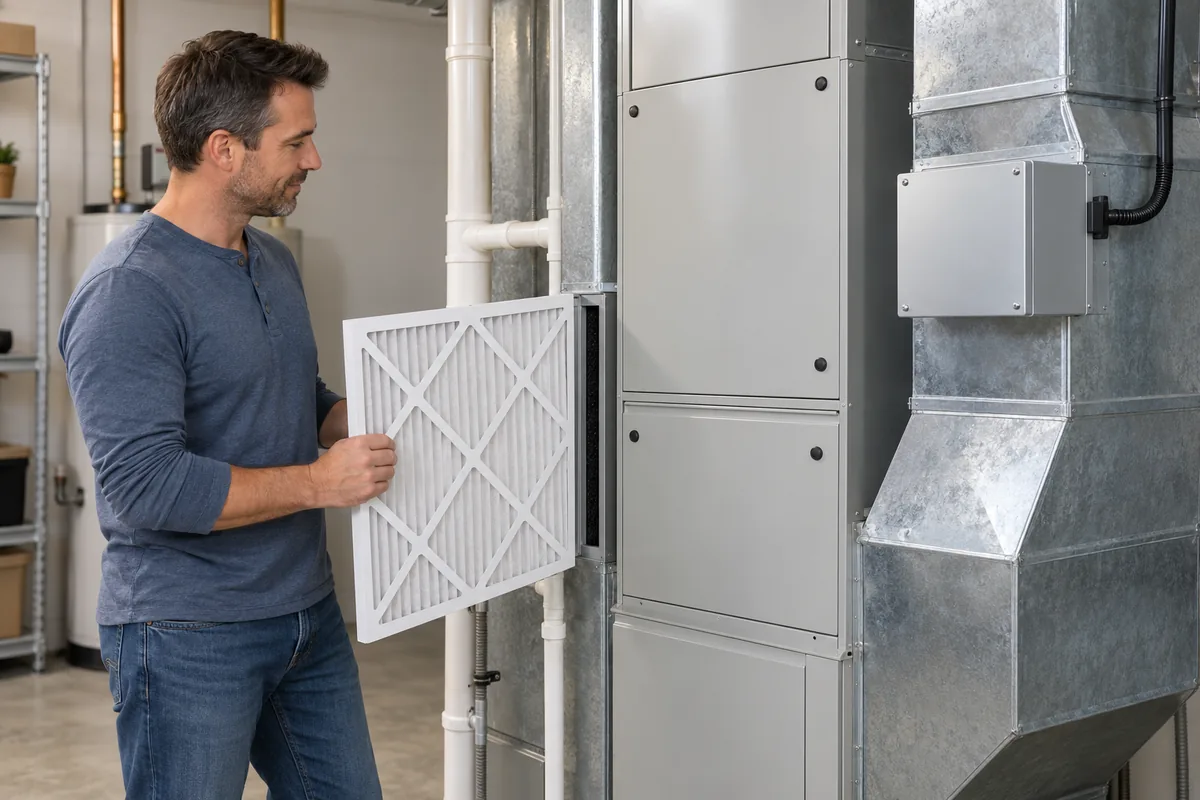
A standard residential HVAC filter sits in the return-air path at a grille, rack, or media cabinet. When the blower runs, air crosses the media and some particles are captured according to the filter's tested efficiency, fit, condition, airflow, and design. The filter also helps keep debris from reaching downstream equipment.
That particle-capture role includes ordinary nonliving pollution that UV does not meaningfully address: household dust, pollen, pet dander, lint, and smoke particles. A filter may also capture particles that carry microorganisms. UV treatment does not make mechanical capture irrelevant; the technologies can act on different parts of the same air-quality problem.
| Question | HVAC air filter | HVAC germicidal UV |
|---|---|---|
| Primary mechanism | Physically captures some particles in moving air | Inactivates susceptible microorganisms receiving adequate UV dose |
| Dust and pollen | Can capture a portion that reaches the media | Does not physically collect them |
| Biological particles | Can capture some particle carriers | May inactivate susceptible organisms under suitable conditions |
| Coil surfaces | Reduces some upstream debris but does not irradiate surfaces | Coil-directed UV can inhibit susceptible growth on illuminated surfaces |
| Performance framework | MERV applies to particle-removal performance for ventilation filters | Depends on wavelength, dose, exposure, target, placement, and system design |
| Can it replace the other? | Does not perform germicidal UV treatment | Does not replace required particle filtration |
If the practical question is which ordinary filter efficiency the system supports, use the existing MERV 8, MERV 11, and MERV 13 comparison. Adding UV is not permission to remove the filter, use the wrong size, or disregard filter compatibility.
Coil UV Lights and In-Duct UV Lights Have Different Purposes
Coil or surface irradiation
Many residential products place a lamp near the indoor cooling coil and drain pan. Those surfaces can remain damp during cooling operation. Because a fixed surface can receive UV energy for a long time, coil-directed treatment can inhibit susceptible biological growth on the illuminated area. EPA's residential technical summary identifies cooling coils and drain pans as an application where UVGI can be effective because of the longer exposure.
That does not establish whole-home air disinfection. Light does not bend around every fin, reach a shaded duct surface, remove an existing moisture source, or remediate growth elsewhere in a building. Carrier's current residential material describes its own product as coil-focused and explicitly says it does not replace the air filter. That product-specific use should not be generalized to every UV installation.
In-duct airstream treatment
Another design aims UV energy at air moving through ductwork or an air-handling unit. Here the system must deliver enough energy during the short time a susceptible microorganism is in the treatment zone. Air velocity, lamp arrangement, distance, output, reflectivity, and the target organism all influence the result.
A coil lamp and an airstream-disinfection system are therefore not interchangeable labels. Seeing a UV lamp near the coil does not prove meaningful treatment of every microorganism moving through the home. Conversely, an engineered in-duct system does not eliminate the filter's particle-removal function.
What UV Lights Cannot Remove From Your Air
UV treatment does not physically remove ordinary particulate pollution. It should not be used as a substitute for a compatible filter when the goal involves:
- Household dust and lint: nonliving particles need collection or source control, not microbial inactivation.
- Pollen and pet dander: these allergen-containing particles remain particle-filtration targets.
- Smoke particles: UV is not a smoke-particle filter. The smoke filtration guide separates particles from gases and odors.
- Gases and VOCs: EPA says research has not shown that UV light removes gases effectively in portable residential air cleaners. Gas removal requires an appropriate and documented technology; UVGI should not be confused with activated carbon or other sorbent media.
- Moisture or mold sources: UV does not repair leaks, condensation, humidity problems, or contaminated building materials outside the treatment zone.
Some products combine UV with photocatalytic oxidation, ionization, filters, or sorbent media. A multi-technology product must be evaluated by each actual component and its evidence. Do not transfer a gas-removal claim from a separate catalyst or carbon stage to the UV lamp itself.
Do You Still Need to Change the Air Filter?
Yes. UV does not stop dust, pollen, smoke particles, pet material, or other debris from loading the filter. It does not create a fixed extension to filter life, keep media clean, or make low-efficiency filtration equivalent to higher-efficiency filtration.
Continue to inspect and replace the filter according to its condition and the filter and equipment instructions. A UV lamp has its own separate maintenance requirements: output can decline with age, and dust on the lamp or protective surface can reduce delivered energy. Follow the exact UV-system instructions rather than assuming one universal lamp-cleaning or replacement interval.
Do not operate a central system without the required filter simply because UV is installed. If the filter is missing, use the guidance for running HVAC without an air filter. If replacement timing is unclear, the filter inspection and replacement guide owns that decision.
How Effective Are HVAC UV Lights?
There is no responsible category-wide percentage. Effectiveness depends on the UV energy delivered to the target, not merely the presence of a glowing lamp or a “UV” label. Important conditions include:
- Wavelength and lamp output: the device must produce an appropriate germicidal wavelength at useful output.
- Dose and exposure time: a surface under continuous illumination receives a different exposure from a particle moving rapidly through a duct.
- Placement and geometry: distance, shadows, reflectivity, lamp orientation, and the treatment-zone shape change what receives UV.
- Air velocity and mixing: these affect how long and how uniformly an airborne target remains in the irradiation zone.
- The microorganism: susceptibility varies, so one laboratory result cannot be applied to every virus, bacterium, fungus, or spore.
- Lamp condition and maintenance: aging, fouling, and improper servicing can reduce useful output.
EPA's residential technical summary cautions that typical home UVGI air cleaners may not deliver enough dose to inactivate most airborne microorganisms because intensity or exposure time is too low. That does not mean every engineered system is ineffective; it means a homeowner should demand evidence for the exact product, configuration, target, and test conditions.
Laboratory reductions on an exposed test surface are not the same as a whole-home result. A percentage should name the organism, surface or airstream, exposure period, test method, and installation assumptions. Without those details, “kills 99.9%” is marketing language without enough context.
Are HVAC UV Lights Safe?
UV-C can injure eyes and skin. ASHRAE advises applying germicidal UV in ways that prevent or minimize occupant exposure, and enclosed in-duct systems should not allow access to operating lamps. Homeowners should not open a UV chamber, defeat a switch, look at an exposed operating lamp, or improvise wiring or placement.
Installation and service must follow the product and equipment requirements. Proper placement also matters because UV can degrade susceptible plastics, wire insulation, filter media, and other materials if they are exposed unintentionally. A qualified professional can evaluate shielding, clearances, access, electrical requirements, material exposure, and whether the proposed arrangement matches the intended purpose.
What about ozone?
Do not generalize in either direction. Not every UV-C product is an intentional ozone generator, but EPA notes that some UV lights without adequate lamp coatings and some related electronic air-cleaning technologies can emit ozone. Ozone is a lung irritant, and EPA advises avoiding devices that intentionally produce it.
Check the exact product's emissions information and credible independent testing. A vague “natural purification” claim is not evidence of safe emissions, while the presence of UV alone does not prove that a device produces ozone. Keep UVGI separate from ionizers, plasma devices, photocatalytic oxidation, and ozone generators unless a product actually combines those technologies.
How to Evaluate HVAC UV Claims
- Identify the intended target. Is the system designed for an illuminated coil surface, a moving airstream, or both?
- Ask what the evidence measured. Look for the named organism, location, exposure time, airflow, test method, and product configuration.
- Separate inactivation from removal. A UV result does not establish particle capture, dust removal, odor control, or VOC removal.
- Keep the required filter. Confirm the correct size, fit, efficiency, and HVAC compatibility independently of the UV decision.
- Check emissions and safety evidence. Avoid intentional ozone generation and verify how the system prevents eye and skin exposure.
- Plan for maintenance. Use the manufacturer schedule for the lamp and continue normal filter inspection; do not invent a combined interval.
- Reject health guarantees. No device makes a home sterile, prevents every infection, eliminates every allergen, or guarantees a medical outcome.
Technical Sources
Frequently Asked Questions
Can I run my furnace without a filter if it has a UV light?
No. Keep the correctly sized, compatible filter required by the HVAC design installed and maintained. UV treatment does not capture dust, pollen, pet dander, smoke particles, or other debris and does not replace the filter's equipment-protection or particle-capture role.
Do HVAC UV lights remove dust?
No. UV treatment does not physically collect ordinary household dust. An HVAC filter captures a portion of airborne particles when the system moves air through the filter.
Do HVAC UV lights kill mold in ducts?
Do not treat one UV lamp as whole-duct mold remediation. Coil-directed UV may inhibit susceptible biological growth on continuously illuminated coil and drain-pan surfaces when properly designed. It does not reach hidden or shaded contamination, repair moisture problems, or prove that an entire duct system is clean.
Do HVAC UV lights remove allergens?
UV does not physically remove pollen, pet dander, dust, or other particles. EPA notes that even inactivated biological particles may retain allergenic or irritating material, so filtration and source or moisture control remain separate needs.
Do HVAC UV lights produce ozone?
Not every HVAC UV device produces the same emissions, but some UV lamps or UV-related air-cleaning technologies can generate ozone. Avoid products designed to create ozone and check the actual device's emissions information and credible independent testing rather than assuming every UV product is ozone-free or ozone-producing.
Do HVAC UV lights make filters last longer?
Do not assume so. UV does not stop dust and other particles from reaching the filter, and no universal filter-life extension follows from adding a UV lamp. Inspect and replace the filter according to its condition and the filter and equipment instructions.
Is an HVAC UV light the same as an air purifier?
The word air purifier covers many different products and does not define one mechanism. An HVAC UV system may treat a coil surface or an airstream, while a portable room cleaner has its own fan and may use particle or gas-removal media. Compare the actual technology and tested purpose.
Are all HVAC UV systems equally effective?
No. Results depend on the intended target, wavelength, delivered UV dose, lamp output and age, exposure time, placement, air velocity, surfaces, maintenance, and the susceptibility of the microorganism. Product-specific evidence cannot be generalized to every installation.
Questions or feedback?
Help Improve Filter Wizard
Tell us what was clear, what was missing, or which air-filter question you want answered next.