Quick Answer
For work that creates airborne dust, the central HVAC should generally be off while dust is being produced. Isolate the work area, collect dust at the source, and protect both supply and return openings while the system is off. Remove every temporary cover before restarting the equipment.
For low-dust work or times when heating or cooling is essential, the plan depends on the project, weather, occupants, and equipment. Do not cover openings and continue running the system. Coordinate dust control and temporary conditioning with the contractor or an HVAC professional instead.
An ordinary HVAC filter may catch some debris, but it is not primary construction-dust containment. Use the system’s supported filter, inspect it during the project, and check it again after final cleanup.
What Counts as Dust-Producing Renovation Work?
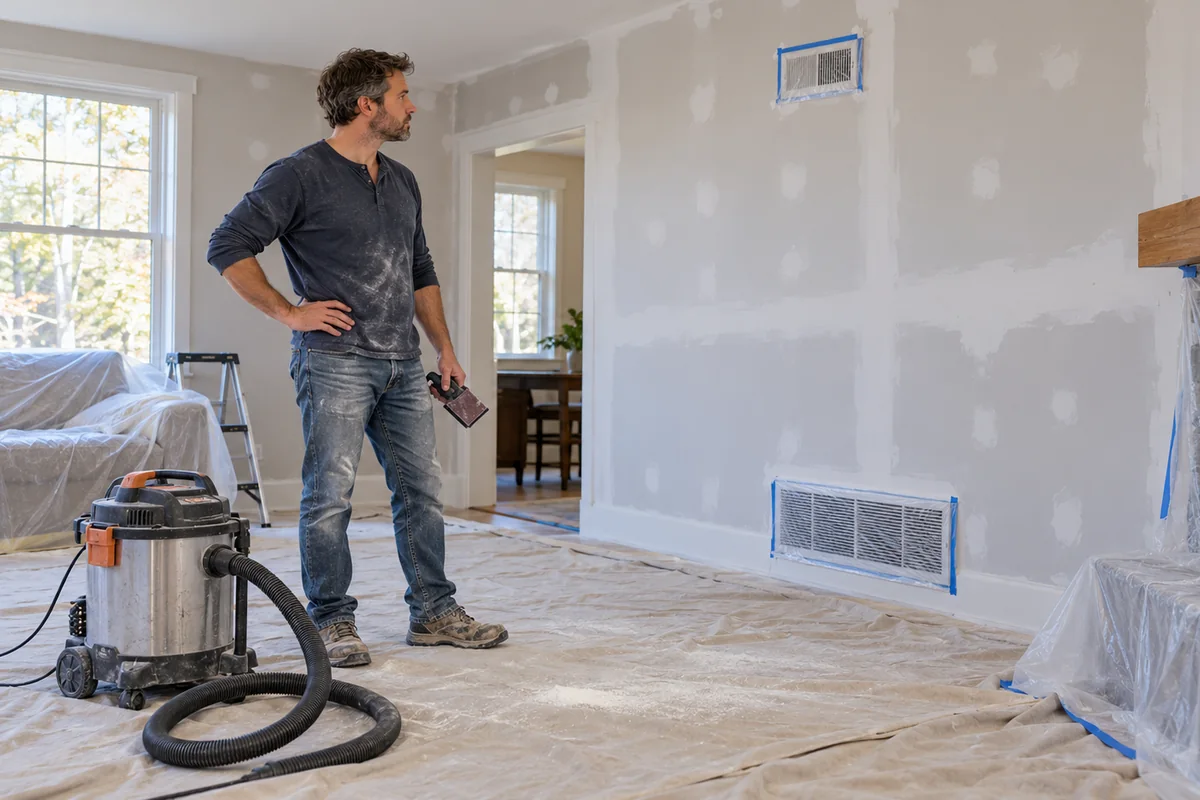
The relevant distinction is not whether a project is called a renovation. It is whether the activity releases enough airborne material for the HVAC system to collect and redistribute it. Drywall sanding, demolition, wood or flooring cutting, concrete or masonry work, insulation disturbance, and aggressive surface preparation can generate substantial dust. Painting a finished wall with a roller usually presents a different particle problem.
Conditions can change within the same project. A room may be low-dust while cabinets are measured, then high-dust when drywall is sanded. Build the HVAC plan around each work phase rather than choosing one setting for the entire renovation.
The EPA Indoor airPLUS duct-protection bulletin says it is critical not to run HVAC equipment during activities that create airborne dust. EPA’s residential remodeling guidance also recommends isolating dust-producing work and protecting duct openings.
Why Running Central HVAC Can Spread Renovation Dust
A forced-air system pulls air toward one or more returns, moves it through the filter and equipment, then sends conditioned air through supply ducts. When dust is suspended in a work area, a nearby return can become a transport path. Material that reaches the return may load the filter, settle in accessible system areas, or move beyond the room.
The filter reduces particles according to its design, fit, condition, and the system’s operation; it does not create a sealed construction zone. EPA notes that a fiberglass filter may catch large debris but not all fine dust reaching the equipment and ducts. The practical hierarchy is therefore:
- Prevent dust from becoming airborne where possible.
- Collect it at the tool or work surface.
- Separate the work zone from occupied spaces.
- Keep central HVAC from drawing through the dusty zone.
- Use the compatible HVAC filter as normal system protection, not the first line of jobsite control.
This also explains why a filter can become dirty unusually fast during renovation. Faster loading is a clue to reduce the dust reaching the system, not an invitation to make the central blower collect more of it.
When Should You Turn Off the HVAC?
Turn central HVAC off during active, substantial dust generation when doing so is consistent with the project and equipment safety plan. That includes phases such as drywall sanding and demolition. The shutdown should cover both automatic heating or cooling calls and fan-only operation; a thermostat set to “off” with the fan still set to “on” can continue moving air.
| Project condition | HVAC approach | Key safeguard |
|---|---|---|
| Heavy airborne dust | Generally keep central HVAC off during the task | Isolate, collect dust at the source, and protect openings |
| Low-dust work | Assess the actual activity and equipment needs | Do not assume “renovation” alone decides the answer |
| Essential heating or cooling | Coordinate a project-specific plan | Never block openings while central HVAC runs |
| After dust work ends | Clean thoroughly, uncover openings, then restart | Account for every temporary cover before operation |
Do not switch off power needed for unrelated safety systems, enter energized control compartments, or alter HVAC wiring. Use normal homeowner controls only. If the contractor’s plan involves equipment shutdowns, temporary conditioning, or work near the furnace or air handler, confirm responsibilities before work begins.
What If You Cannot Leave the HVAC Off?
Extreme weather, medically vulnerable occupants, humidity concerns, or project duration may make a long shutdown impractical. That does not turn a running central system into acceptable dust control. Pause the dust-producing phase and develop a plan that addresses both conditioning and containment.
Depending on the project, that may mean scheduling dusty work in shorter windows, using safe temporary conditioning outside the isolated zone, increasing source capture, or having the contractor and an HVAC professional coordinate system operation. These are project-specific choices. Portable combustion heaters, improvised exhaust arrangements, and blocked HVAC openings can introduce new hazards and are not generic substitutes.
Should You Cover Supply and Return Openings?
For heavy dust work, authoritative guidance supports sealing or protecting supply and return registers in the work area while the HVAC is off. Returns matter just as much as supplies: a return draws room air toward the system, while a supply opening can admit settled debris when the system is idle.
Use a planned, countable method that does not damage finishes or disappear inside the duct. The exact material and attachment method depend on the contractor’s containment plan and the surface. Avoid stuffing loose material into openings or removing components that are not meant for routine homeowner access.
Before restart, perform a room-by-room check and remove every cover. Reinstall any grille or register components according to their original configuration. PNNL’s Building America guidance pairs closing or covering registers during large dusty remodels with turning the central air handler off.
What Should You Do With the HVAC Filter?
Start with one correctly sized, properly seated filter of a type the filter holder and equipment support. Do not stack filters, tape filters together, force a thicker filter into the slot, or jump to an unusually high MERV rating solely because construction is underway. Filter restriction depends on the actual product and system, not on a renovation slogan.
Inspect the filter more often during a dusty project because actual loading can change quickly. Replace it if it becomes heavily loaded, damaged, wet, deformed, or due under the product and equipment guidance. EPA construction guidance calls for replacing filters after construction; in an occupied-home project, an additional mid-project replacement may be warranted when inspection shows substantial loading.
A clean-looking filter is not proof that no dust entered the system. It could reflect limited runtime, a bypass gap, the wrong filter location, or dust being captured at the source. Conversely, a gray filter may still be functioning. Use condition, fit, service history, and the replacement-timing guidance rather than one universal schedule.
What to Do Before Restarting HVAC After Dusty Work
- Stop the dust-producing activity. Allow the contractor’s containment and collection process to finish before dismantling barriers.
- Clean the work zone thoroughly. Use the cleanup methods appropriate to the material and project. Do not dry-sweep fine hazardous dust into the air.
- Inspect accessible openings. Look for visible debris at registers and returns without reaching into equipment or opening energized compartments.
- Remove every temporary cover. Confirm supplies and returns are open and components are correctly reinstalled.
- Inspect the HVAC filter. Replace it when condition and guidance warrant, using the correct size, supported depth, and airflow direction.
- Restart and observe normal operation. Stop and seek qualified help if there is abnormal noise, weak airflow, an equipment alert, or visible debris being discharged.
Continue checking the filter after the project. Dust disturbed during cleanup and normal occupancy may reach the return later even if the active work is complete.
Does Renovation Mean You Need Air-Duct Cleaning?
No—not automatically. EPA says duct cleaning has not been shown to prevent health problems routinely and recommends considering it for specific evidence, such as substantial visible mold growth in hard-surface ducts, vermin, or ducts clogged with excessive dust and debris that is released into the home. Renovation by itself is not proof that the whole duct system needs cleaning.
If a contractor failed to protect the system and visible construction debris entered accessible ducts or equipment, document what you see and obtain a qualified assessment. Do not rely on scare claims, assume every dusty grille proves contamination throughout the system, or attempt to reach deep into ductwork with household tools. Review the EPA duct-cleaning guidance before authorizing work.
When Dust May Be Hazardous, Stop Using Ordinary Renovation Advice
Lead-based paint, asbestos-containing materials, mold contamination, respirable crystalline silica, and unknown suspect material require controls beyond an HVAC-filter article. Do not sand, demolish, vacuum, or ventilate suspected material based on ordinary dust guidance.
Homes built before 1978 may contain lead-based paint; EPA provides separate lead-safe renovation guidance. For suspected asbestos, EPA advises leaving suspect material undisturbed and using an appropriately trained and accredited inspector or professional. Mold remediation and silica-generating work also require material- and task-specific plans.
An HVAC filter, plastic over a register, or a portable air cleaner is not a hazardous-material containment or clearance strategy. Stop work, identify the material through the appropriate process, and follow the applicable regulatory and professional guidance.
Filter Wizard Recommendation
Plan central HVAC as part of dust control before renovation begins. For dust-producing work, keep the system off, isolate and capture dust, protect supply and return openings, and remove every cover before restart. Use one compatible HVAC filter and inspect it based on actual project loading.
If the home cannot safely go without conditioning, or if the project may disturb hazardous material, pause and coordinate a qualified project-specific plan. The HVAC filter is system protection—not a renovation containment system.
Frequently Asked Questions
Should I turn off the HVAC while sanding drywall?
Yes, for dust-producing sanding the central HVAC should generally be off so it does not pull fine dust into returns and distribute it through the system. Isolate the work area, collect dust at the source, and follow the project and equipment safety plan.
Should I cover supply and return vents during renovation?
EPA and PNNL guidance supports protecting supply and return openings during dust-producing work, but only while the HVAC system is off. Remove every temporary cover before restarting the system; never run central HVAC against blocked openings.
Can I run the HVAC with vents covered?
No. Covering supply or return openings while the system runs can obstruct its designed airflow. Temporary opening protection belongs to a coordinated dust-control plan with the HVAC off, and all covers must be removed before restart.
Will the furnace filter catch drywall or construction dust?
An HVAC filter may capture some renovation debris, but it is not a substitute for isolating the work area and collecting dust at the source. Fine dust can pass beyond the filter, and heavy debris can load or damage it quickly.
Should I use a higher-MERV filter during renovation?
Do not assume a higher MERV rating is automatically appropriate. Use a correctly sized filter that the equipment and filter holder support. Filter efficiency does not replace source control, and an unsupported filter can add unwanted resistance.
Should I replace the HVAC filter after renovation?
Inspect the filter during and after dusty work and replace it when it is loaded, damaged, wet, or due under the product and equipment guidance. EPA construction guidance calls for replacing filters after construction; the exact timing during a residential project depends on actual loading and project conditions.
Does renovation dust mean my air ducts need cleaning?
No. Renovation alone does not make duct cleaning automatic. EPA advises considering duct cleaning for specific evidence such as substantial visible contamination or debris released from ducts, not as a routine response to every remodeling project.
What if I cannot turn off the HVAC during renovation?
Pause dust-producing work and coordinate another plan with the contractor or an HVAC professional. Options depend on weather, occupants, equipment, and the work area. Do not solve the conflict by covering openings while the system continues to run.
What if the project may disturb lead, asbestos, mold, or silica?
Stop treating the project as ordinary household dust control. Use the applicable regulatory guidance and qualified professionals for the suspected material. An HVAC filter and plastic over a register are not a hazardous-material remediation plan.
Questions or feedback?
Help Improve Filter Wizard
Tell us what was clear, what was missing, or which air-filter question you want answered next.