Quick Answer
Usually, yes—if you have an accessible return-side filter slot that was designed to close. DOE/PNNL homeowner guidance says this kind of slot should have a door or cover. Depending on the rack, it may use clips, tabs, thumb screws, a sliding strip, or a purpose-made magnetic cover.
Do not assume every nearby opening is that slot. A return grille, a deep-media cabinet door, and the furnace or air handler’s large service panel are different components. Check the actual rack, cabinet, and equipment documentation before replacing or covering anything.
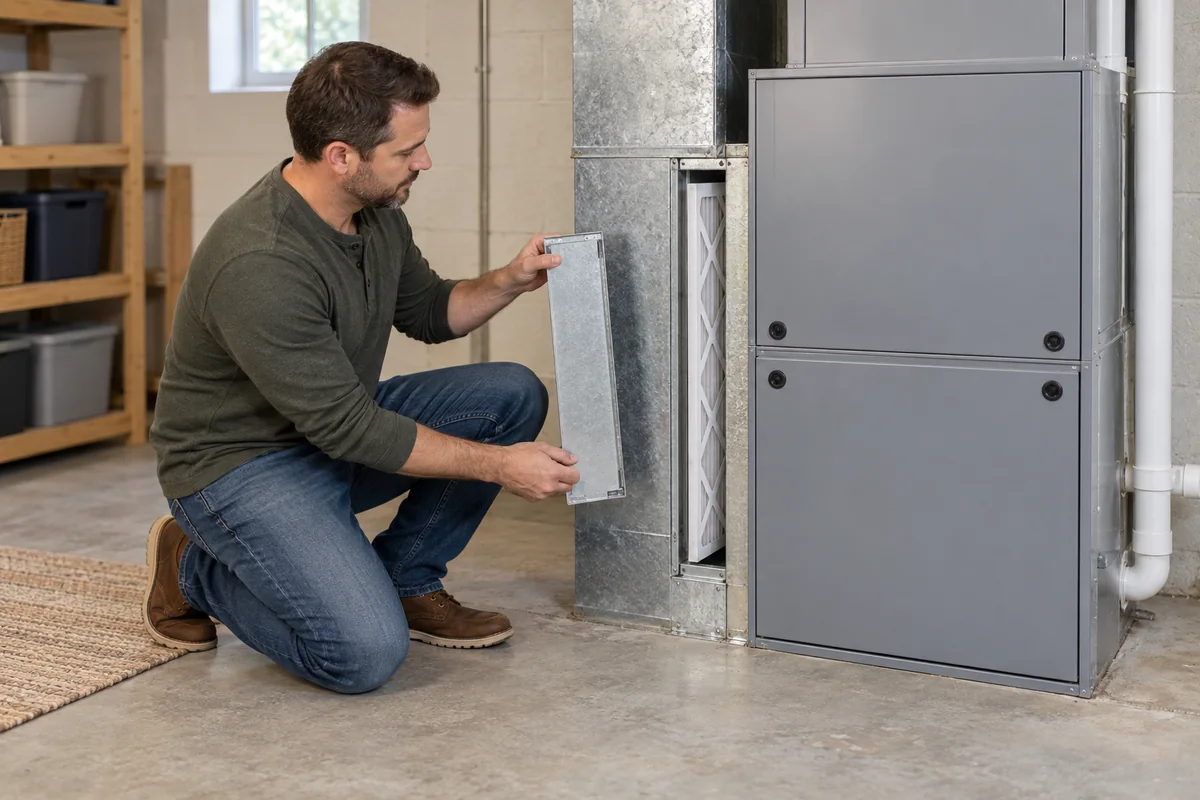
What Does a Furnace Filter-Slot Cover Do?
A furnace-side filter rack needs an opening so the filter can slide in and out. The cover closes that service opening during normal operation. In a common return-side installation, the blower draws air through the return duct toward the filter and equipment. An uncovered or poorly closed access opening can let additional air enter or leave at a point the duct system was not intended to use.
The DOE/PNNL furnace-filter replacement guide specifically tells homeowners to put the filter-access door back in place and identifies clips, tabs, thumb screws, sliding doors, and magnetic plastic covers as possible designs. The BPI-1200 building assessment standard likewise treats an absent or poorly sealed filter-slot cover as a condition to correct.
A cover does not make the filter itself optional. It also does not fix a filter that is the wrong size, installed backward, or loose in the rack. Those remain separate questions about filter fit and airflow direction.
How Can You Tell Whether the Slot Was Designed to Close?
Start with the configuration, not a universal picture. The accessible filter may be at the furnace or air handler, in a dedicated media cabinet, or behind a return grille. A furnace-side rack designed for a cover often has one or more of these clues:
- a narrow metal track or flange around the filter insertion opening;
- clips, tabs, thumb screws, hinges, or a sliding channel;
- a gasket or compressed edge where a door once seated;
- mounting holes or hardware matching a documented cover;
- a nearby cabinet or equipment label that identifies a filter-access part.
The current filter is not proof that the opening is complete. A previous owner or technician could have lost a cover, improvised a temporary closure, or installed the wrong filter. Conversely, a visible grille in a wall or ceiling is supposed to admit room air through its face; the grille itself may be the filter-access closure. Do not cover the face of a return grille.
If the arrangement is unfamiliar, locate the equipment, rack, or media-cabinet model number and use its current manual or parts diagram. Trane’s homeowner maintenance manual, for example, labels filter access separately from the blower access door. That distinction matters more than what a loose panel happens to look like.
Filter-Slot Cover vs. Return Grille, Media-Cabinet Door, and Service Panel
| Component | What it closes | What to verify |
|---|---|---|
| Narrow filter-slot cover | The opening used to slide a shallow filter into a return-side rack | Rack design, clips or track, complete closure, and removable access |
| Return-grille face | A room-side return opening that may hold a filter behind the grille | Hinges or latches, supported filter size, and unobstructed grille face |
| Media-cabinet door | A dedicated housing for deeper or cabinet-specific media | Cabinet model, documented replacement door, latch, and gasket |
| Blower or service panel | An equipment compartment—not merely the filter insertion slot | Manufacturer instructions, all fasteners, and any safety interlock |
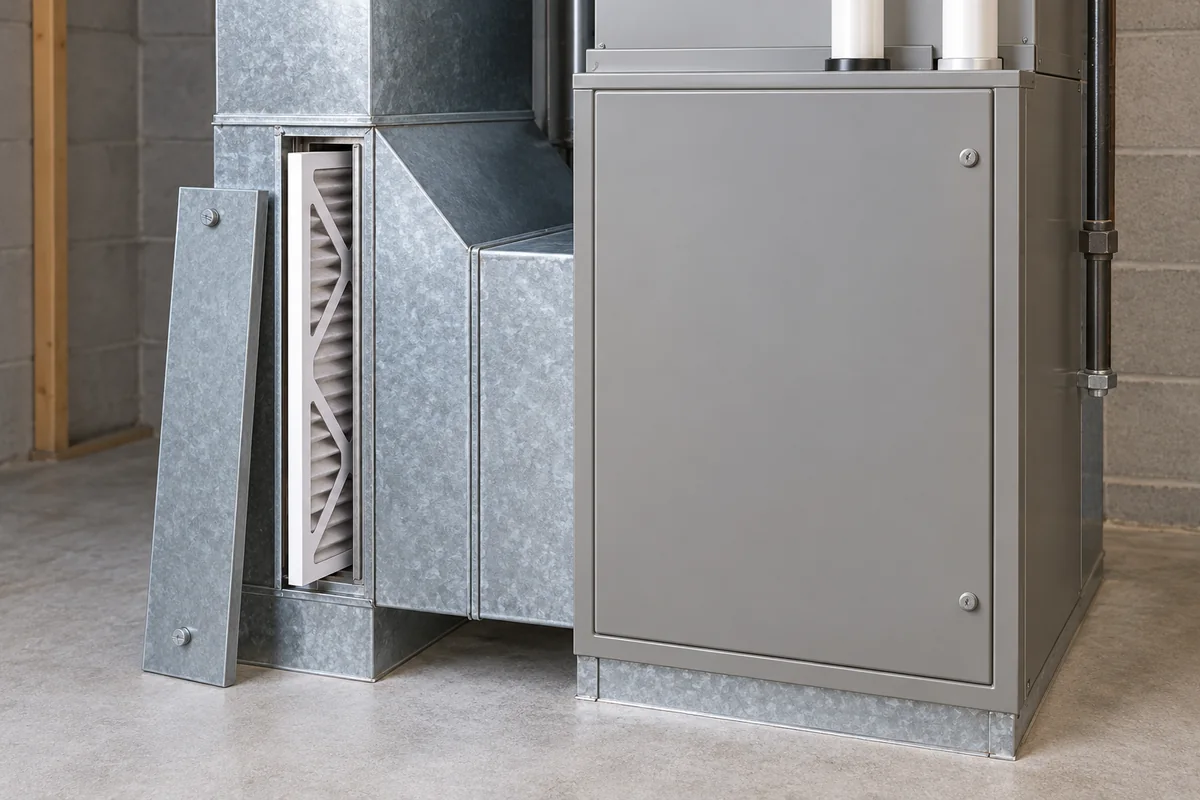
Some filter cabinets have model-specific doors. Resideo lists a replacement door for particular F100 media-air-cleaner models, and Daikin documents magnetic access on one air-cleaner cabinet. Those examples show why a cover style is configuration-specific; they do not make one replacement universal.
Why Can an Open Return-Side Filter Slot Matter?
When the blower operates, the return side of a typical forced-air system is below the surrounding room pressure. A gap at the filter-access opening can therefore become an unintended air path. Depending on where the opening sits relative to the filter media, some of that air may travel around the intended return route or bypass part of the filter.
The practical effect depends on gap size, duct pressure, location, system runtime, and the rest of the installation. It is not defensible to promise that adding a cover will produce a particular airflow, efficiency, energy, dust, or comfort improvement. The supported conclusion is narrower: close the access opening as the rack or cabinet was designed, then diagnose any remaining problem separately.
A missing cover can also make filter symptoms confusing. Air moving through a gap can contribute to noise; a loose filter can move; and bypass can complicate the meaning of a filter that still looks unusually clean. Those symptoms each have other causes, so the cover should be checked without declaring it the only diagnosis.
What Should You Do If the Cover Is Missing or Damaged?
- Turn the system off before an accessible inspection. Follow the shutdown method in the equipment documentation. Do not reach into an operating cabinet.
- Confirm the opening is actually filter access. Trace where the filter sits and distinguish its narrow rack from the large equipment panels, drains, vents, wiring openings, and combustion-air provisions.
- Photograph the opening and nearby labels. Record the furnace, air-handler, rack, or media-cabinet model. A separate accessory cabinet can have a different manufacturer from the furnace.
- Look for the original closure method. Check for a sliding strip, hinge, clips, tabs, thumb screws, magnets, a gasket, or a misplaced door nearby.
- Use current parts documentation. Prefer the documented replacement door, cover, latch, or gasket for a model-specific cabinet. Verify a third-party part against the actual opening and operating conditions rather than relying on a generic “universal” label.
- Restore removable access. The completed repair should close normally while still allowing routine filter changes.
- Request HVAC service when the design is unclear. This is especially important near fuel-burning equipment, wiring, condensate drains, an equipment safety switch, or sheet metal with sharp or damaged edges.
Carrier’s current replacement guidance illustrates why identification comes first: access can be through a blower cabinet or a duct-mounted panel depending on the system, and the panel is closed securely after service.
Do Not Turn a Missing Cover Into an Improvised Fit Problem
A slot cover should close the service opening; it should not clamp an incompatible filter into place. Do not force, fold, crush, trim, or stack filters. Do not pack gaps with cardboard or foam, and do not use a cover to hide a filter that cannot seat in its intended tracks.
Avoid permanent caulk or adhesive over routine filter access. General-purpose tape can loosen, leave residue, or conceal which opening was meant to be serviced. More importantly, never cover a combustion-air opening, flue or vent connection, drain, wiring access, pressure port, or equipment-service panel because it resembles a gap.
When Is HVAC Service the Safer Next Step?
Get qualified help when the slot appears field-built with no clear closure, the rack is bent or detached, the surrounding duct is damaged, the replacement cover cannot seal without force, or the opening is adjacent to inaccessible equipment. Service is also appropriate when a filter moves in the rack or the system whistles after the correct cover and filter are seated.
A technician can identify whether the opening is on the return or supply side, verify the filter’s intended location, check the rack and duct connection, and select a removable closure without blocking another system requirement. This article does not provide sheet-metal fabrication instructions because cabinet and duct modifications are installation-specific.
Filter Wizard Recommendation
If the filter slides into an accessible return-side slot, expect that service opening to have a secure, removable closure unless the rack or equipment documentation says otherwise. Identify the actual holder first, restore the documented door or cover, and keep the larger furnace or air-handler service panel closed.
Treat cover condition, filter size, filter fit, and filter direction as separate checks. A good cover cannot correct a wrong filter, and a correctly sized filter does not make an open access slot acceptable.
Frequently Asked Questions
Does a furnace filter slot need a cover?
Usually, yes, when it is an accessible return-side slot designed to close. DOE/PNNL homeowner guidance says this type of slot should have a door or cover. Confirm the actual configuration because a return grille, media cabinet, and furnace service panel use different closures.
What does a furnace filter-slot cover do?
It closes the opening used to slide the filter into its rack. A properly fitted cover helps keep return air on the intended path and limits air leakage at that access opening. It does not replace the filter or make a wrong-size filter fit.
Can I run the furnace with the filter-slot cover off?
Do not intentionally leave off a cover that the rack or cabinet was designed to use. Restore it as the manufacturer directs before normal operation. If you cannot tell whether the opening is a filter slot or equipment access, stop and check the manual or ask an HVAC technician.
Is the filter-slot cover the same as the blower door?
No. A filter-slot cover is usually a narrow removable closure over the filter-access opening. A blower or service panel is a much larger equipment panel and may be associated with a safety switch. Never treat the service panel as an optional filter cover.
Can I use a magnetic furnace-filter slot cover?
Some filter racks use a purpose-made magnetic cover, and DOE/PNNL lists magnetic plastic covers as one possible design. A magnetic cover is not universal: it must suit the surface, opening, operating conditions, and documented configuration.
Can I tape over a furnace filter slot?
A reusable, removable closure that matches the rack or cabinet is the better long-term solution. Do not permanently caulk or tape over required filter access, and never cover combustion-air, vent, drain, wiring, or equipment-service openings.
Can an open filter slot cause a whistle?
An opening or poorly seated cover can create airflow noise in some systems, but whistling has several possible causes. Inspect the accessible cover and filter fit, then use the dedicated whistling guide or qualified service rather than assuming the cover is the only cause.
How do I find a replacement filter-slot cover?
Identify the rack, media cabinet, furnace, or air-handler model and check its parts documentation. Look for the original door, clips, tabs, thumb screws, or gasket. For an unmarked field-built rack or unclear opening, have an HVAC technician identify and close it without blocking another required opening.
Questions or feedback?
Help Improve Filter Wizard
Tell us what was clear, what was missing, or which air-filter question you want answered next.