Quick Answer: Do Carbon HVAC Filters Remove Odors?
They can reduce some airborne odor compounds, but they do not remove every odor and they do not all work equally well. Activated carbon is a sorbent: gas molecules can adhere to its internal surface. How much reaches and stays on that surface depends on the specific gas, carbon formulation, available media, airflow, contact time, environmental conditions, and remaining capacity.
The U.S. EPA specifically warns that residential HVAC filters with only thin sorbent-impregnated layers may have short service lives and limited odor effectiveness. A product label that says “carbon” or a dark-colored filter face does not establish how much useful sorbent is present or how long it will last.
A compatible carbon-enhanced pleated filter can be reasonable for modest recurring odors when the manufacturer gives useful product information. It is not a substitute for removing the odor source, using appropriate ventilation, maintaining combustion safety, or choosing a particle filter the HVAC system can support.
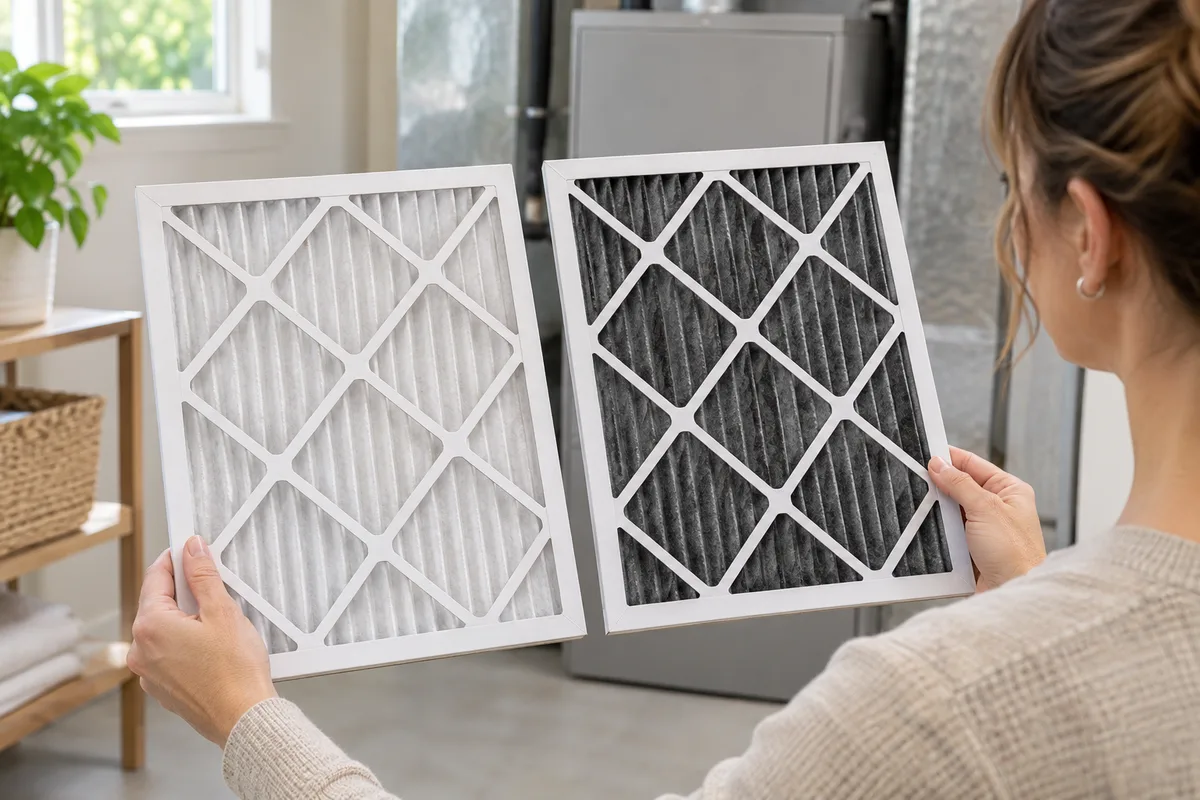
What Does Activated Carbon Actually Do?
Activated carbon has a highly porous internal structure. Certain gas molecules can attach to its surface through adsorption. That is different from absorption, in which a substance is taken into the volume of another material. Gas-phase air cleaners can also use other sorbents or chemically treated media intended for particular compounds.
Adsorption is selective, not universal. ASHRAE explains that one gas-phase medium is not adequate for every contaminant and that a sorbent's performance varies with the compound, media characteristics, contact conditions, and desorption behavior. A carbon product that performs well against one test gas may be much less useful against another household odor.
The carbon also has finite capacity. Once active sites become occupied, removal can decline. Changes in temperature, humidity, concentration, or exposure conditions can affect how gases interact with the media. This is why “contains activated carbon” is a material description—not a complete performance claim.
Particle Filtration and Odor Adsorption Are Different Jobs
A conventional pleated HVAC filter is primarily a particle filter. Its fibers capture airborne material such as household dust, pollen, lint, pet-related particles, and some smoke particles according to the filter's efficiency, fit, condition, airflow, and system operation. Activated carbon addresses certain gases that are small enough to pass through ordinary particle media.
| Question | Pleated particle media | Activated carbon media |
|---|---|---|
| Primary target | Airborne particles | Some gases and odor compounds |
| Typical rating | MERV or another documented particle-efficiency rating | Product- or test-specific gas data; no universal residential odor rating |
| What affects results | Efficiency, fit, airflow, loading, runtime | Gas identity, sorbent type and quantity, contact time, airflow, humidity, saturation |
| What it does not prove | A MERV number does not prove odor removal | A carbon label does not prove particle efficiency or broad gas removal |
Many residential products combine both materials: pleated particle media plus a carbon-coated sheet or carbon-containing layer. That makes one filter capable of two different functions, but the two functions still need separate evidence. A strong particle rating does not certify the carbon portion, and adding carbon does not make an undersized or overly restrictive filter compatible.
Why a Thin Carbon Layer Is Not the Same as a Deep Sorbent Bed
Gas removal generally benefits from enough sorbent and enough contact between the air and that sorbent. Thin residential filter layers are convenient and can fit ordinary racks, but they hold far less material than a deep bed, loose granular cartridge, or dedicated gas-phase air-cleaning system.
EPA's technical summary notes that thin sorbent-impregnated filters may experience “breakthrough” quickly—meaning the target gas begins passing through after available capacity is used. The same EPA document says these thin layers typically have limited effectiveness against odors. It also cautions that residential gas-phase devices are difficult to compare and generally are not expected to remove all gaseous pollutants.
ASHRAE Standards 145.1 and 145.2 provide laboratory methods for certain gas-phase media and in-duct devices. Even those methods have boundaries: ASHRAE says elevated-concentration tests can compare devices but do not predict performance in every application. For an ordinary replacement filter, look for credible, product-specific evidence about the actual media and target gases—not simply a leaf graphic, a black color, or phrases such as “odor defense.”
Which Household Odors Might a Carbon HVAC Filter Help?
“Odor” is a perception, not one chemical. Cooking, pets, tobacco or wildfire smoke, cleaning products, stored chemicals, damp materials, drains, and fuel gas involve different compounds and different hazards. The right response starts with the source.
| Situation | Possible carbon-filter role | More important first step |
|---|---|---|
| Routine cooking odors | May reduce some recirculating gaseous compounds if the media is suitable and not saturated | Use a vented range hood or appropriate kitchen ventilation and clean the source |
| Pet or litter odors | May reduce some airborne odor compounds; particle media can capture some pet-related particles | Clean bedding, litter, carpet, upholstery, and moisture sources |
| Smoke odors | Carbon may adsorb some gases while particle media addresses some smoke particles | Stop or avoid the source and follow smoke-event or fire-safety guidance |
| Paint, solvent, or strong chemical odor | Do not assume a thin carbon filter controls the specific chemicals or exposure | Follow the product safety instructions, reduce the source, and ventilate appropriately |
| Musty or damp odor | May temporarily reduce perception of some compounds but cannot correct wet materials or growth | Find and correct the moisture problem; use qualified assessment when needed |
| Fuel-gas odor or carbon-monoxide alarm | No appropriate role | Leave the area and follow emergency, fire-department, and utility instructions |
A carbon filter should not be used to mask a continuing hazard. EPA describes source control as usually the most effective indoor-air-quality strategy, with ventilation used to reduce pollutant concentrations when appropriate. If an odor started after installing a replacement filter, use the site's separate guide to diagnose a new-filter smell rather than assuming you need more carbon.
Does MERV Measure Odor Removal?
No. MERV measures how a filter performs against particles in specified size ranges under a test method. Odor molecules and other gases require a separate gas-phase treatment mechanism. A MERV 13 filter is not automatically better at odors than a MERV 8 filter, and two products with the same MERV may have entirely different carbon layers.
Evaluate the particle and gas functions separately:
- Particle side: confirm the documented MERV or other particle rating, dimensions, fit, and HVAC-system support.
- Gas side: look for the sorbent type, meaningful media information, named target compounds or odors, relevant test methods, and service guidance.
Do not choose a higher MERV solely because you want odor control. The site's MERV 8, 11, and 13 guide explains the particle-rating decision, including why equipment compatibility and airflow still matter.
How Long Does the Carbon Last?
There is no reliable universal answer such as 30 days, three months, or one heating season. EPA says sorbent service life varies with the pollutant concentration and length of exposure. ASHRAE likewise treats sorbent capacity and replacement as media- and application-dependent.
Important variables include:
- how much usable sorbent the filter contains;
- which gases are present and at what concentrations;
- how much air and how many operating hours pass through the filter;
- humidity, temperature, and other environmental conditions;
- whether several gases compete for the same media;
- storage conditions before installation; and
- the filter's particle loading, fit, and condition.
You usually cannot judge remaining carbon capacity by color. Dark media may look unchanged before and after saturation, while particle dust on the pleats does not reveal how much gas capacity remains. Odor returning sooner can be a practical clue, but perception also changes and the source may have intensified. Follow product-specific instructions, inspect the whole filter, and do not extend use based on appearance alone.
How to Evaluate a Carbon HVAC Filter Before Buying
- Confirm the exact filter size and supported depth. The carbon feature does not excuse a wrong nominal or actual fit. Use the existing filter, rack label, equipment documentation, and air-filter sizing guide.
- Confirm the particle rating is appropriate. Carbon and MERV answer different questions. Keep the equipment manufacturer's filtration and airflow requirements in view.
- Find out what “carbon” means in this product. Is it a light coating, an impregnated sheet, carbon granules, a bonded layer, or a deeper cartridge? More precise documentation is more useful than color.
- Look for media quantity or credible performance evidence. A named test method, target compound, challenge conditions, and service guidance are more informative than an unsupported “eliminates odors” claim.
- Match the claim to the actual odor. Evidence for one chemical does not prove removal of all cooking, pet, smoke, paint, or musty odors.
- Check pressure-drop and compatibility information. Products with the same dimensions and MERV can still differ in construction and resistance. Do not assume the carbon version behaves identically.
- Review replacement guidance and total cost. A low-capacity carbon layer that requires frequent replacement may not be a better value than source control or a purpose-built gas-phase system.
Do not cut, trim, fold, crush, stack, tape, or add a loose carbon sheet to make an unsupported filter fit. If a carbon product does not seat correctly or its construction is not supported by the system, it is not made compatible through improvisation.
Are Activated Carbon HVAC Filters Worth the Extra Money?
Sometimes—but the best answer depends on the product, source, and expectation. A carbon-enhanced HVAC filter can be a reasonable low-complexity supplement when it fits correctly, preserves supported filtration characteristics, provides credible information about its sorbent media, and targets a modest odor that reaches the return-air path.
It is less compelling when:
- the package provides no useful carbon quantity, target, test, or service information;
- the odor comes from a continuing moisture, combustion, sewer, electrical, chemical, or fuel-gas problem;
- the product is being treated as a replacement for ventilation or source removal;
- the expected result is broad VOC removal, “whole-home purification,” or a medical benefit;
- the filter's size, depth, rating, or pressure-drop characteristics are not supported; or
- a dedicated room or process source could be controlled more directly.
For smoke specifically, particles and gases require separate consideration; see the site's smoke-filter guide. For a comparison with room devices that can use larger particle or sorbent media, read HVAC filters versus portable air purifiers. Neither guide turns a marketing claim into verified product performance.
Odors a Carbon Filter Must Not Be Used to Ignore
A filter is not a safety monitor. Leave the home and follow emergency instructions when a carbon-monoxide alarm sounds or when you suspect a fuel-gas leak. The Pipeline and Hazardous Materials Safety Administration says a rotten-egg gas odor can signal a leak: avoid switches, flames, and phones in the affected area, leave, and call 911 from a safe location. The Consumer Product Safety Commission likewise advises moving outside to fresh air and calling 911 if a carbon-monoxide alarm sounds.
EPA's technical review says carbon monoxide is not readily captured by residential gas-phase filtration. Carbon media also does not certify that air containing smoke, solvents, combustion products, or another hazardous contaminant is safe to breathe.
Persistent burning, electrical, sewage, solvent, fuel, or unexplained musty odors warrant source-specific action. Shut down equipment only when it is safe and consistent with manufacturer instructions; do not open energized HVAC compartments or bypass safety devices to investigate an odor. Use the appropriate utility, fire department, poison-control resource, equipment professional, or building specialist for the hazard.
Technical Sources
- U.S. EPA: Guide to Air Cleaners in the Home
- U.S. EPA: Residential Air Cleaners—A Technical Summary
- U.S. EPA: Improving Indoor Air Quality
- ASHRAE: Position Document on Filtration and Air Cleaning
- ASHRAE: Standards 145.1 and 145.2 titles, purposes, and scopes
- PHMSA: What to Do in a Gas Pipeline Emergency
- U.S. CPSC: Carbon Monoxide Fact Sheet
Frequently Asked Questions
Do activated carbon HVAC filters actually remove odors?
They can reduce some odor-causing gases by adsorption, but performance depends on the particular gas, the amount and formulation of sorbent, airflow, contact time, humidity, and how saturated the media is. A thin carbon layer may provide limited or short-lived odor reduction.
Do carbon HVAC filters remove dust and pollen?
The particle-filter portion can capture dust, pollen, and other particles according to its efficiency and fit. Activated carbon addresses certain gases; it does not make particles disappear. Check both the particle rating and the separate carbon-media information.
Does MERV measure odor removal?
No. MERV evaluates particle-removal performance under a test method. It does not rate gas or odor adsorption, so two filters with the same MERV can have very different carbon media—or no carbon at all.
Will an activated carbon HVAC filter remove cooking odors?
It may reduce some gaseous odor compounds, but results depend on the compounds and the filter's sorbent capacity. Use a range hood or other appropriate source ventilation first; a thin carbon HVAC filter should not be the only control for strong or continuing cooking emissions.
Will a carbon HVAC filter remove pet odors?
It may reduce some airborne odor compounds, but it does not remove the source in bedding, carpet, litter, upholstery, or moisture. Cleaning and source control remain primary, while the filter's particle side can capture some pet-related particles according to its rating and fit.
Do carbon filters remove smoke?
Smoke contains both particles and gases. The pleated particle media may capture some smoke particles, while carbon may adsorb some gases. Neither a carbon label nor MERV alone proves broad smoke control, and an HVAC filter does not make a hazardous smoke event safe.
How long does the carbon in an HVAC filter last?
There is no universal service life. Capacity depends on how much sorbent is present, which gases reach it, their concentration, airflow, humidity, runtime, and storage and use conditions. Follow product instructions and do not assume a dark appearance reveals remaining capacity.
Can I add carbon sheets to my furnace filter?
Do not tape, stack, cut, or add improvised media to an HVAC filter rack. Extra material can change fit and airflow resistance. Use a complete filter or accessory documented for the equipment and required dimensions.
Can activated carbon remove carbon monoxide or make a gas leak safe?
No. EPA guidance says carbon monoxide is not readily captured by residential gas-phase filtration. A fuel-gas odor or carbon-monoxide alarm is an emergency signal, not a filter-selection problem. Leave the area and follow emergency and utility instructions.
Are activated carbon HVAC filters worth the extra cost?
They can be reasonable for a compatible system when a product provides credible information about its sorbent media and the target odor is one that the media can address. They are a weaker value when the product merely says carbon, gives no useful performance information, or is being used instead of fixing a continuing source.
Questions or feedback?
Help Improve Filter Wizard
Tell us what was clear, what was missing, or which air-filter question you want answered next.