Quick Answer: Do Mini-Splits Have Filters?
Yes—most residential mini-split indoor units include an air filter, commonly a reusable mesh screen. The indoor unit pulls room air through that filter before heating or cooling the air and returning it to the room. The usual purpose is to catch larger debris such as lint, hair, and coarse dust before it reaches internal components.
That does not make the screen equivalent to a central-HVAC pleated filter. EPA says the filters typically installed in ductless mini-split heat pumps generally do not remove fine particles and are primarily intended to protect equipment from larger debris. Some models offer additional or higher-efficiency media, but those are product-specific claims—not a feature to assume from the words “mini-split.”
The safe rule is to identify the exact indoor-unit model, find its filter instructions, and maintain each documented filter separately. Do not improvise with cut furnace filters or assume every filter can be washed.
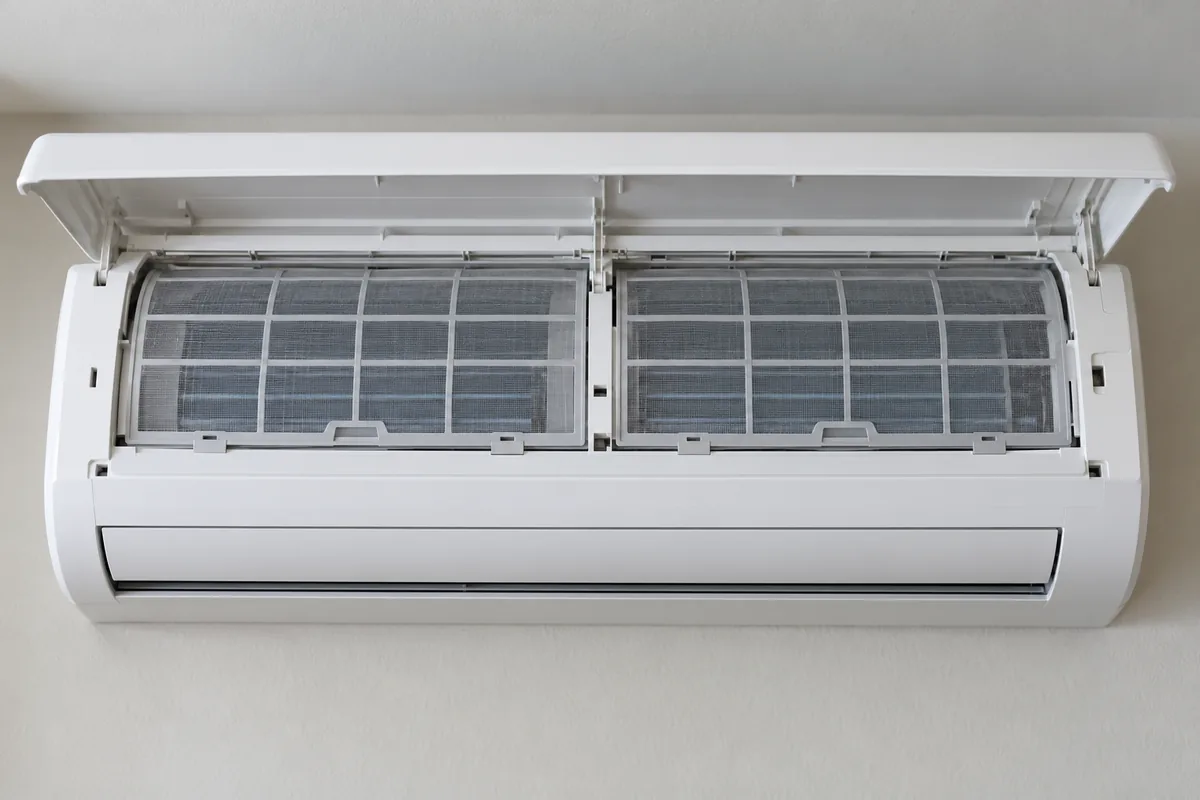
Where Is the Filter on a Mini-Split?
On a common high-wall indoor head, the primary filter is usually behind or immediately under the front air-intake panel. Opening the normal homeowner-accessible cover reveals one or more thin framed screens that slide or lift out along guides. LG's current support material shows both front-access and top-intake arrangements, which is a useful reminder that even wall-mounted units do not all release their filters the same way.
Other indoor-unit styles can be different:
- Ceiling cassettes commonly draw room air through an intake grille and place filters behind that grille.
- Floor-mounted units can use accessible intake filters in the cabinet, but the opening and removal direction are model-specific.
- Concealed or short-duct indoor units may use a return-air filter arrangement that looks more like an air-handler or grille filter than a wall-head screen.
- Multi-zone systems can combine more than one indoor-unit style on a single outdoor unit.
Do not use appearance alone to decide which panel to open. Read the model label and owner manual, and limit homeowner access to the filter panel the manufacturer identifies. A blower wheel, coil, drain pan, wiring space, and other internal parts are not part of routine screen removal.
Is the filter in the outdoor unit?
The room-air filter is associated with the indoor unit because that is where room air is recirculated. The outdoor condenser or heat-pump unit exchanges heat with outdoor air; it is not a place to add a disposable furnace filter, mesh wrap, or homemade screen. Keep the outdoor unit clear according to its instructions and leave internal cleaning and service to qualified personnel.
What Types of Filters Do Mini-Splits Use?
“Mini-split filter” does not describe one standardized replacement product. Manufacturers use different filter frames, sizes, names, accessory media, and service rules. The useful distinction is between the primary coarse screen and any additional model-specific insert.
| Filter or media | Typical role | Maintenance rule |
|---|---|---|
| Primary mesh screen | Catches larger debris before it reaches the indoor coil and fan | Often reusable and washable, but follow the model manual |
| Deodorizing or specialty insert | Product-specific odor, particle, or other claimed treatment | May be cleaned, regenerated, or replaced on a separate schedule |
| Higher-efficiency option | Product-specific fine-particle capture claim | Verify the rating, fit, and approved model compatibility |
| Concealed-unit return filter | Filters return air for a ducted or short-duct indoor unit | Location and type depend on the installed return design |
Fujitsu/GENERAL specifications illustrate the overlap: some indoor units list a washable main air filter while separately listing disposable ion-deodorizing or apple-catechin media. LG likewise cautions that some additional-function filters cannot be washed and instead require periodic replacement. Those are examples of why “mini-split filters are washable” needs qualification.
A specialty-media claim should remain tied to the exact product and test information. A label such as deodorizing, antibacterial, plasma, catechin, or fine dust does not establish a universal efficiency, health outcome, or maintenance method.
How Is a Mini-Split Filter Different From a Furnace Filter?
A central forced-air HVAC filter normally sits in a return grille, equipment-side rack, or media cabinet and serves air moving through a shared duct system. A ductless mini-split head instead recirculates air in the room where that indoor unit is installed. This is why the distinction belongs outside the site's guide explaining when furnace and central-AC filters are the same return-air filter.
Fresh-air equipment is another separate category. ERV and HRV filters serve outdoor-supply and indoor-exhaust air moving through a recovery ventilator; they are not mini-split screens or automatic furnace-filter replacements.
The products also differ physically. A common mini-split primary filter is a thin, appliance-specific plastic mesh screen. A common central replacement is a framed disposable filter with three nominal dimensions and often a MERV rating. One is not a substitute for the other.
Do not cut, fold, tape, stack, or force a pleated furnace filter into a mini-split head. Added or improvised material can obstruct the intake, fit poorly, contact moving parts, or depart from the manufacturer's airflow design. Likewise, do not put a mini-split screen in a central filter rack.
This article also does not change the general washable-versus-disposable HVAC filter decision. That guide addresses central replacement-filter categories. A washable mini-split screen is an equipment-specific service part, not permission to wash a disposable pleated filter.
How Do You Clean a Mini-Split Filter Safely?
Start with the indoor unit's owner manual. Removal direction, washable components, detergent rules, drying instructions, and filter-light reset steps vary. A safe high-level process for a primary screen is:
- Turn the unit off as directed. If the manual calls for disconnecting power before cleaning, follow that instruction. Do not open electrical or service compartments.
- Open only the documented intake or filter cover. Support the panel and do not force hinges or latches.
- Remove the identified primary screens carefully. Note their orientation and guides. Do not pull on the coil, louvers, sensor, or wiring.
- Use the approved cleaning method. Many manufacturers permit gentle vacuuming or washing of the primary mesh. Water, detergent, brushing, and temperature limits are model-specific.
- Let a washed screen dry completely as directed. LG instructs users to dry cleaned filters in a ventilated, shaded place before reassembly. Avoid heat or direct sun unless the manual explicitly allows it.
- Reinstall the screens and close the cover normally. The filter should follow its guides without bending, trimming, or improvised fasteners.
Stop and use professional service if safe access is not possible, a high ceiling requires unsafe positioning, the screen or frame is damaged, the panel will not close, there is ice, water leakage, persistent odor, visible internal contamination, electrical damage, or poor performance after the documented filter step. Routine screen cleaning is not the same as cleaning an indoor coil, blower wheel, or drain system.
How Often Should You Clean or Replace Mini-Split Filters?
There is no defensible universal interval for every mini-split and home. Manufacturer examples range from frequent inspection to model-specific hour or calendar reminders. Loading also changes with system runtime, pets, open windows, cooking, smoke, construction dust, and the room itself.
Use the indoor-unit manual as the starting schedule, then inspect the actual screen condition. A manufacturer reminder light is a maintenance prompt, not necessarily a direct dirt measurement. If the unit has a filter indicator, follow the model-specific cleaning and reset instructions instead of borrowing a sequence from a different remote or brand.
Clean sooner when the screen is visibly loaded or when the manual directs you to inspect it after demanding conditions. Fujitsu/GENERAL includes a dirty air filter in its poor-heating-or-cooling checklist, but weak airflow or poor comfort can have other causes. Do not diagnose refrigerant, electrical, drainage, or internal contamination problems from the filter alone.
Replacement is also component-specific. A durable mesh may be reused until damaged or until its manual specifies replacement, while an added specialty insert may be a consumable with a separate service life. Avoid turning one manufacturer's interval into a rule for all mini-splits.
Do Mini-Split Filters Remove Fine Particles?
Usually not well enough to assume they are a whole-room fine-particle solution. EPA says typical ductless mini-split filters are designed mainly to protect equipment from clogging by larger particles such as pet hair and lint and generally do not filter fine particles. EPA also notes that the unit filters only the air in the room it serves and only while operating.
Some products advertise additional or higher-efficiency filtration. Evaluate the exact indoor-unit and filter documentation: What particle size was tested? Is there a recognized efficiency rating? Does the option fit this model? Is it a full-airflow filter or a small accessory insert? What cleaning or replacement schedule preserves its claim?
Do not assume a built-in screen has a MERV rating. MERV is a standardized framework for ventilation filters, while many appliance-specific mesh screens are not marketed or tested in that framework. Even when a manufacturer offers a rated option, it must be approved for the unit and installed as documented.
If the goal is smoke, very fine dust, or other fine-particle reduction and the mini-split lacks a documented high-efficiency option, EPA suggests considering a portable air cleaner. The site's HVAC filter versus portable air purifier guide explains the room-cleaner role without treating the mini-split screen as a central filter.
Does Every Indoor Head Have Its Own Filter?
In a typical ductless multi-zone system, one outdoor unit serves multiple indoor heads, and each head recirculates air from its own room through its own filter arrangement. The outdoor-unit count therefore does not tell you how many filters need attention. Identify every indoor unit and its model.
That wording matters because “mini-split” can include more than wall heads. A home may combine a wall unit, ceiling cassette, floor unit, or concealed ducted indoor unit on the same multi-zone system. Each can use a different access point, filter size, and maintenance procedure.
This is not a universal rule that every room or every return vent needs an added filter. Maintain only the filter locations designed into the installed equipment. Do not attach extra media to the grille, tape material over an intake, or assume one cleaned head services the others.
A Practical Mini-Split Filter Checklist
- Identify the indoor unit, not just the outdoor condenser. Record the model number for each wall head, cassette, floor unit, or concealed unit.
- Find the model-specific owner manual. Confirm the intended filter access panel, filter types, and cleaning or replacement instructions.
- Separate the primary screen from specialty media. Do not wash an insert merely because the main mesh is washable.
- Keep the room-air role in perspective. The filter serves that indoor unit's intake; it is not automatically a whole-home fine-particle filter.
- Use only documented media. Do not adapt a furnace filter, add unapproved material, or obstruct the intake.
- Escalate beyond routine filter care. Internal coil, blower, drain, refrigerant, electrical, or persistent performance problems belong to qualified service.
Technical Sources
- EPA: Do ductless mini-split heat pumps filter fine particles?
- EPA: Guide to Air Cleaners in the Home
- DOE Building Science Education: Air-source heat pump maintenance tips
- Trane: Do Mini-Splits Have Filters?
- Carrier: Ductless Mini-Split Maintenance
- LG: Air-conditioner filter cleaning guidance
- Fujitsu/GENERAL: Multi-room indoor-unit filter specifications
Frequently Asked Questions
Do all mini-splits have air filters?
Most residential mini-split indoor units include an air filter, commonly a reusable mesh screen, but configurations and service parts vary. Check every installed indoor unit and its model-specific manual rather than assuming one filter design covers every wall unit, ceiling cassette, floor unit, or concealed air handler.
Where is the air filter on a mini-split?
On many high-wall indoor units, the filter sits behind or just under the lift-up front intake panel. Ceiling cassettes, floor units, and concealed or short-duct air handlers can place filters elsewhere. Use the indoor-unit model number and manual before opening a panel.
Is there an air filter in the outdoor mini-split unit?
The normal room-air filter is associated with the indoor unit, which recirculates room air. The outdoor unit exchanges heat with outdoor air and should not be fitted with a furnace filter or homemade filter. Keep it clear and have internal service performed according to manufacturer guidance.
Are mini-split filters washable?
Many primary mesh filters are washable, but not every filter or accessory insert is. Some deodorizing, fine-particle, or other specialty media may have different cleaning or replacement rules. Follow the exact indoor-unit manual before using water or detergent.
How often should I clean a mini-split filter?
There is no universal interval for every model and home. Manufacturer guidance varies, and actual loading depends on runtime and the room. Inspect and clean at the interval in the indoor-unit manual, and check sooner when airflow changes or the screen is visibly loaded.
Can I put a furnace filter in a mini-split?
No. Do not cut, fold, tape, stack, or force a disposable furnace filter into a mini-split indoor unit. Use only the filter and optional media documented for the specific indoor-unit model.
Do mini-split filters have MERV ratings?
Do not assume so. MERV is a test framework used for ventilation air filters, but many built-in mini-split mesh screens are appliance-specific and are not sold with a verified MERV rating. Check the exact product documentation before making an efficiency claim.
Does each mini-split head have its own filter?
In a ductless multi-zone system, each indoor head normally recirculates room air through its own filter arrangement. A concealed or short-duct indoor unit may use a different return-filter setup, so verify every indoor unit rather than relying only on the outdoor-unit count.
Can a mini-split filter replace a portable air cleaner?
Not automatically. EPA says typical mini-split filters are generally intended to protect equipment from larger debris and do not filter fine particles. If fine-particle reduction is the goal, verify a documented high-efficiency option for the exact unit or consider an appropriately sized portable air cleaner.
Questions or feedback?
Help Improve Filter Wizard
Tell us what was clear, what was missing, or which air-filter question you want answered next.