Quick Answer: Do ERVs and HRVs Use Filters?
Yes—residential ERVs and HRVs commonly have one or more dedicated filters. A balanced ventilator brings outdoor air into the home and exhausts indoor air. Depending on the model, filters in one or both air paths catch lint, dust, insects, and other particles before they reach the recovery core and internal components. A supply-side filter can also reduce particles in incoming outdoor air according to its actual efficiency and fit.
The number, material, rating, and service method are not universal. A Broan ERV140/HRV160 family manual shows two washable core filters. RenewAire's residential EV90 specifies separate outdoor-air and return-air MERV 8 filters. Panasonic sells both a model-family-specific washable MERV 6 accessory and a separate MERV 13 filter for particular Intelli-Balance equipment. These examples prove variety—not interchangeability.
Use the ventilator's exact model number and current manual. Do not substitute a furnace filter, wash media without permission, add higher-MERV material because it physically fits, or treat the recovery core itself as a filter.
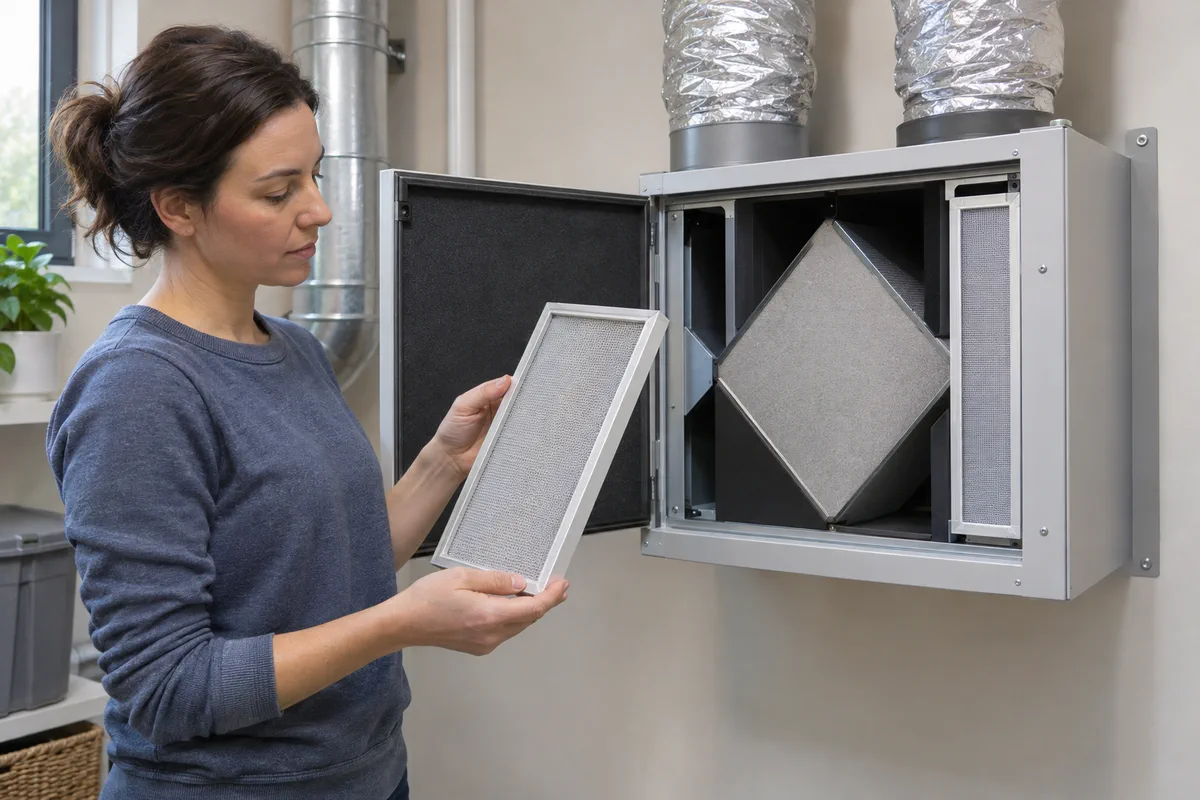
What Do ERV and HRV Filters Actually Do?
ERVs and HRVs are balanced ventilation systems. They move stale indoor air out and bring outdoor air in while a recovery core transfers energy between the separated air streams. An HRV transfers sensible heat. An ERV also transfers some water vapor, depending on its core design. That distinction affects the recovery core, not the basic fact that filters and cores are different parts.
Ventilator filters can serve several related purposes:
- Protect the recovery core. Media ahead of the core limits lint, dust, and debris that can load its entering faces.
- Protect fans and internal passages. The installed filters help keep particles out of components the manufacturer designed them to protect.
- Filter incoming outdoor air. The degree of particle reduction depends on the documented media, its fit, airflow, and condition.
- Filter the exhaust stream before the core. A separate return- or exhaust-air filter can keep indoor lint and dust off the other side of the core.
This does not mean every ERV or HRV is a high-efficiency whole-home air cleaner. RenewAire's EV90 manual explicitly says removing small particles from the home is not the ERV's function. Ventilation brings in and exhausts air; central and portable filtration recirculate air for particle removal. Those functions can complement one another without being interchangeable.
Where Are ERV and HRV Filters Located?
Filters are commonly behind the ventilator's designated user-service door, near the entering air paths or immediately beside the recovery core. The cabinet may be mounted on a wall, suspended in a mechanical room, placed in a basement, or installed in an attic. Access direction and internal layout vary even within one manufacturer's line.
Start with the model label on the ventilation cabinet—not the furnace, outdoor condenser, wall control, or thermostat. Search the manufacturer's support site for that exact model's owner or operation manual. The maintenance diagram should identify the filter frames, their orientation, any clips or brackets, and the approved service method.
Do not open a panel based only on a generic photo. Broan's manual identifies filters that slide from the top of its recovery core, while RenewAire's EV90 places filters behind a latched access door with clips. Other units use different brackets or cassettes. If the unit is difficult to reach, mounted over a stairwell, requires unsafe attic movement, or exposes wiring or blower assemblies beyond the user-service area, use qualified service.
Why Do Some Units Have Two Filters?
A balanced ERV or HRV has two separate air streams:
- Outdoor supply air travels toward the home.
- Indoor exhaust or return air travels toward the outdoors.
The streams pass through separate passages in the recovery core so heat—and, for an ERV, some moisture—can transfer without treating the two air paths as one mixed stream. Some manufacturers place a filter before each side of the core. RenewAire identifies one outdoor-air and one return-air filter on the EV90; the Broan models cited above use two core filters.
That is not a rule that every ERV or HRV has exactly two removable filters. A model may use one main particulate filter plus a different protective screen, more than two pieces, or another arrangement. Supply and exhaust media may also have different efficiencies or part numbers. Count the documented service parts in the manual rather than relying on the number of duct connections or copying a neighboring system.
Are ERV and HRV Filters Washable?
Some are; some are not. A reusable foam or mesh filter may permit vacuuming, rinsing, or washing. A pleated or other disposable particulate filter may require replacement. Even filters that look similar can have different instructions.
| Media type | Possible manufacturer direction | What not to assume |
|---|---|---|
| Foam or mesh filter | Vacuum, rinse, or wash when the manual allows it; dry completely before reinstalling | That every reusable-looking filter tolerates detergent, hot water, or scrubbing |
| Disposable particulate filter | Inspect and replace with the documented part or approved equivalent | That it becomes washable because it has a frame or MERV rating |
| Higher-efficiency accessory | Use only on the models named by the manufacturer | That a higher number fits or preserves airflow on every unit |
| Recovery core | Clean only by the core-specific method in the manual | That filter-washing instructions also apply to the core |
The core distinction is a safety and equipment-protection issue. One Broan manual allows its HRV heat-recovery core to soak in mild soap and water, yet warns not to soak the ERV energy-recovery core and directs users to vacuum it instead. RenewAire likewise warns not to wash its EV90 energy-exchange core. A filter may be washable while the core directly beside it is not.
Do not use bleach, solvents, compressed air, pressure washing, or improvised chemicals unless the exact manual authorizes them. Do not reinstall wet media unless the manufacturer explicitly permits it; where washing is allowed, current Broan guidance requires the filters to dry completely before reinstallation.
How Often Should You Clean or Replace ERV and HRV Filters?
There is no single three-month, six-month, or annual rule for every ERV and HRV. Manufacturer schedules are model-specific and may separate inspection, cleaning, and replacement.
For example, RenewAire's current EV90 page calls for inspecting filters every three months and replacing them as necessary. The referenced Broan family calls its washable-filter service quarterly. Other manuals may direct more frequent checks during continuous operation or difficult outdoor conditions. These are examples for named equipment, not universal intervals.
Use the manual as the baseline, then consider operating conditions. Construction dust, wildfire smoke, pollen, insects, nearby traffic, pets, indoor lint, and longer runtime can load one side faster than the other. A filter that looks clean at a calendar deadline is not proof that the manual can be ignored; some loading is difficult to judge visually, and the unit may have a service reminder based on time rather than measured restriction.
Likewise, do not assume both filters must always be replaced together. If the model uses different supply and exhaust media, their service criteria may differ. Follow the documented inspection and part-replacement rules for each position.
ERV/HRV Filters vs. Furnace Filters
An ERV or HRV filter does not automatically replace the filter serving a furnace, heat pump, or central air conditioner. The systems handle different air paths:
- ERV/HRV filters serve outdoor supply and indoor exhaust air moving through the ventilation unit.
- Central HVAC filters serve return air recirculating through the furnace or air handler.
Some ventilators use dedicated ducts. Others deliver fresh air into, or draw exhaust air from, parts of a forced-air duct system. That connection does not erase the filter locations required by either piece of equipment. A shared duct does not prove that the furnace filter catches everything before the ERV core, and an ERV supply filter does not protect a central blower from all recirculating return air.
This is why the article is separate from the site's explanation of when furnace and central-AC filters are the same return-air filter. It is also distinct from mini-split filter maintenance: a mini-split head usually recirculates room air, while an ERV or HRV exchanges indoor and outdoor air through a recovery core.
Do not cut a standard furnace filter to fit a ventilator, stack extra media, tape filter material across an intake, or leave large gaps. Use the model-specific frame, dimensions, orientation, and part family.
Can You Use a Higher-MERV Filter in an ERV or HRV?
Only when the manufacturer supports that media for the exact unit and configuration. Some ventilators have documented MERV options. Panasonic, for example, sells a washable MERV 6 accessory for its Intelli-Balance Elite and Elite Plus+ families and a separate MERV 13 filter identified for Intelli-Balance 100 equipment. RenewAire lists MERV 8 outdoor- and return-air filters for the EV90 and offers model-specific higher-efficiency accessories in parts of its residential range.
Those examples do not authorize a universal upgrade. MERV describes particle-removal performance under a test method; it does not certify the filter's dimensions, frame, seal, airflow resistance, or compatibility with a particular fan and cabinet. A filter can physically enter a slot and still be unsupported.
Use the manufacturer's part number or approved filter specification. If a higher-efficiency option is not documented, ask the manufacturer or installing contractor rather than forcing one. The site's MERV 8, 11, and 13 guide explains the ratings for conventional HVAC filters, but it cannot override an ERV or HRV's approved media.
How to Find the Correct Replacement Filter
- Record the ventilator's full model number. Do not rely only on the ERV/HRV label or the furnace brand.
- Find the current owner or operation manual. Confirm how many serviceable filters the unit uses and whether the positions differ.
- Identify the media type and part number. Note any MERV rating, frame, orientation, and replacement-kit number tied to that model.
- Check cleaning versus replacement instructions. “Reusable,” “washable,” “vacuum only,” and “replace” are different requirements.
- Verify dimensions product by product. Do not assume one nominal label establishes a universal actual size or frame geometry.
- Use documented replacements. If the original part is unavailable, obtain a manufacturer-supported alternative or qualified model-specific advice.
The filter currently installed is useful evidence, but it is not absolute proof that a previous owner or installer used the correct part. Compare its markings with the model documentation. A loose, crushed, trimmed, or improvised filter should not become the template for another purchase.
What Happens When an ERV or HRV Filter Gets Dirty?
As debris loads the media, resistance can rise and airflow through that path can fall. A dirty or missing filter can also allow more material to reach the recovery core and internal surfaces. RenewAire warns that operating its EV90 without the required filters can let dust block the entering face of the core and reduce unit effectiveness.
Do not turn those general mechanisms into a universal symptom checklist. Some controls may provide a maintenance reminder; others may not. A clogged filter does not always shut the unit down, and low airflow, noise, frost behavior, moisture, or comfort complaints can have causes beyond filter condition. Cleaning or replacing the documented filter is a sensible maintenance step, not proof of a complete diagnosis.
If airflow remains poor, the unit shows a fault, the cabinet contains water or ice, a fan rubs, a core is damaged, or the filter repeatedly loads unusually fast, stop at the user-maintenance boundary and contact qualified service.
What Can Homeowners Safely Check?
- Read the model-specific safety instructions first. Manuals can require the unit to be switched off and unplugged before opening the service door.
- Open only the documented user-access panel. Do not enter an electrical compartment or remove blower assemblies.
- Check the filter count, orientation, and condition. Note which filter belongs to each marked position.
- Use only the approved cleaning method. Keep filter instructions separate from recovery-core instructions.
- Let washable media dry as directed. Reinstall it in the correct frame without force or improvised fasteners.
- Close and secure the access door. Restore power only after the documented parts are back in place.
Leave wiring, motor settings, dampers, airflow balancing, duct changes, interlocks, and internal repairs to qualified personnel. If safe access requires a ladder in a tight attic, work over a stairwell, or unfamiliar disassembly, professional maintenance is the safer route.
Technical Sources
- U.S. Department of Energy Building Science Education: HVAC Energy Recovery Ventilation
- EPA: Air Cleaners and Air Filters in the Home
- Broan-NuTone: ERV140 ECM / HRV160 ECM / HRV160 User Guide
- RenewAire: EV90 residential ERV specifications and maintenance
- RenewAire: EV90 Installation, Operation and Maintenance Manual
- Panasonic: Intelli-Balance 100 MERV 13 Filter
- Panasonic: Intelli-Balance ERV Washable Filter — MERV 6
Frequently Asked Questions
Do all ERVs and HRVs have air filters?
Residential ERVs and HRVs commonly have one or more dedicated filters, but the count, location, efficiency, and construction vary by model. Use the unit model number and owner manual rather than assuming every ventilator has two identical filters.
Why do some ERVs and HRVs have two filters?
A balanced ventilator moves outdoor supply air and indoor exhaust air through separate paths. Some models place a filter in each path to protect the recovery core and other components. Other designs use a different arrangement, so two filters is not a universal rule.
Are ERV and HRV filters washable?
Some foam, mesh, or manufacturer-designated media are washable; other filters must be vacuumed or replaced. Wash only the component and by the method named in the exact model manual, and reinstall washable media only after it is completely dry as directed.
How often should ERV or HRV filters be cleaned or replaced?
There is no universal interval. Current manufacturer examples include quarterly inspection or service, while exact cleaning and replacement needs depend on the model, media, operating conditions, and observed loading. Follow the unit manual and check sooner during unusually dusty or smoky conditions.
Can an ERV or HRV filter replace a furnace filter?
No. ERV and HRV filters serve the ventilation unit's outdoor-supply and indoor-exhaust paths. A furnace or central-HVAC filter serves the system's return-air path. Even when the systems share ductwork, maintain every filter location required by the installed equipment.
Can I install a MERV 13 filter in my ERV?
Only if the manufacturer documents a MERV 13 filter for the exact model and configuration. Some ERVs offer model-specific MERV 13 media, while others do not. Rating, dimensions, frame, and airflow resistance all matter; the number alone does not prove compatibility.
Is the ERV or HRV recovery core the same as the filter?
No. The recovery core transfers heat and, in an ERV, typically some moisture between separated air streams. Filters are separate service components that help protect the core and may filter incoming air. Core cleaning rules can differ sharply from filter-cleaning rules.
Can you run an ERV or HRV without its filters?
Do not bypass a required filter. Manufacturer documentation can require filters to protect the recovery core and maintain intended operation. Replace missing or damaged media with the documented part or obtain model-specific service advice before operating the unit.
Do ERVs filter outdoor smoke?
Do not assume an ERV or HRV makes smoky outdoor air safe. Particle reduction depends on the installed media, fit, airflow, unit design, and condition. Verify the exact filter rating and follow public-health guidance during smoke events; ventilation and recirculating air cleaning are different functions.
Where is the filter in an ERV or HRV?
Filters are commonly behind the unit's designated service door, near the incoming air paths or adjacent to the recovery core. Access layouts vary. Identify the model and use its manual before opening the unit, and do not enter electrical or non-user-serviceable compartments.
Questions or feedback?
Help Improve Filter Wizard
Tell us what was clear, what was missing, or which air-filter question you want answered next.